Martin Luther King, Jr. Without the Whitewash

The journalist Nikole Hannah-Jones reports that she was invited to give a speech for Martin Luther King Day:

. . . A small number of members of the group hosting me wrote and then leaked emails opposing my giving this speech, as it dishonored Dr. King for me to do so. They called me a “discredited activist” “unworthy of such association with King”.

So, I scrapped my original speech and spent the entire first half of it reading excerpts from a bunch of Dr. King’s speeches, but without telling anyone that I was doing so, leading the audience to think King’s words were mine. And, whew, chile, it was AMAZING.

Here is some of it (wherever you see “Black” in capital letters, it’s because I subbed out “Negro” to not give it away):

“It was in the year 1619 that the first BLACK slave was brought to the shores of this nation. They were brought here from the soils of Africa and unlike the Pilgrim fathers who landed here at Plymouth a year later, they were brought here against their will…”

“For more than 200 years Africa was raped and plundered, a native kingdom disorganized, the people and rulers demoralized and throughout slavery the BLACK slaves were treated in a very inhuman form…”

“White Americans must recognize that justice for black people cannot be achieved without radical changes in the structure of our society…The evils of capitalism are as real as the evils of militarism and racism…”

“The problems of racial injustice and economic injustice cannot be solved without a radical redistribution of political and economic power. A nation that continues year after year to spend more money on military defense than on programs of social uplift is approaching spiritual death.”

“The crowning achievement in hypocrisy must go to those staunch Republicans and Democrats of the Midwest and West who were given land by our government when they came here as immigrants from Europe. They were given education through the land grant colleges. . . These are the same people that now say to black people, whose ancestors were brought to this country in chains and who were emancipated in 1863 without being given land to cultivate or bread to eat; that they must pull themselves up by their own bootstraps.”

“What they truly advocate is Socialism for the rich and Capitalism for the poor…”

“We know full well that racism is still that hound of hell which dogs the tracks of our civilization.”

“Ever since the birth of our nation, White America has had a Schizophrenic personality on the question of race, she has been torn between selves. A self in which she proudly professes the great principle of democracy and a self in which she madly practices the antithesis of democracy.”

“The fact is, there has never been a single, solid, determined commitment on the part of the vast majority of white Americans to genuine equality for Black people.”

“The step backwards has a new name today, it is called the white backlash, but the white backlash is nothing new. It is the surfacing of old prejudices, hostilities and ambivalences that have always been there. . . The white backlash of today is rooted in the same problem that has characterized America ever since the black man landed on the shores of this nation.”

“Whites, it must frankly be said, are not putting in a similar mass effort to reeducate themselves out of their racial ignorance . . . With each modest advance the white population promptly raises the argument that BLACK Americans have come far enough.”

“…for the good of America, it is necessary to refute the idea that the dominant ideology in our country, even today, is freedom and equality and that racism is just an occasional departure from the norm on the part of a few bigoted extremists.”

“If America does not respond creatively to the challenge to banish racism, some future historian will have to say, that a great civilization died because it lacked the soul and commitment to make justice a reality for all men.”

“Why do white people seem to find it so difficult to understand that the Black people are sick and tired of having reluctantly parceled out to them those rights and privileges which all others receive upon birth or entry in America?”

“I never cease to wonder at the amazing presumption of much of white society, assuming that they have the right to bargain with the BLACK for their freedom . . . “

Oh, the uncomfortable silence as I read Dr. King’s words at a commemoration of Dr. King’s life when people had no idea that these were his words. When I revealed that everything I said to that point was taken from his speeches between 1956 and 1967 . . . Can you say SHOOK!

Then I read all the names that white Americans called King: charlatan, demagogue, communist, traitor — and brought out the polling showing more than three-quarters of Americans opposed King at his death while 94 percent approve of him now.

I left them with this: People who oppose today what he stood for back then do not get to be the arbiters of his legacy. The real Dr. King cannot be commodified, homogenized, and white-washed and whatever side you stand on TODAY is the side you would have been back then.

In fact, most white Americans in 1963 opposed the March on Washington where Dr. King gave the “I Have A Dream Speech” with that one line that people opposed to anti-racism like to trot out against those working for racial justice. [Note: that one line is “Judge us by the content of our character, not by the color of our skin”, which certainly doesn’t mean what they’d like it to mean.]

This is why the 1619 Project exists. This is why the decades of scholarship that undergirds the 1619 Project exists. Because if we do nothing, they will co-opt our history and use it against us.

Dr. King was a radical critic of racism, capitalism and militarism. He didn’t die. He was assassinated. And many, including Reagan, fought the national holiday we’re now commemorating. If you haven’t read, in entirety, his speeches, you’ve been miseducated and I hope that you will.
Comparing the Former Guy to a Tired Comedy Act

His act has gotten very old. Maybe that will contribute to a crushing defeat in 2024. From Matt Lewis of The Daily Beast:

There was a time when D____ T____ made news with his rallies—when he said things that utterly shocked us. Who could forget the firestorm he started, for example, when he went after Colin Kaepernick and other NFL players who knelt during the national anthem in 2017, or earlier that year when he called Barack Obama “the founder of ISIS”?

T____’s performance in Arizona on Saturday night—his first rally in months and his much-hyped chance to respond to the one-year anniversary of the Jan. 6 Capitol riot—was neither shocking nor terribly newsworthy.

It didn’t even merit a mention on The Washington Post’s homepage Sunday morning. The New York Times only used T____’s speech as a peg to write a broader story under the headline: “T____ Rally Underscores G.O.P. Tension Over How to Win in 2022.”

A few years ago, T____ rallies spawned breathless coverage and drove multiple news cycles. But The Times’ story isn’t even about the rally, and their mentioning it is mostly perfunctory. . . .

TV sitcom showrunners sometimes react to declining ratings by introducing a “Cousin Oliver”—which, quite often, is a cute kid whose smart-alecky sass is meant to liven up a tired atmosphere. Sometimes it works, sometimes it’s evidence a show [is desperate]. But T____’s never been an ensemble cast type of personality. He’s the whole show, and the surrounding players are as replaceable and ephemeral as Spinal Tap’s exploding drummers.

The Arizona rally may have been the unofficial kickoff of his 2024 campaign. But this time around, T____ will have to work harder to break through—and not just because the media is less likely to give him ample air time free of charge.

Call it the Andrew Dice Clay conundrum: If your entire schtick is based on shock value, eventually the audience grows inured, and the lack of substance becomes embarrassingly plain.

T____ made assertions in Arizona Saturday night that might once have garnered buzz (on Sunday morning, at least). But they’re getting little play. In its writeup of the rally, Politico said T____ “issued a blistering response to Democrats” and that he “opened his speech by falsely claiming ‘proof’ that the 2020 election was ‘rigged.’” A more telling fact is that this “blistering response” was not deemed worthy enough to be the site’s lead story. What might have spawned outrage and wagging tongues a few years prior now elicits a collective chorus of yawns.

Here’s the thing about moving the Overton Window: The process of shifting standards and assumptions matters greatly at the societal level. It’s bad when news consumers become desensitized to a former president erroneously claiming an election was stolen. It also cannibalizes one of T____’s greatest assets: his ability to shock and awe. His schtick is tired, and that can often equate to a professional death sentence.

T____’s rock-concert rallies provide enough of his greatest hits for the fans and groupies who actually attend them. But for performers to remain relevant, they require new material. And politics is more stand-up comedy than rock and roll.

The Rolling Stones can play their more-current hits a million times, yet we will still keep clamoring for “Sympathy For The Devil.” But can you imagine Chris Rock getting an HBO special and doing 2016 material? The same goes for T____. Nobody wants to hear a political retread who rehashes his same tired conspiracy theories ad nauseam.

T____ seems like the sort of man who could appreciate the temporal, consumerist, and disposable culture of modernity. We fetishize what is new and what is next. Yet, T____’s obsession with relitigating an election that is now two calendar years past runs contrary to this modern American tendency. In this regard, his ego T____s his marketing savvy.

To be sure, T____ also benefits from the (bogus) sense he was wronged. But it’s hard to see how such a backward-looking 75-year-old man can remain in the vanguard. On Saturday night, T____ wasn’t just stuck in 2020—he was also stuck in the 20th century. There were numerous references to communism (more so than usual), including a reference to the Jan. 6 Commission’s witness interviews, which he compared to Stalinist show trials.

You might forgive T____ for such fanciful attacks on Nancy Pelosi and Congressional Democrats, since his criticism of Joe Biden isn’t terribly effective. T____ isn’t skilled at prosecuting a substantive policy critique . . .  (the best T____ could do was mock him for seeming dazed and confused). All this is to say, the new material didn’t kill on Saturday night.

The theme was “Make America Great Again
Again” . . .  But does lightning ever really strike twice? For every “Godfather II” masterpiece there’s dozens of “Ghostbusters II” failed sequels.

We’d be fools to count T____ out entirely. . . .  But he needs new material, and fast, because if his Arizona rally shows anything, it’s that the old routine just doesn’t land anymore.

The Best Argument Against the Filibuster: It’s Unconstitutional!

There’s a rumor that Krysten Sinema (“Dem” – AZ) thinks her career — including being elected to the Senate — has been so impressive that her logical next step is to run for president. That’s why she doesn’t care that protecting the filibuster is killing the Democratic agenda and that, as a result, Democrats in Arizona hate her. She’s planning to run for president in 2024 under the banner of “bipartisanship”. It’s a ludicrous idea, but her big money donors are willing to fuel her fantasies. 

Filibuster reform may be dead for now but Thomas Geoghagen explains why the filibuster is  unconstitutional. From The New Republic: 

Over the course of many years and many think pieces, the case against the filibuster has been laid out. Typically, critics of the Jim Crow relic invoke various historical facts (some of which have apparently been lost on, or willfully ignored by, certain critical members of the Senate), as well as an array of practical and prudential bases. Onto the pile, however fruitlessly, let us add another: The filibuster is a plot against Vice President Kamala Harris—to take away her constitutional right to vote.

Article I, Section 3 of the Constitution makes it plain: Harris, as chair of the Senate, is given the responsibility to vote “when the Senate is equally divided.” In all the furor over the filibuster blocking voting rights legislation, keep in mind it is blocking Harris from this constitutional right, as well. The supermajority rule that ran counter to the Founders’ desires, now upheld by the filibuster’s status quo, is not just aiding in the disenfranchisement of voters by blocking meaningful voting rights legislation from passage—it’s also disenfranchising the woman sent to Washington to resolve the disputes of a divided Senate.

It would be fitting if Harris, given the chance to gavel the filibuster out of existence to pass the Freedom to Vote Act, reclaimed her rights at the same time. She can put that to the Senate on January 17 when any rules changes are being considered—by starting with a declaration that the filibuster is not just unfair or undemocratic but unconstitutional, as well.

The filibuster is not just a technical violation of Article I—though it is precisely that—it’s also a repudiation of its original design. That design created a bicameral legislature, with each house operating by majority rule, to replace the single legislative chamber that operated under the Articles of Confederation by supermajority or unanimous consent. By sneaking in a supermajority rule on the sly, as a procedural rule of debate, the Senate has essentially brought back a form of the obsolete Articles of Confederation. It shouldn’t really come as any surprise that the republic now faces a similar impetus toward disunion to the one it faced when the Articles were in place. The plot against Kamala Harris is not just a plot against the Constitution—it’s a force that threatens the existence of the United States itself.

It is without doubt a fact that the Framers wanted a deliberative legislative body. That’s why they divided the Congress into two houses—to provide a vital check and balance. Supermajority rule in the Senate upends the Framers’ intentions: It places too great a check on the House—without the House’s consent. More specifically, it inflicts an institutional injury on the House, as the “active principle of government” that the House is unable to redress. This is exactly what worried James Madison, Alexander Hamilton, and others who bitterly criticized supermajority rules.

Yes, as defenders of the filibuster point out, the Senate has a right to make rules as to its own proceedings, but trifling with majority rule crosses textual red lines. Beyond the aforementioned Vice President Voting Clause in Article 1, Section 3, there is also the “Presentment Clause” of Article I, Section 7, which says in two places—yes, twice—that any bill or resolution passed by the House and Senate, “shall, before it becomes law, be presented to the President,” and if sent back, then it must be “approved by two thirds of each House.” The Presentment Clause would make no sense if the Senate required more than a majority to send it to the president in the first place. Finally, there is the Enumeration of Super Majority Rules, the seven times in the text of the Constitution that specifically lay out where and when a supermajority is expressly required.

One might nevertheless ask, why not by majority rule permit Congress [to institute] rule by supermajority? Of course this is an academic question—for Congress, by vote of both Houses, has never adopted a supermajority rule. The filibuster is simply a rule of the Senate, which has the effect of limiting the ability of the Congress to act. But Congress itself has never approved it. Yes, there has long been a cloture rule for the so-called “talking” filibuster. In 1917, the Senate adopted such a rule, which then required a two-thirds vote—now reduced to three-fifths. And while this rule did have a disgraceful and pernicious effect in race-related matters, the talking filibuster of old only on rare occasions held up a majority vote, maybe once or twice a year or not at all. But in our time, the talking filibuster for which the rule was intended is gone; no one has to talk to block a bill. And what was a procedural rule to get to a vote faster is now a rule that stops a vote from happening at all.

No, Congress has not adopted and never would adopt such a rule. Why would the House consent? As it now exists, it lets the Senate place a much greater check on legislation passed by the House than the Framers ever intended. It’s bad enough that this upsets the balance of power between the Senate and House, but it also upends the balance of power between the federal government and the states. The Senate, representing the states, is blocking the House, representing the people.

For the sake of argument, let us assume the text of the Constitution is less explicit than it actually is. Allowing Rule 22, which bars a vote by the majority without even active debate, still violates two fundamental canons of constitutional interpretation. The first canon, or rule, is the expressio unius principle—listing the exceptions for supermajority implies the exclusion of all others. That principle is basic in constitutional interpretation. In the case of Powell v. McCormack, the Supreme Court barred the U.S. House from excluding Adam Clayton Powell as a member because of “unethical conduct.” That was not one of the bases listed in the Constitution, and the listing of those bases implied the exclusion of others.

Additionally, to allow the Senate to add a supermajority rule would violate a second canon, the so-called Federalism Canon—which calls for the balance between federal and state power to be left alone. The filibuster changes the relative balance of power between the Senate, representing the states, and the House, representing the people. It is no accident that in blocking voting rights legislation, it is being used to protect the states from being regulated.

Harris, as chair, could reach the same conclusions. Rather than just hope a Senate majority uses the “nuclear option” to rid us of the filibuster, she could press the button. For the reasons above, she could declare the supermajority for cloture to be in conflict with Article I.

She may fail in the attempt. A majority can overturn a ruling of the chair. It is not so easy even for some Democrats in the Senate to give up the filibuster. There are many, many other bills that the senators take up other than voting rights legislation. So individual senators are caught in a dilemma worthy of a class in game theory—though glad to remove it for A, they do not want to remove it for B, or maybe C, or maybe D, or maybe an unknown X that will arrive later in their six-year terms. So the filibuster remains in place forever—except now for the budget and for nominations to judgeships and political positions. In these two cases, the budget and nominations, there is no choice but to get rid of the filibuster or there would be institutional collapse of the courts and of the executive branch.

However, with the John Lewis Act and Freedom to Vote Act, we are speaking about the institutional collapse of democracy itself. Protecting the integrity of federal elections from state interference is necessary to the integrity of the federal government—it is an obligation that is set forth in the original Elections Clause, Article I, Section 4. It is the only clause, the only text, that says Congress can override any state regulation of a federal election. Ever since 1787, Article I, Section 4 has been in there, the original nuclear option, to protect the national government from institutional collapse. It is an outrage to use the filibuster to block even the power of the national government to save itself. Surely that must have at least the same priority as enacting a budget by majority rule.

Let the vice president show some muscle in defense of her country. Let the debate start on January 17 with a ruling from the chair that Rule 22 is in conflict with her own right to cast a vote when the Senate is evenly divided. Then let her dare the Senate to overrule her. To reclaim the right to vote in the blocked legislation, she should begin with reclaiming her own right to vote, as well.

By a quirk of history, the plot against America is now also a plot against a Black woman’s right to vote. Who says the vice president has nothing to do?

Behind the Screaming Headlines About Inflation

Any commentary on inflation that doesn’t take into account the pandemic is worthless. With the Delta variant and now Omicron, the economy isn’t functioning normally. The virus is limiting the supply of goods and services, while Americans have more disposable income than before the pandemic. Reduced supply and increased demand means inflation. What will happen with inflation after Omicron peaks, sometime in the near future? Nobody knows, but perhaps inflation hysteria isn’t justified? 

What the Bureau of Labor Statistics reported today:

The Consumer Price Index for All Urban Consumers (CPI-U) increased 0.5 percent in December on a seasonally adjusted basis after rising 0.8 percent in November . . .  Over the last 12 months, the all items index increased 7.0 percent before seasonal adjustment. The energy index rose 29.3 percent over the last year and the food index increased 6.3 percent.

Increases in the indexes for shelter and for used cars and trucks were the largest contributors to the seasonally adjusted all items increase. The food index also contributed, although it increased less than in recent months, rising 0.5 percent in December. The energy index declined in December, ending a long series of increases; it fell 0.4 percent as the indexes for gasoline and natural gas both decreased. . . . 

A brief summary from Catherine Rampell of The Washington Post:

Since Covid began, consumer spending has risen a ton — especially for goods and especially for durable goods. Services up a little since February 2020, but not much.
At exactly the same time goods are in much higher demand, supply chains for goods have snarled. Hence, price spikes.

[Today’s report shows] once again, durable goods (cars, TVs, computers, appliances) in the lead for inflation, at 16.8% year-over-year, not seasonably adjusted.

Nondurables (food, clothing) in 2nd place at 10.2%. Services (travel, healthcare, education) with the least price growth at 4%, in part because so many services remain high risk.

Durables are by definition durable—we don’t need to buy/replace them often. Many expected that demand for durables (and therefore price pressures) would eventually run out of steam; how many fridges can people buy? Durable spending has slowed recently but is still way up compared to pre-Covid.

Maybe the demand for durables fades, supply chains unsnarl, price pressures recede. That would be good. Then the question becomes – what happens to services? Services inflation has generally been lower than goods inflation…but rents (a service) have been rising, and those are “sticky”.

Anther reason to worry that inflation might persist for a while yet, even as supply chains untangle themselves, is inflation expectations. Expectations of higher prices can become self-fulfilling.

An overview and the political context from Rep. Tom Malinowski (Democrat-NJ):

Virtually everyone agrees on the cause of the harmful inflation we’re experiencing: people have more money to spend, but that demand is chasing too little supply. But who we blame and how we propose to solve it reveals a lot about our political divide.

It’s an incredible fact that despite one of the worst economic crashes in our history, average Americans (not just the super rich) have more household wealth to spend today than they did before the pandemic. 

Government spending — bailing out small businesses and state & local governments, helping people who lost jobs, stimulus checks & the child tax cut — worked to rescue our economy and left Americans with the extra cash we are now trying to spend (i.e., higher demand).

FI6RegiXIAQwva9

Had the government not done those things, it’s absolutely true that there would [be less] inflation now. 

But we also wouldn’t have amazing economic growth with historically low unemployment [and higher wages across the country]. Millions of Americans would be destitute.

So when you hear people blame “Biden spending” for inflation, what they’re saying is that you should have less money to spend . . . that your wages should be lower; that your taxes should be higher; that the government should have let your employer or municipality go bankrupt.

What most Democrats are saying is that increased demand (more people with more money to spend) is a good thing!  And that the way to beat inflation is to help the supply of goods and services in the economy to catch up to healthy consumer demand.

We’re focused on improving efficiency of our ports and delivery systems, which helped greatly during the holiday season. Some good news: The port of New York/New Jersey is moving 20%+ more goods than before the pandemic without delays. . . . As Omicron passes in the US, our labor disruptions will ease. But we must also get more people vaccinated in countries where COVID has shut down factories critical to our supply chains.

Crushing COVID is obviously critical to fighting inflation. As Omicron passes in the US, our labor disruptions will ease. But we must also get more people vaccinated in the US and in countries where COVID has shut down factories critical to our supply chains.

If you’re concerned about inflation, you should also support letting employers legally hire people already in the US who desperately want to work the jobs now being unfilled — and back politicians who would rather fix the economy than demonize immigrants.

To sum up: The solution to inflation is not to squeeze middle class Americans as Republicans are suggesting, so that we have less to spend on cars, food, and travel. The solution is to build back supply chains resilient enough to meet American consumers’ post-pandemic needs.

Finally, from The Washington Monthly, how lack of competition (and missing anti-trust enforcement) has made the supply chain so vulnerable:

In recent weeks, senior Biden administration officials have been arguing that monopolization explains at least some of the inflation that is eroding the otherwise impressive wage gains average Americans are experiencing. The case they make is that firms in concentrated industries are using their excessive market power to raise prices and fatten their bottom lines at the expense of consumers. They point specifically to industries like oil and gas and meat processing, where corporate profits are skyrocketing.

. . . In the meat industry, thanks to lax antitrust enforcement, four companies now control 55 to 85 percent of the markets for beef, pork, and poultry. Since the fall of 2020, the price of beef has risen by more than 20 percent, far higher than the inflation rate. At the same time, the profits of the meat-packing industry are up more than 300 percent. Consolidation is hardly limited to the meat industry. It is rampant throughout the economy. So too are recent corporate profit rates . . .

But for argument’s sake, let’s say that . . . predatory pricing by oligopolistic firms isn’t driving the current inflation, but rather, “supply chain hiccups” brought on by pandemic induced labor shortages and high demand. The question is, why were the supply chains so fragile in the first place?

The answer is monopoly—in particular, the hollowing out of capacity as a result of industry consolidation and Wall Street’s demand for short term profits. Consider the case of semiconductors—crucial components in most of the products we use. As recently as a decade ago, America was producing vast numbers of cutting-edge semiconductors right here on our shores. Since then, . . . the federal government has allowed the biggest domestic manufacturer, Intel, to buy up or drive out most of its U.S. competitors. The firm then offshored or sold off its U.S. manufacturing capacity to reduce costs. That boosted Intel’s stock price and delighted investors. But it left the company with scant domestic capacity to increase supply when COVID-19 shut down Asian semiconductor factories. The falloff in semiconductor supply has led, in turn, to shortages of, and higher prices for, everything from cars to cell phones.

Or consider the cargo ships that haven’t been able to get products into and out of U.S. ports. That, too, is a problem exacerbated by monopoly. Ocean shipping was a highly regulated industry until a quarter century ago . . . That led to three vast carrier alliances, all foreign owned, gaining control of 80 percent of the ocean shipping market. These alliances then built super-sized cargo ships that can only dock in a few ports, like the ones in Los Angeles and Long Beach, which now service 40 percent of all U.S. traffic. This highly consolidated system kept shipping prices, and hence overall inflation, low for years. Now, its brittleness is contributing to inflation.

Once supplies do land in U.S. ports, there are not enough trucks and truck drivers to deliver products to our warehouses and stores. In the recent past, however, many of those goods were delivered by freight rail. Why aren’t those goods now moving on trains? Because . . . the federal government allowed the railroad industry to monopolize. And the Wall Street hedge funds that control those monopolies have more recently demanded that they rip up tracks, mothball rail cars, and lay off seasoned union employees to get costs down and stock prices up. Now our freight rail system doesn’t have the capacity to take up the slack. . . . 

Of course, it took decades, and countless bad decisions in Washington, for our supply chains to become as concentrated, uncompetitive, and breakable as they are now. It will take years of strong antitrust enforcement and other measures to set things right.

Virus Update

First, the bad news:

The United States surpassed its record for covid-19 hospitalizations on Tuesday, with no end in sight to skyrocketing case loads, falling staff levels and the struggles of a medical system trying to provide care amid an unprecedented surge of the coronavirus.

Tuesday’s total of 145,982 people in U.S. hospitals with covid-19 . . . passed the record of 142,273 set on Jan. 14, 2021, during the previous peak of the pandemic in this country.

But the highly transmissible omicron variant threatens to obliterate that benchmark. If models of omicron’s spread prove accurate — even the researchers who produce them admit forecasts are difficult during a pandemic — current numbers may seem small in just a few weeks. Disease modelers are predicting total hospitalizations in the 275,000 to 300,000 range when the peak is reached, probably later this month.

As of Monday, Colorado, Oregon, Louisiana, Maryland and Virginia had declared public health emergencies or authorized crisis standards of care, which allow hospitals and ambulances to restrict treatment when they cannot meet demand [The Washington Post].

In the U.S., 840,000 confirmed deaths and 1,700 every day (almost all of whom are unvaccinated). However:

Scientists are seeing signals that COVID-19â€Čs alarming omicron wave may have peaked in Britain and is about to do the same in the U.S., at which point cases may start dropping off dramatically.

The reason: The variant has proved so wildly contagious that it may already be running out of people to infect, just a month and a half after it was first detected in South Africa.

At the same time, experts warn that much is still uncertain about how the next phase of the pandemic might unfold. . . . And weeks or months of misery still lie ahead for patients and overwhelmed hospitals even if the drop-off comes to pass.

“There are still a lot of people who will get infected as we descend the slope on the backside,” said Lauren Ancel Meyers, director of the University of Texas COVID-19 Modeling Consortium, which predicts that reported cases will peak within the week.

The University of Washington’s own highly influential model projects that the number of daily reported cases in the U.S. will crest at 1.2 million by Jan. 19 and will then fall sharply “simply because everybody who could be infected will be infected,” according to Mokdad [ABC News].

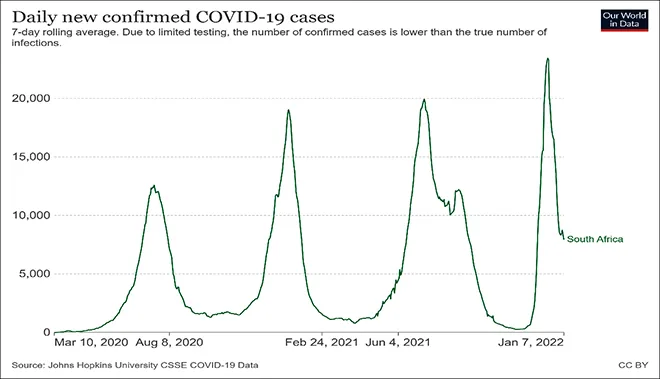
What’s happened in South Africa, with omicron as the latest spike: 

Finally, a note from France [The Washington Post]:

In an interview with France’s Le Parisien newspaper, [French President Emmanuel] Macron shared his thoughts about France’s unvaccinated population. He did not mince his words. “The unvaccinated, I really want to piss them off,” Macron said. “And so, we’re going to continue doing so until the end. That’s the strategy.”

The English translation hardly does the comment justice. In French, the verb he used is “emmerder,” which means, quite literally, to cover in excrement. The ire is difficult to translate, but in French it is crystal clear.

Actually, it’s quite easy to translate using the verb form of a different four-letter word — followed by “on them”.