This Isn’t What We Need, But Nature Isn’t Asking Us

As Omicron declines around much of the world, scientists are watching a new variant that’s even more contagious. So far, they don’t think it will have much effect on countries like the US that have already passed their Omicron peak. But this development reminded me of a recent book: Rob Dunn’s A Natural History of the Future: What the Laws of Biology Tell Us about the Destiny of the Human Species. From a NY Times review:

Levees surround us. Yes, some hold back rivers that strain against their embankments. But others hold back diseases, which are ready to saturate and overwhelm the fragile walls of antibiotics we’ve erected. And sometimes levees fail. The metaphor extends beyond epidemiology. Nature ceaselessly advances, trespasses, embarrasses our every effort to keep it at bay, and ultimately bursts through. Its rivers will not be contained.

In A Natural History of the Future, the ecologist Rob Dunn sketches an arresting vision of this relentless natural world — a world that is in equal measures creative, unguided and extravagant. Fog a tree with pesticides and watch new beetle species tumble from the canopy by the hundreds, a “riot of unnamed life.” Chlorinate your water and, though you might wipe out most parasites, you’ll soon bedew your shower head with chlorine-resistant mycobacteria. Make a world fit for bedbugs, then try to kill them with chemicals, and you’ll end up — not in a world without bedbugs, but one in which they’ve “evolved resistance to half a dozen different pesticides.”

Life is not a passive force on the planet, and much as we might presume to sit in judgment of Creation — even sorting species by their economic value to us — we live on nature’s terms. The sooner we recognize this, Dunn argues, the better.

Brannen2-superJumbo

As humans retreat into more and more sanitized spaces, and our homes become spotless, Febrezed bunkers of sterility, we’ll increasingly find that we’ve not only failed to eradicate our microbial opponents, we’ve actually helped create new, more virulent forms of them.

Enter the terrifying “megaplate” experiment, carried out by researchers at Harvard. In it, E. coli is made to grow across what is essentially a giant petri dish, one partitioned into sections laced with increasingly lethal doses of antibiotics. In the final stage of the megaplate, the bacteria meet a concentration of antibiotics many thousands of times higher than that which can kill your garden-variety E. coli. Even so, at the rate of “one mutation per billion divisions,” the bug evolves, casually crossing the entire plate, even the almost impossibly lethal barrier at the end, slipping through the antibiotic revetments as surely as water through a crumbling dike. And in only 10 days.

“I show it in talks,” Dunn writes of a video of the experiment. “It makes people quiet. It is what Kant called the horrifying sublime.”

The experiment can be run again, and again it will take about 10 days. What goes for E. coli scales up to agricultural pests, only temporarily inconvenienced by new pesticides until they evolve around them. While ecology is sometimes regarded as one of the squishier sciences, these kinds of eventualities begin to point to something like a set of laws underlying it all. These laws — though lacking the bedrock status of the laws of physics — can sometimes be nearly as predictive. If we want to know what’s coming, then, we would be well advised to familiarize ourselves with them, Dunn argues. To that end, his book functions as a helpful crash course in ecology and, as the title implies, an augur of sorts.

The law of the niche, for instance, predicts that many hapless species will fail to track their habitats on our warming world and will go extinct (think snails marooned on quickly shrinking islands). Others, however, will be cast about the face of the earth as their climate niche expands, and will flourish. Most concerning, perhaps, Aedes is coming. Just as epidemiologists warned for years that a pandemic was not merely possible but inevitable, ecologists now warn us of the looming mosquito heyday as we warp the climate. Key to this warning is the choice of modal verb: It’s not that these tropical pests “could” establish themselves in much of the Southern United States if we’re not careful, but rather that they “will.” And they will carry with them “some complex mix of the dengue virus and the yellow fever virus, but also the viruses that cause chikungunya, Zika fever and Mayaro.”

While it might not surprise us to read that mosquitoes have a niche that affects their distribution on the planet, it might be more difficult to recognize that we humans do as well. We are animals after all, and can be studied as such by ecologists. Even with the spread of air-conditioning, and all the creature comforts afforded by burning fossil fuels by the gigaton, we still mostly inhabit the same shockingly narrow band of the globe that we have for millennia. But as we push the climate beyond the norms of the past three million years we will hit the hard limits of physiology. And as the familiar rhythms of the seasons grow more syncopated and strange, some swath of our range will be increasingly foreclosed, to God knows what geopolitical effect. Many of us will have to move.

Along this unsettling journey into the future, the mood is leavened here and there by oddities, which Dunn dusts off like the docent of a strange natural history museum. We learn that the Taung child, one of the earliest hominins known to science, was eaten by eagles. We learn that the yeasts that make beer come from the bodies of wasps. That when humans spread out into new landmasses our “face mites diverged.” The impression all this arcana leaves with the reader is that we live in a much weirder, more disorienting world than we tend to appreciate.

We simplify this chaos, this riot of life, at our peril. We hoist plants from their natural context, consign them to vast monocultures, then act surprised when the rest of nature conspires to tear them down. We panic when bees fail to submit to the rote demands of industrial agriculture. But if simplifying nature is the cause of so many modern ills, then Dunn’s policy prescription, conversely, comes down to one simple dictum: Diversify. Diversify the microbes in your intestines, the crops in your fields, the plants in your watershed, the research in your grant proposals. Recruit the forests to filter your water. Let a trillion microbial flowers bloom.

This strategy works because nature is cleverer than us. The science historian George Dyson once described evolution itself as a kind of computational process that solves problems like how to swim, and how to fly. But the new problems we’ve given it to solve are ill considered, and the solutions it produces often undesirable. We dare life to overtop the levees of pesticides, herbicides, antibiotics; to overrun the concrete outcrops of cities, insinuate itself in the cracks of human society and pick the locks of our immune system. If we wipe out charismatic megafauna, of the sort that graces the brochures of conservation nonprofits, fine, nature seems to say, a florescence of rats and crows it is. Want to live in modular outcrops of steel, glass and cement, fed by rivers of pavement spanning thousands of miles? Very well, this will be a migration corridor for mice, pigeons and disease. They represent life too, after all, and the planet gives not a whit if it’s inhabited by lions or cockroaches. There are now beetles that consume only grains, mosquitoes that live only in the London metro. “Evolution creates,” Dunn writes, “and acts of creation are never complete.”

Dunn’s account leaves an overwhelming impression of fecundity, growth, adaptation. But this isn’t a naïvely rosy vision of the future like some contrarian tracts on the resilience of nature in the Anthropocene. From a human perspective this will be an impoverished world, and many of Dunn’s warnings are concrete and sobering. . . .  The rivers are rising.
The Scandal Is that They’re So Good at Creating “Scandals”

Mehdi Hassan of MSNBC is impressed:

You do have to admire the rightwing media echo chamber’s ability to weaponize even the most hyped-up of stories (John Durham filing!), misrepresent AND distort it, and then push it out with a relentless message discipline on cable and online that liberals could only ever dream of. . . . 

If your coverage and analysis of U.S. politics doesn’t center on or even include the fact that the right has a massive, well-funded, coordinated propaganda machine and its opponents don’t, then you’re really not doing it right.

Paul Waldman of The Washington Post is too:

On an average day, Fox News tells dozens or even hundreds of outright lies. Meanwhile there’s an entire trial happening in New York about A SINGLE WORD in a New York Times editorial about Sarah Palin, which was quickly corrected. Different worlds. 

Mr. Waldman wrote more about this latest instance of propaganda vs. reality:

When some appalling new story emerges of political actors lying to the public, should [the news media] confront it? Or will the attempt to debunk the story only draw more attention to it, spreading the lies further?

There’s no perfect answer that fits every situation. But at the very least, it’s important to understand how systems of propaganda operate, so we can try to minimize the damage they do. And never in our history has there been a propaganda system that operates with the skill, enthusiasm and outright shamelessness of the one conservatives have working for them right now.

That’s depressingly evident in the latest “blockbuster” story gripping the right, a story built on a grab bag of misleading assertions, misinterpretations and outright lies. It forces us to ask yet again: Is it possible to have a healthy democracy when so much of it is soaking in misinformation?

The current story concerns John Durham, the special counsel who has spent almost three years investigating the investigation into Russia’s attempts to subvert the 2016 election. You can read a comprehensive rundown of the facts here or here.

Durham has indicted Democratic lawyer Michael Sussmann for allegedly lying to the FBI, which Sussmann denies [that indictment itself is incredibly weak — it involves whether Sussman said he was representing a client in a private conversation he had with an FBI agent he knew]. In 2016, Sussmann, whose firm was doing legal work for Hillary Clinton’s campaign, gave the FBI a tip involving supposedly suspicious internet traffic between servers in Trump buildings and a Russian bank; it turned out to be nothing nefarious.

Sussman got the information through another client of his, Rodney Joffe, a technology executive with government cybersecurity contracts, including one that involved protecting the White House from cyber attacks.

In a court filing last week, Durham alleged that Joffe “exploited” his arrangement with the White House to obtain the data in question “for the purpose of gathering derogatory information about Donald Trump.”

Joffe vigorously denies this. His spokesperson says examining such data was par for the course, as he was doing cybersecurity work for the government, and in late 2016, everyone was appropriately concerned about Russian hacking. Durham has not indicted Joffe for anything.

But this is where the propaganda machine goes nuclear.

Fox News is treating this like a stunning revelation (“Worse than Watergate” trumpeted Sean Hannity), dramatically amping up the story with each retelling. After all, it isn’t good enough to say a lawyer with a second-order connection to the Clinton campaign got information from another client with legitimate access to White House internet traffic data; that’s not nearly scandalous enough.

So Fox published a headline reading “Clinton campaign paid to ‘infiltrate’ Trump Tower, White House servers to link Trump to Russia, Durham finds.” The Washington Examiner claimed Sussmann “spied on Trump’s White House office” — even though the internet data came from 2016, when Barack Obama was president.

“Hillary broke into a presidential candidate’s computer server and a sitting president’s computer server,” ludicrously claimed Fox host Jesse Watters. “There, her hackers planted evidence, fabricated evidence connecting Trump to Russia.”

Tucker Carlson added that Clinton’s campaign stole “presumably text messages,” which not even Durham alleges.

These are all lies. This is not about “hacking,” no evidence was planted and the data on White House traffic came from when Obama was president. You can argue that Durham’s filing was itself misleading and tendentious [which it was], but even if every word of it was true, what they were saying on Fox was outrageously false.

But the propaganda machine doesn’t stop there. Republican politicians — even those who know better — see their constituents being fed this line, so they rush to get in on the act:

The coverage has gone meta; Fox is now angrily asking why other news outlets are not matching their breathless coverage of this nothing burger, feeding their viewers’ paranoid fantasies about cover-ups and conspiracies.

So in no time, we move from questionable claims to obviously false allegations to demands for legal retaliation against political opponents to whining about their own victimhood, with the enthusiastic participation of GOP officeholders, none of whom has the courage to say, “Hey guys, I hate Hillary as much as anyone, but it seems like we’re running out ahead of the facts here.”

That’s because every Republican relies on the propaganda machine. It helps their own campaigns. It keeps the base in a state of perpetual anger. And if you question it, you will become its enemy.

This is happening while there’s an entire trial going on in New York about a single inaccurate word in a New York Times editorial about Sarah Palin — an editorial that was quickly corrected. The Times is falling all over itself to explain how it got something wrong, and no one on the left is defending the paper. Meanwhile, Fox programming contains extraordinary amounts of factual errors, misleading assertions and outright lies, almost none of which ever get corrected.

So where does that leave us? The unfortunate answer is that when a propaganda apparatus such as this one is so deeply embedded within one of our parties, it becomes almost impossible to puncture. Fantasies are accepted as fact, lies become immune to refutation and anyone who displays even a modicum of honesty is denounced as a traitor.

There may be a solution out there, a strategy to pull our politics back to reality. But if there is, we haven’t found it yet.

Unquote.

The former president issued a statement regarding this “scandal” claiming members of the Clinton campaign would have been executed (for crimes they didn’t actually commit), back when America was stronger. His bullshit was dutifully repeated here, there and everywhere as if it made any sense at all.

As we sink further into the abyss.

Some Conservatives Want to Avoid a Coup in 2024

One such conservative is J. Michael Luttig. You know he’s a conservative, because he clerked for Antonin Scalia, worked for Ronald Reagan and was made a federal judge by the first President Bush. After 15 years as a judge, he was Boeing’s general counsel for 13 years (2008 income = $2.8 million). He’s apparently consulting with “a number of senior Republican senators” regarding changes to the Electoral Count Act. He warned America in a piece for the NY Times today: 

The clear and present danger to our democracy now is that former President D____ T____ and his political allies appear prepared to exploit the Electoral Count Act of 1887, the law governing the counting of votes for president and vice president, to seize the presidency in 2024 if Mr. T____ or his anointed candidate is not elected by the American people.

The convoluted language in the law gives Congress the power to determine the presidency if it concludes that Electoral College slates representing the winning candidate were not “lawfully certified” or “regularly given” — vague and undefined terms — regardless of whether there is proof of illegal vote tampering. After the 2020 election, Republican senators like Ted Cruz of Texas and Josh Hawley of Missouri tried to capitalize on those ambiguities in the law to do Mr. T____’s bidding, mounting a case for overturning the results in some Biden-won states on little more than a wish. Looking ahead to the next presidential election, Mr. T____ is once again counting on a sympathetic and malleable Congress and willing states to use the Electoral Count Act to his advantage.

He confirmed as much in a twisted admission of both his past and future intent earlier this month, claiming that congressional efforts to reform the Electoral Count Act actually prove that Mike Pence had the power to overturn the 2020 presidential election because of the alleged “irregularities.” The former vice president pushed back forcefully . . . 

The back-and-forth repudiations by Mr. T____ and Mr. P____ lay bare two very different visions for the Republican Party. Mr. T____ and his allies insist that the 2020 election was “stolen,” a product of fraudulent voting and certifications of electors who were not properly selected. Over a year after the election, they continue to cling to these disproved allegations, claiming that these “irregularities” were all the evidence Mr. Pence needed to overturn the results, and demanding that the rest of the G.O.P. embrace their lies. The balance of the Republican Party, mystifyingly stymied by Mr. T____, rejects these lies, but, as if they have fallen through the rabbit hole into Alice’s Wonderland, they are confused as to exactly how to move on from the 2020 election when their putative leader remains bewilderingly intent on driving the wedge between the believers in his lies and the disbelievers.

This political fissure in the Republican Party was bound to intensify sooner or later, and now it has, presenting an existential threat to the party in 2024. If these festering divisions cost the Republicans in the midterm elections and jeopardize their chances of reclaiming the presidency in 2024, which they well could, the believers and disbelievers alike will suffer.

While the Republicans are transfixed by their own political predicaments, and the Democrats by theirs, the right course is for both parties to set aside their partisan interests and reform the Electoral Count Act, which ought not be a partisan undertaking.

Democrats, for their part, should regard reform of the Electoral Count Act as a victory — essential to shore up our faltering democracy and to prevent another attack like the one at the Capitol on Jan. 6, 2021. These are actually the worthiest of objectives.

Republicans should want to reform the law for these same reasons, and more. Of course, some may never support reform of the Electoral Count Act simply because the former president has voiced his opposition to the efforts to revise it. But there are consequential reasons of constitutional and political principle for the large remainder of Republicans to favor reform in spite of the former president’s opposition.

Republicans are proponents of limited federal government. They oppose aggregation of power in Washington and want it dispersed to the states. It should be anathema to them that Congress has the power to overturn the will of the American people in an election that, by constitutional prescription, is administered by the states, not Washington . . . [although he doesn’t mention that the Constitution (Article I, Section 4, Clause 1) gives Congress the authority to change the rules for elections].

Constitutional conservatives, especially, should want Electoral Count Act reform, because they should be the first to understand that the law is plainly unconstitutional. Nothing in the Constitution empowers Congress to decide the validity of the electoral slates submitted by the states. In fact, the Constitution gives Congress no role whatsoever in choosing the president, save in the circumstance where no presidential candidate receives a majority of the electoral votes cast.

T____ acolytes like Mr. Cruz and Mr. Hawley should appreciate the need to reform this unconstitutional law. . . . No Republican should want to be an accessory to any successful attempt to overturn the next election — including an effort by Democrats to exploit the law.

If the Republicans want to prevent the Electoral Count Act from being exploited in 2024, several fundamental reforms are needed. First, Congress should formally give the federal courts, up to and including the Supreme Court, the power to resolve disputes over state electors and to ensure compliance with the established procedures for selecting presidential electors — and require the judiciary’s expeditious resolution of these disputes. Congress should then require itself to count the votes of electors that the federal courts have determined to be properly certified under state law.

Congress should also increase the number of members required both to voice an objection and to sustain one to as high a number as politically palatable. At the moment, only one member of each chamber is necessary to send an objection to the Senate and House for debate and resolution — an exceedingly low threshold that proved a deadly disservice to the country and the American people during the last election.

Currently, Congress has the power under Article II and the Necessary and Proper Clause to prevent states from changing the manner by which their electors are appointed after the election, but it has not clearly exercised that authority to prevent such postelection changes. It should do so.

Finally, the vice president’s important, but largely ministerial, role in the joint session where the electoral votes are counted should once and for all be clarified.

It is hardly overstatement to say that the future of our democracy depends on reform of the Electoral Count Act. Republicans and Democrats need to . . . fix this law before it enables the political equivalent of a civil war three years hence. The law is offensive to Republicans in constitutional and political principle, officiously aggrandizing unto Congress the constitutional prerogatives of the states. It is offensive to Democrats because it legislatively epitomizes a profound threat in waiting to America’s democracy. The needed changes, which would meet the political objections of both parties, should command broad bipartisan support in any responsible Congress. . . . 

Come to think of it, the only members in Congress who might not want to reform this menacing law are those planning its imminent exploitation to overturn the next presidential election.

Maybe We’ll Reach a Tipping Point

The Republican majority on the Supreme Court (three of whom were appointed by the worst president of modern times) decided that the Occupational Health and Safety Administration didn’t have the authority to impose a vaccine/testing mandate on employees at large companies because people who don’t work at large companies also get Covid-19. (People also die from carbon monoxide poisoning when they’re not at work, so OSHA probably shouldn’t protect employees from that either).

Later, the Supreme Court majority let stand a law in Texas that gives anybody in the state the right to sue someone who receives or administers an abortion after the woman has been pregnant for six weeks, contrary to previous Supreme Court decisions. Other states with Republican legislatures immediately began enacting similar laws. There’s now a strong possibility that the Republican majority will overturn the Roe v. Wade decision this year, allowing states to make abortion illegal again.

A three-judge appeals court ruled that Georgia’s new congressional map was a clear violation of the Voting Rights Act. Two of the judges who said the map was illegal were Republicans appointed by the same worst president, yet the Supreme Court majority allowed the map to stay in effect through the upcoming elections.

Meanwhile, in Canada, a mob of truck drivers decided to block the streets of the nation’s capital, causing the city’s mayor to declare an emergency. Another group, for the most part not driving big trucks, decided to block bridges between Canada and the US, disrupting trade and travel in both countries, in particular, the delivery of goods by both Canadian and American truck drivers. Yet right-wing figures in the US are supporting the Canadian blockades and discussing similar actions in the US.

If the Supreme Court majority overturns Roe v. Wade, if trade and travel are further disrupted by right-wing agitators, maybe there will be a tipping point. A majority of voters will understand that Republican politicians do not have their interests in mind and will vote accordingly.

(I forgot to mention the movement among right-wingers across the country to ban certain books and to eliminate history lessons that make white kids “uncomfortable”. It’s another example of Republicans going too far.)

One of the Most Sickening Developments in Recent Times

And wouldn’t you know, it involves our corrupt Supreme Court.

From Paul Waldman of The Washington Post:

In 2019, the Supreme Court ruled that it has no power to do anything about partisan gerrymandering, allowing states to gerrymander to their hearts’ content. But at the time, it clarified that it could still strike down racial gerrymanders, since drawing district lines that have the effect of eroding the power of minority groups would violate the Voting Rights Act.

But now the court may have cleared a path to potentially harming African American voters in another way, by further diluting their prospects for electing preferred candidates . . . 

Combine the Alabama case on which the court just ordered a stay with its decision to allow Texas’s abortion vigilante law to go into effect — all but outlawing abortion in the second largest state, Roe v. Wade be damned — and you can see the emergence of a new kind of political/legal process. It’s one Republicans will increasingly deploy to remake the landscape of U.S. law.

Here’s how it works:
 
  1. A Republican state legislature passes an obviously and unquestionably unconstitutional law.
  2. The Supreme Court uses its “shadow docket” to allow the law to remain in place for an extended period, nullifying the existing constitutional order in one state.
  3. Eventually, the court issues a sweeping order taking the changes nationwide — but since everyone saw it coming, it may not seem as radical as it might have, and in any case the court doesn’t really care what anyone thinks.

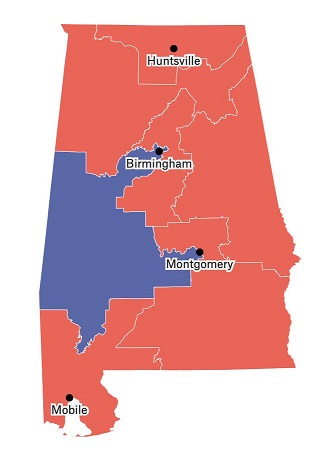
In the Alabama case, the GOP-run state legislature created a congressional map that packs many of the state’s Black voters into a single district. Though they make up 27 percent of the state’s population, African Americans have a remote chance of winning in only one of the state’s seven congressional districts. In Alabama, voters are highly divided by race; according to exit polls, 77 percent of Whites in Alabama voted for Donald Trump in 2020, compared with 55 percent in the country as a whole.

After a lengthy trial, a three-judge panel found that the map discriminated against the state’s Black voters in violation of Section 2 of the Voting Rights Act and ordered the state to produce a new map. That panel was made up of one judge appointed by Bill Clinton and two appointed by Trump, suggesting the legal judgment was clear.

[Here’s the map. The Republicans sent tentacles out to include Birmingham, Montgomery and one other area in order to cram as many Black people as possible into that single Democratic district.]
FLB43q2XwAgkxsY

Alabama appealed to the Supreme Court, where five justices [the most reactionary ones] issued a stay nullifying the lower court’s ruling, allowing a map that seems to clearly violate the Voting Rights Act to remain in place. They also accepted the case for a full hearing and judgment later on, but the stay came through what is now known as the “shadow docket,” where increasingly consequential rulings are issued on an emergency basis.

Justice Brett M. Kavanaugh, writing for the majority, said that it was too close to the election later this year, so the court simply had to intervene on Alabama’s behalf.

Even Chief Justice John G. Roberts Jr., the architect of the court’s long assault on voting rights and the author of its 2013 decision gutting other sections of the Voting Rights Act , was unable to justify what his [far right] colleagues did. In a brief dissent, he wrote that while he agreed with the decision to take the case for a full consideration — signaling that he looks forward to driving another stake into the heart of the Voting Rights Act — “the District Court properly applied existing law in an extensive opinion with no apparent errors for our correction.”

But the other five conservatives felt free to intervene. As Justice Elana Kagan wrote in dissent, “Today’s decision is one more in a disconcertingly long line of cases in which this Court uses its shadow docket to signal or make changes in the law, without anything approaching full briefing and argument.”

When it allows clearly unconstitutional or otherwise problematic state laws to remain in place, the court not only creates sweeping de facto change for temporary periods, it also sends a message to Republican state legislatures that nothing is off the table.

Is there a constitutional right you’d like to eliminate, a federal law you find displeasing, an outrageous fantasy you’d like to turn into reality? Pass a law making it happen, no matter how crazy, and there’s a good chance we’ll let it stand, at least for a while. And after that, who knows?

. . ., We’re embarking in a new era, in which a radicalized Republican Party meets an unusually aggressive Supreme Court majority eager to reimagine the whole scope of American law. And with six [Republicans, three appointed by the worst president in history] , they have a margin of error that allows them to indulge their wildest policy ambitions.