Whereof One Can Speak đŸ‡ș🇩

Nothing special, one post at a time since 2012

How Forced Births Will Affect Women’s Healthcare

From Kate Riga of Talking Points Memo:

… The Supreme Court has not only let red states flip the calendar pages back to pre-1973 America. In many ways, it’s worse than that.

Abortion has become a foundational pillar to all kinds of health care procedures. Ripping it out [reduces their availability].

America now faces a reality that will be like returning to the early ‘70s, but with half a century of medical and technological advances that health care providers in certain states can no longer use. Since Roe, abortion care became drastically safer and more efficient, and the medical procedures involved in abortion have become indelibly embedded in the wider health care landscape. They’ve become a key aspect of all kinds of other health care, from miscarriage management to cancer treatment.

Now, in states from Texas to Ohio, we’re already seeing how abortion — or procedures that can be construed as abortion — are deeply intertwined with health care more broadly, and what it means for them to be taken away.

It’s easier, and convenient for the anti-abortion movement, to imagine abortion as a siloed-off procedure, under the auspices of Planned Parenthood and only relevant to young women seeking to end their unwanted pregnancies. But for decades, that hasn’t been the case.

After Roe, Abortion Becomes Safe

After the Supreme Court legalized abortion nationwide, researchers and physicians could finally learn how to get better at it.

“If the procedure is illegal, you can’t do clinical studies and you can’t develop new procedures because you’re doing it secretly,” Johanna Schoen, a professor of history at Rutgers University told TPM. “Most people providing abortions were not clinicians and not able to do it in a medical setting.”

“After Roe, clinicians made it not only the safest out-patient procedure in the country, but also much safer than pregnancy and delivering a baby,” she added. “All of that has to do both with the improvement of abortion procedures and development of new ones.”

In addition to the procedure improvements, after Roe, physicians started receiving more training in how to perform abortions and manage potential complications. Mortality rates associated with abortion started to plummet. And the number of women hospitalized for abortion-related complications dropped between 1970 and 1977, with a steep dip after 1973. By 1995, fewer than 0.3 percent of abortion patients were hospitalized with complications from the procedure.

Abortion Is Now Woven Throughout Today’s Medical Landscape 

While abortion care developed apace, other related medical technologies improved too. By the late 1970s, ultrasounds were being used widely in American hospitals, helping to advance detection of fetal abnormalities.

As the technology continued to improve over the next few decades, physicians became better able to identify abnormality markers. Under Roe, in states that hadn’t impinged on the abortion right with gestational bans (many diagnoses occur in the second trimester, though advances are pushing some earlier), women could opt for an abortion once abnormalities were detected rather than carrying the pregnancy to term.

Now, after Dobbs, experts are certain that women in states with draconian abortion bans will have to go through labor and give birth to babies that cannot survive.

The development of ultrasound technology has also enabled physicians to more accurately diagnose unruptured ectopic pregnancies in a way that was not possible pre-Roe. In these pregnancies, the fertilized egg implants outside of the uterus where it cannot survive but can pose a deadly threat to the woman if it’s allowed to grow.

The improvement in mortality rates associated with ectopic pregnancies followed: a more than 70 percent decrease in deaths-to-cases from 1970 to 1978.

Already, stories are emerging about the demise of Roe throwing ectopic pregnancy care into chaos. Doctors report feeling unsure about whether abortion bans — which are often written using broad political messaging language rather than medical — include ending ectopic pregnancies, which are not viable. Various lawmakers and anti-abortion activists have proven themselves to be particularly unlearned on the subject, some suggesting that terminating ectopic pregnancies is not medically necessary, while others have offered up a supposed solution — just moving the ectopic pregnancy inside of the uterus — technology for which does not currently exist.

Another medical success story already under threat is in-vitro fertilization, or IVF. The first IVF baby was born in 1978; since then, initial single-digit success rates have blossomed to nearly 50 percent for cases where the woman is under 35 years old. One to two percent of births in the United States annually result from IVF.

Fertility clinics have already been flooded with calls by people panicked about what abortion bans mean for their procedures. During IVF, clinicians usually implant one or two embryos in the uterus and store the rest for potential future use. It’s unclear whether bans would stop people from discarding the unneeded embryos, perhaps forcing them to pay to keep them frozen forever. Genetic testing of the embryos could become illegal. And if some embryos don’t survive the implantation process — or are nonviable and discarded — clinics could potentially be liable.

Some states are already contemplating granting personhood to the embryos, which could put IVF clinics out of business and leave the people who depend on them without options.

Far-Reaching Consequences

Even cancer treatment, a seemingly far cry from reproductive care, depends on abortion to afford its patients the right to treat their illnesses without worrying about the oftentimes toxic effect those treatments have on fetuses.

Cancer occurs in about one in every 1,000 pregnancies annually, leaving the women with few options even while Roe’s protections were the law of the land. Many treatments can cause miscarriages or birth defects in the developing fetuses, especially at the beginning of the pregnancy. The CEO of the American Cancer Society said that radiation therapy is never given to pregnant patients at all.

Ending their pregnancies, for these patients, can become a matter of literal life and death — the only way for women to receive the full gamut of treatment to cure their cancer. Now, in some states, women may have to choose: lifesaving treatment that will harm the developing fetus, or leaving their cancer untreated.

Some pharmacists are already restricting patients’ access to methotrexate, a therapy for certain kinds of cancer that can induce abortions. Methotrexate is also used in treating ectopic pregnancies and, since the 1980s, soothing chronic inflammation and pain, making it a mainstay in treating diseases like lupus, rheumatoid arthritis and psoriasis. The Arthritis Foundation has stood up a hotline amid reports of patients struggling to obtain the drug.

Two other pills — mifepristone and misoprostol, the collective “abortion pill” approved by the Food and Drug administration for combined used through 49 days of gestation in 2000, and for longer now — are already being acutely targeted by anti-abortion lawmakers. There’s a long history of animosity towards mifepristone in particular, with the FDA baselessly categorizing it as dangerous for years.

Those medications are indispensable in treating miscarriages, which at least one in four American women will have by age 45. Even before the Dobbs ruling, women have had to rely on abortion clinics for miscarriage treatment, often because of arbitrary limitations on who can distribute mifepristone. That problem has been compounded since the ruling by sparking confusion among some hospitals about whether other aspects of miscarriage care will be misconstrued by authorities as an elective abortion.

“Management of miscarriages and ectopic pregnancies are things that were not really possible when abortion was illegal,” Schoen said. “Women in the middle of miscarriages and ectopic pregnancies were up shit’s creek — and people died as a result of that.”

Abortion is a medical success story. Bringing the procedure out of the shadows allowed clinicians to make it safe and humane, and to weave it into other medical treatments. Procedures that are related to, or can be construed as abortion, are now integral parts of an astoundingly wide range of medical care. All of it is under threat.

The Supreme Court is not sending large swaths of the country back to the relative ignorance of pre-Roe America. It’s sending us back in time armed with prodigious knowledge and then-undreamed-of technology that lessen women’s suffering, and uncomplicate and alleviate illnesses where pregnancy is not an option — but forbidding health care workers to use that knowledge.

Women will suffer and they will die, even while doctors have 50 years of medical advancements at their backs….
We Should Believe It When We See It

Minutes after passing a bipartisan bill to increase US production of semiconductors, Senate Democrats announced that, believe it or not, conservative “Democratic” Senator Joe Manchin has agreed to pass a Democrats-only budget reconciliation bill that addresses some of President Biden’s Build Back Better agenda.

One cool thing about this is that evil Republican Senator Mitch McConnell said he wouldn’t support the semiconductor bill if Democrats tried to do any good Build Back Better stuff. So it appears the Democrats waited until right after the semiconductor bill passed to announce they were doing something Build Back Better-ish (i.e. good) after all. Maybe this will work out, assuming erratic “Democratic” Senator Krysten Sinema goes along, giving Senate Democrats the 50 votes they need (with Vice President Harris breaking the tie in the 50-50 Senate):

From Crooked Media’s free, informative, daily newsletter:

Dear readers, have we ever told you how wise and handsome we’ve always found Sen. Joe Manchin (D-WV) to be? No? Well it’s totally true, and senator, if you’re reading this, you would look especially good allowing the passage of climate legislation that will prevent our country from simultaneously burning and drowning. 

In a surprise turn of events, Manchin and Sen. Majority Leader Chuck Schumer announced today that they struck a deal on a domestic-spending package that includes climate and energy programs and tax increases on the wealthy. This is a breakthrough after more than a year of negotiations that looked all but dead two weeks ago when Manchin abruptly announced he would not support any new climate spending, because he was just too concerned about inflation, you guys!!! 

Manchin has been a thorn in the side of his Democratic colleagues, the main holdout on most of the progressive social policies the Biden administration had hoped to enact. In his somewhat-opaque statement, Manchin signaled support for climate and energy programs, as well as “adopting a tax policy that protects small businesses and working-class Americans while ensuring that large corporations and the ultra-wealthy pay their fair share in taxes.” Is this the same Joe Manchin we have come to know and mostly-disdain? Could it be?  

Well yes, it still mostly is the same old Joe. The bill agreed upon was titled the Inflation Reduction Act of 2022 [eyes roll out of my head] and Manchin in his statement made sure to include a jab at the much more comprehensive Build Back Better, which he can now brag to his pals across the aisle about helping to kill. His statement also focuses mostly on inflation, and not the climate emergency or the many ills that Build Back Better was trying to treat. But for once I will resist dragging Joe’s ass too hard, because this bill is much better than the extremely-narrow drug-pricing package Dems were prepared to accept when it looked like Manchin was ready to walk away entirely last month.

And now that Fossil Fuel Joe is on board, the bill is much more likely to actually become law, and the bill is actually good [although we don’t know all the details yet].  

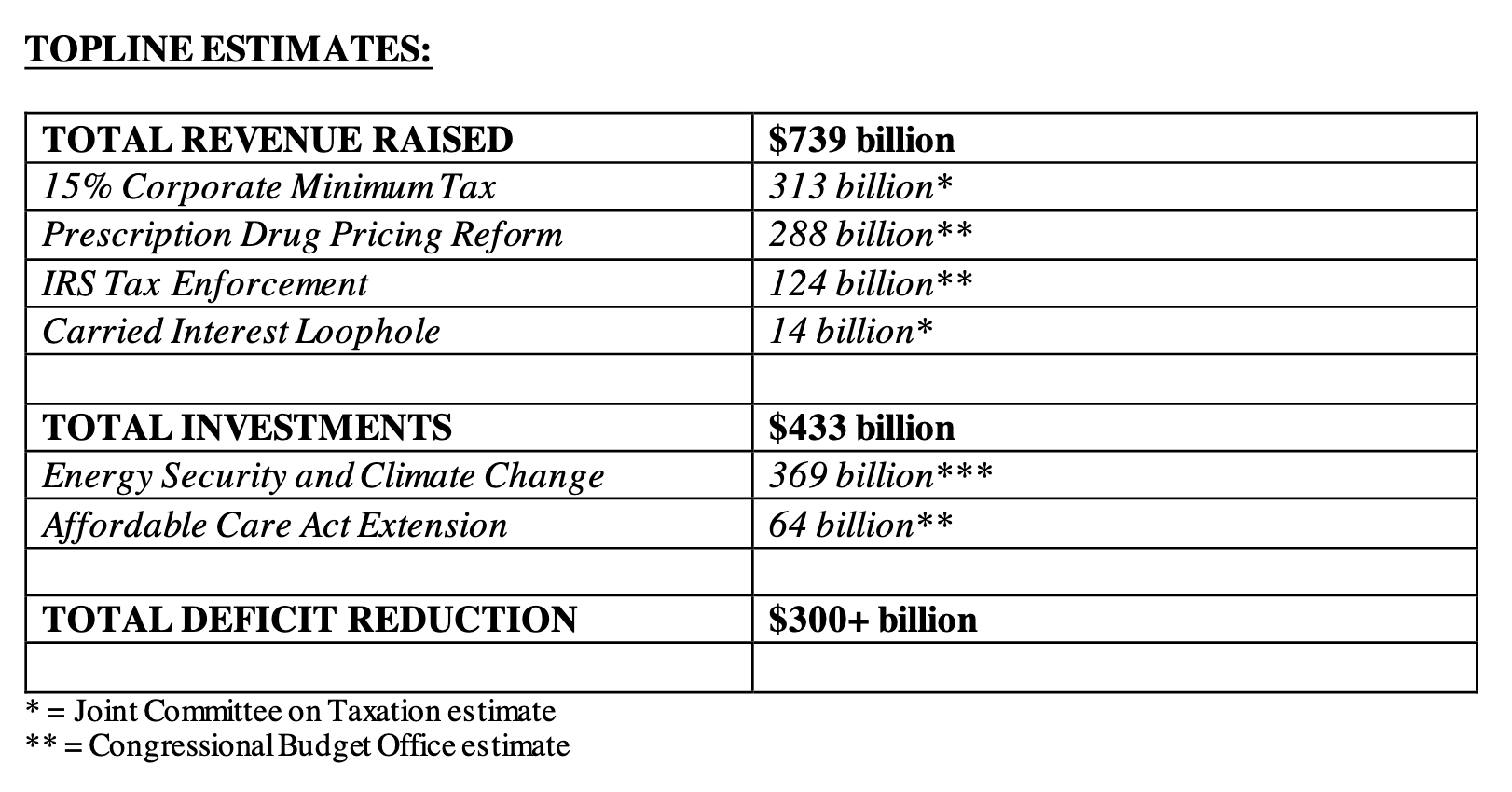
The climate provisions in the proposed bill are the largest fiscal piece of it, to the tune of $369 billion, which is good. All aspects of the bill—the reduction in energy and health care costs, and the deficit reduction—are anti-inflationary, which is also good. The bill allows Medicare to negotiate drug prices and lowers ACA premiums, and closes a whole host of tax loopholes with increased funding to the IRS, all without any regressive, shit-eating spending cuts you’d normally expect Congress to include in a big budget bill. We’re not sure where his change of heart came from (was he visited by three ghosts when he had covid this week?) but we’re not questioning it.  

Assuming Dems can pass the bill in the House and the Senate parliamentarian allows it to be approved with 51 votes (or 50 and a tie break from VP Harris) through the budget reconciliation process, this has a serious chance of becoming law as early as August. This would be a huge win for Democrats going into midterms, who will need every single win they can get. It will give them a concrete answer to voters rightly asking, “What have you done for me lately?” 

The bill faces a number of hurdles before it can become law, but White House Joe has signed off on it in a statement, so we thank you, Senate Joe, for your begrudging cooperation at last. Kyrsten Sinema don’t even FUCKING think about it.

An initial summary of the compromise bill.

Finally, Some Confirmation

The Washington Post reported tonight:

The Justice Department is investigating President D____ T____’s actions as part of its criminal probe of efforts to overturn the 2020 election results, according to four people familiar with the matter.

Prosecutors who are questioning witnesses before a grand jury — including two top aides to Vice President Mike Pence — have asked in recent days about conversations with T____, his lawyers, and others in his inner circle who sought to substitute T____ allies for certified electors from some states Joe Biden won, according to two people familiar with the matter. Both spoke on the condition of anonymity to discuss an ongoing investigation.

The prosecutors have asked hours of detailed questions about meetings T____ led in December 2020 and January 2021; his pressure campaign on Pence to overturn the election; and what instructions T____ gave his lawyers and advisers about fake electors and sending electors back to the states, the people said. Some of the questions focused directly on the extent of T____’s involvement in the fake-elector effort led by his outside lawyers, including John Eastman and Rudy Giuliani, these people said.

In addition, Justice Department investigators in April received phone records of key officials and aides in the T____ administration, including his former chief of staff, Mark Meadows, according to two people familiar with the matter. That effort is another indicator of how expansive the Jan. 6 probe had become, well before the high-profile, televised House hearings in June and July on the subject….

There are two principal tracks of the investigation that could ultimately lead to additional scrutiny of T____, two people familiar with the situation said, also speaking on the condition of anonymity to discuss an ongoing investigation.

The first centers on seditious conspiracy and conspiracy to obstruct a government proceeding, the type of charges already filed against individuals who stormed the Capitol on Jan. 6 and on two leaders of far-right groups, Stewart Rhodes and Henry “Enrique” Tarrio, who did not breach the Capitol but were allegedly involved in planning the day’s events.

The second involves potential fraud associated with the false-electors scheme or with pressure T____ and his allies allegedly put on the Justice Department and others to falsely claim that the election was rigged and votes were fraudulently cast….

But Could He Be Elected from a Jail Cell?

On a very hot summer afternoon, what better to consider than what to do about “a pathetic, degenerate huckster capable of great violence and evil” who is going to run for president again? Followed by some encouraging words from Merrick Garland. First, from Charles Blow of The New York Times:

His entire foray into politics has been one of testing the fences for weaknesses. Every time a fence has failed, he has been encouraged. He has become a better political predator.

With the conclusion of this series of hearings about the Jan. 6 insurrection, it has become ever clearer to me that T____ should be charged with multiple crimes. But I’m not a prosecutor. I’m not part of the Department of Justice. That agency will make the final decision on federal charges.

The questions before the Justice Department are not only whether there is convincing evidence that T____ committed the crimes he is accused of but also whether the country could sustain the stain of a criminal prosecution of a former president.

I would turn the latter question around completely: Can the country afford not to prosecute Trump? I believe the answer is no.

He has learned from his failures and is now more dangerous than ever.

He has learned that the political system is incapable of holding him accountable. He can try to extort a foreign nation for political gain and not be removed from office. He can attempt a coup and not be removed from office.

He has learned that many of his supporters have almost complete contempt for women. It doesn’t matter how many women accuse you of sexual misconduct; your base, including some of your female supporters, will brush it away. You can even be caught on tape boasting about sexually assaulting women, and your followers will discount it.

He has learned that the presidency is the greatest grift of his life. For decades, he has sold gilded glamour to suckers — hawking hotels and golf courses, steaks and vodka — but with the presidency, he needed to sell them only lies that affirmed their white nationalism and justified their white fragility, and they would happily give him millions of dollars. Why erect a building when you could simply erect a myth? T____ will never willingly walk away from this.

Now with the investigation into his involvement in the insurrection and his attempts to steal the election, he is learning once again from his failures. He is learning that his loyalty tests have to be even more severe. He is learning that his attempts to grab power must come at the beginning of his presidency, not the end. He is learning that it is possible to break the political system.

Not only does T____ apparently want to run again for president; The New York Times reported that he might announce as soon as this month, partly to shield himself “from a stream of damaging revelations emerging from investigations into his attempts to cling to power after losing the 2020 election.”

T____ isn’t articulating any fully fleshed-out policy objectives he hopes to accomplish for the country, but that should come as no surprise. His desire to regain power has nothing to do with the well-being of the country. His quest is brazenly self-interested. He wants to retake the presidency because its power is a shield against accountability and a mechanism through which to funnel money.

Should his re-election bid prove successful, T____’s second term will likely be far worse than the first.

He would tighten his grip on all those near him. Mike Pence was a loyalist but in the end wouldn’t fully kowtow to him. The same can be said of Bill Barr. T____ will not again make the mistake of surrounding himself with people who would question his authority.

Some of the people who demonstrated more loyalty to the country than they did to T____ during these investigations were lower-level staff members. For the former president, they, too, present an obstacle. But he might have a fix for that as well.

Axios reported on Friday that “T____’s top allies are preparing to radically reshape the federal government if he is re-elected, purging potentially thousands of civil servants and filling career posts with loyalists to him and his ‘America First’ ideology”.

According to Axios, this strategy appears to revolve around his reimposing an executive order that would reassign tens of thousands of federal employees with “some influence over policy” to Schedule F, which would strip them of their employee protections so that T____ could fire them without recourse to appeal. [Note: T____ created Schedule F by executive order a few weeks before the 2020 election. It gave him unprecedented power to ignore civil service rules. President Biden repealed the executive order on his second day in office.]

Perhaps most dangerous, though, is that T____ will have learned that while presidents aren’t too big to fail, they are too big to jail. If a president can operate with impunity, the presidency invites corruption, and it defies the ideals of this democracy.

A T____ free of prosecution is a T____ free to rampage.

Some could argue that prosecuting a former president would forever alter presidential politics. But I would counter that not prosecuting him threatens the collapse of the entire political ecosystem and therefore the country.

Unquote.

We don’t know what it will mean, but Attorney General Merrick Garland repeated his intention to hold everybody responsible for January 6th (and possibly the entire attempted coup):

It Was Religion, Plain and Simple (and Crazy)

It’s the official doctrine of the Catholic Church that a zygote, blastocyst, embryo or fetus is just as much a human being as you or me. It’s a crazy idea, but it shouldn’t matter to the rest of us what a church’s doctrine is as long as they leave the rest of us alone (and don’t do anything crazy to their children on religious grounds). It shouldn’t even matter to the rest of us that a lot of non-Catholics have adopted the same peculiar idea. The problem is that millions of people who accept this strange religious doctrine want the rest of us to act as if we accept it too.

I don’t know how many people who want to force pregnant women and girls to give birth are motivated by the religious idea or by the desire to control women’s and girls’ lives. Some or many are motivated by both. Linda Greenhouse, who writes about the judicial system for the New York Times, says she originally put the Dobbs decision that overturned Roe v. Wade in the abortion category, but then decided it was really about religion:

My own way of keeping track of a Supreme Court term is to log each of the term’s decisions on a chart labeled by category: criminal law, administrative law, speech, federalism and so on. For this past term, one of my charts was, of course, labeled “abortion,” and naturally that’s where I recorded Dobbs v. Jackson Women’s Health Organization….

But the other day, going over my charts before filing them away to prepare for the next term, a realization struck me. I had put Dobbs in the wrong place. Along with the decision about the praying football coach and the one requiring Maine to subsidize parochial school tuition, Dobbs belongs under “religion”….

Justice Alito took pains to present the majority’s conclusion as the product of pure legal reasoning engaged in by judges standing majestically above the fray of Americans’ “sharply conflicting views” on the “profound moral issue” of abortion, as he put it in the opinion’s first paragraph. And yet that very framing, the assumption that the moral gravity of abortion is singular and self-evident, gives away more than members of the majority, all five of whom were raised in the Catholic Church, may have intended.

A recent essay in my local newspaper by a Congregational minister, John Nelson, was a powerful reminder that in speaking from one particular religious tradition, the court ignored other vital streams of religious thought. “Samuel Alito is as free as any person to hold forth on morals and politics,” Pastor Nelson wrote, “but his opening salvo is backed up with no reflection on the sources, claims or nuances of morality, leaving the impression that the decision was developed through moral bias rather than moral reasoning.” Describing his own response to the decision as one of “fury,” the pastor said that the justices, in their “concern for the lives of fetuses,” overlooked the “lived experience” of women. “To show no regard for a lived experience is immoral,” he wrote.

Indeed, the fetus is the indisputable star of the Dobbs opinion. That is not necessarily obvious at first reading: The opinion’s 79 pages are larded with lengthy and, according to knowledgeable historians, highly partial and substantially irrelevant accounts of the history of abortion’s criminalization. In all those pages, there is surprisingly little actual law. And women, as I have observed before, are all but missing. It is in paragraphs scattered throughout the opinion that the fetus shines.

“None of the other decisions cited by Roe” and Planned Parenthood of Pennsylvania v. Casey, the 1992 ruling that reaffirmed the right to abortion, “involved the critical moral question posed by abortion,” Justice Alito wrote. “They are therefore inapposite.” Further on, he wrote: “The dissent has much to say about the effects of pregnancy on women, the burdens of motherhood, and the difficulties faced by poor women. These are important concerns. However, the dissent evinces no similar regard for a state’s interest in protecting prenatal life.”

This was a strange criticism of the dissenting opinion, signed jointly by Justices Stephen Breyer, Sonia Sotomayor and Elena Kagan. They argued vigorously for retaining the 1992 Casey decision, which in fact, in a departure from Roe, declared that the state’s interest in fetal life was present from the moment of conception. Casey authorized the states to impose waiting periods and “informed consent” requirements that the court in the years following Roe v. Wade had deemed unconstitutional.

Justice Alito knows the Casey decision very well. As a federal appeals court judge, he had been a member of the panel that upheld most of Pennsylvania’s Abortion Control Act in the case that became Casey. Then-Judge Alito, alone on the panel, wanted to uphold a provision of the state law that required a married woman to inform her husband of her plan to get an abortion.

In affirming the appeals court’s decision, the Supreme Court in Casey emphasized in one of the opinion’s most vivid passages the unconstitutional burden that the spousal notice requirement placed on women: “We must not blind ourselves to the fact that the significant number of women who fear for their safety and the safety of their children are likely to be deterred from procuring an abortion as surely as if the Commonwealth had outlawed abortion in all cases.” Perhaps that aspect of the Casey decision still rankled. In any event, Justice Alito’s attack on his dissenting colleagues for ignoring the state’s interest in fetal life was seriously misguided.

Of course, from his point of view, Casey didn’t go far enough because the weight the court gave to fetal life was well below 100 percent. The Casey decision was five days shy of 30 years old when the court overturned it, along with Roe v. Wade, on June 24. Given that this was their goal from the start, the justices in the Dobbs majority really had only one job: to explain why. They didn’t, and given the remaining norms of a secular society, they couldn’t.

There is another norm, too, one that has for too long restrained the rest of us from calling out the pervasive role that religion is playing on today’s Supreme Court. In recognition that it is now well past time to challenge that norm, I’ll take my own modest step and relabel Dobbs for the religion case that it is, since nothing else explains it.