We Have a Millstone Around Our National Neck

It’s good to have a constitution, but not every constitution is good. Charles Blow of The New York Times evaluates ours:

… I have been thinking about what I would say to Biden about the threats to American democracy. The most acute threat, it’s true, comes from election deniers and the authoritarian mass movement led by the previous president….. But the long-term threat is less an imposition from bad actors and more a constitutive part of our political system. It is, in fact, the Constitution. Specifically, it is a set of fundamental problems with the structure of our government that flow directly from the Constitution as it currently exists.

We tend to equate American democracy with the Constitution as if the two were synonymous with each other. To defend one is to protect the other and vice versa. But our history makes clear that the two are in tension with each other — and always have been. The Constitution, as I’ve written before, was as much a reaction to the populist enthusiasms and democratic experimentation of the 1780s as it was to the failures of the Articles of Confederation.

The framers meant to force national majorities through an overlapping system of fractured authority; they meant to mediate, and even stymie, the popular will as much as possible and force the government to act with as much consensus as possible.

Unfortunately for the framers, this plan did not work as well as they hoped. With the advent of political parties in the first decade of the new Republic — which the framers failed to anticipate in their design — Americans had essentially circumvented the careful balance of institutions and divided power. Parties could campaign to control each branch of government, and with the advent of the mass party in the 1820s, they could claim to represent “the people” themselves in all their glory.

Americans, in short, had forced the Constitution to accommodate their democratic impulses, as would be the case again and again, up to the present. The question, today, is whether there’s any room left to build a truly democratic political system within the present limits of our constitutional order.

In his new book “Two Cheers for Politics: Why Democracy is Flawed, Frightening — and Our Best Hope,” the legal scholar Jedediah Purdy says the answer is, essentially, no. “Our mainstream political language still lacks ways of saying, with unapologetic conviction and even patriotically, that the Constitution may be the enemy of the democracy it supposedly sustains,” Purdy writes.

This is true in two ways. The first (and obvious) one is that the Constitution has enabled the democratic backsliding of the past six years. Founding-era warnings against demagogues — used often to justify our indirect system of choosing a president — run headfirst into the fact that [the last one] was selected constitutionally, not elected democratically….

And consider this: In the 2020 presidential election, a clear majority of Americans voted against [the incumbent] in the highest turnout election of the 21st century so far. But with a few tens of thousands of additional votes in a few states, [he] would have won a second term under the Constitution. “A mechanism for selecting a chief executive among propertied elites in the late eighteenth century persists into the twenty-first,” Purdy writes, “now as a key choke point in a mass democracy.”

The Constitution subverts democracy in a second, more subtle way. As Purdy notes, the counter-majoritarian structure of the American system inhibits lawmaking and slows down politics, “making meaningful initiatives hard to undertake”…..

Even if you keep MAGA Republicans out of office (including [their leader]), you’re still left with a system the basic structure of which fuels dysfunction and undermines American democracy….

What makes this all the worse is that it has become virtually impossible to amend the Constitution and revise the basics of the American political system. The preamble to the Constitution may begin with “We the People,” but as Purdy writes, “A constitution like the American one deserves democratic authority only if it is realistically open to amendment.” It is only then that we can “know that what has not changed in the old text still commands consent.” Silence can have meaning, he points out, “but only when it is the silence of those free to speak.”

There is much more to say about the ways that our political system has inhibited democratic life and even enabled forms of tyranny. For now, it suffices to say that a constitution that subverts majority rule, fuels authoritarian movements and renders popular sovereignty inert is not a constitution that can be said to protect, secure or even enable American democracy.

In a speech in Philadelphia last month, Biden did speak publicly on the threats to American democracy. He focused, as almost any president would, on the Constitution. “This is a nation that honors our Constitution. We do not reject it. This is a nation that believes in the rule of law. We do not repudiate it. This is a nation that respects free and fair elections. We honor the will of the people. We do not deny it.”

The problem, and what this country must confront if it ever hopes to turn its deepest democratic aspirations into reality, is that we don’t actually honor the will of the people. We deny it. And it’s this denial that sits at the root of our troubles.
God Help Us

There’s a big, big difference between being a true follower of Jesus of Nazareth and calling yourself a “Christian”. Putting that aside, the percentage of Americans who say they’re Christians has been going down, while those who claim to be have become more more fervid in their political beliefs.

[According to the Pew Research Center,] since the 1990s, large numbers of Americans have left Christianity to join the growing ranks of U.S. adults who describe their religious identity as atheist, agnostic or “nothing in particular.” This accelerating trend is reshaping the U.S. religious landscape….

The Center estimates that in 2020, about 64% of Americans, including children, were Christian. People who are religiously unaffiliated, sometimes called religious “nones,” accounted for 30% of the U.S. population. Adherents of all other religions – including Jews, Muslims, Hindus and Buddhists – totaled about 6%.

Depending on whether religious switching continues at recent rates, speeds up or stops entirely, the projections show Christians of all ages shrinking from 64% to between a little more than half (54%) and just above one-third (35%) of all Americans by 2070. Over that same period, “nones” would rise from the current 30% to somewhere between 34% and 52% of the U.S. population.

Brynn Tannehill, writing for The New Republic, considers what that may mean for our politics:

As American youths leave home, they leave the faiths of their parents and never return. This is in great part because the teachings of most churches in the U.S. are fundamentally at odds with what young people believe: particularly on topics like abortion, marriage equality, birth control, and premarital sex. They simply fail to see how such out-of-touch institutions are relevant….

The most crucial factor is how Christianity has slowly become primarily a political identity for many (overwhelmingly conservative) people. Over the past 40 years, membership in nice, bland, mainline Protestantism has plummeted, from 30 percent of the public down to 10 percent. Conversely, evangelical membership (and the number of white evangelicals) boomed in the 1970s and ’80s and then slowly declined. But evangelical groups are still much larger than the mainline Protestant denominations, constituting about 23 percent of adults and up to 37 percent of Americans claiming to be “born again.” Because white evangelicals are one of the most consistently conservative groups in the country, the result is that people who identify as Christian or attend church frequently are far more likely also to identify as Republican.

Black churches have held steady for decades at about 8 percent of the population. They are still associated with social justice goals, but they can also tend toward social conservatism, which can produce tension….Latinos were traditionally part of the Catholic Church. However, traditionally white evangelical denominations have had some luck luring Latinos away with social conservatism and the false machismo projected by Republicans, which explains some of the electoral shift seen in 2020.

Just as those who attend church frequently tend to be Republican, the converse is also true: Those with no religion are far more likely to be Democrats. Data analysis by Ryan Burge shows that white evangelicals have had a stranglehold on the [Republican Party] for over two decades and form a clear majority, alongside conservative Catholics. However, by 2018, the “nones” represented a plurality (28 percent) of Democrats, whose gains have come at the expense of evangelicals, mainlines, and Catholics within the party. Today, almost half of Gen Z has no religion….

A 2017 survey of 2,002 U.S. adults age 23 to 30 who attended a Protestant church … in high school found that 66 percent had stopped attending church. Seventy percent of those cited religious, ethical, or political beliefs for dropping out. Other major reasons cited included hypocrisy, churches being judgmental, and a lack of anything in common with other people at the church.

The danger of this widening schism is not a lack of shared sense of community, or people not doing enough charitable work. The danger lies in this creating the conditions for a future that looks more like present-day Russia or Iran.

Conservative Christians have a deep sense of victimhood and fear about a secular America and are willing to end democracy to prevent it. As David Frum noted, “If conservatives become convinced that they cannot win democratically, they will not abandon conservatism, they will abandon democracy.”

It has not gone unnoticed that Republicans are increasingly claiming the mantle of being Christian Nationalists. A recent poll found that although 57 percent of Republicans recognize that declaring the U.S. a “Christian nation” is unconstitutional, over 60 percent would support it….

Tannehill then cites two current instances of conservative (or reactionary) religion being combined with political power. They’re worst case scenarios for America:

First there is the Russian Orthodox Church, headed by Patriarch Kirill. He’s been one of Vladimir Putin’s most loyal allies and has been willing to put the church’s blessing on virtually anything Putin does. This includes supporting Russian actions in Ukraine in the name of stamping out the corrupting Western influence of homosexuality and protecting the Russky mir (Russian world). More recently, he has declared that dying in battle washes away all of one’s sins…. On top of the fascism, Russian Orthodox church leaders have made themselves obscenely wealthy by supporting Putin’s kleptocracy.

What we’re seeing in Iran is what happens when a sclerotic, gerontocratic, authoritarian theocracy tries to impose its will on a younger population that no longer accepts the legitimacy of the government and also rejects some of its core religious teachings. Protests erupted over 22-year-old Mahsa Amini being tortured and killed by “morality police” for wearing her hijab the “wrong” way. Women have responded by tearing off their head scarves and burning them. Men have attacked police, and riots have racked the country for weeks. The internet has been shut down, and at least 75 people have been killed so far. The Iranian regime has reportedly lost control of a predominantly Kurdish town on the border as well.

Unquote.

For millions of Americans, Christianity has become a political identity that favors the creation of a single-party, single-religion theocracy. Russia and Iran demonstrate where that can lead, either to becoming “a corrupted tool of fascism (as in Russia) or an oppressive, omnipresent force (as in Iran) against which the population can achieve change only through revolution”.

For Those Interested in Interest Rates

If there’s one thing it’s hard to predict, it’s the future. (So, apparently, Yogi Berra once said.)

That didn’t stop Prof. Paul Krugman from writing about the future of interest rates in his New York Times newsletter (I’m leaving out most of his charts):

From a financial point of view, 2022 has, above all, been the year of rising interest rates. True, the Federal Reserve didn’t begin raising the short-term interest rates it controls until March, and its counterparts abroad acted even later. But long-term interest rates, which are what matter most for the real economy, have been rising since the beginning of the year in anticipation of central bank moves.

These rising rates correspond, by definition, to a fall in bond prices, but they have also helped drive down the prices of many other assets, from stocks to cryptocurrencies to, according to early indications, housing.

So what will the Fed do next? How high will rates go? Well, there’s a whole industry of financial analysts dedicated to answering those questions, and I don’t think I have anything useful to add. What I want to talk about instead is what is likely to happen to interest rates in the longer run.

Many commentators have asserted that the era of low interest rates is over. They insist that we’re never going back to the historically low rates that prevailed in late 2019 and early 2020, just before the pandemic — rates that were actually negative in many countries.

But I don’t see that happening. There were fundamental reasons interest rates were so low three years ago. Those fundamentals haven’t changed; if anything, they’ve gotten stronger. So it’s hard to understand why, once the dust from the fight against inflation has settled, we won’t go back to a very-low-rate world.

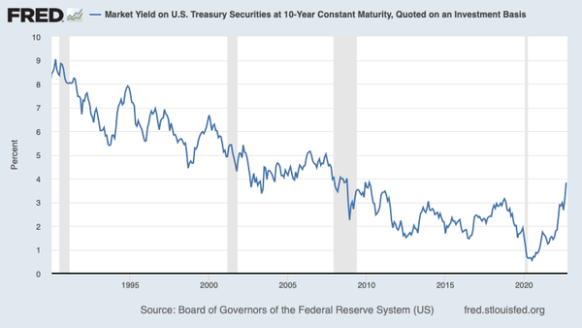
Some background: The low interest rates that prevailed just before the pandemic were the end point of a three-decade downward trend:

krugman041022_2-articleLarge

What do we think caused that trend? Some commentators say that it was artificial, that the Fed kept pushing rates down by printing money. But basic macroeconomics says that this shouldn’t be possible: If you keep rates artificially low for an extended period, the result should be high inflation. And until the price surge of 2021-22, inflation stayed subdued year after year.

A useful concept here, going back more than a century to the work of the Swedish economist Knut Wicksell, is that of the so-called “natural rate of interest”. Wicksell defined the natural rate either as the interest rate that matched saving with investment or as the rate consistent with overall price stability. These definitions are actually consistent with each other: An interest rate that is too low, so that investment spending exceeds the supply of savings, will cause inflationary overheating of the economy.

And the fact that we didn’t see inflationary overheating over the course of a 30-year trend of falling interest rates suggests that the decline wasn’t artificial — that the natural rate must have been falling over that period.

Why might the natural rate have declined? The most likely culprit is a decline in investment demand, driven by a combination of demographic and technological stagnation.

The key insight is that investment spending is driven in large part by growth — growth in the number of workers and in technological progress. A growing labor force needs more office space, more houses, and so on; a stagnant work force only needs to replace structures and equipment as they wear out. Technological progress can also contribute to investment by making it worthwhile to replace outmoded capital goods, and also by making people richer so they can demand more living space, and so on; if technological progress slows down, investment spending tends to fall.

Since the 1990s, both of these drivers of investment lost a lot of their momentum.

Once the last of the baby boomers reached their mid-20s, the number of Americans in their prime working years, which had risen rapidly for decades, flattened out:

This demographic downturn was even stronger in other wealthy countries. The working-age population in Europe has been declining since 2010, and it has fallen in Japan at a fairly rapid clip.

Technological change is harder to pin down, but it’s difficult to escape the sense that major innovations are becoming increasingly rare…. And for what it’s worth, estimates of total factor productivity, a measure meant to capture the economy’s overall technological level, have grown slowly since the mid-2000s:

So is there any reason to expect either demography or technology to be more favorable for investment in, say, 2024 than they were in 2019? I don’t see it.

It’s true that there has been a lot of recent technological progress in green energy, and it’s possible that an energy transition, helped by Joe Biden’s climate policies, will contribute to investment in the years ahead. But that aside, the same factors that kept interest rates low before the pandemic still seem to be in place.

What about inflation? Another old principle in thinking about interest rates is the Fisher effect, which implies that an increase in expected inflation should normally lead to an equal rise in interest rates. And inflation has spiked in the past year and a half.

That spike is, however, probably temporary. There’s a huge amount to say about inflation, but the 30,000-foot view goes like this: During the pandemic slump, governments gave households huge amounts of aid to maintain their incomes in the face of economic lockdowns. This meant that consumer purchasing power remained high despite a temporary reduction in productive capacity, causing a surge in prices — and leading central banks to hike rates to bring inflation back down.

But there doesn’t seem to be much question about whether they will, in fact, control inflation. Certainly, financial markets expect inflation to revert to pre-pandemic norms:

In summary, then, low interest rates weren’t artificial; they were natural. And it’s hard to see anything that will cause the natural rate to rise once the current inflation spike is over. So the era of low interest rates probably isn’t over after all.

Unquote.

Prof. Krugman may be underestimating the effect of progress in green technologies and how much work will be needed in order to implement them. He may be underestimating the effects of the worsening climate crisis. Or advances in artificial intelligence or biotechnology or nuclear fusion. Or the benefits of advanced technologies given to us by visitors from another world. 

But if the recent trend continues, interest rates will go down again. Since interest rates affect both borrowing and saving, and thereby the world’s economy, that’s interesting.

His Future and Ours

Salon interviewed George Conway, a Republican lawyer married to the infamous Kellyanne Conway (press secretary in the former administration) and who became known as an ex-Republican critic of the ex-president. I had a reaction to his closing comments.

How do we balance political expediency versus legal necessity? The law takes time, but [the former president] is an imminent danger to American society right now. Something needs to be done, and we are running out of time. 

At the end of the day, we have to follow the legal system and apply it evenhandedly — but that should be done as expeditiously as possible. The Justice Department has clearly come around to that understanding. They are now expanding their investigations of Jan. 6, [his] other alleged crimes and related matters at the highest levels. I don’t think it’s going to take them very long to put together a case on the classified documents. And I don’t think they have a choice, even if they wanted to resist prosecuting him. It’s going to be sooner rather than later. [He] could easily be under both federal and state indictment at some point between Election Day [Nov. 8] and New Year’s Day.

What do you think is going to happen with these criminal cases? Does he take a plea bargain? There’s this fantasy among some liberal folks that [he] does a perp walk and goes to prison. I don’t see that happening. If anything, [he] pays fines and takes a plea deal. Merrick Garland and the Department of Justice will not put a former president in prison. 

I don’t believe that [he] is going to plea bargain. I think he could go to prison, but it is more likely that he will serve home confinement. In all likelihood, he will be convicted of multiple felonies. I don’t know if there’s ever going to be a perp walk, but I don’t think it’s a fantasy either. There’s a good chance that [he] will end up with a felony conviction. I know he has cut deals in civil cases, but that’s just writing checks. To reiterate, I do not believe that [he] will plead out. This all goes so much to the core of [his] identity that he will try to tear the country apart before he settles one of these criminal cases.

That is a powerful statement. 

[He] will incite violence on his behalf. He will try to pretend it is something spontaneous. Does [he] have enough power and influence over his followers to threaten the republic? I don’t think so. But I do think it’s enough to be dangerous.

What are you most concerned about? And what, if anything, are you hopeful about, regarding the country’s future?

What keeps me up at night is the violence that [he] could potentially cause. The danger of violence will increase as the 2024 election approaches. What gives me hope is that the legal reckoning is coming…. I am hopeful that the American people will be so exhausted by this whole saga that they will be drawn toward all the things that tie us together as a nation and people. Of course we may disagree with one another, and do so passionately. But in the end we are all Americans, and we have more in common than divides us. I hope we can get back to that and heal….

First, nothing keeps me up at night except the desire to stay up.

More importantly, when the former president is finally indicted somewhere, the authorities will let him show up with his lawyers and hear the charges. He won’t ever be in handcuffs or a cell. If he accepts a deal or is convicted, he’ll get house arrest, not prison, and then may leave the country.

Right-wing violence is always a threat (much more than left-wing or Islamic violence) but my biggest short-term concern is that Republicans will do well-enough in upcoming elections, either legally or illegally (by ignoring the results), that — with the help of radical reactionaries on the Supreme Court — they’ll consolidate minority rule. They’ll change the laws in enough states to make it very hard for them to lose (and the laws to be changed back). Add that to their built-in advantages in the Senate and Electoral College and elections won’t matter much.

The only hope I have is that once enough members of my generation die off, fewer voters will watch network or cable TV and be misled by right-wing and corporate propaganda or local news that “leads with what bleeds”.

My longer-term concern (although it becomes shorter all the time) is the climate crisis and the many ways a warmer climate will affect life on Earth. But it doesn’t keep me up at night.

On that subject, however, here’s an article from the MIT Press called “How to Fix Climate Change (A Sneaky Policy Guide)”:

We may already have a “miracle” fix for climate change. [It’s] a planetary emergency. We have to do something now — but what? Saul Griffith, an inventor and renewable electricity advocate (and a recipient of a MacArthur “genius” grant), has a plan. In his book “Electrify,” Griffith lays out a detailed blueprint for fighting climate change while creating millions of new jobs and a healthier environment. Griffith’s plan can be summed up simply: Electrify everything. He explains exactly what it would take to transform our infrastructure, update our grid, and adapt our households to make this possible. Billionaires may contemplate escaping our worn-out planet on a private rocket ship to Mars, but the rest of us, Griffith says, will stay and fight for the future….
.

Connecting Global Dots

Josh Marshall of Talking Points Memo looks at the big picture: 

It’s interesting to step back sometimes and consider … our times. Today we have our ongoing battle over democracy and authoritarianism in the U.S. The UK is in its latest stage of its ongoing national self-immolation. Italy has just elected its first far-right government since Benito Mussolini’s rise to power in the early 1920s. Russia, which has made itself into the international clarion of rightist nationalism, is stumbling through a succession of largely self-inflicted catastrophes in its war of choice in Ukraine.

Let’s go back to the Arab Spring. The Arab Spring unsettles or topples governments across the Arab Middle East. But it triggers long-running civil wars in Syria and Libya. The first especially, but also the second, are the main drivers of the European Union migrant crisis of 2015, in which some 1.3 million refugees/migrants requested asylum in the EU, the most in any single year since World War II. Given the closeness of the vote and the great focus on the migrant crisis in 2015 and 2016, it’s very hard to imagine the UK leaves the European Union without this chain of events … beginning in December 2010.

Less obvious is that you can make a looser but I think still fairly persuasive argument that these events play a key role in the rise of [MAGA-ism] in the United States….The rise of [MAGA-ism] is part of a long progression within the United States. [However, their leader’s] particular platform — to the extent you can call it that — focused on “the wall” and immigrants from Mexico and Central America….

But there’s a somewhat different commonality I am focusing on.

The [reactionary] right is, paradoxically, highly internationalized if not internationalist. There’s a deep confluence and sharing of ideas, imagery and programs between the U.S. and Europe. The narratives of “our out of control migration” and white Christian cultures under threat was a common, interwoven and reinforcing pattern on both sides of the Atlantic….

These are of course only the barest thumbnail outlines of recent history and its relationship to the present…. Why this interests me is that migration flows and their intensity are going to increase over time. The most basic reason is climate. Our potential climate futures range from really bad to truly catastrophic. But anywhere on that spectrum you have lots of people trying to move from places that are less habitable than they used to be or are in the throes of political and economic instability for those same reasons. Telecommunications and transport technology greatly accelerate that process.

A century ago a poor peasant in India or Ecuador may have known in a general way that there were vastly richer societies in Europe and North America. But they couldn’t really know the details and it was close to impossible to get there anyway. Today, almost everyone in the world can see through electronic media how people live in Europe, North America, and other parts of the affluent world and — though it’s hard and often dangerous — it is possible to get there.

What we can draw from this is that the accelerating patterns of global migration which are so central to the politics of the last decade and have helped reshape politics in Europe and North America will almost certainly continue to intensify.