The truth unquestionably is, that the only path to a subversion of the republican system of the Country is, by flattering the prejudices of the people, and exciting their jealousies and apprehensions, to throw affairs into confusion, and bring on civil commotion…
When a man unprincipled in private life desperate in his fortune, bold in his temper, possessed of considerable talents, having the advantage of military habits—despotic in his ordinary demeanour—known to have scoffed in private at the principles of liberty—when such a man is seen to mount the hobby horse of popularity—to join in the cry of danger to liberty—to take every opportunity of embarrassing the General Government & bringing it under suspicion—to flatter and fall in with all the non sense of the zealots of the day—It may justly be suspected that his object is to throw things into confusion that he may “ride the storm and direct the whirlwind.”
… No popular Government was ever without its Catalines & its Cæsars. These are its true enemies.
Unquote.
From “Objections and Answers respecting the Administration of the Government”, August 18, 1792, available at Founders Online.
This is the English novel that begins: “The past is a foreign country: they do things differently there”. It tells the story of a boy named Leo who spends the summer of 1900 at the home of a wealthy friend. Without understanding the significance of his role, Leo begins delivering messages between his friend’s unmarried sister and a local farmer. He is told that the messages are secret and pertain to “business”, but of course there’s more to it than that.
The novel, published in 1953, was the basis for an excellent movie of the same name that starred Julie Christie and Alan Bates. It’s beautifully written, if a little verbose at times. The only odd thing about it is that it’s in the form of a memoir, as if the grownup Leo is describing events of 50 years ago. Since no normal person could possibly remember what happened that long ago in such detail, we have to assume that the narrator is unreliable or it’s a case of extreme artistic license.
Every now and then, you might find yourself wondering “What’s the deal with these people?” Why are four Republican Congressmen sponsoring a bill that would abolish the Environmental Protection Agency? Why does the President think financial advisers should be free to give advice that favors themselves, not their clients? Why did a wealthy relative of mine strongly resent paying taxes for public schools?
Paul Waldman, writing in The Washington Post, nicely explains the guiding principle behind actions and attitudes like these:
President [D]rump is not an ideologue — not because he’s open-minded, but because he has little in the way of particular beliefs about policy. He does, however, have impulses, inclinations and prejudices. House Speaker Paul Ryan (R-Wis.), on the other hand, is an ideologue, as are many if not most of his compatriots in Congress.
Put that Congress and this White House together, and you get a Republican government with a clear and coherent ideology, one you can sum up in a short declarative statement:
You’re on your own.
This is the driving principle behind nearly everything the Republicans are trying to do in domestic affairs…
He then offers examples. They make very interesting reading if you’ve been trying to understand how people like Drump and Ryan manage to consistently choose the wrong side of every issue.
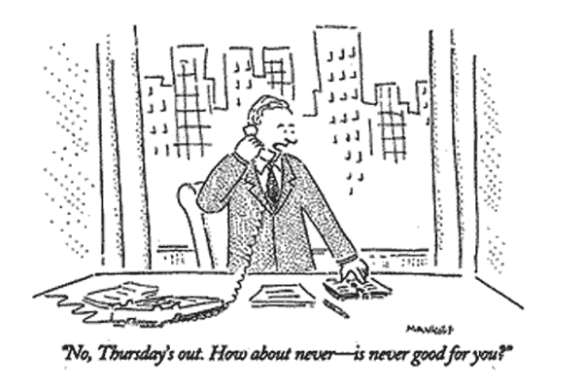
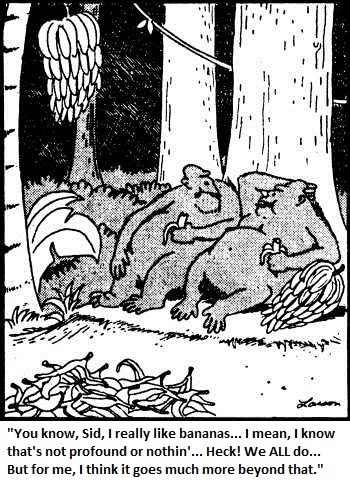
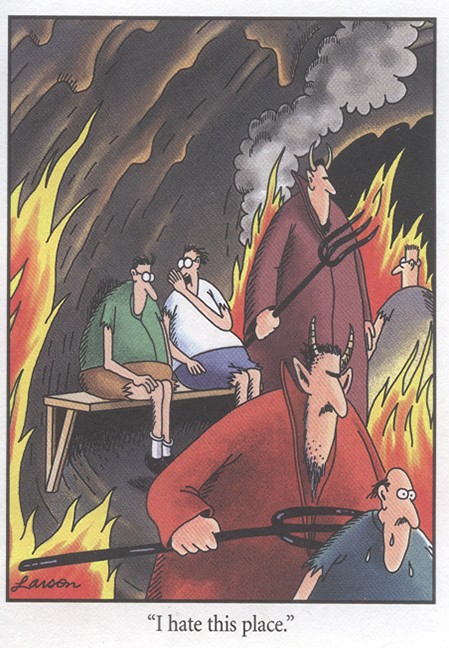
There were four cartoons on the bulletin board in my office for many years, back when I was paid to help the wheels of finance capitalism turn. Maybe there was a theme that united them. Of course, not everyone liked them as much as I did.
The first one was by Bob Mankoff, the cartoon editor of The New Yorker, who recently announced he’s leaving that job. It’s the most famous one he drew.
The other three were by Gary Larson, who drew The Far Side for 15 brilliant years.
So is there a theme here? We have a businessman subverting standard practice; a gorilla who sees himself as more complex than his peers; someone in a horrible situation who thinks it’s worth stating the obvious but is afraid he might make things even worse; and two spiders with very high hopes doomed to failure.
It was a “successful” career, but no wonder I still have bad dreams about the place.
Thales of Miletus is generally credited with being “the first philosopher in the Greek tradition [and] as the first individual in Western civilization known to have entertained and engaged in scientific philosophy” (Wikipedia). Less formally, he’s known as the ancient Greek who thought everything is made of water.
But that wasn’t a crazy idea at the time:
Thales [c. 624 – c. 546 BC] is recognized for breaking from the use of mythology to explain the world and the universe, and instead explaining natural objects and phenomena by theories and hypothesis, i.e. science. Almost all the other Pre-Socratic philosophers followed him in explaining nature as deriving from a unity of everything based on the existence of a single ultimate substance, instead of using mythological explanations. Aristotle reported Thales’ hypothesis that the originating principle of nature and the nature of matter was a single material: water (Wikipedia).
Jumping forward around 2,500 years, we’re still trying to figure out what everything is made of. If you’d asked me a few days ago, and given me a few seconds to think about it, I’d probably have said everything is made of very tiny particles like quarks and photons:
Fortunately, however, the scales have been lifted from my eyes. All it took was watching a lecture by a physicist named David Tong. It’s called “Quantum Fields: The Real Building Blocks of the Universe”. Here’s how he explains the situation on his University of Cambridge webpage:
Fields
We learn in school that the basic building blocks of matter are particles. In fact, we often continue to teach this in universities where we explain that quarks and electrons form the lego-bricks from which all matter is made.
But this statement hides a deeper truth. According to our best laws of physics, the fundamental building blocks of Nature are not discrete particles at all. Instead they are continuous fluid-like substances, spread throughout all of space. We call these objects fields.
The most familiar examples of fields are the electric and magnetic field. The ripples in these fields give rise to what we call light or, more generally, electromagnetic waves. The field [relating to a magnet is shown here].
From Fields to Particles
If you look closely enough at electromagnetic waves, you’ll find that they are made out of particles called photons. The ripples of the electric and magnetic fields get turned into particles when we include the effects of quantum mechanics.
But this same process is at play for all other particles that we know of. There exists, spread thinly throughout space, something called an electron field. Ripples of the electron field get tied up into a bundle of energy by quantum mechanics. And this bundle of energy is what we call an electron. Similarly, there is a quark field, and a gluon field, and Higgs boson field. Every particle your body — indeed, every particle in the Universe — is a tiny ripple of the underlying field, moulded into a particle by the machinery of quantum mechanics.
These fields fill the universe, even what seems to be empty space. All of the particles the physicists have identified are manifestations of these fields. In some sense, apparently, so are we.
Prof. Tong gave his lecture at the Royal Institution in London in November. It’s an hour-long introduction to Quantum Field Theory for the general public. He’s an entertaining speaker and, as an added bonus, he looks and sounds a lot like the comedian John Oliver.
If you want to jump ahead a little, it’s about nine minutes in when he announces that:
The best theories we have tell us that the fundamental building blocks of nature are not particles but something much more nebulous and abstract. The fundamental building blocks of nature are fluid-like substances which are spread throughout the entire universe and ripple in strange and interesting ways. That’s the fundamental reality in which we live. These fluid-like substances, we have a name for, we call them “fields”.
Have fun. After this, you may never see the world in the same way.
(Hmm, notice how I didn’t mention You Know Who once? This should not suggest that anything is back to normal yet. Far from it.)


You must be logged in to post a comment.