Touching a Nerve: Our Brains, Our Selves by Patricia S. Churchland

Patricia Churchland is a well-known professor of philosophy. She is married to another well-known professor of philosophy, Paul Churchland. The Churchlands were profiled in The New Yorker in 2014 in an article called “Two Heads: A Marriage Devoted to the Mind-Body Problem”. They are both associated with a philosophical view known as “eliminative materialism”. Very briefly, it’s the idea that we are mammals, but with especially complex mammalian brains. and that understanding the brain is all we need in order to understand the mind. In fact, once we understand the brain sufficiently well, we (or scientists anyway) will be able to stop using (eliminate) common mental terms like “belief” and “desire” and “intention”, since those terms won’t correspond very well to what actually goes on in the brain.

So when I began reading Touching a Nerve, I expected to learn more about their distinctive philosophical position. Instead, Prof. Churchland describes the latest results in neuroscience and explains what scientists believe goes on in the brain when we live our daily lives, i.e. when we walk around, look at things, think about things, go to sleep, dream or suffer from illnesses like epilepsy and somnambulism. She admits that we still don’t understand a lot about the brain, but points out that neuroscience is a relatively new discipline and that it’s made a great deal of progress. I especially enjoyed her discussion of what happens in the brain that apparently allows us to be conscious in general (not asleep and not in a coma) vs. what happens when we are conscious of something in particular (like a particular sound), and her reflections on reductionism and scientism, two terms often used as pejoratives but that sound very sensible coming from her.

The closest she comes to mentioning eliminative materialism is in the following passage, when she seems to agree (contrary to my expectations given what I knew about the Churchlands) that common mental terms won’t ever wither away:

If, as seems increasingly likely, dreaming, learning, remembering, and being consciously aware are activities of the physical brain, it does not follow that they are not real. Rather, the point is that their reality depends on a neural reality… Nervous systems have many levels of organization, from molecules to the whole brain, and research on all levels contributes to our wider and deeper understanding [263].

I should also mention that the professor shares a number of stories from her childhood, growing up on a farm in Canada, that relate to the subject of the book. She also has an enjoyable style, mixing in expressions you might not expect in a book like this. For example, she says that reporting scientific discoveries “in a way that is both accurate and understandable” in the news media “takes a highly knowledgeable journalist who has the writing talent to put the hay down where the goats can get it” [256].

Here is how the book ends [266]:

Bertrand Russell, philosopher and mathematician, has the last word:

“Even if the open windows of science at first make us shiver after the cozy indoor warmth of traditional humanizing myths, in the end the fresh air brings vigor, and the great spaces have a splendor of their own.”

Rock on, Bertie.
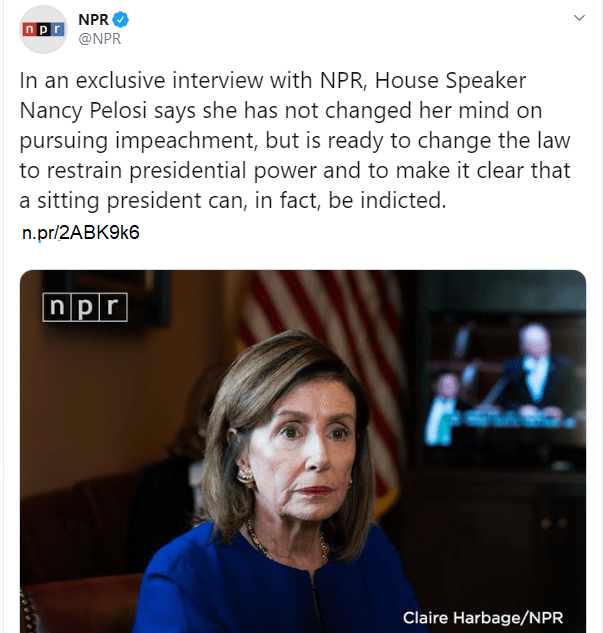
It’s Real Easy To Email Nancy

How about letting her know how you feel about impeachment? It’s so easy to send her an email. Simply click here.

A Bright Spot on the Distant Horizon?

Things are not getting better in Washington. To put it mildly. The T@@@p administration continues to resist any congressional oversight. Democrats direct witnesses to appear, sometimes issue subpoenas, the administration refuses to cooperate and the disputes vanish into the glacially-slow bowels of the federal courts.

The Treasury Department has refused to give the president’s tax returns to Congress, as required by law. The Director of National Intelligence is refusing to transmit a whistle blower’s complaint to Congress, even though it pertains to national security and the law says Congress shall receive it. The Judiciary Committee finally got a T@@@p associate to appear yesterday and it got very little coverage, even though the witness confirmed that the president obstructed justice. There is now more evidence that the administration’s last appointment to the Supreme Court lied to Congress and the FBI’s vetting investigation was a sham. The leading Democrat in the Senate doesn’t want to talk about it.

Congressional committees can hold people in contempt and fine them thousands of dollars a day or put them in jail. They have gone to court instead. The Speaker of the House could create a special committee devoted to impeaching the president, but she resists even saying the word “impeachment”. Meanwhile, the Judiciary Committee’s impeachment inquiry is just one item on their agenda. They may have another hearing next week.

Meanwhile, the president is using money Congress appropriated for the Defense Department to build his wall. It’s going to damage environmentally-sensitive areas along the border. The Justice Department is investigating automakers because they agreed with the state of California to protect air quality. Now the president wants to remove California’s ability to set its own air quality standards, as California has been permitted to do for decades. T@@@p is also threatening to round up homeless people in Los Angeles and put them who knows where, even though he has no authority to do so. His Immigration and Customs Enforcement police force is training for urban warfare. And there may be war around the Persian Gulf.

There are too many scandals and other offenses for most mortals to keep track of. Unlike Hillary’s emails, which were beaten to death, journalists and pundits jump from one topic to the next. Los Angeles writer Amy Siskind continues to document as much as she can at The Weekly List, but there is too much to digest (if you’re interested, she accepts small donations to support her work).

So is there a bright spot on the horizon? Here’s a hint.

EErknsGXYAULWGSgettyimages-1168719088merlin_160921611_f00988a6-ab58-471d-92d4-cc721bc3810c-jumbomerlin_160921593_4121a1d9-ed39-4363-bc05-36f6443a5267-jumbo

She gave a speech in New York this week. Up to 20,000 people attended. She called for big, structural change to address the corruption in our politics (she called our president “corruption in the flesh”). She believes that corruption is the fundamental reason Washington doesn’t work for average people. She spent four hours after the speech having her picture taken with a very long line of people. When complimented on her stamina, she said she stayed for four hours but so did the last guy in line. Polls now show her in second place for the Democratic nomination. The latest poll in Iowa, where the first votes will be cast, has her in the lead. Her campaign slogan is “Dream Big, Fight Hard”. She’ll make a great president if we make it that far.

Checking In With Krugman

Prof. Paul Krugman summarizes where things stand with the economy and Our Dear Leader.

[DT] marked the anniversary of 9/11 by repeating several lies about his own actions on that day [Note: the New York Times cowardly referred to them as “exaggerations”]. But that wasn’t his only concern. He also spent part of the day writing a series of tweets excoriating Federal Reserve officials as “Boneheads” and demanding that they immediately put into effect emergency measures to stimulate the economy — emergency measures that are normally only implemented in the face of a severe crisis.

Trump’s diatribe was revealing in two ways. First, it’s now clear that he’s in full-blown panic over the failure of his economic policies to deliver the promised results. Second, he’s clueless about why his policies aren’t working, or about anything else involving economic policy.

Before I get to the economics, let’s talk about one indicator of Trump’s cluelessness: his remarks about federal debt.

In addition to demanding that the Fed cut interest rates below zero, Trump declared that “we should then start to refinance our debt,” because “the USA should always be paying the lowest rate.” Observers were left scratching their heads, wondering what he was talking about.

Actually, however, it’s fairly obvious. Trump thinks that federal debt is like a business loan, which you can pay down early to take advantage of lower interest rates. He’s clearly unaware that federal debt actually consists of bonds, which can’t be prepaid (which is one reason interest rates on federal debt are always lower than, say, rates on home mortgages). That is, he imagines that the government’s finances can be managed as if the U.S. were a casino or a golf course, and it never occurred to him to ask anyone at Treasury whether that’s how it works.

But back to the economy. Why is Trump panicking?

After all, while the economy is slowing, we’re not in a recession, and it’s by no means clear that a recession is even on the horizon. There’s nothing in the data that would justify radical monetary stimulus — stimulus, by the way, that Republicans, including Trump, denounced during the Obama years, when the economy really needed it.

Furthermore, despite Trump’s claims that the Fed has somehow done something crazy, monetary policy has actually been looser than Trump’s own economic team expected when making their rosy forecasts.

In the summer of 2018 the White House’s economic projections envisioned that this year three-month interest rates would average 2.7 percent, while 10-year rates would be 3.2 percent. The actual rates as I write this are 1.9 and 1.7 percent, respectively.

But while there’s no economic emergency, Trump apparently feels that he’s facing a political emergency. He expected a booming economy to be his big winning issue next year. If, as now seems likely, economic performance is mediocre at best, he’s in deep trouble.

Remember, Trump’s two signature economic policies were his 2017 tax cut and his rapidly escalating trade war with China. The first was supposed to lead to a decade or more of rapid economic growth, while the second was supposed to revive U.S. manufacturing.

In reality, however, the tax cut delivered at most a couple of quarters of higher growth. More specifically, huge tax breaks for corporations haven’t delivered the promised surge in wages and business investment; instead, corporations used the windfall to buy back stocks and pay higher dividends.

At the same time, the trade war has turned out to be a major drag on the economy — bigger than many people, myself included, expected. Until last fall the general expectation was that Trump would deal with China the way he dealt with Mexico: make a few mainly cosmetic changes to existing arrangements, claim victory, and move on. Once it became clear that he was really serious about confrontation, however, business confidence began falling, dragging investment down with it.

And voters have noticed: Trump’s approval rating on the economy, while still higher than his overall approval, has started to decline. Hence the panicky demands that the Fed pull out all the stops.

But while Trump realizes that he’s in trouble, there’s no indication that he understands why [Note: Prof. Krugman is being unnecessarily polite]. He’s not the kind of person who ever admits, even to himself, that he made mistakes; his instinct is always to blame someone else while doubling down on his failed policies.

Even actions that look like a slight policy softening, like his announcement of a two-week delay in implementing some China tariffs, betray a deep incomprehension of the problem — which has as much to do with his capriciousness as with the tariffs per se. Policy zigzags, even if they involve delaying tariffs, just add to the will-he-or-won’t-he uncertainty that’s causing companies to put investment on hold.

So what happens next? Trump could reverse course, and do what most people expected a year ago, reaching a deal with China that more or less restores the status quo. But that would be a de facto admission of defeat — and at this point it’s not clear why the Chinese would trust him to honor any such deal past Election Day.

Unquote. “It’s not clear why the Chinese would trust him” is an understatement of cosmic proportions.

American Cosmic: UFOs, Religion, Technology by D. W. Pasulka

I don’t know what to make of this book. The author is a professor in the Philosophy and Religion Department at the University of North Carolina, Wilmington. The book was published by Oxford University Press. It’s received positive reviews in a number of reputable publications.

For the most part, Professor Pasulka treats the subject of UFOs or “unidentified aerial phenomena” from a scholarly perspective. She says the book is “about contemporary religion, using as a case study the phenomenon known as the UFO. It is also about technology” [1], in particular, how technology can affect the development of religion. A well-known example is how the printing press allowed the the mass production of Bibles in languages other than Latin. Widespread use of that powerful new technology contributed greatly to the Protestant Reformation. Based on her research, she believes there is a “widespread and growing religiosity focused on UFOs”, not only because of evidence or testimony regarding UFOs, but because the mass media (especially TV shows and movies) have convinced millions of people that UFOs represent highly-advanced technology, possibly of extraterrestrial origin.

To further her argument, she points out that religious references to supernatural events and entities often sound just like contemporary reports of strange phenomena in the skies and visitations from otherworldly beings. She argues that people who report contact with extraterrestrials are often greatly affected, in the same way that figures from religious history who reported visions (of the Virgin Mary, for example) were said to be affected.

I’m not sure there really is “widespread and growing religiosity focused on UFOs”. Maybe there will be one day. But I don’t think it’s going to happen unless more evidence is provided. One of the problems with American Cosmic is that the scientists and technologists who speak to the author about their beliefs aren’t identified. She says there is a significant group of well-known, extremely successful individuals who are convinced we are being visited by beings from other worlds or other dimensions. Some of them believe these beings are helping us make technological progress, rather like the mysterious black monoliths did in 2001: A Space Odyssey.

Unfortunately, these respected researchers apparently insist on remaining anonymous out of fear that their professional reputations will suffer. So when Professor Pasulka tells us how she visited a secret location in the New Mexico desert in the company of one of these world-famous researchers, and that they found an artifact there, which other scientists later determined was “so anomalous as to be incomprehensible”, which “could not have been generated or created on Earth”, which “could not have been made in this universe”, we  are asked to take her word for it [240].

I didn’t find the parts of the book dealing with the relationship between religion and technology, or the detailed biographies of various researchers, very interesting. The descriptions of UFO sightings and bizarre visitations, however, were interesting in the way that good science fiction can be interesting. I didn’t come away convinced that all of the incredible stories are true. On the other hand, when you read stories in the New York Times or see something like this on CNN, who knows? (Note: the CNN story features the dangerous clown who lives in the White House for a few seconds at the end. Just a warning.)