One Way To Return To Work and School

Three professors think there is a good way for people to start going back to work and school. Their suggestion is partly based on how long people who get the virus usually become contagious, which is three days on average.

First, the population would be divided into two groups — like our cars were divided into two groups by odd and even license plates when OPEC made trouble in the 1970s and it was very hard to buy gas.

Grouping could be done using the first letter of everyone’s last name, such as A to L and M to Z. Doing the groups that way would give the members of a family the same schedule (of course, there would have to be flexibility to handle special cases).

Each group would then go to work or school on a schedule of four days on, ten days off. Group A to L would start work on a Monday, work four days, then take off ten days. Group M to Z would go to work or school the following Monday, work four days and then take off.

The result would be that people would be at work or school 40% of the time: four days instead of the usual ten every two-weeks (of course, there would have to be flexibility again, one reason being that somebody has to mind the store or the police station on Fridays and weekends).

Working or being educated would still be possible during our ten days “off” at home. The totally unemployed would be working part-time. The point is that we’d be taking a step toward a more normal existence for most people.

When I read the professors’ article, I wondered why they chose a four-day schedule if people are usually contagious after three days. Aside from how four days fits nicely into the fourteen days of two weeks, they believe that getting sick would be unlikely even if people were in close contact and someone became contagious at the beginning of the four days. They did some math:

Models we created at the Weizmann Institute in Israel predict that this two-week cycle can reduce the virus’s reproduction number — the average number of people infected by each infected person — below one. So a 10-4 cycle could suppress the epidemic while allowing sustainable economic activity.

More from the article:

Even if someone is infected, and without symptoms, he or she would be in contact with people outside their household for only four days every two weeks, not 10 days, as with a normal schedule. This strategy packs another punch: It reduces the density of people at work and school, thus curtailing the transmission of the virus.

The cyclic strategy is easy to explain and to enforce. It is equitable in terms of who gets to go back to work. It applies at any scale: a school, a firm, a town, a state. A region that uses the cyclic strategy is protected: Infections coming from the outside cannot spread widely if the reproduction number is less than one. It is also compatible with all other countermeasures being developed.

Workers can, and should still, use masks and distancing while at work. This proposal is not predicated, however, on large-scale testing, which is not yet available everywhere in the United States and may never be available in large parts of the world. It can be started as soon as a steady decline of cases indicates that lockdown has been effective.

The cyclic strategy should be part of a comprehensive exit strategy, including self-quarantine by those with symptoms, contact tracing and isolation, and protection of risk groups. The cyclic strategy can be tested in limited regions for specific trial periods, even a month. If infections rates grow, it can be adjusted to fewer work days. Conversely, if things are going well, additional work days can be added. In certain scenarios, only four or five lockdown days in each two-week cycle could still prevent resurgence.

The coronavirus epidemic is a formidable foe, but it is not unbeatable. By scheduling our activities intelligently, in a way that accounts for the virus’s intrinsic dynamics, we can defeat it more rapidly, and accelerate a full return to work, school and other activities.

Two Charts (Signs of the Times)

This first one is hard to believe. The rate on the government’s 10-year Treasury bond is around 0.70%. That’s the lowest it’s been for more than 150 years. Whoever buys one of these bonds is basically giving the government an interest-free loan, money the government could use to help people who’ve lost their jobs, small businesses that have lost their customers and local governments that are spending more and collecting less in taxes because of the virus.

Untitledrate

This second chart is easy to believe. It shows confirmed Covid-19 cases per million people. Although the president and his cronies claim that America’s response to the virus has been “spectacular”, compared to a country with a competent national government, South Korea, our response has been spectacularly bad. We’re the red line. South Korea is the blue.

EXmSXioXsAA1wph

Getting Ahead of Themselves

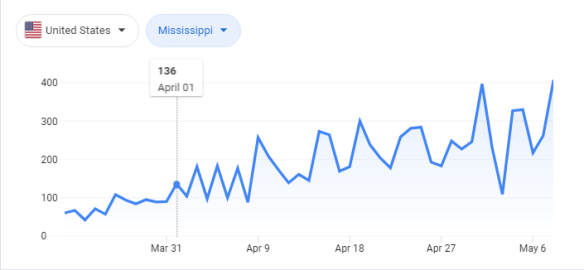
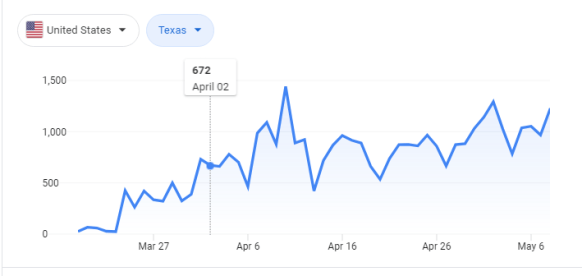
As pressure builds to “reopen” America, it should be noted that if you remove the New York metropolitan area (which includes northern New Jersey) from the statistics, the number of Covid-19 cases is increasing. The New York metro area has been hit the hardest and is now showing improvement. But the situation is getting worse elsewhere, including states where Republican politicians are eager to move past all this unpleasantness.

ScreenHunter_3952-May.-09-19.12 (1)

Here are the trend lines for four states with right-wing governors in thrall to Dear Leader:

ArizonaMissNebraskaTexas

From Andy Slavitt, former administrator of Medicare and Medicaid:

Like many countries, we picked a strategy to beat COVID-19. We just decided not to stick to it. It’s a long and difficult road, and after we climbed halfway we decided it was too hard and chose to roll back down the hill.

There is, however, a plan to slowly and steadily bring the economy back, but only by solving the public health crisis. It was put forward by [the] White House all of three weeks ago. It had gates and stages, and hinged on conditions on the ground. But none of the conditions have been met.

Rather than wait, [the Toddler] grew impatient. He wants life to go back to the way it was before the pandemic. He wants the economy growing. [He wants to be re-elected, not judged a “loser”!]

Our expectations are simple. The truth, no matter how hard. To know that our safety matters. A plan which uses all our tools and best thinking that we stick with. Candor in discussing the tough trade offs.

We’re not getting that.

Instead, in Slavitt’s words, we’ll get:

… a food fight between the hardened realists who can tolerate death to “get our country back”, and the “public health mafia who are willing to kill the economy for the sake of a few people who will die soon anyway.” And if those people say that the death toll is going to be big, they’re just alarmists.

Many in the news media will present this as one more political controversy requiring balance between “both sides”. Dana Milbank of The Washintgon Post sees it as something else:

This is state-sanctioned killing. It is a conscious decision to accept 2,000 preventable deaths every day, because our leaders believe the victims [will be] poor schlubs who work in meat-processing plants… It is deliberately sacrificing the old, factory workers, and black and Hispanic Americans, who are dying at higher rates….

All we can do is pray for a vaccine breakthrough and hope summer weather helps. That’s because our president abandoned the fight. [He] can lie all he likes about the adequacy of testing and supplies, and blame his predecessor, his opponents and the media for his incompetence. It [won’t] matter to the virus.

Finally, some not exactly optimism from Tom Tomorow:

Untitled

They Pity Us

The US response to the coronavirus crisis has been paralysed by a contradiction that the Republicans have inserted into the heart of US democracy. On the one hand, they want to control all the levers of governmental power. On the other, they have created a popular base by playing on the notion that government is innately evil and must not be trusted.

From Fintan O’Toole, who writes for The Irish Times (behind a paywall):

Over more than two centuries, the United States has stirred a very wide range of feelings in the rest of the world: love and hatred, fear and hope, envy and contempt, awe and anger. But there is one emotion that has never been directed towards the US until now: pity. [Note: There was pity after 9/11, but for a very different reason.]

However bad things are for most other rich democracies, it is hard not to feel sorry for Americans. Most of them did not vote for D—- T—- in 2016. Yet they are locked down with a malignant narcissist who, instead of protecting his people from Covid-19, has amplified its lethality. The country T—- promised to make great again has never in its history seemed so pitiful.

Will American prestige ever recover from this shameful episode? The US went into the coronavirus crisis with immense advantages: precious weeks of warning about what was coming, the world’s best concentration of medical and scientific expertise, effectively limitless financial resources, a military complex with stunning logistical capacity and most of the world’s leading technology corporations. Yet it managed to make itself the global epicentre of the pandemic.

As the American writer George Packer puts it in the current edition of the Atlantic, “The United States reacted … like Pakistan or Belarus – like a country with shoddy infrastructure and a dysfunctional government whose leaders were too corrupt or stupid to head off mass suffering.”

It is one thing to be powerless in the face of a natural disaster, quite another to watch vast power being squandered in real time – wilfully, malevolently, vindictively. It is one thing for governments to fail (as, in one degree or another, most governments did), quite another to watch a ruler and his supporters actively spread a deadly virus. T—-, his party and Rupert Murdoch’s Fox News became vectors of the pestilence.

The grotesque spectacle of the president openly inciting people (some of them armed) to take to the streets to oppose the restrictions that save lives is the manifestation of a political death wish. What are supposed to be daily briefings on the crisis, demonstrative of national unity in the face of a shared challenge, have been used by T—- merely to sow confusion and division. They provide a recurring horror show in which all the neuroses that haunt the American subconscious dance naked on live TV.

If the plague is a test, its ruling political nexus ensured that the US would fail it at a terrible cost in human lives. In the process, the idea of the US as the world’s leading nation – an idea that has shaped the past century – has all but evaporated…..

It is hard to remember now but, even in 2017, when T—- took office, the conventional wisdom in the US was that the Republican Party and the broader framework of US political institutions would prevent him from doing too much damage. This was always a delusion, but the pandemic has exposed it in the most savage ways.

What used to be called mainstream conservatism has not absorbed T—- – he has absorbed it. Almost the entire right-wing half of American politics has surrendered abjectly to him. It has sacrificed on the altar of wanton stupidity the most basic ideas of responsibility, care and even safety.

Thus, even at the very end of March, 15 Republican governors had failed to order people to stay at home or to close non-essential businesses. In Alabama, for example, it was not until April 3rd that governor Kay Ivey finally issued a stay-at-home order.

In Florida, the state with the highest concentration of elderly people with underlying conditions, governor Ron DeSantis, a T—- mini-me, kept the beach resorts open to students travelling from all over the US for spring break parties. Even on April 1st, when he issued restrictions, DeSantis exempted religious services and “recreational activities”.

Georgia governor Brian Kemp, when he finally issued a stay-at-home order on April 1st, explained: “We didn’t know that [the virus can be spread by people without symptoms] until the last 24 hours.”

This is not mere ignorance – it is deliberate and homicidal stupidity. There is, as the demonstrations this week in US cities have shown, plenty of political mileage in denying the reality of the pandemic. It is fuelled by Fox News and far-right internet sites, and it reaps for these politicians millions of dollars in donations, mostly (in an ugly irony) from older people who are most vulnerable to the coronavirus.

It draws on a concoction of conspiracy theories, hatred of science, paranoia about the “deep state” and religious providentialism (God will protect the good folks) that is now very deeply infused in the mindset of the American right.

T—- embodies and enacts this mindset, but he did not invent it. The US response to the coronavirus crisis has been paralysed by a contradiction that the Republicans have inserted into the heart of US democracy. On the one hand, they want to control all the levers of governmental power. On the other they have created a popular base by playing on the notion that government is innately evil and must not be trusted.

The contradiction was made manifest in two of [his] statements on the pandemic: on the one hand that he has “total authority”, and on the other that “I don’t take responsibility at all”. Caught between authoritarian and anarchic impulses, he is incapable of coherence.

But this is not just D—- T—-. The crisis has shown definitively that [his] presidency is not an aberration. It has grown on soil long prepared to receive it. The monstrous blossoming of misrule has structure and purpose and strategy behind it.

There are very powerful interests who demand “freedom” in order to do as they like with the environment, society and the economy. They have infused a very large part of American culture with the belief that “freedom” is literally more important than life. My freedom to own assault weapons trumps your right not to get shot at school. Now, my freedom to go to the barber (“I Need a Haircut” read one banner this week in St Paul, Minnesota) trumps your need to avoid infection.

Usually when this kind of outlandish idiocy is displaying itself, there is the comforting thought that, if things were really serious, it would all stop. People would sober up. Instead, a large part of the US has hit the bottle even harder.

And the president, his party and their media allies keep supplying the drinks. There has been no moment of truth, no shock of realisation that the antics have to end. No one of any substance on the US right has stepped in to say: get a grip, people are dying here.

That is the mark of how deep the trouble is for the US – it is not just that T—- has treated the crisis merely as a way to feed tribal hatreds but that this behaviour has become normalised. When the freak show is live on TV every evening, and the star is boasting about his ratings, it is not really a freak show any more. For a very large and solid bloc of Americans, it is reality.

And this will get worse before it gets better. T—- has at least eight more months in power… [He] will pump more hatred and falsehood, more death-wish defiance of reason and decency, into the groundwater. If a new administration succeeds him in 2021, it will have to clean up the toxic dump he leaves behind. If he is re-elected, toxicity will have become the lifeblood of American politics.

Either way, it will be a long time before the rest of the world can imagine America being great again.

[The same applies to this part of the world.]

The Plan Is To Have No Plan

From Jay Rosen, a journalism professor at New York University:

This is my read on what the government’s guidance and actions amount to…. My purpose in posting it is to challenge the American press to be a lot clearer in its descriptions.

The plan is to have no plan, to let daily deaths between one and three thousand become a normal thing, and then to create massive confusion about who is responsible— by telling the governors they’re in charge without doing what only the federal government can do, by fighting with the press when it shows up to be briefed, by fixing blame for the virus on China or some other foreign element, and by “flooding the zone with shit,” Steve Bannon’s phrase for overwhelming the system with disinformation, distraction, and denial, which boosts what economists call “search costs” for reliable intelligence.

Stated another way, the plan is to default on public problem solving, and then prevent the public from understanding the consequences of that default. To succeed this will require one of the biggest propaganda and freedom of information fights in U.S. history, the execution of which will, I think, consume the president’s re-election campaign. So much has already been made public that the standard script for a White House cover up (worse than the crime…) won’t apply. Instead, everything will ride on the manufacture of confusion. The press won’t be able to “expose” the plot because it will all happen in stark daylight. The facts will be known, and simultaneously they will be inconceivable.

“The plan is to have no plan” is not a strategy, really. Nor would I call it a policy. It has a kind of logic to it, but this is different from saying it has a design— or a designer. Meaning: I do not want to be too conspiratorial about this. To wing it without a plan is merely the best this government can do, given who heads the table. The manufacture of confusion is just the ruins of Trump’s personality meeting the powers of the presidency. There is no genius there, only a damaged human being playing havoc with our lives.Â