A few hours ago: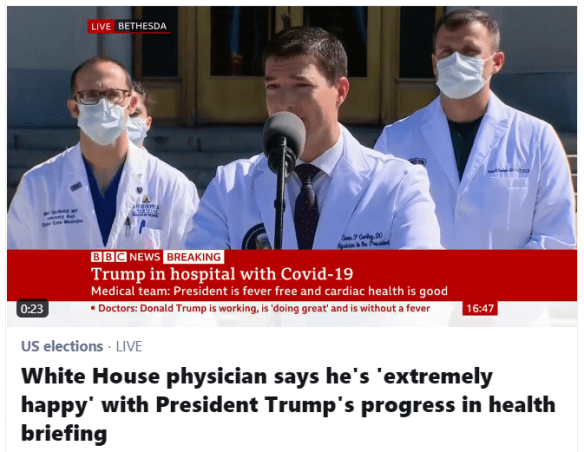
Fewer hours ago:

An hour ago:
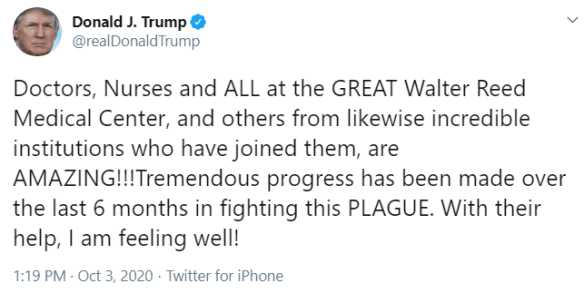
Previously, while in public:
It’s basically the flu.
Now that he has it:
It’s a PLAGUE.
A few hours ago:
Fewer hours ago:
An hour ago:
Previously, while in public:
It’s basically the flu.
Now that he has it:
It’s a PLAGUE.
At the Rose Garden event last Saturday when they introduced the Republican nominee to the Supreme Court:
Guests mingled, hugged and kissed on the cheek, most without wearing masks. An indoor reception followed the outdoor ceremony.
Seven days later, at least eight people who attended the ceremony have tested positive for the coronavirus, including the president. Several more of the president’s closest aides and advisers have also tested positive.
Then, our president got to work, spreading the joy:

Of course, we’re only heard about some of the famous people who got the virus in the Rose Garden, at the White House, on Air Force One, at the rally or the fundraisers, not the common folk who rubbed shoulders with the rich and famous, or provided security, or served the drinks.
We knew he was a heartless prick who only cares about himself, but I mean, wow.
Postscript: The White House doctor (i.e. public relations representative) has now “clarified” the timeline, explaining that when he said “72 hours” he meant “day three”, not “three days ago” (?). So it was actually Thursday night, after all the traveling about, when the president knew he had the virus, not Wednesday morning. Of course, everyone who speaks for the president can be trusted to deliver the unvarnished truth, so there’s nothing to see here. Obviously.
Our mail-in ballots arrived today. I’m wondering if I should vote for the candidate who’s a decent person with a substantial record of government service? Or his opponent, a horrible person with a history of deceit and fraud? Further down the ballot, should I vote for candidates who will help the next president achieve his goals or the ones who will do everything possible to make him fail? Hmm.
One reason to vote for Biden and members of his party is that, despite what many think, Democratic presidents have a better record on the economy than Republican presidents. Paul Krugman of the City University of New York and the New York Times explains:
[On Monday night], Joe Biden claimed that his tax and spending plans would create millions of jobs and promote economic growth. Txxxx claimed that they would destroy the economy.
Well, everything we know suggests that Biden was right and Txxxx wrong. And I’m not the only one saying this. Nonpartisan analysts like Moody’s Analytics and the not-exactly-socialist economists at Goldman Sachs are remarkably high on Biden’s proposals. . . .
There’s a widespread perception that Republicans are better than Democrats at managing the economy. But that’s not at all what the record says.
Yes, Ronald Reagan presided over a long economic expansion; but so did Bill Clinton, and the Clinton boom was both longer and bigger. The economy did in fact add many jobs under Txxxx before the coronavirus struck, but this simply represented the continuation of an expansion that began under Barack Obama.
And those were the good stretches. Both Bushes presided over really poor economic performance.
Republicans also have a long history of claiming that progressive policies would lead to economic disaster. They’ve been wrong every time.
They’ve been wrong about tax hikes: When Clinton raised taxes in 1993, Republicans confidently predicted recession, but what actually happened was a huge boom. When California raised taxes under Jerry Brown, the right called it “economic suicide”; again, the economy boomed.
They’ve also been wrong about social programs. Obamacare, the G.O.P. insisted, would destroy millions of jobs. One of the dozens of attempts to repeal the Affordable Care Act was actually called the “Repealing the Job-Killing Health Care Law Act.” Yet in the six years after January 2014, when the act went into full effect, the economy added almost 15 million jobs.
And let’s not forget the flip side, the many, many times Republicans promised that cutting taxes on the rich would produce an economic miracle, promises that never came true. There’s a reason conservatives still go on and on about the Reagan boom, all those years ago; it’s the only example they have that even seems to support their economic ideology. (It doesn’t, but that’s another topic.)
But there’s a difference between saying that progressive policies are not the disaster conservatives claim and saying that Biden’s plan would actually promote growth. Why are Moody’s and Goldman Sachs so high on his proposals? Why do I share that optimism?
First, the background. Even before the coronavirus, good employment numbers could hide underlying economic weakness. For at least the past decade, we’ve been living in a world of excess savings: the amount the private sector saves persistently exceeds the amount it spends on real investments. This savings glut is reflected in low interest rates, even when the economy is strong.
Low interest rates, in turn, limit the ability of the Federal Reserve to fight downturns, which is why Jerome Powell, the Fed’s chairman, has been pleading for more fiscal stimulus.
In today’s world, then, we actually want the government to run budget deficits, because they put excess savings to use. But we also want those deficits to be productive — to boost investment, and strengthen the economy in the long run.
The 2017 Txxxx tax cut flunked that test. It increased the budget deficit, but the main driver of that red ink — a huge cut in corporate taxes — utterly failed to yield the promised surge in business investment.
Biden’s plan would roll back that corporate tax cut, replacing it with spending programs likely to yield much more bang for the buck. In particular, much of the spending would be on infrastructure and education — that is, outlays aimed at strengthening the economy in the long run, as well as boosting it over the next few years.
When Moody’s ran this program through their model, it concluded that by the end of 2024, real gross domestic product would be 4.5 percent higher than under a continuation of Txxxx’s policies, translating into an additional 7 million jobs. Goldman Sach’s estimates are similar: a 3.7 percent gain in G.D.P.
Now, a model is only a model, and economists’ predictions are often wrong (although some of us are willing to acknowledge error and learn from our mistakes).
But if you’re trying to assess the candidates’ economic claims, you should know that Txxxx’s predictions of a Biden bust lack credibility, not just because Txxxx lies about everything, but because Republicans always predict disaster from progressive policy, and have never yet been right.
And you should also know that Biden’s assertions that his plan would give the economy a significant boost are well grounded in mainstream economics and supported by independent, nonpartisan analyses. . . .
Unquote.
There’s a simple reason why Democrats do better. They believe in sharing the wealth. Republicans don’t.
Hmm. I think we should go with the Democrats.
A writer for The Atlantic argues that there’s “a potential, overlooked way of understanding this pandemic that would help answer [questions about it], reshuffle many of the current heated arguments, and, crucially, help us get the spread of COVID-19 under control”:
By now many people have heard about R0—the basic reproductive number of a pathogen, a measure of its contagiousness on average. But unless you’ve been reading scientific journals, you’re less likely to have encountered k, the measure of its dispersion. The definition of k is a mouthful, but it’s simply a way of asking whether a virus spreads in a steady manner or in big bursts, whereby one person infects many, all at once. After nine months of collecting epidemiological data, we know that this is an overdispersed pathogen, meaning that it tends to spread in clusters, but this knowledge has not yet fully entered our way of thinking about the pandemic—or our preventive practices.
The now-famed R0 (pronounced as “r-naught”) is an average measure of a pathogen’s contagiousness, or the mean number of susceptible people expected to become infected after being exposed to a person with the disease. If one ill person infects three others on average, the R0 is three. This parameter has been widely touted as a key factor in understanding how the pandemic operates. News media have produced multiple explainers and visualizations for it. . . . . Dashboards track its real-time evolution, often referred to as R or Rt, in response to our interventions. . .
Unfortunately, averages aren’t always useful for understanding the distribution of a phenomenon, especially if it has widely varying behavior. If Amazon’s CEO, Jeff Bezos, walks into a bar with 100 regular people in it, the average wealth in that bar suddenly exceeds $1 billion. . . .Clearly, the average is not that useful a number to understand the distribution of wealth in that bar, or how to change it. . . . Meanwhile, if the bar has a person infected with COVID-19, and if it is also poorly ventilated and loud, causing people to speak loudly at close range, almost everyone in the room could potentially be infected—a pattern that’s been observed many times since the pandemic begin, and that is similarly not captured by R. That’s where the dispersion comes in.
There are COVID-19 incidents in which a single person likely infected 80 percent or more of the people in the room in just a few hours. But, at other times, COVID-19 can be surprisingly much less contagious. Overdispersion and super-spreading of this virus are found in research across the globe. A growing number of studies estimate that a majority of infected people may not infect a single other person. A recent paper found that in Hong Kong, which had extensive testing and contact tracing, about 19 percent of cases were responsible for 80 percent of transmission, while 69 percent of cases did not infect another person.
This finding is not rare: Multiple studies from the beginning have suggested that as few as 10 to 20 percent of infected people may be responsible for as much as 80 to 90 percent of transmission, and that many people barely transmit it.
This highly skewed, imbalanced distribution means that an early run of bad luck with a few super-spreading events, or clusters, can produce dramatically different outcomes even for otherwise similar countries. Scientists looked globally at known early-introduction events, in which an infected person comes into a country, and found that in some places, such imported cases led to no deaths or known infections, while in others, they sparked sizable outbreaks. . . . In Daegu, South Korea, just one woman, dubbed Patient 31, generated more than 5,000 known cases in a megachurch cluster.
Unsurprisingly, SARS-CoV, the previous incarnation of SARS-CoV-2 that caused the 2003 SARS outbreak, was also overdispersed in this way: The majority of infected people did not transmit it, but a few super-spreading events caused most of the outbreaks. MERS, another coronavirus cousin of SARS, also appears overdispersed, but luckily, it does not—yet—transmit well among humans.
This kind of behavior, alternating between being super infectious and fairly noninfectious, is exactly what k captures, and what focusing solely on R hides. . . .
Nature and society are replete with such imbalanced phenomena, some of which are said to work according to the Pareto principle, named after the sociologist Vilfredo Pareto. Pareto’s insight is sometimes called the 80/20 principle—80 percent of outcomes of interest are caused by 20 percent of inputs—though the numbers don’t have to be that strict. Rather, the Pareto principle means that a small number of events or people are responsible for the majority of consequences. This will come as no surprise to anyone who has worked in the service sector, for example, where a small group of problem customers can create almost all the extra work. . . .
To fight a super-spreading disease effectively, policy makers need to figure out why super-spreading happens, and they need to understand how it affects everything, including our contact-tracing methods and our testing regimes.
There may be many different reasons a pathogen super-spreads. Yellow fever spreads mainly via the mosquito Aedes aegypti, but until the insect’s role was discovered, its transmission pattern bedeviled many scientists. . . . Much is still unknown about the super-spreading of SARS-CoV-2. It might be that some people are super-emitters of the virus, in that they spread it a lot more than other people. . . .
In study after study, we see that super-spreading clusters of COVID-19 almost overwhelmingly occur in poorly ventilated, indoor environments where many people congregate over time—weddings, churches, choirs, gyms, funerals, restaurants, and such—especially when there is loud talking or singing without masks. For super-spreading events to occur, multiple things have to be happening at the same time, and the risk is not equal in every setting and activity. . . .
[Muge Cevik of the University of St. Andrews] identifies “prolonged contact, poor ventilation, [a] highly infectious person, [and] crowding” as the key elements for a super-spreader event. Super-spreading can also occur indoors beyond the six-feet guideline, because SARS-CoV-2, the pathogen causing COVID-19, can travel through the air and accumulate, especially if ventilation is poor. Given that some people infect others before they show symptoms, or when they have very mild or even no symptoms, it’s not always possible to know if we are highly infectious ourselves. We don’t even know if there are more factors yet to be discovered that influence super-spreading.
But we don’t need to know all the sufficient factors that go into a super-spreading event to avoid what seems to be a necessary condition most of the time: many people, especially in a poorly ventilated indoor setting, and especially not wearing masks. As Natalie Dean, a biostatistician at the University of Florida, told me, given the huge numbers associated with these clusters, targeting them would be very effective in getting our transmission numbers down.
Overdispersion should also inform our contact-tracing efforts. In fact, we may need to turn them upside down. Right now, many states and nations engage in what is called forward or prospective contact tracing. Once an infected person is identified, we try to find out with whom they interacted afterward so that we can warn, test, isolate, and quarantine these potential exposures. But that’s not the only way to trace contacts. And, because of overdispersion, it’s not necessarily where the most bang for the buck lies. Instead, in many cases, we should try to work backwards to see who first infected the subject.
Because of overdispersion, most people will have been infected by someone who also infected other people, because only a small percentage of people infect many at a time, whereas most infect zero or maybe one person. As Adam Kucharski, an epidemiologist, . . . explained to me, if we can use retrospective contact tracing to find the person who infected our patient, and then trace the forward contacts of the infecting person, we are generally going to find a lot more cases compared with forward-tracing contacts of the infected patient. [Those] will merely identify potential exposures, many of which will not happen anyway, because most transmission chains die out on their own. . . .
Even in an overdispersed pandemic, it’s not pointless to do forward tracing to be able to warn and test people, if there are extra resources and testing capacity. But it doesn’t make sense to do forward tracing while not devoting enough resources to backward tracing and finding clusters, which cause so much damage. . . .
Perhaps one of the most interesting cases has been Japan, a country with middling luck that got hit early on and followed what appeared to be an unconventional model, not deploying mass testing and never fully shutting down. By the end of March, influential economists were publishing reports with dire warnings, predicting overloads in the hospital system and huge spikes in deaths. The predicted catastrophe never came to be, however, and although the country faced some future waves, there was never a large spike in deaths despite its aging population, uninterrupted use of mass transportation, dense cities, and lack of a formal lockdown.
[Hitoshi Oshitani of Japan’s COVID-19 Cluster Taskforce] told me that in Japan, they had noticed the overdispersion characteristics of COVID-19 as early as February, and thus created a strategy focusing mostly on cluster-busting, which tries to prevent one cluster from igniting another. Oshitani said he believes that “the chain of transmission cannot be sustained without a chain of clusters or a megacluster.” Japan thus carried out a cluster-busting approach, including undertaking aggressive backward tracing to uncover clusters. Japan also focused on ventilation, counseling its population to avoid places where the three C’s come together—crowds in closed spaces in close contact, especially if there’s talking or singing . . .
Oshitani contrasts the Japanese strategy, nailing almost every important feature of the pandemic early on, with the Western response, trying to eliminate the disease “one by one” when that’s not necessarily the main way it spreads. Indeed, Japan got its cases down, but kept up its vigilance: When the government started noticing an uptick in community cases, it initiated a state of emergency in April and tried hard to incentivize the kinds of businesses that could lead to super-spreading events, such as theaters, music venues, and sports stadiums, to close down temporarily. Now schools are back in session in person, and even stadiums are open—but without chanting.
It’s not always the restrictiveness of the rules, but whether they target the right dangers. As [one scientist] put it, “Japan’s commitment to ‘cluster-busting’ allowed it to achieve impressive mitigation with judiciously chosen restrictions. Countries that have ignored super-spreading have risked getting the worst of both worlds: burdensome restrictions that fail to achieve substantial mitigation. The U.K.’s recent decision to limit outdoor gatherings to six people while allowing pubs and bars to remain open is just one of many such examples.”
Could we get back to a much more normal life by focusing on limiting the conditions for super-spreading events, aggressively engaging in cluster-busting, and deploying cheap, rapid mass tests—that is, once we get our case numbers down to low enough numbers to carry out such a strategy? Many places with low community transmission could start immediately. . . .
After releasing Pet Sounds and “Good Vibrations” in 1966, Brian Wilson tried to keep it all going with Smile in 1967. Things didn’t work out, so Smile became rock music’s most famous, most well-regarded, unfinished, semi-existing album. Brian and the other Beach Boys went on to lesser things (as did Brian’s lyricist for the project, Van Dyke Parks), while the legend of Smile grew.

I use the word “legend” because in this case it’s appropriate. The story was told again and again. Unreleased recordings were quietly shared. Speculation abounded among certain Beach Boys fans. Would the group ever finish Smile? What would it be like when we finally got to hear it? What would people have thought in 1967 if Smile had come out before Sergeant Pepper? The Beach Boys and Beatles were having a friendly competition in the mid-60s. We know how that came out.
Brian Wilson, having begun a solo career in the 80s, changed the Smile story in a big way in 2004. Overcoming considerable obstacles, he and his band debuted Smile at a February concert in London. From The Guardian:
So how good, finally, is Smile, the great lost song cycle that Brian Wilson kept the world waiting 37 years to hear? The only possible answer, after Friday night’s world premiere in London, is that it is better than anyone dared hope. Multiple spontaneous ovations were the reward for the former Beach Boy and his musicians, whose pristine performance breathed life into a 45-minute work previously known only through various shattered and dispersed fragments.
Seven months later, Brian Wilson presented us with Brian Wilson Presents Smile. Metacritic, a site that tries to synthesize critical opinion, has it down as the third-best reviewed album of the 21st century:
Well, better 37 years late than never. Originally intended to be the Beach Boys’ 1967 follow-up to their legendary ‘Pet Sounds,’ ‘Smile’ was finally recorded as originally intended in April 2004 by Wilson and his current band, including co-songwriter Van Dyke Parks.
“Originally intended” is a stretch, since nobody, including Mr. Wilson, really knows how he intended to put Smile‘s pieces together in 1967. (Not being able to put the pieces together was a very big part of the problem.)
In 2011, Capitol Records released a big set of Beach Boys recordings from the 60s, The Smile Sessions, also to great acclaim. And that was that.

Except that while we were waiting those 37 years, a number of us (hundreds of us? thousands?) created our own versions of Smile, using whatever pieces were available (legally and otherwise). I did one in 2002, two years before Brian did. If only he’d asked me for help in 1967!
Mine differs from the typical unofficial arrangement, mainly in two ways. I started with something someone put together from mostly instrumental tracks and called “The Elements”. I think it’s an excellent prelude to what comes later. I also used a version of the song “Wonderful” from the Smiley Smile album (what the Beach Boys released in lieu of Smile), not the original “Wonderful” with a harpsichord that most fans seem to prefer. I like the later one a lot more.
Anyway, here’s my Smile from 2002 in two formats up in the Microsoft cloud (YouTube objected due to copyright):
Audio plus unsophisticated video that identifies the tracks (MP4, 52 mb)

(By the way, whether or not you watched any of that ridiculous “debate”, please vote and send the maniac back to private life and almost certain criminal prosecution.)
 Whereof One Can Speak 🇺🇦
You must be logged in to post a comment.