Yeah, the Senate Can and Should Convict Him After He’s Gone

There’s a bit of a disagreement about whether the Senate can vote to convict our impeached president after he toddles off on January 20th. The legal experts who say the Senate can do it and should do it have by far the best argument.

Yesterday, Prof. Laurence Tribe of Harvard Law explained why the Senate can act.

Prof. Stephen Vladeck of the University of Texas law school explains it below:

Yesterday’s vote by the House of Representatives to impeach President Txxxx (again) came notwithstanding objections from Republicans that such a move is unnecessary. Because Mr. Txxxx’s term ends at noon on Jan. 20, the argument goes, there is little point in expending energy to reinforce what is already, despite Mr. Txxxx’s best efforts, a legal inevitability.

But some commentators have gone further — arguing not only that Congress should not impeach and remove Mr. Txxxx but also that come Jan. 20, it cannot do so, because the Constitution doesn’t allow for the impeachment and removal of “former” officers. This argument is wrong as a matter of text, structure, historical practice and common sense. And Mr. Txxxx is the poster child for why, even after he leaves office, such accountability is not just constitutionally permissible but necessary.

With the Senate not expected to reconvene until next Tuesday, Mr. Txxxx’s impeachment trial could not begin until Wednesday afternoon at the earliest — after the inauguration of his successor. Article II, Section 4 of the Constitution provides that the “President, Vice President and all civil officers of the United States, shall be removed from office on impeachment for, and conviction of, treason, bribery, or other high crimes and misdemeanors.” If that were all that the Constitution said about impeachment, there might be something to the argument that once the individual no longer holds the office, the impeachment power becomes defunct.

But Article I, Section 3 says more. In describing the powers of the Senate to conduct an impeachment trial, it provides that “Judgment in cases of impeachment shall not extend further than to removal from office, and disqualification to hold and enjoy any office of honor, trust or profit under the United States” (emphasis added).

That latter clause is the key, because it drives home that the Senate has two decisions to make in impeachment cases: First, it must decide whether an officer should be removed. Then it must decide whether this person should be disqualified from holding any future federal office. Indeed, of the eight officers the Senate has ever voted to remove, it subsequently voted to disqualify only three of them — reinforcing that removal and disqualification are separate inquiries. And as this procedure and historical practice make clear, by the time the Senate votes on disqualification, the officer has already been removed. In other words, disqualification, at least, is itself necessarily a vote about a former (as opposed to current) officer.

More than that, the disqualification power is both the primary evidence of and the central reason the Constitution allows for the impeachment of former officers. Were it otherwise, an officer facing impeachment, or an officer who has already been impeached and is about to be removed, could also avoid disqualification simply by resigning. In 1876, disgraced Secretary of War William Belknap tried exactly that — resigning minutes before the House vote on his impeachment. The House impeached him anyway, concluding that his resignation did not defeat Congress’s impeachment power. And although some senators ultimately voted to acquit Belknap (who narrowly escaped a guilty verdict) because he was no longer in office, the Senate as a body first concluded that it had the power to try former officers, adopting a resolution that Belknap could be tried “for acts done as Secretary of War, notwithstanding his resignation of said office” before he was impeached.

The Belknap case cemented two precedents: Congress can impeach and remove former officers, but the fact that the defendant is no longer in office is one factor that senators may take into account in deciding whether to vote to convict. So, when President Richard Nixon resigned in August 1974 in an effort to forestall his seemingly inevitable impeachment and removal, that act did not deprive Congress of the constitutional power to still impeach, remove and disqualify him; it merely mitigated the perceived political expediency of doing so. By resigning, Mr. Nixon took at least some responsibility for his conduct. And the circumstances of his resignation left no reason to believe that he would ever again be a candidate for federal office.

But there is no indication that Mr. Txxxx plans to resign. His term ends next Wednesday only because Section 1 of the 20th Amendment says so. He is not going willingly. And he has made no secret of his interest in running for president again in 2024. What’s more, under the Former Presidents Act of 1958, he stands to receive significant financial and other tangible benefits, including a handsome annual stipend, funds for offices and a staff, and a pension. But that same statute denies such benefits to a former president who was removed “pursuant to Section 4 of Article II of the Constitution.” So whether Mr. Txxxx is impeached, convicted and disqualified determines not only whether he could ever again hold federal office but may also bear upon the extent to which federal taxpayers will be subsidizing his activities in the years to come.

The conservative argument would say that the Constitution leaves Congress powerless to deal with such a case — or with any scenario in which a president commits grossly impeachable acts in his final days in office. Not so. Whether he should be convicted and disqualified remains, under the Constitution, in the sole purview of the Senate.

And whereas the conservative argument against a post-Jan. 20 impeachment presupposes that the matter will inevitably end up in the courts (which may be sympathetic to Mr. Txxxx), that claim, too, is erroneous. In 1993, the Supreme Court held that it’s not for the courts to review the propriety of impeachments. As Chief Justice William Rehnquist wrote, neither any extrinsic evidence from the Constitutional Convention nor contemporaneous commentary suggested that the founders even contemplated “the possibility of judicial review in the context of the impeachment powers.” It’s ultimately Congress’s call — for former officers as much as current ones.

Unquote.

If the authors of the Constitution had been a bit more careful, they would have written “removal or disqualification”, not “removal and”. Damn founding fathers! That blemish seems to be the only reason to say the Senate can’t act after the 20th. As the professors explain, it’s not a good reason and not how impeachment has worked in the past.

I don’t know if there are 17 Republican senators who will agree to convict DJT (that plus the 50 Democrats will be enough). There are excellent reasons to do so. For one thing, he deserves to be convicted. Another reason is it will permit the Republicans to free themselves from the threat that he will run again in 2024 (actually, it will stop him running again and seeking campaign contributions as of January 20th, which he will no doubt do if given the chance). Any Republican senator who wants to run for president has a motive to remove competition.

A third reason is that we shouldn’t have to subsidize this guy’s gilded lifestyle after he leaves office. He’s supposed to be a billionaire. Let him uses his own resources, assuming he stays out of prison. In particular, he can afford to hire his own security detail, especially now that it’s been revealed that Ivanka and Jared wouldn’t let the Secret Service use the bathrooms in their D.C. mansion.

PS: I don’t know if it’s true, but former presidents are supposedly eligible for top secret briefings from the government. We shouldn’t trust one more secret to the Lord of the Lies and his extremely big mouth.
Garry Kasparov and Alexandra Petri on What Should Come Next

Garry Kasparov, former world chess champion, left Russia in 2013, fearing persecution for his political views. He became a citizen of Croatia and now lives in New York City. He has some thoughts post-January 6th:

As terrible as the events of Jan. 6 were — and I’m on the record warning of “the unimaginable” — I’m going to repeat what I said after Election Day: It’s not over.

There will be more violence, especially if the Capitol perpetrators and those who incited them — starting with the President — are not held accountable.

The correct response is the dispassionate application of the law. Not political persecution, but not politically motivated leniency, either. We don’t have to choose between unity and justice. Avoiding doing the right thing will only prolong the crisis and give aid and comfort to enemies of the state and of the peace.

[The] Founding Fathers failed to resolve the historical challenge of slavery, passing a bloody Civil War on to future generations. Despite Abraham Lincoln’s assassination, Reconstruction allowed the South a “defeat with honor,” decades of Jim Crow, and the pernicious Lost Cause mythology that persists today.

. . . No new mythology should be allowed to sprout from this vile transgression. The worst result would be letting the mutineers off the hook — and this includes the elected officials who encouraged them, . . . especially President Txxxx. That they, and scores of other Republicans, continue to attack the integrity of the election even now is beyond the pale. . . .

History teaches us the cost of well-meaning but shortsighted attempts to sacrifice justice for unity. Russians learned this in the hardest possible way after the fall of the Soviet Union. . . . They declined to root out the KGB security state in the interest of national harmony. It would be too traumatic, our leaders said, to expose the countless atrocities the Soviet security forces committed and to punish their authors.

A feeble truth commission was quickly abandoned by President Boris Yeltsin, and soon even the Soviet archives were closed, although not before researchers . . . revealed some of the KGB’s atrocities. The KGB’s name was changed to the FSB and its members quietly stayed in touch and intact. The result? A mere nine years after the Soviet Union collapsed in 1991, Russia elected a former KGB lieutenant colonel, Vladimir Putin, to the presidency. It was the last meaningful election we ever had. We chose unity and we got dictatorship.

America should not make a similar mistake. The truth may hurt, but lies will do far greater damage in the end. Americans should be prepared for a long fight against these anti-democratic forces. The attack on the Capitol has opened every eye; there can be no more feigned ignorance of the crisis.

Many Americans were shocked by how many of their compatriots, including nearly all GOP officials, have been willing to go along with Txxxx’s open assault on the pillars of their open society, from the free press to fair elections. . . . Demagogues don’t find radicals to lead, they steadily radicalize their followers one outrage at a time. The culmination, so far, was January 6.

Hemingway wrote in “For Whom the Bell Tolls”: “There are many who do not know they are fascists but will find it out when the time comes.” The time has come, and we are finding them out. . . .

Unquote.

Alexandra Petri writes a humor column for The Washington Post. One of her columns last week was called “I See No Choice But to Resign from this Death Star as It Begins to Explode”. Today she has “Now Is Not the Time to Point Fingers, Julius Caesar. Now Is the Time for Healing”. She’s very good at her job:

Now is not the time to cast blame and call out names. Now is the time for healing. Please stop bleeding on my toga; that is a sad reminder of a hurtful time I hope we can put behind us. The last thing we need is to be thinking about the past, when I have already dropped my dagger, forgotten every threatening or negative thing I ever said, and am, frankly, ready to move on. Now is the time to come together, for the good of Rome.

The Present Danger

According to The New York Times:

[A joint intelligence bulletin issued by federal authorities says] the deadly breach at the Capitol last week will be a “significant driver of violence” for armed militia groups and racist extremists who are targeting the presidential inauguration next week.

Disseminated widely to law enforcement agencies across the country, the bulletin is labeled “Domestic Violent Extremists Emboldened in Aftermath of Capitol Breach, Elevated Domestic Terrorism Threat of Violence Likely Amid Political Transitions and Beyond.” [It says] anti-government militias and racists extremists “very likely pose the greatest domestic terrorism threats in 2021″.

The “boogaloo,” a movement that seeks to start a second civil war, and extremists aiming to trigger a race war “may exploit the aftermath of the Capitol breach by conducting attacks to destabilize and force a climactic conflict in the United States,” according to the bulletin.

The federal officials wrote that extremist groups have viewed the breach of the Capitol as a success and have been galvanized by the death of Ashli Babbitt, a QAnon follower who was shot by the police as she tried to enter the . . . Speaker’s Lobby, just outside the House chamber. The extremists could perceive that death as “an act of martyrdom”.

[The bulletin says] the Capitol breach, as well as conspiracy theories from QAnon, will likely inspire such extremists “to engage in more sporadic, lone-actor or small-cell violence against common” violent extremist “targets, including racial, ethnic, or religious minorities and institutions, law enforcement, and government officials and buildings”.

The federal officials also wrote that “the shared false narrative of a ‘stolen’ election,” the false claim perpetuated by President Txxxx, “may lead some individuals to adopt the belief that there is no political solution to address their grievances and violent action is necessary.”

The Jan. 6 rally in Washington, D.C., and subsequent breach of the Capitol also offered an opportunity for militia members and extremists from different groups to meet, which could increase the extremists’ “willingness, capability, and motivation to attack and undermine a government they view as illegitimate.”

Unquote.

So some parts of the federal government are already conveying accurate information. It’s a step forward that people at these agencies were allowed to point out that their (current) boss is lying about winning the election and that right-wing extremists are the most dangerous domestic threat (as they’ve been for years). 

In other good news, Jim Acosta of CNN tonight referred to the president as “Lord of the Lies”. But where was he with that phrase the past four years when we really needed it?

Fear vs. the White Male Effect

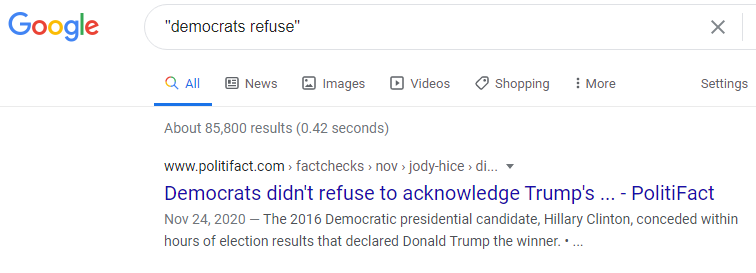
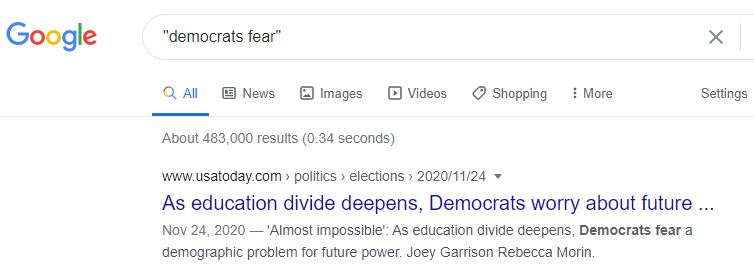
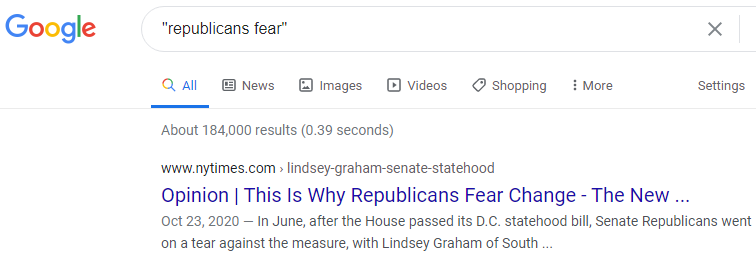
There was a story in the news a little while ago about a Democrat or two fearing that impeaching our criminal president again would cause more division in our beleaguered nation. So I decided to do a small, very unscientific study of a possible difference between Democrats and Republicans. My hypothesis was that Democrats are often said to be afraid of something, while Republicans rarely are. Here are the results (which may be hard to see, so I’ll summarize them below):

UntitledUntitled2

Google came back with 483,000 results for “democrats fear” but only 184,000 results for “republicans fear”. That’s an impressive difference.

To rule out the possibility that Google simply has more results about Democrats, I did another search. I compared “democrats refuse” and “republicans refuse” (simply because Republicans seem to say “no” a lot).

Untitled23Untitled234

As you may be able to see, there were equally striking results. There were 86,000 results for “democrats refuse” and 314,000 for “republicans refuse”. 

What does this tell us about the two parties? I’m not sure. Maybe Democrats are more concerned about consequences than Republicans are. They probably worry more. They are certainly more open to compromise, i.e. less likely to refuse. 

This brings me to two relevant articles. The first describes a significant difference between White men and everybody else. It’s called “The Science That Explains Trump’s Grip on White Males”:

Cognitive scientists long ago coined a term for the psychological forces that have given rise to the gendered and racialized political divide that we’re seeing today. That research, and decades of subsequent scholarly work, suggest that if you want to understand the Txxxx phenomenon, you’d do well to first understand the science of risk perception.

[In 1994] a group of researchers . . .  published a study that asked about 1,500 Americans across the country how they perceived different kinds of risks, notably environmental health risks. [They] found that White males differed from White women and non-White men and women in how they perceived risks. For every category of threat, White men saw risk as much smaller and much more acceptable than did other demographic groups. This is what they dubbed “the White male effect”. They also found that White women perceived risks, across the board, to be much higher than White men did, but this was not true of non-White women and men, who perceived risk at pretty much the same levels. . .  Eventually, expansions of this study would include a wide range of risks including handguns, abortionnuclear threat, and capital punishment.

The perception of risk, of course, relates to fear. Where there is no risk, there is nothing to fear. There is scientific evidence, therefore, that Republicans (who tend to be White men) are less fearful than Democrats (who tend to be women and non-White).

The second article is “The Democrats’ Stark, Historic Choice”. The author argues that Democrats need to rise above their fears if we’re going to preserve (what remains of) our democracy:

For all the cant we’ll soon be drowned in about the soul of the nation and healing, the Democratic Party and the country now face what is ultimately a problem of public policy. Today, less than half our population controls 82 percent of the Senate’s seats. By 2040, given current demographic trends, the most conservative third of the country alone will control nearly 70 percent of its seats. All of this amounts to a permanent and growing advantage for a party whose leaders greeted the president with applause at its winter meeting after Wednesday’s attack.

The Democrats will soon have the presidency. They will have the House of Representatives. By the skin on the skin of their teeth, they will have the Senate. They will, in sum, be entering into an alignment of power in Washington that we have every reason to believe is becoming exceptionally rare. And every actor within that trifecta will have a choice to make. Should a party that mounted a crusade against a legitimate election and the democratic process—a party whose rhetoric has killed—continue to accrue structural power? Or should the Democratic Party work to curb it? 

The author goes on to argue that Democrats need to overcome their fear of institutional change and take aggressive advantage of their fragile Congressional majority. The legislative filibuster should be eliminated in order to pass a full restoration of the Voting Rights Act, expand the franchise, grant statehood to Washington, D.C., and Puerto Rico, and reform the Supreme Court.

As always, the Republicans will refuse to accept small-“d” democratic reforms. The Democrats shouldn’t fear doing whatever they can to achieve them.

One Real Bad Chicken

A personal note:

I can’t bring myself to watch the proceedings. I wanted to hear what the good guys had to say a year ago, because the issues were relatively murky. There was a timeline to understand. I wanted to see the argument laid out one step at a time. The case for impeachment this time is simple. 

On top of that, I’ve gotten the gist of the opposition’s argument. Somebody on Twitter summed up my reaction:

Just in awe of the shamelessness of GOP reps who voted to decertify the election results one week ago today standing up and kvetching that a quick impeachment is a reckless application of the House’s procedural powers.

“You’re using this as a weapon, and you’re destroying this little experiment in self-government.” –Rep. Gohmert, referring not to his own attempt to get Pence to unilaterally throw out the 2020 election but to Pelosi not routing impeachment through the proper committees. 

I wonder how many of them will actually vote for the impeachment. So far only five have said they will. More of them would except they’re afraid for their lives. They fear their own voters. They’ve said that in private (of course). They fear their own voters, the ones who could have lynched Pence and Pelosi, and blown up the Capitol if they’d been more competent. An enormous insane bloodthirsty fascist chicken has come home to roost.

Other tweets I’ve been saving. One from Prof. Timothy Snyder:

The claim that Txxxx won the election is a Big Lie. A Big Lie changes reality. To believe it, people must disbelieve their senses, distrust their fellow citizens, and live in a world of faith. 

A Big Lie demands conspiracy thinking, since all who doubt it are seen as traitors.

A Big Lie undoes a society, since it divides citizens into believers and unbelievers.

A Big Lie destroys democracy, since people who are convinced that nothing is true but the utterances of their leader ignore voting and its results.

A Big Lie must bring violence, as it has.

A Big Lie can never be told just by one person. Txxxx is the originator of this Big Lie, but it could never have flourished without his allies on Capitol Hill.

There is a cure for the Big Lie. Our elected representatives should tell the truth, without dissimulation, about the results of the 2020 election. Politicians who do not tell the simple truth perpetuate the Big Lie, further an alternative reality, support conspiracy theories, weaken democracy, and foment violence far worse than that of January 6, 2021.

One from Prof. Paul Krugman:

The basic story of the [Republican Party] is that it was taken over by plutocrats, who invited racists and conspiracy theorists into the tent because they thought it would help them cut taxes. Then they woke up one day and realized that the crazies were in charge.

And one in response to the president’s latest statement on the matter:

If the man had any interest at all in easing tensions and calming tempers, he’d hold a televised press conference conceding the election, communicating that there was no evidence of fraud, that Biden will legitimately take office on the 20th, and there’s no reason to protest it.