There’s Something Called “Quantum Biology”

Occasionally you hear some news and wonder “Why didn’t I ever hear about this before?” That was my reaction to the news that scientists have been investigating something called “quantum biology” for the past 20 years or so.

Last week, there was a link on the always interesting Self Aware Patterns blog to a Guardian article called “You’re Powered by Quantum Mechanics. No, Really…”. The article was written by two scientists, the physicist Jim Al-Khalili and the geneticist Johnjoe McFadden. Here’s the news I found extremely surprising:

As 21st-century biology probes the dynamics of ever-smaller systems – even individual atoms and molecules inside living cells – the signs of quantum mechanical behaviour in the building blocks of life are becoming increasingly apparent. Recent research indicates that some of life’s most fundamental processes do indeed depend on weirdness welling up from the quantum undercurrent of reality.

Really? People with various qualifications have speculated for years about quantum mechanical phenomena occurring in the human brain, usually in an attempt to justify belief in free will. But this is real science based on experimental results (albeit with a dose of speculation too).

The McFadden/Al-Khalili article cites three examples in which quantum phenomena appear to play a crucial role in biology. First, enzymes appear to work via quantum tunneling:

Enzymes … speed up chemical reactions so that processes that would otherwise take thousands of years proceed in seconds inside living cells. Life would be impossible without them. But how they accelerate chemical reactions by such enormous factors, often more than a trillion-fold, has been an enigma. Experiments over the past few decades, however, have shown that enzymes make use of a remarkable trick called quantum tunnelling to accelerate biochemical reactions. Essentially, the enzyme encourages electrons and protons to vanish from one position in a biomolecule and instantly rematerialise in another, without passing through the gap in between – a kind of quantum teleportation. 

Second, photosynthesis seems to involve wave/particle duality:

The first step in photosynthesis is the capture of a tiny packet of energy from sunlight that then has to hop through a forest of chlorophyll molecules …. The problem is understanding how the packet of energy appears to so unerringly find the quickest route through the forest. An ingenious experiment … revealed that the energy packet was not hopping haphazardly about, but performing a neat quantum trick. Instead of behaving like a localised particle travelling along a single route, it behaves quantum mechanically, like a spread-out wave, and samples all possible routes at once to find the quickest way.

Third, there are animals who appear to rely on quantum entanglement:

A third example of quantum trickery in biology … is the mechanism by which birds and other animals make use of the Earth’s magnetic field for navigation. Studies of the European robin suggest that it has an internal chemical compass that utilises an astonishing quantum concept called entanglement, which Einstein dismissed as “spooky action at a distance”. This phenomenon describes how two separated particles can remain instantaneously connected via a weird quantum link. The current best guess is that this takes place inside a protein in the bird’s eye, where quantum entanglement makes a pair of electrons highly sensitive to the angle of orientation of the Earth’s magnetic field, allowing the bird to “see” which way it needs to fly.

McFadden has published another article at Aeon in which he further discusses the examples above and throws in a possible relationship between quantum mechanics and the sense of smell. In addition, a quick search online turned up an article from the MIT Technology Review explaining how quantum entanglement may stop large DNA molecules from falling apart and an overview of developments in quantum biology from the BBC.

Not everyone is convinced of the quantum nature of these phenomena, of course, and research continues. Still, I think this is all extremely interesting. In one sense, it’s surprising that living things could employ phenomena like entanglement and quantum tunneling that seem so bizarre and so removed from ordinary life. But in another sense, it shouldn’t be a surprise if millions of years of evolution have allowed both plants and animals to take advantage of such powerful and fundamental natural phenomena.

Time Flies and Stuff Happens

Jim Holt has written a nice article on that eternally perplexing subject: the nature of time. As expected, it left me properly perplexed.

Consider this passage:

Events judged to be in the past by one observer may still lie in the future of another; therefore, past and present must be equally definite, equally “real.” In place of the fleeting present, we are left with a vast frozen timescape—a four-dimensional “block universe”… Nothing is “flowing” from one event to another. As the mathematician Hermann Weyl memorably put it, “The objective world simply is; it does not happen. Einstein, through his theory of relativity, furnished a scientific justification for a philosophical view of time [called] “eternalism.” Time, according to this view, belongs to the realm of appearance, not reality. The only objective way to see the universe is as God sees it: sub specie aeternitatis [“under the aspect of eternity”].

But wait (if it’s appropriate to use that term). What is the ultimate fate of the universe?

Ever since its birth in the Big Bang, some 13.82 billion years ago, the universe has been expanding. If this expansion continues forever … the stars will burn out; black holes will evaporate; atoms and their subatomic constituents will decay. In the deep future, the remaining particles … will spread out into the void, becoming so distant from one another that they will cease to interact. Space will become empty except for the merest hint of “vacuum energy”. Yet in this future wasteland of near nothingness, time will go on; random events will continue to occur; things will “fluctuate” into existence, thanks to the magic of quantum uncertainty, only to disappear again into the void….But there is another possible cosmic fate. By and by, at some point in the far future, the expansion that the universe is currently undergoing might be arrested—maybe by gravity, maybe by some force that is currently unknown. Then all the hundreds of billions of galaxies will begin to collapse back on themselves, eventually coming together in a fiery all-annihilating implosion.

Well, you might ask, which is it? Does time belong to the realm of appearance, not reality? Or has the universe been expanding for 13.82 billion years?

Is it correct to say the “objective world simply is; it does not happen”? Or should we say that stuff happens all the time?

Holt is probably correct when he says that “most physicists … agree with Einstein that time’s passage is an illusion; they are eternalists.” Here’s how the “Time” article in the Stanford Encyclopedia of Philosophy defines eternalism:

Eternalism says that objects from both the past and the future exist just as much as present objects. According to eternalism, non-present objects like Socrates and future Martian outposts exist…, even though they are not currently present. We may not be able to see them at the moment, on this view, and they may not be in the same space-time vicinity that we find ourselves in …, but they should nevertheless be on the list of all existing things.

The idea here is that the history of the universe may be thought of as a series of events on a continuum that stretches from the past to the future, but which never includes a moment that is “now”. We can say that one event is earlier or later than another (e.g. the Big Bang is about 14 billion years earlier than December 1, 2014), but it’s wrong to think that the moment you or I perceive as “now” has any special significance, so far as the universe is concerned.

It’s as if the timeline of the universe were a long, straight line between points A and B. Between A and B there are many other points, but none of them is more real than any other. Instead, each point on the line and each moment in the history of the universe (and every object that has ever existed or ever will) exists in the very same way.

Nevertheless, as Holt goes on to say, some physicists are “presentists”. So are some philosophers (as well as most “normal” people who have ever thought about the issue). Presentists believe that “now is a special moment that really advances…; this would still be true, they believe, even if there were no observers like us in the universe”. In the words of the Stanford Encyclopedia:

Presentism is the view that only present objects exist. … According to Presentism, if we were to make an accurate list of all the things that exist … there would be not a single non-present object on the list. Thus, you and the Taj Mahal would be on the list, but neither Socrates nor any future Martian outposts would be included.  

I confess that I find presentism much easier to understand than eternalism. In fact, eternalism sounds sufficiently crazy that there must be extremely good reasons for very smart people to believe it.

Is every object and every event in the history of the universe equally real, so that the biggest triceratops who ever lived and the dinner you’re going to have next New Year’s Eve are just as real as the chair you’re sitting on? Holt says Einstein answered that question and the answer is “Yes!”:

What Einstein [showed] was that there is no universal “now.” Whether two events are simultaneous is relative to the observer. And once simultaneity goes by the board, the very division of moments into “past,” “present,” and “future” becomes meaningless. Events judged to be in the past by one observer may still lie in the future of another; therefore, past and present must be equally definite, equally “real.” In place of the fleeting present, we are left with a vast frozen timescape—a four-dimensional “block universe.”

Maybe that’s the conclusion to be drawn from the scientific evidence. On the other hand, quoting the Stanford Encyclopedia again:

Perhaps it can be plausibly argued that while relativity entails that it is physically impossible to observe whether two events are absolutely simultaneous, the theory nevertheless has no bearing on whether there is such a phenomenon as absolute simultaneity.

Thinking about what might be the case beyond our powers of observation may qualify as metaphysics rather than physics, but it seems to me that change is a fundamental feature of the universe, time is the rate of change, and wherever and whenever changes occur, time is passing. My “now” is different from your “now” in the same way that my “here” is different from your “here”. But each “now” marks a real point in time (a point in the overall history of the universe), just like each “here” marks a real point in space (the universe’s overall expanse).

Eternalism, however, treats time as if it’s one more spatial dimension, a dimensioin in which all locations are equally real. I don’t think time is like that at all. Some moments (or temporal locations) were real, some will be real, and when a moment becomes real, it’s now. Not merely from our perspective, but in reality.

Anyway, that’s my opinion. If you and I aren’t more real than Socrates or the 75th President of the United States (whoever she turns out to be) in a very significant sense, meaning that we exist and they sure don’t, well, this isn’t a universe I want to spend time in.

Ebola, Obama, Republicans, the Usual Nonsense

From Evert Cilliers, writing at the very good Three Quarks Daily site:

What is it about Ebola and America? We have fewer cases than you can count on one hand of this horrible disease, among a nation of 300 million plus, and we’re freaking out as if ISIS has landed and beheaded everyone in Congress (not a bad idea, actually, they’d be doing us all a favor).

And now our President has gone and appointed an Ebola czar. What is this new Czar supposed to do? Go and comfort the families of the one dead from Ebola and the couple of others now in hospital? Big job. Jeez, why is our President acting like a scare-mongered wimp himself? He is supposed to be the grownup in the room. One would expect him to say something like this:

“My dear Americans,

Take a chill pill. Ebola is not a threat to our nation. The Republican Party is a bigger threat, the way they stand against raising the minimum wage for our folks who need to get food stamps even though they’re working all day. Why do Americans who actually work have to earn so little that they can’t even feed themselves? And why are we subsidizing Walmart and McDonalds who pay their employees so little they need food stamps? Walmart is costing you over $6 billion a year out of your taxes you pay in public assistance to their employees. Ebola is the last of our problems. Ignore it. I do. No need to act like a bunch of hysterical wimps. Let the GOP do that. They’re good at being wimps. It’s the other side of their coin. They act like wimps because they’re bullies. So why don’t you go out in November and vote against them? I need Congress back on my side so we can actually make some laws that will benefit the American people.”

Unless you’re a nurse with an Ebola patient, which you’re not.

More from Mr. Cilliers at Three Quarks Daily.

The Data From All the Senses, Part 2 (Lengthy)

When I refer to “sense data”, I mean information that’s conveyed in one of several ways, either through one of our many senses (of which there are more than the five Aristotle counted), or by whatever other means information makes its way into our stream of consciousness (for example, the introspection that allows us to carry on inner soliloquies). Philosophers sometimes use the term “qualia” to refer to “the introspectively accessible, phenomenal aspects of our mental lives”, but “sense data” emphasizes the informational aspect of our experience. I also think it’s appropriate to think of our conscious experience as a whole. The term “data”, understood as a collective noun, emphasizes what’s often called “the unity of consciousness”.

A term that could be used is in place of “sense data” is “sensorium”. Wikipedia cites the Oxford English Dictionary:

A sensorium is the sum of an organism’s perception … where it experiences and interprets the environments within which it lives…. In medical, psychological, and physiological discourse it has come to refer to the total character of the unique and changing sensory environments perceived by individuals. These include the sensation, perception, and interpretation of information about the world around us by using faculties of the mind such as senses, phenomenal and psychological perception, cognition and intelligence.

As David Chalmers put it in the article I quoted a few days ago: “What unites all of these states is that there is something it is like to be in them. All of them are states of experience.”

So what is sense data? From what is ordinarily called the “mental” point of view, sense data is information expressed as sights, sounds, smells, feelings, thoughts and so on. Although a computer can run a program perfectly well with one source of information (the data stored as tiny magnetic regions on a hard drive, for example), creatures like us need more. We require lots of information about the world in order to survive and it’s beneficial to collect that information in more than one way (echolocation would be especially handy at night). 

Hence, we evolved with various capacities for collecting information about the world inside and outside our bodies. If the information we collect is accurate, it will generally allows us to maneuver successfully and avoid difficulties. If it’s garbled, incomplete, hard to understand, illusory or even hallucinatory, it will tend to be less helpful.

From what is ordinarily called the “physical” perspective, however, sense data is activity in our brains. Scientists, of course, can only detect what’s happening in our brains up to a point, since the technology is so new. We, however, have a front row seat, metaphorically speaking. In fact, we each have a metaphorical theater to ourselves. We each experience some of the activity in our brains as sense data, i.e. sights, sounds, smells, feelings, thoughts and otherwise. Nobody understands how this works yet – how or why particular kinds of activity are experienced in particular ways – but that seems to be only a matter of time.

Among professional philosophers, the idea that sense data or conscious experience is brain activity is controversial, although not so much among scientists who study the brain. The so-called “identity theory” has been debated for decades and various alternatives have been offered. Nevertheless, it still seems to me that mental activity is brain activity, somewhat like heat is the motion of atoms or molecules, a cloud is water vapor and a squirrel is a collection of cells. 

One big objection to the identity theory that seems very wrong is that it leaves no room for minds or mental activity. Many philosophers used to believe that the mind is a mental substance that’s somehow attached to the physical substance of the body (and that made sense if a person’s mind or soul was supposed to float away post mortem). Very few philosophers think that today. Yet there are still those who believe that mental properties are very different from physical properties. Property dualism, in particular, is the idea that consciousness is a fundamental property not reducible to physical properties.

I don’t see any good reason to believe that. The simple, most plausible explanation for why so-called mental events or properties seem different from so-called physical events or properties is this: when we’re conscious, we experience some physical events in our brains as mental events (what I’m calling “sense data”), but we never experience other physical events, either in our bodies or outside them, in the same way. The traditional way of describing this distinction is to say that we have direct experience of what’s happening in our conscious minds and indirect experience (via our eyes and ears, for example) of everything else. 

Consider what we know about perception and feelings like pain or hunger. Stimuli of various kinds come in contact with specialized cells in the body. Electrical impulses make their way via the nervous system to the brain. A tiny number of these impulses are combined with the brain’s own contributions, resulting in conscious experience. It’s the activity in the brain itself that ultimately counts.

You really could be a brain in a vat and have a vivid mental life, assuming the technology existed to allow your brain to receive the necessary stimuli (and thus the necessary information to process) and to react accordingly (by seeking new stimuli, for example, as in “Hey, what’s that noise over there?”). Using the traditional terminology, It’s the end product (the sense data) that you are “directly” aware of. So long as that information kept arriving and your brain could react appropriately, your world would seem the same.

It’s the things that information is about, whether it’s the sunburn on your back, a band playing in the park or your daughter’s first day at school, that we are “indirectly” aware of (again using the standard terminology). But all of it is (or was or will be) physical stuff, whether it’s the band in the park, the electrical stimuli or the brain’s own activity. It’s all ultimately composed of things like quarks and bosons (and maybe some dark matter or dark energy, whatever those are).

But the direct vs. indirect distinction can be misleading in at least two ways. First, calling our awareness of things outside our brains “indirect” suggests that there could be a more direct way of being aware of such things. But how could that possibly be? How could I possibly be more aware of the chair I’m sitting in than by sitting in it, looking at it, measuring it, touching it and so on? Experiencing something outside of us isn’t and cannot be the same as experiencing the brain activity that’s part of us. Nevertheless, using our senses to gain knowledge about such things is the ideal, most direct way there could possibly be.

Second, saying that we are directly aware of sense data may suggest that our awareness is complete. It’s sometimes said that we have “privileged access” to our sense data. That’s certainly true, since nobody else has the same access to our sense data that we do. Similarly, the Stanford Encyclopedia article on sense data lists this as the third defining feature of traditional sense data theories: “Sense data [has] the properties that perceptually appear to us”. That’s usually understood to mean that we can’t be mistaken about what our sense data is. We may interpret our sense data incorrectly, but if you have blue sense data, your sense data is definitely blue, even if the thing your sense data is about (the wall in front of you, for example) isn’t blue at all. It could be a different color, as we usually describe such things. In reality, it’s got no “color” (the blueness you actually see) in itself at all. 

This doesn’t mean that we can always accurately describe what our sense data is or even know what we’re sensing. Data, after all, is sometimes vague, incomplete, too complex to understand and even inconsistent. (Imagine seeing an object directly in front of you that isn’t there when you try to touch it.) It’s reasonable to say that sense data always has the properties that perceptually appear to us, so long as we don’t take that to mean we are always clear about what those properties are.

The most popular objection to sense data theories is that they break the link between us and the external world. If we’re only aware of sense data, how do we know that anything outside our own minds even exists? How do we know that there is a physical world at all? Or perhaps you and I are like Keanu Reeves before he was unplugged.

Given the sense data I’ve had over the years and am still having, I’m very sure that there is a physical world outside my mind that contains New York City, our cat, Rice Krispies and aluminum siding. But am I absolutely, completely, 100% certain beyond any doubt whatsoever? Not really. I could get an extremely, extremely big surprise one day.

But so what? I’m not absolutely, completely, 100% certain that the world wasn’t created 10 seconds ago, with geological strata and historical records in place and all of us enjoying false memories of years gone by. Being able to conceive of a very different world doesn’t make that very different world plausible. Philosophers (some of them) are paid to worry about these things, and many have tried to prove beyond any possible doubt things we and they already know to be true. But the quest for absolute certainty on this or almost any other topic is a waste of time. It’s impossible to achieve and wouldn’t be of any use if it was.

In conclusion, I should mention that, in a 2009 survey of philosophy professors, graduate students and others who follow academic philosophy, only 19% of the respondents accepted or leaned toward “sense-datum theory” or “qualia theory” in the philosophy of perception. However, applying simple labels to philosophical theories is extraordinarily difficult. The most popular answer was “other” with 43%, but coming in second was “representationalism” with 26%. Another article in the Stanford Encyclopedia describes representationalism or representative realism as follows:

… our immediately experienced sense-data, together with the further beliefs that we arrive at on the basis of them, constitute a representation or depiction of an independent realm of material objects — one that we are, according to the representationalist, justified in believing to be true.

I couldn’t (and didn’t) say it better myself.

PS — It’s very difficult to contract Ebola in a country with a decent public health system, so please don’t worry. It’s not spread like a cold or the flu. If you’re in a country with a poor public health system and people are getting the disease, please don’t expose yourself to the bodily fluids of someone who has a high fever, body aches, etc. You can only get it from the bodily fluids of someone who already has symptoms.
The Data From All the Senses

Alan Lightman, currently Professor of the Practice of the Humanities (!) at MIT, has posted a short article about consciousness at the New Yorker‘s site. Its centerpiece is a visit with Robert Desimone, an MIT neuroscientist who is trying to understand what happens in the brain when we pay attention to something.

Neuroscientists already know that different parts of the brain are activated when we look at faces as opposed to other objects. In one of Desimone’s experiments, people were shown a series of photographs of faces and houses and told to pay attention to either the faces or houses, but not both.

When the subjects were told to concentrate on the faces and to disregard the houses, the neurons in the face location fired in synchrony, like a group of people singing in unison, while the neurons in the house location fired like a group of people singing out of synch, each beginning at a random point in the score. When the subjects concentrated instead on houses, the reverse happened. Furthermore, another part of the brain, called the inferior frontal junction, a marble-size region in the frontal lobe, seemed to conduct the chorus of the synchronized neurons, firing slightly ahead of them.

 Evidently, what we perceive as “paying attention” to something originates, at the cellular level, in the synchronized firing of a group of neurons, whose rhythmic electrical activity rises above the background chatter of the vast neuronal crowd. Or, as Desimone once put it, “This synchronized chanting allows the relevant information to be ‘heard’ more efficiently by other brain regions.”

Something else that’s interesting in the article is what the neuroscientist says about what’s been called philosophy’s “hard problem”, i.e. understanding the nature of consciousness: 

Without hesitation, Desimone replied that the mystery of consciousness was overrated. “As we learn more about the detailed mechanisms in the brain, the question of ‘What is consciousness?’ will fade away into irrelevancy and abstraction,” he said. As Desimone sees it, consciousness is just a vague word for the mental experience of attending, which we are slowly dissecting in terms of the electrical and chemical activity of individual neurons.

DeSimone compares understanding consciousness to understanding “the nature of motion” as it applies to a car. Once we understand how a car operates, there’s nothing more to say about its motion. Or in a physiological comparison he might have made, we will eventually understand what consciousness is or how it works just like we now understand what digestion is or how it works.

But I think there’s something importantly different about consciousness as compared to the motion of a car or even the digestion of a sandwich.This is how David Chalmers, the philosopher who first referred to the “hard” problem (as opposed to the “easy” problems) of consciousness, put it in his 1995 article “Facing Up to the Problem of Consciousness”:

Consciousness poses the most baffling problems in the science of the mind. There is nothing that we know more intimately than conscious experience, but there is nothing that is harder to explain. All sorts of mental phenomena have yielded to scientific investigation in recent years, but consciousness has stubbornly resisted….

The really hard problem of consciousness is the problem of experience. When we think and perceive, there is a whir of information-processing, but there is also a subjective aspect…. This subjective aspect is experience. When we see, for example, we experience visual sensations: the felt quality of redness, the experience of dark and light, the quality of depth in a visual field. Other experiences go along with perception in different modalities: the sound of a clarinet, the smell of mothballs. Then there are bodily sensations, from pains to orgasms; mental images that are conjured up internally; the felt quality of emotion, and the experience of a stream of conscious thought. What unites all of these states is that there is something it is like to be in them. All of them are states of experience.

It is undeniable that some organisms are subjects of experience. But the question of how it is that these systems are subjects of experience is perplexing. Why is it that when our cognitive systems engage in visual and auditory information-processing, we have visual or auditory experience: the quality of deep blue, the sensation of middle C? How can we explain why there is something it is like to entertain a mental image, or to experience an emotion? It is widely agreed that experience arises from a physical basis, but we have no good explanation of why and how it so arises. Why should physical processing give rise to a rich inner life at all? 

So Desimone claims that once we understand the physical processes that occur in the brain (the mechanisms of consciousness), the philosophical problem of consciousness will evaporate. Chalmers, on the other hand, says that even if we were to understand the “physical processing” in the brain, the hard problem of consciousness would remain. According to Chalmers, “specifying a mechanism that performs the function” of consciousness, as Desimone hopes to do one day, won’t solve the mystery at all.

I agree with Desimone up to a point. I think the neuroscientists will eventually answer the philosophers’ question as Chalmers posed it in the paragraphs above. Why should such and such physical processing give rise to an inner life? Well, why should such and such physical processing give rise to digestion or respiration or, for that matter, to water boiling or leaves falling? When such and such physical, chemical or biological events take place, what happens is digestion, respiration, water boiling and leaves falling, as the case may be. If an organism’s parts are arranged a certain way, the organism will have an inner life. Or if, as might be the case one day, a machine’s parts are arranged a certain way, the machine will have an inner life. That’s how the world – the world we happen to be in – works (or will work).

I don’t believe this “why should” question concerning experience or consciousness is very interesting from a philosophical perspective. It seems to me that it’s “merely” a very difficult scientific question to which scientists haven’t yet found the answer. It certainly isn’t the hardest problem in philosophy.

To me, a more interesting question is this: What is felt experience anyway? What exactly is the deep blue or middle C that we experience? For example, when we look at an orange, the precise nature of our experience depends on several factors, including the surface of the orange, the light in our environment and our sensory apparatus. That’s why it makes no sense to say that the surface of an orange is orange in itself. When we hold an orange, the surface feels bumpy, but it presumably wouldn’t feel the same way if we were much, much smaller or much, much larger.

I’m not suggesting at all that David Chalmers has failed to recognize the real issue here. But I think that stating the issue in this way emphasizes the most puzzling aspect of consciousness. Here’s another way of putting it: if the world outside of us isn’t just as we experience it, and it’s not in our heads either (there are relatively few colors or sounds inside our brains), where the hell is it? 

These days, philosophers often compare brains to computers. The brain is the hardware and the mind is the software. But it occurred to me recently that software doesn’t do anything unless it has data to process (that’s not a great insight if you’ve ever worked with or thought about computers). This got me to wondering if we should think of our experience as data. Not the kind of data that computers process, but a special kind of data that takes a variety of forms (in Chalmers’ words, “the felt quality of redness, the experience of dark and light, the quality of depth in a visual field….the sound of a clarinet, the smell of mothballs…. bodily sensations…. mental images…. the felt quality of emotion…. a stream of conscious thought”). We might call this kind of data “sense data”. 

But, lo and behold, that’s exactly what a number of philosophers in the early 20th century, including Bertrand Russell and G. E. Moore, began calling it. (Actually, I already knew that, but it was still a pleasant surprise when I realized I’d gone from thinking about computers to thinking about a 100-year old theory).

Theories that refer to sense data and similar entities aren’t as popular among philosophers as they used to be, but such theories have been one of the most discussed topics in epistemology (the theory of knowledge) and the philosophy of perception for a long time. William James referred to “the data from all the senses” before Russell and Moore (although James wouldn’t have accepted Russell’s or Moore’s particular views). And sense data theories had their precursors in the 17th and 18th century writings of Rene Descartes and the British empiricists Locke, Berkeley and Hume. 

As usual, the Stanford Encyclopedia of Philosophy has a helpful article on the subject. The author, Michael Huemer, characterizes sense data in this way (using “data” in the traditional plural sense rather than as a singular collective noun):

On the most common conception, sense data (singular: “sense datum”) have three defining characteristics:

  1. Sense data are the kind of thing we are directly aware of in perception,
  2. Sense data are dependent on the mind, and
  3. Sense data have the properties that perceptually appear to us.

Many philosophers deny that sense data exists or that we’re directly aware of it. Proposition 3 above is also especially controversial. It’s also often argued that if we were actually aware of sense data, we’d be cut off from the world around us. I don’t plan to discuss any of this further right now, but it’s a topic I want to get back to. It’s a really hard philosophical problem.

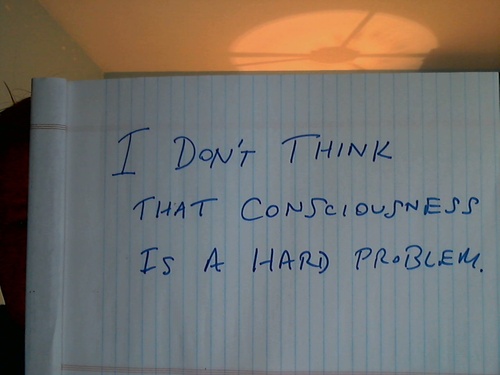
PS — There is a funny site called Philosopher Shaming that features anonymous and not so anonymous pictures of philosophically-inclined people owning up to their deepest and darkest philosophical secrets. I uploaded my picture two years ago: 

tumblr_ma8nqi5Bj31renf8po1_500