Where We Stand with the Vaccinations

The vaccine is out there. It’s not being administered fast enough. But now there’s a plan. From The New York Times [with commentary included]:

President Biden’s promise to administer 100 million vaccines by his 100th day in office is no longer a lofty goal; it is attainable at the current pace at which shots are going into arms. In fact, some experts have suggested that the president’s ambition is far too modest. [His ambition is to get the whole country vaccinated; his promise was to do 100 million by late April.]

Federal data shows that the United States is already administering about one million doses a day, and even doubling that rate would not cause the country to fall short of distribution capacity or supply. . . . 

Mr. Biden made the 100-day pledge in early December, before any vaccine had been authorized for use in the United States. At the time, experts called the goal “optimistic” given their concerns about manufacturing and distribution capacity.

Since then, two vaccines have been approved and the United States has secured contracts for deliveries of doses through July. And while some jurisdictions have said that they are running out of doses, states and U.S. territories are using only about half of the shots that the federal government has shipped to them, on average. . . .

Pfizer and Moderna have pledged to deliver a combined 200 million doses by the end of March, with an additional 200 million doses to be delivered by the end of July.

Under those circumstances, it is feasible that up to two million doses could be given per day, and Mr. Biden’s goal of 100 million shots could be reached by early March.

But ramping up vaccinations will not be easy. And national supply and distribution figures do not reflect the often complicated local realities.

“The complexity of administering vaccines may grow over the coming weeks as we open up a lot of new provider sites,” said Dr. Julie Swann, an industrial and systems engineering professor at North Carolina State University who was an adviser to the C.D.C. during the 2009 H1N1 pandemic.

Getting shots in arms has already been hard, Dr. Swann noted. Providers get little notice of how much vaccine they will receive, making it difficult to plan and set up appointments. Estimating demand can be tricky too, which means that vaccines may be used more quickly in some locations than others, leading to wasted doses.

“The administration needs to be both fighting immediate fires and putting in the infrastructure to make this work better, too,” Dr. Swann said [which is what the president and his staff are doing, three days after the inauguration].

Unquote.

The new administration has issued a “National Strategy for the COVID-19 Response and Pandemic Preparedness”. This is the summary of the plan to “mount a safe, effective, comprehensive vaccination campaign”:

The United States will spare no effort to ensure Americans can get vaccinated quickly, effectively, and equitably. The federal government will execute an aggressive vaccination strategy, focusing on the immediate actions necessary to convert vaccines into vaccinations, including improving allocation, distribution, administration, and tracking. Central to this effort will be additional support and funding for state, local, Tribal, and territorial governments — and improved line of sight into supply — to ensure that they are best prepared to mount local vaccination programs. At the same time, the federal government will mount an unprecedented public campaign that builds trust around vaccination and communicates the importance of maintaining public health measures such as masking, physical distancing, testing, and contact tracing even as people receive safe and effective vaccinations. To mount a safe, effective, comprehensive vaccination campaign, the United States will:

  1. Ensure the availability of safe, effective vaccines for the American public.
  2. Accelerate getting shots into arms and get vaccines to the communities that need them most.
  3. Create as many venues as needed for people to be vaccinated.
  4. Focus on hard-to-reach and high-risk populations.
  5. Fairly compensate providers, and states and local governments for the cost of administering vaccinations.
  6. Drive equity throughout the vaccination campaign and broader pandemic response. Launch a national vaccinations public education campaign.
  7. Bolster data systems and transparency for vaccinations.
  8. Monitor vaccine safety and efficacy. Surge the health care workforce to support the vaccination effort.

The plan is only 200 pages long.

Yeah, we’re finally getting an administration that’s competent and wants the government to work. Patience is a virtue.
Biden’s Questions for His Top Science Adviser

Joe Biden plans to make the director of the Office of Science and Technology Policy a Cabinet-level position for the first time. Last week, he sent a letter to Eric Lander, the geneticist who will hold that position, asking how the United States should address scientific and technological issues in the coming decades. I’m sure the president-elect didn’t write every word, but he put his name on it:

In 1944, President Franklin D. Roosevelt authored a letter to his science advisor, Dr. Vannevar Bush, posing the question of how science and technology could best be applied to benefit the nation’s health, economic prosperity, and national security in the decades that would follow the Second World War. Dr. Bush’s response came in the form of a report, titled Science—the Endless Frontier, that would form the basis of the National Science Foundation and set the course of scientific discovery in America for the next 75 years.

Those years have brought about some of the most consequential scientific advancements in human history with America leading the way. But three quarters of a century later, the contours of our lives have changed. . . . And the nature of discovery itself has changed by leaps and bounds—reaching celestial heights, and microscopic complexities, that were unimaginable not so long ago.

For this reason, I believe it is essential that we refresh and reinvigorate our national science and technology strategy to set us on a strong course for the next 75 years, so that our children and grandchildren may inhabit a healthier, safer, more just, peaceful, and prosperous world. This effort will require us to bring together our brightest minds across academia, medicine, industry, and government—breaking down the barriers that too often limit our vision and our progress, and prioritizing the needs, interests, fears, and aspirations of the American people.

President Roosevelt asked Dr. Bush to consider four specific questions. Today, I am tasking you and your colleagues with five. My hope is that you, working broadly and transparently with the diverse scientific leadership of American society and engaging the broader American public, will make recommendations to our administration on the general strategies, specific actions, and new structures that the federal government should adopt to ensure that our nation can continue to harness the full power of science and technology on behalf of the American people.

1. What can we learn from the pandemic about what is possible—or what ought to be possible— to address the widest range of needs related to our public health?

Even as we work urgently to overcome the coronavirus pandemic, we must learn from this moment by grappling with the challenges, inequities, and opportunities we’ve seen in order to better prepare for the future. How can we dramatically improve our ability to rapidly address threats from pathogens, including emerging pandemics, potential bioweapons, and antibiotic resistance? How can we dramatically speed our ability to develop and conduct clinical trials of therapies for other types of diseases like cancer? How can we enable the rapid sharing, with patient consent, of health information to build a smarter and more effective healthcare system? . . .

2. How can breakthroughs in science and technology create powerful new solutions to address climate change . . .?

Climate change represents an existential threat that requires bold and urgent action. But at the same time, the necessity of solving it also presents us with an extraordinary opportunity to make groundbreaking investments in our infrastructure, enhance America’s resilience, promote environmental justice, and create new cutting-edge industries and millions of good-paying jobs that will advance American leadership for generations to come.

Achieving our commitment of net-zero carbon emissions by 2050 will require deploying existing, cost-effective clean energy technologies manufactured in America; drawing on innovative solutions to capture and store carbon; and spurring American technological ingenuity to develop new zerocarbon technologies that can reshape the marketplace. . . .

The United States has a long, successful, and bipartisan history of using federal research, purchasing, and policies to help jumpstart critical industries—including, for example, when we pioneered and led the semiconductor industry. How can we refresh that model to deliver a healthier, safer, more prosperous, and sustainable future for our children, while preserving our natural environment for future generations?

3. How can the United States ensure that it is the world leader in the technologies and industries of the future that will be critical to our economic prosperity and national security, especially in competition with China?

. . . New technologies are emerging in increasingly rapid cycles that promise to transform our lives. Each arrives with a distinct set of promises and challenges—and each carries the capacity to dramatically impact job creation, equity, and national security. Other countries—especially China—are making unprecedented investments and doing everything in their power to promote the growth of new industries and eclipse America’s scientific and technological leadership. . . .

What is the right level of national investment, and what are the pillars of a national strategy that will rapidly propel both research and development of critical technologies? What structures, infrastructures, and policies are needed to accelerate the path from research laboratories to development projects to the marketplace? How can we strengthen and expand the connections between academia, industry, and government . . .? And, importantly, how do we ensure that technological advances create rather than diminish high-quality jobs?

4. How can we guarantee that the fruits of science and technology are fully shared across America and among all Americans?

The benefits of science and technology remain unevenly distributed across racial, gender, economic, and geographic lines. How can we ensure that Americans of all backgrounds are drawn into both the creation and the rewards of science and technology? How can we ensure that science and technology hubs flourish in every part of the country, driving economic development in every American hometown? How can we ensure that advances in medical science benefit the health of all Americans, including substantially reducing racial and socioeconomic health disparities?

5. How can we ensure the long-term health of science and technology in our nation?

Science and technology have flourished in the United States because of a rich ecosystem of people, policies, and institutions. This ecosystem must be nurtured and refreshed . . . How can we protect scientific integrity within government—and make government a premier destination for scientists and technologists to work? . . . How can we ensure the United States will remain a magnet for the best and brightest minds throughout the world?

I believe that the answers to these questions will be instrumental in helping our nation embark on a new path in the years ahead—a path of dignity and respect, of prosperity and security, of progress and common purpose. They are big questions, to be sure, but not as big as America’s capacity to address them. I look forward to receiving your recommendations—and to working with you, your team, and the broader scientific community to turn them into solutions that ease everyday burdens for the American people, spark new jobs and opportunities, and restore American leadership on the world stage.

Fear vs. the White Male Effect

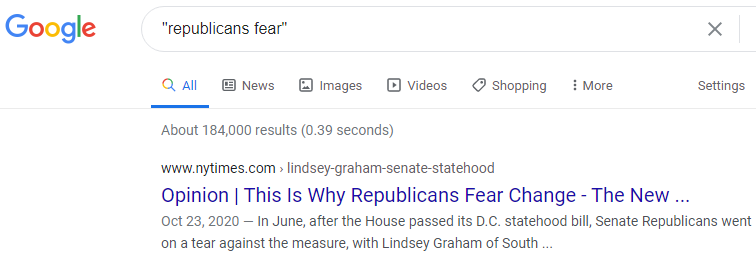
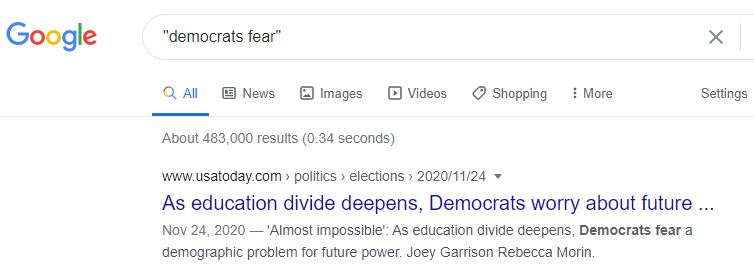
There was a story in the news a little while ago about a Democrat or two fearing that impeaching our criminal president again would cause more division in our beleaguered nation. So I decided to do a small, very unscientific study of a possible difference between Democrats and Republicans. My hypothesis was that Democrats are often said to be afraid of something, while Republicans rarely are. Here are the results (which may be hard to see, so I’ll summarize them below):

UntitledUntitled2

Google came back with 483,000 results for “democrats fear” but only 184,000 results for “republicans fear”. That’s an impressive difference.

To rule out the possibility that Google simply has more results about Democrats, I did another search. I compared “democrats refuse” and “republicans refuse” (simply because Republicans seem to say “no” a lot).

Untitled23Untitled234

As you may be able to see, there were equally striking results. There were 86,000 results for “democrats refuse” and 314,000 for “republicans refuse”. 

What does this tell us about the two parties? I’m not sure. Maybe Democrats are more concerned about consequences than Republicans are. They probably worry more. They are certainly more open to compromise, i.e. less likely to refuse. 

This brings me to two relevant articles. The first describes a significant difference between White men and everybody else. It’s called “The Science That Explains Trump’s Grip on White Males”:

Cognitive scientists long ago coined a term for the psychological forces that have given rise to the gendered and racialized political divide that we’re seeing today. That research, and decades of subsequent scholarly work, suggest that if you want to understand the Txxxx phenomenon, you’d do well to first understand the science of risk perception.

[In 1994] a group of researchers . . .  published a study that asked about 1,500 Americans across the country how they perceived different kinds of risks, notably environmental health risks. [They] found that White males differed from White women and non-White men and women in how they perceived risks. For every category of threat, White men saw risk as much smaller and much more acceptable than did other demographic groups. This is what they dubbed “the White male effect”. They also found that White women perceived risks, across the board, to be much higher than White men did, but this was not true of non-White women and men, who perceived risk at pretty much the same levels. . .  Eventually, expansions of this study would include a wide range of risks including handguns, abortion, nuclear threat, and capital punishment.

The perception of risk, of course, relates to fear. Where there is no risk, there is nothing to fear. There is scientific evidence, therefore, that Republicans (who tend to be White men) are less fearful than Democrats (who tend to be women and non-White).

The second article is “The Democrats’ Stark, Historic Choice”. The author argues that Democrats need to rise above their fears if we’re going to preserve (what remains of) our democracy:

For all the cant we’ll soon be drowned in about the soul of the nation and healing, the Democratic Party and the country now face what is ultimately a problem of public policy. Today, less than half our population controls 82 percent of the Senate’s seats. By 2040, given current demographic trends, the most conservative third of the country alone will control nearly 70 percent of its seats. All of this amounts to a permanent and growing advantage for a party whose leaders greeted the president with applause at its winter meeting after Wednesday’s attack.

The Democrats will soon have the presidency. They will have the House of Representatives. By the skin on the skin of their teeth, they will have the Senate. They will, in sum, be entering into an alignment of power in Washington that we have every reason to believe is becoming exceptionally rare. And every actor within that trifecta will have a choice to make. Should a party that mounted a crusade against a legitimate election and the democratic process—a party whose rhetoric has killed—continue to accrue structural power? Or should the Democratic Party work to curb it? 

The author goes on to argue that Democrats need to overcome their fear of institutional change and take aggressive advantage of their fragile Congressional majority. The legislative filibuster should be eliminated in order to pass a full restoration of the Voting Rights Act, expand the franchise, grant statehood to Washington, D.C., and Puerto Rico, and reform the Supreme Court.

As always, the Republicans will refuse to accept small-“d” democratic reforms. The Democrats shouldn’t fear doing whatever they can to achieve them.

Starting the Year on a Positive Note

It’s not 100% positive, of course, but it’s something to keep in mind (any port in a storm). From Paul Krugman of The New York Times:

The next few months will be hell in terms of politics, epidemiology and economics. But at some point in 2021 things will start getting better. And there’s good reason to believe that once the good news starts, the improvement in our condition will be much faster and continue much longer than many people expect.

OK, one thing that probably won’t get better is the political scene. Day after day, Republicans — it’s not just Dxxxx Txxxx — keep demonstrating that they’re worse than you could possibly have imagined, even when you tried to take into account the fact that they’re worse than you could possibly have imagined. . . .

But on other fronts there’s a clear case for optimism. Science has come to our rescue, big time, with the miraculously fast development of vaccines against the coronavirus. True, the United States is botching the initial rollout, which should surprise nobody. But this is probably just a temporary hitch, especially because in less than three weeks we’ll have a president actually interested in doing his job [and is an actual human being].

And once we’ve achieved widespread vaccination, the economy will bounce back. The question is, how big will the bounce be?

Our last economic crisis was followed by a sluggish recovery. Employment didn’t return to 2007 levels until 2014; real median household income didn’t regain the lost ground until 2016. And many observers expect a replay of that story, especially if Republicans retain control of the Senate and engage, once again, in economic sabotage under the pretense of being fiscally responsible.

But the crisis of 2020 was very different from the crisis of 2008, in ways that make our prospects look much better this time around.

The last economic crisis involved a Wile E. Coyote moment: The private sector suddenly looked down, realized that there was nothing supporting extravagant housing prices and extremely high levels of household debt, and plunged. The result was an extended period of depressed spending. The only way to have avoided multiple years of high unemployment would have been sustained, large-scale fiscal stimulus — and the [Republicans] prevented that.

This 2020 crisis, by contrast, was brought on by a headwind out of nowhere, in the form of the coronavirus. The private sector doesn’t seem to have been particularly overextended before the pandemic. And while we shouldn’t minimize the hardships faced by millions of families, on average Americans have been saving like crazy, and will emerge from the pandemic with stronger balance sheets than they had before.

So I’m in the camp that expects rapid growth once people feel safe going out and spending money. Mitch McConnell and company will, no doubt, do what they always do when a Democrat occupies the White House, and try to sabotage the recovery. But this time the economy won’t need support as badly as it did during the Obama years.

And I suspect, although with less confidence, that the boom will go on for a long time. Why? Because like a number of other people, I’m getting optimistic about the future of technology.

The years that followed the 2008 crisis weren’t just marked by sluggish job growth. They also coincided with a period of technological disappointment. As [one entrepeneur] put it, it was an era in which we wanted flying cars but got 140 characters instead. . . . That is, we were doing some flashy stuff pushing information around, but not making much progress in the material world, which is still where we mainly live.

Lately, however, I’ve been hearing a lot of buzz around new physical technologies that reminds me of the buzz about information technology in the early 1990s, which presaged the productivity surge from 1995 to 2005. Biotechnology finally seems to be coming into its own — hence those miraculous vaccines. There has been incredible progress in renewable energy; I’m old enough to remember when solar power was considered a hippie fantasy, and now it’s cheaper than fossil fuels. There’s room for more skepticism about the near-term prospects for things like self-driving vehicles and lab-grown meat, but the fact that we’re even talking about such innovations is a good sign for the future.

This new wave of innovation doesn’t have much to do with policy, although progress in renewables can be partly attributed to the Obama administration’s promotion of green energy. But the Biden administration, unlike its predecessor, won’t be anti-science and won’t try desperately to preserve the coal-burning past. That will help us take advantage of progress.

I’m less confident in my techno-optimism than I am in my expectations for a rapid employment recovery once we’ve been vaccinated. But all in all, there’s a pretty good chance that Joe Biden will preside over an economy that surprises many people on the upside. 

Could This Be a More Sensible Timeline? (Quantum Mechanics Edition)

This post has nothing to do with politics.

One of the big mysteries or surprises in quantum physics is “non-locality”. This is the apparent fact that two particles can be “entangled”, such that even though they’re a billion miles apart, when something happens to one, something automatically happens to the other. The particles are far away in spacetime, but it’s as if they’re somehow right next to each other, possibly in some “deeper” reality. If that’s true, it’s pretty damn cool. 

From Quanta Magazine:

In a series of breakthrough papers, theoretical physicists have come tantalizingly close to resolving the black hole information paradox that has entranced and bedeviled them for nearly 50 years. Information, they now say with confidence, does escape a black hole. If you jump into one, you will not be gone for good. Particle by particle, the information needed to reconstitute your body will reemerge. Most physicists have long assumed it would; that was the upshot of string theory, their leading candidate for a unified theory of nature. But the new calculations, though inspired by string theory, stand on their own, with nary a string in sight. Information gets out through the workings of gravity itself — just ordinary gravity with a single layer of quantum effects. . . .

What it all means is being intensely debated in Zoom calls and webinars. The work is highly mathematical and has a Rube Goldberg quality to it, stringing together one calculational trick after another in a way that is hard to interpret. Wormholes, the holographic principle, emergent space-time, quantum entanglement, quantum computers: Nearly every concept in fundamental physics these days makes an appearance, making the subject both captivating and confounding.

And not everyone is convinced. . . .

But almost everyone appears to agree on one thing. In some way or other, space-time itself seems to fall apart at a black hole, implying that space-time is not the root level of reality, but an emergent structure from something deeper. Although Einstein conceived of gravity as the geometry of space-time, his theory also entails the dissolution of space-time, which is ultimately why information can escape its gravitational prison. . . .

The researchers drew on a concept that Richard Feynman had developed in the 1940s. Known as the path integral, it is the mathematical expression of a core quantum mechanical principle: Anything that can happen does happen. In quantum physics, a particle going from point A to point B takes all possible paths, which are combined in a weighted sum. The highest-weighted path is generally the one you’d expect from ordinary classical physics, but not always. If the weights change, the particle can abruptly lurch from one path to another, undergoing a transition that would be impossible in old-fashioned physics.

The path integral works so well for particle motion that theorists in the ’50s proposed it as a quantum theory of gravity. That meant replacing a single space-time geometry with a mélange of possible shapes. To us, space-time appears to have a single well-defined shape — near Earth, it is curved just enough that objects tend to orbit the center of our planet, for example. But in quantum gravity, other shapes, including much curvier ones, are latent, and they can make an appearance under the right circumstances. . . .

For [Stephen Hawking], space-time might knot itself into doughnut- or pretzel-like shapes. The extra connectivity creates tunnels, or “wormholes,” between otherwise far-flung places and moments. These come in different types.

Spatial wormholes are like the portals beloved of science-fiction writers, linking one star system to another. So-called space-time wormholes are little universes that bud off our own and reunite with it sometime later. Astronomers have never seen either type, but general relativity permits these structures, and the theory has a good track record of making seemingly bizarre predictions, such as black holes and gravitational waves, that are later vindicated. Not everyone agreed with Hawking that these exotic shapes belong in the mix, but the researchers doing the new analyses of black holes adopted the idea provisionally. . . .

Theorists in the West Coast group imagined sending [radiation escaping from a black hole] into a quantum computer. After all, a computer simulation is itself a physical system; a quantum simulation, in particular, is not altogether different from what it is simulating. So the physicists imagined collecting all the radiation, feeding it into a massive quantum computer, and running a full simulation of the black hole.

And that led to a remarkable twist in the story. Because the radiation is highly entangled with the black hole it came from, the quantum computer, too, becomes highly entangled with the hole. Within the simulation, the entanglement translates into a geometric link between the simulated black hole and the original. Put simply, the two are connected by a wormhole. “There’s the physical black hole and then there’s the simulated one in the quantum computer, and there can be a replica wormhole connecting those,” said Douglas Stanford, . . . a member of the West Coast team. This idea is an example of a proposal by [Juan Martin] Maldacena and Leonard Susskind  . . . in 2013 that quantum entanglement can be thought of as a wormhole. The wormhole, in turn, provides a secret tunnel through which information can escape the interior [of the black hole] . . .

Theorists have been intensely debating how literally to take all these wormholes. The wormholes are so deeply buried in the equations that their connection to reality seems tenuous, yet they do have tangible consequences. . . .

But rather than think of the wormholes as actual portals sitting out there in the universe, [some physicists] speculate that they are a sign of new, nonlocal physics. By connecting two distant locations, wormholes allow occurrences at one place to affect a distant place directly, without a particle, force or other influence having to cross the intervening distance — making this an instance of what physicists call nonlocality. “They seem to suggest that you have nonlocal effects that come in” [one physicist] said. In the black hole calculations, the island and radiation are one system seen in two places, which amounts to a failure of the concept of “place.” “We’ve always known that some kind of nonlocal effects have to be involved in gravity, and this is one of them . . . Things you thought were independent are not really independent.”

At first glance, this is very surprising. Einstein constructed general relativity with the express purpose of eliminating nonlocality from physics. Gravity does not reach out across space instantly. It has to propagate from one place to another at finite speed, like any other interaction in nature. But over the decades it has dawned on physicists that the symmetries on which relativity is based create a new breed of nonlocal effects. . . 

All this reinforces many physicists’ hunch that space-time is not the root level of nature, but instead emerges from some underlying mechanism that is not spatial or temporal. . . 

Skepticism is warranted if for no other reason than because the recent work is complicated and raw. It will take time for physicists to digest it and either find a fatal flaw in the arguments or become convinced that they work. . . .

Unquote.

So it looks like the universe is making more sense. Maybe we’ve entered a more sensible timeline, in which physics is less paradoxical and the president behaves like an adult politician/human being!