Cutting Taxes for the Rich Simply Helps the Rich (Duh)

Some counterintuitive ideas are fine. Others counterintuitive ideas are stupid (and self-serving).

A counterintuitive idea popular among conservatives is that helping the rich makes them productive while helping the poor makes them lazy. Another is that cutting taxes on the rich increases what the government collects in taxes. Sure it does!

From CBS News:

Tax cuts for the wealthy have long drawn support from conservative lawmakers and economists who argue that such measures will “trickle down” and eventually boost jobs and incomes for everyone else. But a new study from the London School of Economics says 50 years of such tax cuts have only helped one group — the rich.

The new paper by [two British economists] examines 18 developed countries — from Australia to the United States — over a 50-year period from 1965 to 2015. The study compared countries that passed tax cuts in a specific year, such as the U.S. in 1982 when President Ronald Reagan slashed taxes on the wealthy, with those that didn’t, and then examined their economic outcomes. 

Per capita gross domestic product and unemployment rates were nearly identical after five years in countries that slashed taxes on the rich and in those that didn’t, the study found. 

But the analysis discovered one major change: The incomes of the rich grew much faster in countries where tax rates were lowered. Instead of trickling down to the middle class, tax cuts for the rich may not accomplish much more than help the rich keep more of their riches and exacerbate income inequality, the research indicates.

“Based on our research, we would argue that the economic rationale for keeping taxes on the rich low is weak” said a co-author of the study. “In fact, if we look back into history, the period with the highest taxes on the rich — the postwar period — was also a period with high economic growth and low unemployment.”

Unquote.

But not to worry, conservatives! Facts have a well-known liberal bias.

The Sharp Divide in American Politics

I used to view American politics as mainly a struggle between capital (big business and the rich) and labor (the rest of us). That conflict still exists, but I think it’s more helpful today to see our politics as a fight about democracy.

Their side wants fewer people to vote. Our side want more people to vote. 

From Greg Sargent of The Washington Post:

Amid the stream of delusion, depravity, malevolence and megalomania that characterized D____ T____’s speech to the Conservative Political Action Conference on Sunday, one message should be regarded as arguably more important than all the others combined.

It’s this: The former president told his audience that the Republican Party’s success in coming years depends, in no small part, on its commitment to being an anti-democracy party.

T____ didn’t say this in precisely those words, of course. But that message blared through all the background noise like a loud, clanging alarm bell.

This will require Democrats to redouble their focus on passing their big package of pro-democracy reforms as soon as possible — and to be prepared to nix the legislative filibuster to get it into law. It may be tempting to dismiss or ignore T____’s deranged rantings, but Democrats should see this one message as an actionable one.

As expected, T____’s CPAC speech doubled down on the big lie that the election was stolen from him — and then some. . . .

But embedded in that big lie was an unintentional truth. It was revealed when T____ uncorked an extended riff suggesting that [his party’s] future prospects depend on what he called “election reforms.”

“Another one of the most urgent issues facing the Republican Party is that of ensuring fair, honest, and secure elections,” T____ declared. “We must pass comprehensive election reforms, and we must do it now.”

By “election reforms,” T____ actually meant a redoubled commitment to making it harder to vote. We know this, because he said so: He went on to declare that Democrats had used the “China virus” as an “excuse” to make vote-by-mail easier.

“We can never let that happen again,” T____ said. “We need election integrity and election reform immediately. Republicans should be the party of honest elections.”

This is absurd (Republican legislatures also facilitated vote-by-mail) and full of lies (the election’s legitimacy was upheld in dozens of courts). But that doesn’t change its underlying meaning, which is unambiguous: T____ lost because voting wasn’t hard enough; Republicans must push as forcefully as possible in the opposite direction; this is “urgent.”

The rub of the matter is that all across the country, Republicans are acting on exactly this reading of the situation. [These actions] include sharp cuts to early voting; restricting vote-by-mail in numerous ways; and in the most extreme cases, proposals to allow state legislatures to appoint presidential electors in defiance of the state’s popular vote.

Meanwhile, in numerous states, Republicans are gearing up to use this year’s decennial redrawing of electoral maps to entrench extreme gerrymanders. They have openly declared that this will help them win back the House in 2022 . . . .

Crucially, these efforts are increasingly animated by the same lie about the election’s illegitimacy that T____ told at CPAC. [It’s] their excuse to continue entrenching anti-democratic and anti-majoritarian advantages wherever possible.

This simply requires Democrats to pass the For the People Act in the Senate and House. It includes numerous provisions that would make voting and registration easier; curb restrictions on voting and vote-by-mail; mandate nonpartisan redistricting commissions; and restore voting rights protections gutted by the Supreme Court.

Democrats [must also] be prepared to end the legislative filibuster when Republicans block the package in the Senate. Yes, Democrats face major obstacles to this in the form of Democratic Sens. Joe Manchin III (W.Va.) and Kyrsten Sinema (Ariz.).

But a case must be made to those holdouts that Democrats cannot allow Republicans to grind their agenda to a screeching halt — in the face of multiple short and long term crises facing the country — through the exercise of minority rule, facilitated by what has become yet another cynically-wielded tool of counter-majoritarian obstructionism.

“The Big Lie about 2020 is built on an ugly truth: T____ and the Republican Party have turned their backs on our constitutional vision of government of, by, and for the people,” Sen. Jeff Merkley (D-Ore.) told me in an emailed statement.

“You heard it from T____ himself,” Merkley continued. “We’ve got to get the For the People Act signed into law ASAP so the next elections are decided by the will of the voters, not rigged by corrupt politicians.”

Democrats keep telling us that the prospects for civic renewal in the wake of T____ism’s continued degradations — and the [right’s] ongoing slide into authoritarianism — depend on making government and democracy more functional and responsive. If they really believe this, that imposes obligations on them to do just that. . . .

Taking this idea seriously requires acting where possible to prevent the [Republicans’] increasing radicalization from further wrecking our democratic system. We know exactly what this will look like. T____ just told us so himself.

Unquote.

It might not be possible to get all fifty Democratic senators to agree to abolish the filibuster. But there are other options. This is part of a January article from The Hill called “Senate Democrats Leery of Nixing Filibuster”:

Sen. Ron Wyden (D-Ore.) said that he supported going back to the talking filibuster — a “Mr. Smith Goes to Washington”-style change that would let senators block a bill or nominee for as long as they could stay on the floor discussing it . . .

One idea floated by Democrats is trying to get an agreement to enact smaller rules changes that would leave the 60-vote legislative filibuster intact when it comes to ending debate on legislation, but make it easier to move bills on the Senate floor.

Sen. Chris Murphy (D-Conn.), who is supportive of filibuster reforms, [said] that outright nixing the 60-vote legislative filibuster was not going to happen in a 50-50 Senate, given opposition from some of his Democratic colleagues: “Let’s figure out ways [to reform Senate rules so] that the minority doesn’t control the place every single day”.

What the Majority Wants vs. the Minority Rule Party

The American Rescue Plan the House of Representatives passed early Saturday morning has so much in it that one amazing provision is hardly being mentioned:

President Biden and Democratic lawmakers want to fight child poverty by giving U.S. families a few hundred dollars every month for every child in their household — no strings attached. A kind of child allowance. . . . Experts say it could cut child poverty nearly in half (NPR).

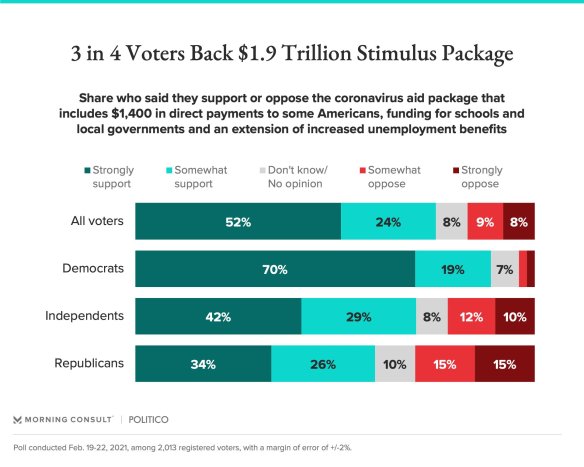
It’s understandable, therefore, that polls say an overwhelming majority of Americans support the Democrats’ Covid relief bill. One poll says 76% — even 60% of Republicans — support it. But not a single Republican in the House of Representatives voted for it. 
EvPxyZ5XYAQ9PJP

Paul Waldman and Greg Sargent of The Washington Post both have columns about the bill and the politics. Here’s a mixture from what they wrote:

If I asked you to explain the Republican case against the Covid relief bill, what would you say? Well, they think it’s too expensive, and they’d rather not give too much help to states and localities. But their arguments against it seem halfhearted, anemic, almost resigned. . . .

This ought to be a moment when the GOP is back in its comfort zone. It’s not a party built for governing; Republicans no longer have much of a policy agenda, their leaders have become much more skilled at obstruction than at passing laws, and they have an enormous propaganda machine with a talent for creating fear and outrage. The party’s specialty is opposition.

One of the things they’ve done in the past is cast every new Democratic or liberal move as a harbinger of an impending apocalypse. Obamacare, they said in 2010, would destroy the American health care system. If gay people are allowed to marry, they said in 2004, the result would be the end of families and the breakdown of society. Both predictions proved ludicrously wrong, but at the time, they were highly effective means of motivating opposition. Today you can still find such rhetoric, but you have to look for it. . . .

Back in 2009, [Republican congressman Paul Ryan] made a very public case against a stimulus a fraction this big, making an actual argument (if a fraudulent one) about what debt Armageddon would mean for American society.

These days it’s harder to make that case. Republicans blew up the deficit with a huge tax cut for the rich, and cheered along as the pre-Covid economy was rocket-fueled with stimulus. Economists no longer fear the long-term risks of massive deficit spending amid big crises.

As a result, there’s nothing close to the same kind of public argument this time. As Paul Krugman points out:

Republicans appear to be losing the economic argument in part because they aren’t even bothering to show up

It’s as if they know they don’t have to.

They may well fully expect Democrats to . . . get the economy booming again, even as the vaccine rollout and other policies successfully tame the pandemic.

Yet Republicans know that even if this happens, they still have a good chance at recapturing the House at a minimum, helped along by a combination of voter suppression and other counter-majoritarian tactics and built-in advantages.

[Outside of Washington] they’re racing forward with an extraordinary array of new voter suppression efforts. Such measures are advancing in Georgia, Florida and Iowa, and in many other states.

In a good roundup of all these new efforts, Ari Berman notes:

After record turnout in 2020, Republican-controlled states appear to be in a race to the bottom to see who can pass the most egregious new barriers to voting.

On top of that, Republicans are openly boasting that their ability to take back the House next year will gain a big lift from extreme gerrymanders. Some experts believe they can do that even if Democrats win the national House popular vote by a margin similar to that of 2020.

So is there any reason to doubt that they’re primarily counting on more of the same as their path back to power this time?

[But controlling the White House and both houses of Congress] presents an extraordinary opportunity for Biden and congressional Democrats if they can see their way clear to take advantage of it.

Right now, Democrats are tying themselves in knots trying to figure out how to increase the minimum wage, something President Biden ran on, their entire party believes in, and which is overwhelmingly popular with the public. Some want $15 an hour, while others would prefer $11.

Yet the Senate parliamentarian has ruled that a straight minimum wage increase can’t pass via the reconciliation process — the only way to pass a bill with a simple majority vote — the details of which are incomprehensible, or endlessly maddening, or both.

So Democrats have to find some kind of fiscal somersault to try to get the minimum wage increase into the Covid relief bill. 

This is no way to make laws. And what’s even worse is that it’s happening at a moment when Republicans — who in the past have been nothing if not skilled at undermining, vilifying, and sabotaging Democratic presidents — have seldom looked more feckless.

Republicans just haven’t been able to take the hatred and fear their hardcore base feels for Biden and scale it up and out, which then affects their ability to whip up frenzied opposition to the things he’s trying to do. And the broader context matters, too: When we’re caught in a pandemic and an economic crisis, only so many people will get worked up about whether a transgender girl is allowed to play softball.

That gives Democrats the chance to move forward confidently with their agenda, an agenda that is enormously popular. Yet some in the party are still in the grip of the nonsensical belief that it’s more important to retain a Senate procedure whose purpose is to thwart progress than to pass laws that solve problems.

In every American state legislature and in most every legislature around the world, if there’s majority support for a bill, it passes. In almost all cases supermajorities are only required, if ever, on things like constitutional amendments.

And every argument the filibuster’s defenders make about it — that it produces deliberative debate, that it encourages bipartisanship, that it makes for cooperation and compromise — is simply wrong, as anyone who has been awake for the last couple of decades knows perfectly well.

The Covid relief bill will pass, because it’s the only thing Democrats can do without a supermajority. It’s a vital, popular bill that could have been done in cooperation with Republicans had they wanted, but instead they’ve decided to oppose it. Which is their right, but it also shows how a simple majority should be the requirement for more legislating — which can only happen if the filibuster is eliminated.

The first weeks of the Biden presidency show the path Democrats can take: Push forward with the popular and consequential parts of your agenda, don’t be distracted by bleating from Republicans, act as though the public is behind you (because it is), and you might find that the Republican opposition machine isn’t as potent as it used to be.

But none of that will be possible unless Democrats can deliver on their promises. If they let themselves be handcuffed by the filibuster, the Biden presidency will fail and Republicans will take control of Congress. In other words, Democrats will have done the job Republicans couldn’t do themselves.

Unquote.

Neither of the columnists mentioned two key parts of the Democratic agenda.

The John Lewis Voting Rights Advancement Act would strengthen the Voting Rights Act of 1965. It would protect voters from racial discrimination and voter suppression.

The For the People Act would expand voting rights, overhaul our campaign finance system, and end extreme partisan gerrymandering.

All that stands in the way of these bills becoming law is the current requirement that ten Republican senators vote for them. That’s why the 50 Democratic senators need to end or severely limit the filibuster, thereby restoring majority rule to the US Senate. That’s how we can help restore majority rule to the United States of America.

On Cold, Slippery Ground at the Stupid Coup

According to the Chicago Project on Security and Threats, 40% of the people charged with crimes on January 6th are business owners or have white-collar jobs. Compared with previous rightwing extremists, relatively few of them were unemployed. Only about 10% had “identifiable ties to right wing militias or other organized violent groups”. Most were identified as “mainstream T____ supporters” (The Guardian).

Mark Danner tells what it was like outside the Capitol on January 6th. 

Harsh and gray dawned the day of the Stupid Coup, with a lowering sky of dense dark clouds, slippery muddy grass underfoot, and a stiff, unforgiving wind that kept the “Stop the Steal” flags flapping. Face-painted and brightly festooned pilgrims bearing banners—snarling T____ straddling a tank, pumped-up T____-as-Rambo brandishing a machine gun, grimacing T____ as motorcycle gang chieftain—milled about the archaic hulk of the Washington Monument looking like the remnants of a post-apocalyptic cult, with beefy bearded men in camo pants and Harley jackets, and women wearing red, white, and blue sweatshirts and draped in red “Make America Great Again” flags like Roman togas. And everywhere on hats and helmets and sweatshirts and pants was that double-plosive syllable he had spent his life affixing to buildings and airplanes and “universities” and steaks and vodka: “T____: NO BULLSHIT!” “FIGHT FOR T____!” “JESUS IS MY SAVIOR, T____ IS MY PRESIDENT.”

As I advanced toward the White House and the booming, reverberating electronic voices, the crowd began to thicken and finally to coalesce. Before I knew it I had been pressed into a mass of bodies straining toward a faintly gesticulating figure hundreds of yards away, echoed by the crudely pixelated image of an amped-up Eric T____, magnified a hundred times on the jumbotron, just glimpsable through the MAGA hats and flags. The crowd moved roughly as one, borne along by its rhythmic chants (“USA! USA! USA!” “Stop the Steal! Stop the Steal! Stop the Steal!”), and atop its messy bulk swayed the flags and the stretching hands clutching cell phones, on which the figure on the jumbotron (now the brass-voiced Evita of T____ism, Kimberly Guilfoyle) was replicated a few thousand times as far as one could see. Pressing my elbows against the bodies beside me I struggled to keep my footing on the wet ground, swallowed the incipient claustrophobic panic, and breathed in the acrid smell of marijuana wafting over us. All we needed was a mosh pit.

“Oh, I love him!” “Yeah, he’s amazing!” The dark-haired young women jostling against me from behind were struggling to hold a sightline to stare adoringly up at D____ Jr., now kissing his girlfriend Kimberly. With his slicked-back hair, open-necked shirt, and gaping jacket, he looked for all the world like a just-past-his-prime used-car salesman. “This isn’t their Republican Party anymore!” D____ Jr. roared. “This is  D____T____’s Republican Party!” Preening like a rock star, he extended his hand-mic to the crowd to catch the answering roar. Did the Republicans now gathering at the Capitol hear it? Did Vice President Mike Pence, presiding over the electoral vote certification, hear it? For D____  Jr. was shouting out a simple truth that for all its undeniability many in the party had never quite believed or managed to grasp in all its implications. T____ owned them. And as his owner’s prerogative he imposed an unstinting and singular loyalty: not loyalty mostly to him, with some prudently reserved for the Constitution and the law. No. Loyalty entirely to him. Today would be the day of choosing.

It is a testament to the powers of ambition and self-delusion that the thousands of garishly costumed people around me could see this clearly even while the sophisticated members of Congress and the media and intelligentsia could not. Moments before, as the royal family chatted in a tent in front of the White House and prepared to come out on stage, a broadly smiling Guilfoyle, clad in a smart black cape and shimmying briefly for the camera, said she hoped Pence would have “the courage or brains to do the right thing” and block the certification of Joe Biden’s election. Guilfoyle, a former Fox News anchor, is a lawyer who worked as a federal prosecutor and an assistant district attorney in California, and here she was, in a video later posted by D____ Jr., professing to believe that the vice-president would soon be turning the 2020 election over to the loser. T____ himself had been explicitly pressuring and then threatening Pence for days, both on Twitter and especially at the rally in Dalton, Georgia, two nights before, on the eve of the state’s two Senate runoff elections, where he mused that Pence “is a great guy. Of course, if he doesn’t come through, I won’t like him quite as much.”

Shortly after Rudolph Giuliani appeared (“Rudy! Rudy! Rudy!”) to propose that the election be settled by “trial by combat,” T____ himself slowly sauntered onstage to the strains of Lee Greenwood’s “Proud to Be an American.” After admiring the crowd and praising the grandeur of the Washington Monument, he laid out in laborious and disordered detail all the ways the unprecedented landslide “we” had won had been stolen—a litany he had recited two days before in Georgia and the week before that during his hour-long cajoling and whining and threatening telephone call with Georgia secretary of state Brad Raffensperger. And after he had read out once more all the discredited claims about all the dark doings in inner-city Detroit and Philadelphia and Atlanta—adding ruefully that the wily Georgians had now succeeded in stealing the election again—the president came to the point of what lay before us this day:

We’re going to have to fight much harder. And Mike Pence is going to have to come through for us. And if he doesn’t that will be a sad day for our country…. We’re going to walk down, and I’ll be there with you, we’re going to walk down to the Capitol and we’re going to cheer on our brave senators and congressmen and women, and we’re probably not going to be cheering so much for some of them. Because you’ll never take back our country with weakness. You have to show strength and you have to be strong. We have come to demand that Congress do the right thing…. We fight. We fight like hell, and if you don’t fight like hell, you’re not going to have a country anymore.

Deafening paroxysms of jubilation and rage greeted this doctrinal statement of T____ism, for who could better summarize the philosophy, such as it was, in fewer words? T____ as Rambo, as tank commander, motorcycle gang leader, and on and on. The imagery of T____ism is about strength and cruelty and dominance even as the rhetoric is about loss and grievance and victimization: about what was taken and what must be seized back by strength. And we would have to bring that strength, for certain it was that the politicians would turn out to be traitors, just like all the rest. From that fateful ride down the gilt staircase in the pink-marbled lobby of T____ Tower five years before—T____ism’s March on Rome—it had been about this: “Taking back the country.” Taking it back from the rapists and the killers, the undocumented and the illegitimate, the Black and the brown from “shithole countries” who should go back “where they came from.” Now it had all come down to this.

“Fight for T____! Fight for T____!” Above my head a tall homemade flag on a jointed metal pole flapped and waved and finally extended out fully for a moment, and I could read the words that had been printed in black type: “Lead Us Across the Rubicon!” And on the other side: “The die is cast!” I managed to nudge with my elbow the clean-cut, thirtyish young man gently waving the pole. “I like your flag,” I said. He turned his head back at me and smiled: finally, one who understood. “Yes,” he said. “It’s time.”

To the strains of “Tiny Dancer” and then “YMCA,” the mass began to loosen and separate. I slowly followed my new friend’s flag at a distance, my shoes wet and caked with mud, my feet near frozen. Caesar had led his soldiers across the Rubicon: the river had been the unwritten boundary beyond which a general was not permitted to bring his forces into Republican Rome. And yet the parallel had much to recommend it. Could his legions have been more loyal to their commander than these were to theirs? Was not our republic, too, beset with maladies its feckless leaders had proved powerless to remedy? Infestations of grasping and illegitimate foreigners. Obscene inequalities of wealth and power. Long-stagnant incomes. Senseless and unending foreign wars. Dispossessed and desperate veterans. And most of all a corrupt political class that had lost the confidence of the people. What was preserving the republic worth when set against such mortal ills? What was that supposedly noble cause but an excuse to maintain the rotting status quo?

In our dense procession we marched up Constitution Avenue. All the museums were shuttered, all the buildings closed. Washington had been shut down, first by the pandemic, now by us. Shops and hotels had covered their plate glass in plywood. The side streets were near deserted, except for the black-and-white police cars blocking the corners with their flashing blue strobes. This day would set a record in pandemic deaths and the next day would set another, surmounting for the first time four thousand dead. We were marching in a time of plague, and I felt vulnerable in my mask. Self-conscious, too: not one marcher in ten wore them. “They’re locking us down, taking away our freedom and our country, too!” someone exclaimed. Were the words meant for my ears? Few masks, yes, but fine makeshift costuming: we were a parade in motley, a dense Children’s Crusade of T____sters, with our flags pointed half forward now, as if we were advancing full-tilt on Jerusalem.

Lined up against the wall of a museum, men in tactical gear stood with backs turned, pissing. A woman in a kind of red, white, and blue pajama suit gazed down at her phone and shouted, “Pence just threw T____ under the bus!” A blond-haired woman in a woolly T____ hat said to no one in particular, “The courts won’t help. The Supreme Court won’t help. The only one left is us…”

Unquote. The article, written January 14th for The New York Review of Books, goes on from there, but it’s his first-hand account that evokes the event and who showed up.

Statistics for a Sunday Afternoon

Over the past 20 years, the US economy has grown at an annual rate of 1.9%. Goldman Sachs predicts a rate of 7% for 2021 (Washington Post).

The provision in President Biden’s Covid relief bill to send almost all families monthly checks of up to $300 per child would move close to 10 million children above the poverty line, cutting child poverty nearly in half (Los Angeles Times).

Asked to describe what happened during the assault on the Capitol, 58% of [the unindicted co-conspirator’s] voters call it “mostly an Antifa-inspired attack that only involved a few of [his] supporters” (USA Today).

We’ve had almost 500,000 confirmed Covid deaths in the US. To include that many names, the Vietnam Veterans Memorial would have to be 87 feet tall (Washington Post).

hith-vietnam-vets-memorial-2 (1)

The number of atoms in your body is roughly 1028 — that’s a 1 followed by 28 zeros (New York Times). There are around 1,000 different species of bacteria living on your skin (Nature).