A Few Thoughts on the Indictment, and a Disturbing List

The Mueller investigation implied that our former president was guilty of obstruction of justice. Mueller’s final reported listed 10 times he may have committed that crime. But the Department of Justice doesn’t like to prosecute presidents. Nothing happened. For reasons unknown, in 2021, the new attorney general let the matter drop, even though the former president was now a private citizen.

Now, more than two years later, the Department of Justice has convinced a grand jury that private citizen Donald J. Trump has committed a new set of crimes. The grand jury’s indictment is entitled “United States of America v. Donald J. Trump and Waltine Nauta, Defendants” (Nauta is one of Trump’s employees).

An important thing to note is that this ex-official isn’t accused of doing anything when he was in office. He could have removed all kinds of sensitive material from the White House when he was still president (like others have done before him) and nothing would have happened except justifiable criticism for being loose with government secrets. But when he was no longer president, he was required to give it all back, like others have done. His crimes boil down to lying to the FBI about which documents he had, hiding them and refusing to give them back.

These are the specific felonies he’s charged with:

  1. Willful Retention of National Defense Information (a section of the Espionage Act)
  2. Conspiracy to Obstruct Justice
  3. Withholding a Document or Record
  4. Corruptly Concealing a Document or Record
  5. Concealing a Document in a Federal Investigation
  6. Scheme to Conceal
  7. False Statements and Representations

They probably could have added another crime to the list, since he shared what he had with other people.

Note: There is absolutely no evidence that Hillary Clinton, Joe Biden or Mike Pence ever committed any of these crimes even though sensitive material was found in their possession at some point. (A major difference being that none of them refused to return anything or lied to the cops.)

Assuming the defendant pleads Not Guilty on Tuesday, it will be months before there’s a trial (assuming he doesn’t drop dead, lose his mind, change his plea, flee the country, etc. etc. in the meantime). In our judicial system, a “speedy trial” is hardly ever a quick one.

Although a biased, incompetent right-wing judge (Aileen “Loose” Cannon) will accept the defendant’s plea next week, it seems impossible that she will handle the rest of the case. Has a judge ever presided over a federal criminal case in which the defendant chose her to be a judge? No. It would be like a kennel club official deciding who’ll be the judge at a dog show and then entering her own dog in the contest.

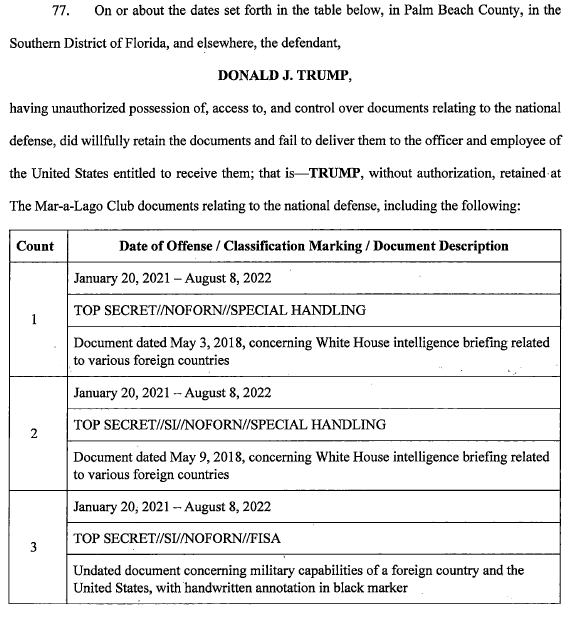
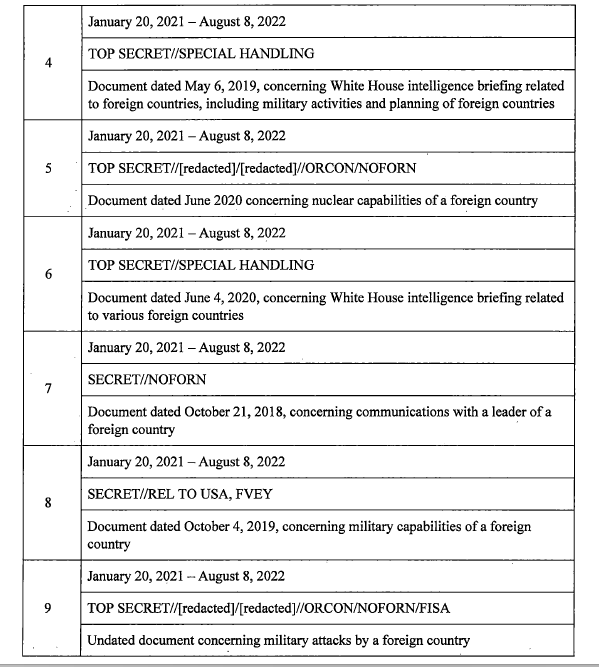
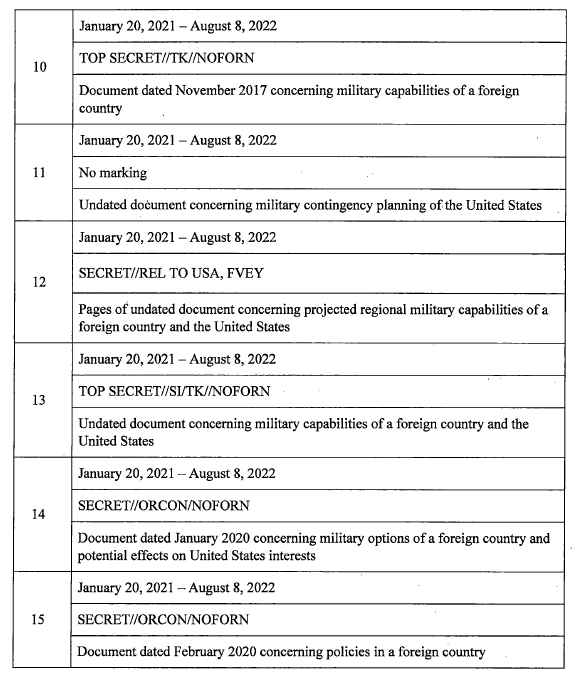
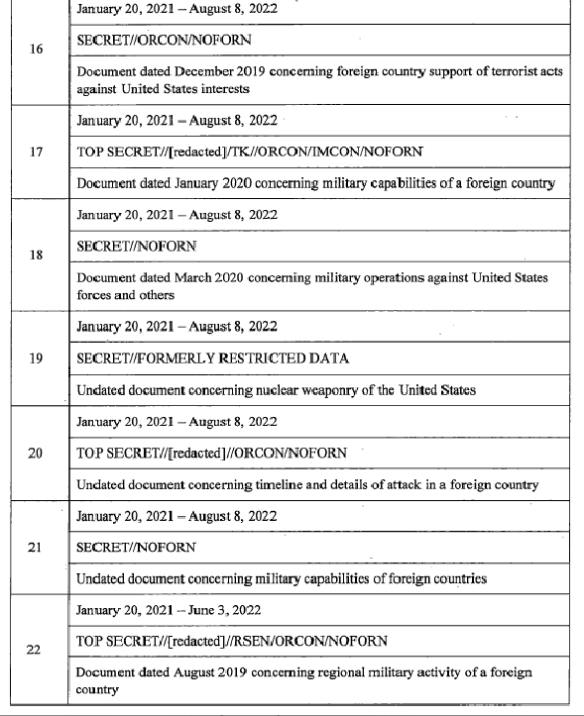
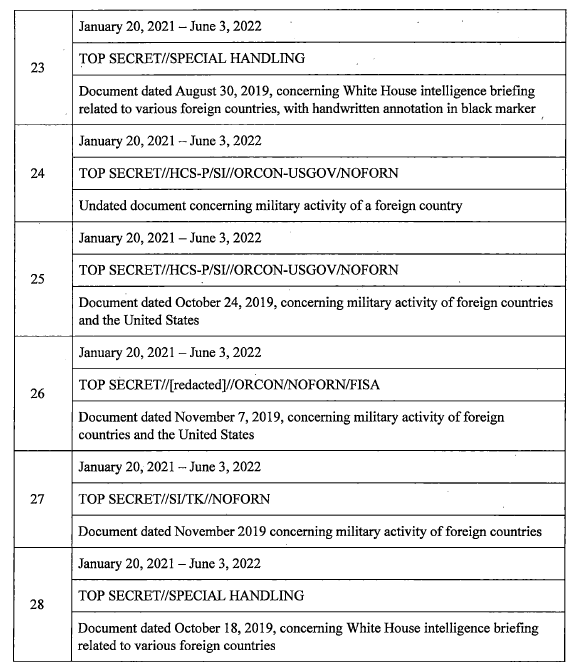
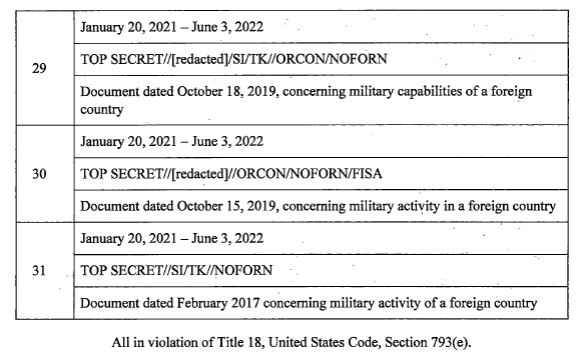
Finally, the part of the indictment that mainly describes the movement and concealment  of boxes, which goes from page 17 to page 26, is kind of boring, but one of the things after that is very interesting. I don’t think anybody in the government knows if the defendant is still holding on to stuff he shouldn’t have. It’s also possible the prosecutors didn’t list the most sensitive documents he took (it would make the U.S. government’s ability to keep secrets look even worse). But take a look at the documents listed:

Untitled1Untitled2

Untitled3Untitled4Untitled5Untitled6

On Some Who Choose to Ignore Reality

Massive Canadian wildfires and an unfortunate weather pattern have resulted in the worst air quality we’ve ever experienced on the East Coast of the United States. The air quality index for New York City reached 405 yesterday. Anything above 300 is considered “hazardous”, i.e. an environmental emergency that may harm even healthy young people.

Climate scientists have been saying for years that one effect of the climate crisis will be more dangerous wildfires. But pundits at Fox “News” don’t want to admit there is a climate crisis. They also don’t want to admit that wearing masks helped save lives during the pandemic. For these reasons, some have told their viewers, many of whom are over 65, not to worry. No need to stay indoors. No need to wear a mask outside.

The Five co-host Jeanine Pirro took issue with Rep. Alexandria Ocasio-Cortez (D-NY), who issued a call to “adapt our food systems, energy grids, infrastructure, and healthcare” in response to the “climate crisis.” In response, Pirro said: “Other Democrats are pumping up climate hysteria and bringing back, you guessed it, mask insanity.”

This remarkable right-wing reaction to an undeniable problem brought to mind a couple things I’ve read recently.

An article in The New York Times describes an experience the author Joan Didion and her husband John Gregory Dunne had at the Royal Hawaiian Hotel in June 1968. Sen. Robert Kennedy had just been assassinated, shortly after the assassination of the Rev. Martin Luther King….

A television had been set up on the Royal Hawaiian’s lanai, a large veranda. When the couple arrived, it was already crowded with viewers, and … a musical variety program was playing…. “Hollywood Palace” was scheduled to air next, but the evening’s programming was pre-empted by the special news program on Kennedy’s assassination. The lanai crowd wasn’t happy. Some stood up to leave.

The ABC news special … opened with a rendition, by the actor Hume Cronyn, of William Butler Yeats’s “The Second Coming,” the same poem from which Ms. Didion had drawn the title of her first book of essays, Slouching Towards Bethlehem: “And what rough beast, its hour come round at last, slouches towards Bethlehem to be born?”

As the three-hour special wore on, Ms. Didion looked around the veranda and noticed that everyone who was sitting there earlier in the evening had left. A few guests stopped to ask about the program she was watching, but at the reply — Bobby Kennedy — they continued on their way…. “It was as if they were shutting their minds to it, shutting their eyes,” [Dunne later said]….

For Didion, “it was, in some ways, a very radicalizing experience for me”. These tourists from the mainland, she realized, enjoying their Hawaiian vacation as if nothing had happened, were not going to have any part of a national tragedy — even as, on the hotel’s television, Robert Kennedy’s casket was transported by rail to Washington and along the tracks nearly two million people lined up to pay their respects.

To Ms. Didion, the contrast between these scenes and the Royal Hawaiian’s conspicuously deserted veranda felt appalling. With Kennedy’s assassination, she said, “it was as if all the disturbances of the whole past couple of years came to a head that night. And here was a whole part of America that wasn’t having it … It was like something snapping”…

“It seemed as if these people did not count themselves as part of the community. That they came from another America”….They could watch “The Lawrence Welk Show” but ignore a political assassination. The same economic system that put these specific Americans in the position to take this vacation — the white-collar stability, the inequality sustaining it — was what allowed them, now, to turn their backs. They didn’t really care about any of it; the broader narrative of patriotism and pride was just an excuse for doing what they wanted — for their self-interest — a narrative they could apply and discard from one situation to the next as they saw fit.

The implications weighed heavily on Didion: How could this country continue to exist if the people who’d gained the most from it refused to contribute? How long until the dark pattern she and [her husband] saw in Kennedy’s murder reached its natural conclusion? It’s a sense of catastrophe — of that rough beast in the distance slouching closer — that, to many current Americans, feels strikingly familiar.

Writing for New York Magazine, Jonathan Chait describes the Republican Party’s “authoritarian acceleration”:

For a time in early 2021, Txxxx’s support for the insurrection was a black mark on his record that even many loyalists couldn’t condone. That taboo is fading from memory. Txxxx has said he would “most likely” pardon “many” of his allies arrested on January 6 and has turned Ashli Babbitt, who was shot trying to break into a sealed hallway while storming the Capitol, into a martyr. [Another Republican presidential candidate, Ron DeSantis] has promised to pardon at least some J6-ers….

Most instructive of all are the rationalizations used by Txxxx’s erstwhile skeptics within the party. They have concluded, more in sorrow than in anger, that since the party contains a very large faction of voters who believe Txxxx is entitled to legal impunity, the only choice is to placate them. “Republican voters do not respond well to Republican lawmakers who make the case against [his] legal misconduct in plain terms. I wish they did, but they don’t,” says National Review’s Noah Rothman, defending DeSantis’s position on the insurrectionists…..

[A] Republican strategist recently explained the calculation to Politico’s Jonathan Martin in similar terms: “The conservative media ecosystem has built a giant wall of inoculation around everything Txxxx…. To forcefully condemn Txxxx as a menace to democracy is to echo the other tribe, to put on the blue jersey … Shaming your own voters is not a recipe for victory.”

It is sobering to see such an unblinkered description of the party’s intellectual rot attached to such a fatalistic conclusion. The party’s leader is an authoritarian and a crook, and its media apparatus is rank propaganda, making it impossible to identify or correct even the grossest crimes. This is the definition of an internal culture that is beyond repair. The only possible response for anybody possessing a minimal commitment to democracy is to get out.

Yet the years since Txxxx arrived on the Republican scene have instilled in the party’s elite a learned helplessness. The notion that the party could grow so dangerous that they must abandon it for the sake of the Republic is unimaginable to them. Txxxx is planning a second term that can break down every guardrail that held him back the first time. The Republican “opposition,” as it were, is dedicated to bringing more planning, intraparty support, and ruthlessness to the very same project.

While she was still in Hawaii, Didion had “an attack of vertigo, nausea and a feeling that she was going to pass out,” for which she “underwent an extensive psychiatric evaluation and was prescribed an antidepressant”. She later wrote: “By way of comment, I offer only that an attack of vertigo and nausea does not now seem to me an inappropriate response to the summer of 1968″.

How about to the late spring of 2023?

Wise Legal Advice Biden May Not Be Getting and Possibly Good News About Russia

As is often the case, there is a golden mean between paying no attention to politics and paying too much. Since I don’t have President’s Biden ear, I’m guilty of the latter (I’m pretty sure the messages I’ve sent him didn’t made it to his desk).

Nevertheless, here is some brief discussion of the debt ceiling I read today that I want to share:

From Josh Marshall of Talking Points Memo:

Even though this won’t come as new news to many of you, the following is still a clarifying prism. A negotiation is usually two sides haggling to get things they want. Leverage is often unequal…. But in this negotiation, Republicans are getting various policy priorities and Democrats are “getting” Republican agreement not to create a global financial crisis. That’s extortion, not negotiation. A government can’t operate in any consistent or sustainable way when policy deliverables go to the party willing to credibly threaten the most damage to the country.

And from two law professors with fancy titles who work at respected universities:

Our advice has always amounted to a version of the now-overused mantra: “Keep calm and carry on.” The best thing to do in a debt ceiling crisis is to continue to raise the money necessary to pay the government’s bills. If Republicans block action on the debt ceiling, the President would indeed break the law by issuing new debt. But among his options at that point, all of which would be bad, that would be the closest thing to a plain-vanilla response. We would not see the government stiff its creditors.

Instead, the Treasury Department would do what it always does: go into the financial markets and raise funds from willing lenders. Those lenders would almost certainly demand higher interest payments than otherwise, which would offer the irony that the Republicans’ vows to “do something about the debt” will result in more debt, not less. But in a world of their making, borrowing money as it is needed, in as close to the normal way as possible, will be President Biden’s best (and least unconstitutional) option.

Elsewhere, there’s evidence that some Russian soldiers are switching sides and actually taking back territory from the Russian army. It isn’t a surprise that some of the troops don’t care for Putin at all. This is a good sign, combined with the fact that Ukraine is offering special treatment for soldiers who surrender, including care overseen by the Red Cross and no requirement to ever return to Russia. We used to think high-level officials might be the ones to do something about Putin. Maybe the uprising will start in the lower ranks. After all, the Russian Revolution began with mutiny in the army.

These Are Not Roosevelt’s “Four Freedoms”

This might be the best political comment ever left on a blog:

Conservatism consists of exactly one proposition, to wit: There must be in-groups whom the law protects but does not bind, alongside out-groups whom the law binds but does not protect.

Jamelle Bouie of The New York Times (one of their columnists who is actually worth reading) offers evidence for that proposition in “The Four Freedoms, According to Republicans”:

On Tuesday, Republicans in North Carolina overrode Gov. Roy Cooper’s veto to pass a strict limit on bodily autonomy in the form of a 12-week abortion ban…. North Carolina Republicans are obviously not the only ones fighting to ban, limit or restrict the right to bodily autonomy, whether abortion or gender-affirming health care for transgender people. All across the country, Republicans have passed laws to do exactly that wherever they have the power to do so, regardless of public opinion in their states or anywhere else. The war on bodily autonomy is a critical project for nearly the entire Republican Party, pursued with dedication by [everybody] from the lowliest state legislator to the party’s powerful functionaries on the Supreme Court.

You might even say that in the absence of a national leader with a coherent ideology and agenda, the actions of Republican-led states and legislatures provide the best guide to what the Republican Party wants to do and the best insight into the society it hopes to build.

[Their] attack on bodily autonomy [is] part of a larger effort to restore traditional hierarchies of gender and sexuality. What else is on the Republican Party’s agenda, if we use those states as our guide to the party’s priorities?

There is the push to free business from the suffocating grasp of child labor laws. Republican lawmakers in Arkansas, Iowa, Missouri and Ohio have advanced legislation to make it easier for children as young as 14 to work more hours, work without a permit and be subjected to more dangerous working conditions. The reason to loosen child labor laws — as a group of Wisconsin Republicans explained in a memo in support of a bill that would allow minors to serve alcohol at restaurants — is to deal with a shortage of low-wage workers in those states.

There are other ways to solve this problem — you could raise wages, for one — but in addition to making life easier for the midsize-capitalist class that is the material backbone of Republican politics, freeing businesses to hire underage workers for otherwise adult jobs would undermine organized labor and public education, two bĂȘtes noires of the conservative movement.

Elsewhere in the country, Republican-led legislatures are placing harsh limits on what teachers and other educators can say in the classroom about American history or the existence of L.G.B.T.Q. people….Nationwide, Republicans in at least 18 states have passed laws or imposed bans designed to keep discussion of racial discrimination, structural inequality and other divisive concepts out of classrooms and far away from students.

Last but certainly not least is the Republican effort to make civil society a shooting gallery. Since 2003, Republicans in 25 states have introduced and passed so-called constitutional carry laws, which allow residents to have concealed weapons in public without a permit. In most of those states, according to the Giffords Law Center to Prevent Gun Violence, it is also legal to openly carry a firearm in public without a permit.

Republicans have also moved aggressively to expand the scope of “stand your ground” laws, which erode the longstanding duty to retreat in favor of a right to use deadly force in the face of perceived danger…. It should be said as well that some Republicans want to protect gun manufacturers and dealers from lawsuits. Gov. Bill Lee of Tennessee did just that this month — after a shooting in Nashville killed six people, including three children, in March — signing a bill that gives additional protections to the gun industry.

What should we make of all this? In his 1941 State of the Union address, Franklin Roosevelt said there was “nothing mysterious about the foundations of a healthy and strong democracy” and that he, along with the nation, looked forward to “a world founded upon four essential human freedoms.” Famously, those freedoms were the “freedom of speech and expression,” the “freedom of every person to worship God in his own way,” the “freedom from want” and the “freedom from fear.” Those freedoms were the guiding lights of his New Deal, and they remained the guiding lights of his administration through the trials of World War II.

There are, I think, four freedoms we can glean from the Republican program.

There is the freedom to control — to restrict the bodily autonomy of women and repress the existence of anyone who does not conform to traditional gender roles.

There is the freedom to exploit — to allow the owners of business and capital to weaken labor and take advantage of workers as they see fit.

There is the freedom to censor — to suppress ideas that challenge and threaten the ideologies of the ruling class.

And there is the freedom to menace — to carry weapons wherever you please, to brandish them in public, to turn the right of self-defense into a right to threaten other people.

Roosevelt’s four freedoms were the building blocks of a humane society — a social democratic aspiration for egalitarians then and now. These Republican freedoms are also building blocks, not of a humane society but of a rigid and hierarchical one, in which you can either dominate or be dominated.

Six Legal Reasons the President Should Ignore the Debt Ceiling

Republicans threatening to cause a financial crisis by refusing to raise the debt ceiling unless their agenda is enacted are practicing extortion, plain and simple (“extortion”: the act or practice of wresting anything from a person [or persons] by force, by threats, or by any undue exercise of power). It is not negotiation.

Any advisors or other members of his administration who are telling the president that he shouldn’t issue an executive order for the Secretary of the Treasury to ignore the debt ceiling and keep paying the government’s bills (if that becomes necessary) are deeply mistaken.

Concerns that the Supreme Court would somehow intervene and create a financial crisis are overblown. The President doesn’t need the court’s permission. If it becomes necessary, he should demonstrate leadership and present the court with a fair accompli.

Concerns that the President taking unilateral action to avoid a financial crisis would somehow create a comparable financial crisis are simply stupid.

Robert Hockett, is the Edward Cornell Professor of Law and a Professor of Public Policy at Cornell University; Senior Counsel at Westwood Capital, a socially responsible investment bank; and a Fellow of the Century Foundation think tank. He has worked at the International Monetary Fund and the Federal Reserve Bank of New York and serves in a consultative capacity for a number of U.S. federal, state, and local legislators and regulators.

Writing for Forbes magazine, he provides six legal reasons why adhering to the federal budget takes precedence over the debt ceiling law. You might not care to read so much on this subject. I just wish the damn president, his new chief of staff, the Secretary of the Treasury and the Attorney General would:

Writing in outrage for over a decade about the illegality of the putative ‘debt ceiling as I, along with several distinguished colleagues, have been doing, I am not a little relieved to see some of our longstanding arguments gaining traction. I am a little bit troubled, however, by how attention has centered almost solely upon the 14th Amendment to the U.S. Constitution.

The 14th Amendment is, to be sure, one of the grounds upon which the ‘debt ceiling’ must be declared null and void – for reasons even beyond those we’re hearing right now, as I’ll indicate. But there are at least five additional such grounds. It might then be helpful to elaborate them, along with their mutual complementarities, in summary fashion.

Let’s start with the constitutional and legislative backdrop …

Articles I and II of the Constitution vest both Congress and the President with budgetary roles. All spending and revenue-raising must be legislated, and valid legislation must be passed by both chambers of Congress and signed into law by the President. Final budgets, such as they are, are accordingly joint Congressional and Presidential products – save in such rare circumstances as those in which Congress overrides a Presidential veto with a supermajority vote.

The Constitutional provisions that I have just channeled are broadly worded and prescribe very little as to the details of federal budget processes. These are determined, instead, by more legislation. In 1921, through the Budget & Accounting Act, Congress vested primary budget formulation responsibility with the President, establishing both detailed timetables and the predecessor of today’s Office of Management and Budget (OMB) to help shepherd the process along.

The ‘debt ceiling’ is rooted in this era, during which Congress relinquished its previous role as legislator of every distinct federal bond-issuance. Congress did this to afford the President – by their own law our primary budget-formulator – more flexibility in determining revenue sources for funding the growing variety of legislated programs. That’s right, the original ‘ceiling’ was about affording the President more discretion, not less.

It is no accident that the Liberty Bond Act of 1917 (original source of the ‘ceiling’), the 1913 vintage 16th Amendment to the Constitution authorizing the federal income tax, the thereby enabled Revenue Act of 1913, the Federal Reserve Act of 1913, and the aforementioned Budget & Accounting Act of 1921 all came in rapid succession. In effect, these enactments, all passed by Congress and signed into law by the President, constituted one coherent federal budget regime.

All of this changed, however, in 1974. The ‘crisis’ that occasioned the change was brought on, like so many others of the era, by President Richard Nixon. Nixon had an unfortunate tendency to think himself more ‘imperial’ than the Constitution allowed, and took it upon himself to decide with unprecedented frequency what Congressionally legislated and funded programs, even though he had signed them into law in the first place, were worthy of actual execution and funding.

The practice in which he manifested this proclivity was known as ‘impoundment.’ The idea was that instead of spending what Congress had instructed him to spend and what he had agreed, by signing their legislation, to spend, Nixon was routinely spending only what he wished to spend, while ‘impounding’ the rest – in effect, holding it hostage.

Congress put an end to this chicanery by passing the Congressional Budget and Impoundment Control Act of 1974, pursuant to which both Congress and the President go through detailed procedural steps in formulating their own budgets, which budgets are then ‘reconciled’ and collated before being legislated into law piecemeal through sundry program authorization and appropriations acts passed by Congress and signed by the President. (The Supreme Court closed all plausible loopholes in the Act in Train v. City of New York one year later.)

This is also the origin of the Congressional Budget Office (CBO), designed as a counterpart to the President’s OMB. In effect, then, what we have had for the past 50 years is an altogether new budget regime superseding the regime put in place 50 years before then. The earlier regime, in other words – including its ‘debt ceiling’ component – was implicitly repealed by the later regime.

You can see this by noting the logic – or shall we say the arithmetic – of the post-1974 regime. Pursuant to that regime the duly legislated federal budget first determines both revenue and spending, then assigns the President and his Treasury Department the task of filling any gaps between the former and the latter through debt issuance. And, since the President is prohibited under this regime from not spending what the budget mandates he spend, the regime effectively mandates that he borrow any time mandated spending exceeds mandated revenue.

We are now situated to see why the 1917 ‘debt ceiling’ as presently wielded like an AR-15 by a rump faction of the House Republican Caucus is actually no more than a leaky water pistol. For there is literally no way for the President to comply with the putative ‘ceiling’ … that does not entail his violating the federal budget itself — as formulated pursuant to the 1974 regime that superseded the early 20th century regime. Here are the six reasons why


Reason 1. The ‘Take Care’ Clause: Article II, Section 3 of our Constitution requires that the President ‘take care that the Laws be faithfully executed.’ President Nixon effectively violated this provision by not spending as Congress, through that law which is the federal budget, mandated that he spend. President Biden would be doing the same were he not to spend as the last federal budget requires that he spend, and were he not to borrow in so doing as that budget arithmetically mandates that he borrow.

Reason 2. The ‘Presentment’ Clause, a.k.a. ‘Line-Item-Veto’ prohibition: Article I, Section 7 of our Constitution requires that bills passed by both chambers of Congress be ‘presented’ as wholes to the President, which the latter then signs into law or vetoes. In Clinton v. City of New York (1998), our Supreme Court held that the Line Item Veto Act of 1996 violated this clause by purporting to permit the President to ‘cherry-pick’ which budget items would become law and which ones would be left on the cutting room floor.

Were President Biden to ‘prioritize’ payments mandated by the current federal budget as the aforementioned rump faction of the House Republican Caucus suggests, he would be doing precisely what the Court held that President Clinton couldn’t do and that Congress could not authorize.

Reason 3. The 14th Amendment: Article XIV, Section 4 of our Constitution provides that ‘[t]he validity of the public debt of the United States, authorized by law… shall not be questioned.’ The framers’ intention in enacting this Constitutional provision is of particular interest right now. The self-styled ‘Confederate States of America,’ controlled by slave owners, had pulled their members from Congress and endeavored to destroy our federal union ‘from without’ by launching military attacks … in 1861. President Lincoln and Congress incurred unprecedented federal debt (multiplying it 80-fold, from a bit over 64 million to 5.2 billion), in the form of Treasury securities sold to millions of Americans, in financing the successful effort to end that rebellion.

As the nation began healing at the Civil War’s end, concerns grew that Southern legislators readmitted to Congress would continue their effort to destroy our federal union, save now from within, by repudiating the war-occasioned federal debt that American statespersons since Alexander Hamilton had recognized as the essential financial binding agent holding our union together. Indeed, Southern legislators were quite open about their intentions on this score, which is precisely what occasioned the requirement that Southern states ratify the 14th Amendment as a condition of rejoining the Union rather than remaining militarily occupied conquered territories.

The applicability of the 14th Amendment to the present ‘debt ceiling’ insanity grows quite clear when we recall this history. It is a striking fact both that the aforementioned rump faction of the House Republican Caucus nearly all hail from former Confederate or Confederate-border states, and that many of them have called for a ‘national divorce’ …. It is equally striking that most of these … Republicans have been transparent about their aims … to sow chaos and thereby pave the way for a Weimar style anti-constitutional putsch by their criminal ringleader and serial bankrupt in Mar-a-Lago, Florida – who has himself now explicitly called for default on the national debt.

Reason 4. The ‘Later in Time’ Rule: It is a well established judicial canon of statutory construction that when an old law appears to conflict with a newer law or treaty, the older law must either be interpreted in a manner that does not conflict with the newer law, or be treated as having been implicitly repealed by the newer law. There are two ways in which this canon is applicable to our present ‘debt ceiling’ imbroglio.

First, the 1974 budget regime clearly displaces the earlier regime, including its ‘debt ceiling.’ This is made dramatically clear in the 1974 regime’s requiring both that the President execute the budget in full (no impoundments), and that s/he issue debt in so doing to fill any gap between spending and revenue. And second, any current budget enacted later in time than the last ‘debt ceiling’ hike of course supersedes the latter.

It is for this reason that I’ve often written that ‘the budget is its own “debt ceiling.”’ Indeed, in light of the anti-impoundment content of the 1974 Act, it is clear that the budget is both its own floor and its own ceiling. It is self-contained. It is the be all and end all of federal budgeting. It is the entirety of the law governing spending, taxing, and borrowing, with no role left to be played by the old 1917 Liberty Bond Act ‘ceiling.’

Reason 5. The ‘Absurd Result’ Canon: It is also a well established canon of statutory construction that, when a legal provision – either as written or as it would be applied – can be construed in more than one way and one such way would yield a result so absurd that the legislature cannot plausibly be taken to have intended it, the interpretation yielding that result must be considered mistaken.

In the present context, it is clear that the interpretation of the ‘debt ceiling’ proffered by the aforementioned rump faction of the Republican House Caucus would yield multiple absurdities of the relevant sort. It would require the President to violate contract obligations (which US borrowings assuredly are), the last-legislated federal budget of 2022, the 1974 Congressional Budget and Impoundment Control Act, and one or more of the three Constitutional provisions assayed above.

And that is to say nothing of the cataclysm that default on our national debt, which we’ve never reneged on before, would bring to the US dollar, to US debt servicing costs, to the US banking and financial sectors, to the nation’s pension and mutual fund holders, to the nation’s inflation rate and its broader economy, and indeed to the world’s capital markets and trading economy.

It is simply impossible to imagine the framers of the Liberty Bond Act of 1917 – who were seeking to facilitate the financing of the First World War effort – or indeed any member of Congress prior to the aforementioned rump faction of the House Republican Caucus, ever having intended even one of these outcomes, let alone all of them.

Reason 6. The ‘Constitutional Avoidance’ Doctrine: Finally, it is also a well established canon of statutory construction that, when a legal provision – either as written or as it would be applied – can be construed in more than one way and one such way would raise a Constitutional issue, the interpretation yielding that result should if possible be considered mistaken.

The applicability of this doctrine to the present imbroglio is, like those of the previous legal doctrines, quite clear as well. The ‘debt ceiling’ as interpreted by today’s [MAGA] Republicans would squarely conflict with the 14th Amendment as noted above. Either the interpretation, then, or the ‘ceiling’ itself must be deemed without legal force.

I hope that the point is now made. Neither the President, nor the Treasury Secretary, nor any responsible member of Congress need worry that there would be anything ‘legally questionable’ about either or both Congress’s and the President’s simply disregarding the ‘debt ceiling’ and continuing to make good on the nation’s legal obligations as always. No court would find otherwise.

There simply is no uncertainty here. Indeed, the law quite clearly, quite certainly and quite squarely requires one thing. It requires that Congress and the President alike recognize that the old 1917 relic known as the ‘debt ceiling’ as presently applied is null and void, and has been so both since its inception and especially since Congress smacked down the would-be ‘imperial’ President Nixon a half-century ago.