Looking Back at Another Age of Acrimony

I’ve got two big books in a holding pattern. First, there’s Grant, Ron Chernow’s enormous biography of Ulysses S. Grant. I’ve read most of it, but now that the Civil War is over and Grant’s been elected president, I’m having trouble going forward. The other one is the almost equally enormous The Republic For Which It Stands by the historian Richard White. Its subtitle is “The United States during Reconstruction and the Gilded Age, 1865-1896”. I’m only a few pages into that one.

The problem is that White’s book and the next 300 pages of Chernow’s both deal with Reconstruction — the failed attempt to give Black people equal rights in the South after the war — and the Gilded Age — the period from around 1870 to 1900 that featured rapid economic growth and increasing inequality in the whole country. It might be too much to read further about that important and relevant period while living through our own version of the Gilded Age, with its astounding inequality and troubled politics (now featuring dangerous attacks on voting rights).

Anyway, Smithsonian Magazine has an interesting article about the same period. It’s by Jon Grinspan, the author of The Age of Acrimony: How Americans Fought to Fix Their Democracy, 1865-1915. The article is much shorter than any of these books. Here’s most of it: 

. . . Most people don’t often think about the politics of the late 1800s. Call it “historical flyover country,” an era stranded between more momentous times, when U.S. presidents had funny names and silly facial hair. But for our current political crisis, this period is the most relevant, vital and useful. The nation’s wild elections saw the highest turnouts and the closest margins, as well as a peak in political violence. Men and women campaigned, speechified and fought over politics, in a system struggling with problems all too familiar today. . . .

American democracy held revolutionary new promise in the mid-1800s. For all its flaws, the nation was experimenting with a bold new system of government—one of the first in world history to give decisive political power to people without wealth, land or title. Working-class voters predominated at the polls. Poor boys grew up to be president. And reformers fought for votes for women and Black Americans.

At the end of the Civil War in 1865, with slavery dead, the old aristocracy vanquished, and four million formerly enslaved people hoping for new rights, Americans began to talk about “pure democracy.” That concept was never well defined, but for many activists, it meant that it was time for the people to rule. But how to get a busy, distractable, diverse nation to participate?

Decades earlier—from the 1820s to the 1850s—campaigners tried to engage voters by building bonfires, holding barbecues and offering plenty of stump speeches while handing out booze. Then, on the eve of the Civil War, supporters of Abe Lincoln’s hit on a new style. Lincoln’s Republican party introduced the “Wide Awakes” clubs to America. Gangs of young partisans, wearing dark, shimmering martial uniforms and armed with flaming torches, stormed through towns and cities in midnight marches. For the half century after 1860, every political campaign worth mentioning borrowed this approach, organizing massive rallies of tens of thousands of uniformed, torch-waving marchers. Diverse crowds turned out, from boisterous veteran voters to rowdy boys, from grandmothers to young women, from journalists armed with pens to political rivals armed with their revolvers.

Such public politics became, in the words of one comedian, “our great American game.” Political rancor grew precipitously. Saloons resounded with heated debates. On train cars, Americans took straw polls to see how strangers would vote. At dinner tables, families bonded—or broke up—debating an upcoming race. Even when exhausted Americans threw down their newspapers, they looked up only to find partisan broadsides slathered on every wall. “Ignorance is bliss now,” complained one woman as she canceled her political newspapers, weary of the whole spectacle.

For voters, participation meant an even deeper immersion. Election Day was a communal, combative, boozy bacchanal. White’s metaphor was apt, when people voted, they literally got drunk on Election Day. One Norwegian wrote home from Chicago, remarking that “it was fun to see” crowds of workers leaving their factories to go vote, “either before or after stopping at a bar.” During the 1876 election, which drew an unprecedented 81.8 percent turnout—Rutherford B. Hayes’s campaign handed out massive oversize beer steins, despite the fact that Hayes and his wife were devout teetotalers.

All the carousing culminated at a rambunctious polling place, when a voter selected a colorful ticket from his party’s ballot “peddlers,” made his way past the opposing party’s intimidating “challengers,” and placed his vote in a wooden or glass ballot box. Amid singing, shouting and heckling from the other voters in his community, it was a scene of heated, convulsive political theater. The system seemed designed to take over life, distort opinions, attract bad actors, raise voices and destroy civility.

In northern cities, a sneering establishment worried that the system was dominated by a working-class majority who could always outvote them. The celebrated Boston aristocrat Francis Parkman famously complained that democracy didn’t work in his 1878 “The Failure of Universal Suffrage,” a screed that claimed that the voters were “a public pest” and that the real threat to America came not from above, but beneath. Belief in equality and majority rule, Parkman argued, was destroying America.

Equal suffrage met even more aggressive attacks in the South. White supremacist ex-Confederates, who lost the war and had remained on the fringes of politics for most of a decade after, used the Democratic party to terrorize Black voters, end Reconstruction and dramatically suppress voter participation. Within a few short years of the end of slavery, one million formerly enslaved Americans became voters, but most lost their rights nearly as quickly as Reconstruction ended and the Jim Crow era began.

In the North, voter turnouts peaked from 1876 to 1896, and elections were never closer. No president in this period came to office by winning a majority of the popular vote [i.e. the presence of multiple candidates in the elections from 1876 to 1892 meant nobody got more than 50% ]. Even with racial issues falling out of the national spotlight, fights over money and inequality fired up voters.

Though the electorate turned out in huge numbers, marchers filled squares and newspapers attacked rivals, politics failed to bring real change. This system—overheating and yet standing still—led only to anger and agitation. In 1881, the mentally ill drifter Charles Guiteau, who had campaigned for President James Garfield at torchlit rallies, felt slighted and decided that America would be better off if the “President was out of the way.” So Guiteau bought the largest pistol he could find, and shot Garfield—the murder was the second assassination of a president in just 16 years. Within two decades, another madman would gun down President William McKinley. And every seven years, on average, a sitting congressman was murdered.

American politics had hit on an amazing ability to mobilize citizens, but also to agitate them to unspeakable violence. Citizens looked for someone to blame. Presidents were criticized, but really the executive branch was so weak that they could do very little. Powerful party bosses often nominated friendly, malleable do-nothings to the job. More people blamed politicians as a class. Brilliant cartoonists like Thomas Nast and Joseph Keppler mocked politicians as snarling beasts, overfed vultures, sniveling rats and thuggish bosses. Others attacked the rising immigration rates, like Francis Willard, the leader of the Women’s Christian Temperance Union, who blamed America’s out-of-control politics on “alien illiterates.” Others still aimed (more accurate) attacks at railroads, corporations, robber barons and lobbyists who seemed to be buying up America. The muckraking reporter Henry Demarest Lloyd wrote that “liberty produces wealth, and wealth destroys liberty.”

. . . Some well-to-do reformers blamed, not individuals or groups, but the culture and etiquette of American democracy. All those noisy rallies were nothing more than a “silly sort of show,” those busy polling places were “vulgar,” “venal” and “filthy.” American democracy, a growing upper middle-class movement argued, needed an intervention, and in an era of Temperance politics, reformers knew just how to achieve it.

First, they went after the booze. Reform organizations pulled the liquor licenses from political fundraisers, closed saloons on Election Day and passed prohibition laws on the county and state level. Voters were more clearheaded, but those partisan saloons had been key institutions for working-class men. Shutting them down meant shutting many out.

Cities banned marches without permits and used police and militias to punish unlawful assembly. And parties desperate to win over “the better class of people,” as one reformer put it, stopped paying for torches, uniforms, fireworks and whiskey. Campaigners shifted from thrilling street-corner oratory to printed pamphlets. To some, these changes looked like innovations. The Los Angeles Times cheered the citizens who had spent previous elections “on the street corner shouting, or in the torchlight procession,” but could now be “found at home” reading quietly.

Starting in 1887, state after state switched to the secret ballot—a dense government form that was cast privately—and dispatched with party-printed tickets. By isolating each voter “alone with his conscience” in the polling booth, or behind a voting machine’s curtain, he was certainly made more reflective, but also more removed. Those who could not read English, who had previously voted by color-coded ballots, were out of luck with the complicated machines, text-heavy ballots or unsympathetic poll workers. And those who participated in Election Day because they enjoyed the day as a nationwide happening, with its the sense of community and membership, saw little appeal with the new confessional box style.

Predictably, turnout crashed. In the 1896 presidential election, 80 percent of eligible Americans were still voting, but by 1924, voter participation plummeted to fewer than 49 percent. Voters who were poorer, younger, less well-educated, African American, or immigrants or children of immigrants were especially shut out of the political arena. White, middle class Americans cheered the trend, with some even bragging about the low turnouts. “It was gratifying,” reported an Augusta, Georgia, newspaper in 1904 “to see voting booths free of noisy crowds.”

The revolution lasted for a century. What Americans now consider “normal politics” was really stifled Democracy, the post-intervention cool, calm model—lower drama but lower participation. Now, however, those old tendencies may be creeping back.

. . . Tribalism, division and “general cussedness” (as they used to call it) is up, but so is attention and turnout. The two might go hand-in-hand; the 2020 election was the first since 1900 to boast turnouts above 66 percent. . . .

Unquote.

I agree with the author that more democracy would be a good thing. The question is whether more democracy can be achieved without more political turmoil and strife (and more bullshit peddled by one of our major parties).
I’m Intentionally Avoiding This Topic

It’s too damn depressing. But for the record, here are two stories from the front page of The New York Times:

— With Florida Bill, Republicans Continue Unrelenting Push to Restrict Voting

Republican lawmakers are marching ahead to overhaul voting systems in states where they control the government, Next up: Texas

— G.O.P. Seeks to Empower Poll Watchers, Raising Intimidation Worries

As Republican lawmakers seek to make voting harder and more confusing, they are simultaneously making a push to grant more autonomy to partisan poll watchers. In the past, poll watchers have been used to intimidate voters and harass workers.

One from The Washington Post:

— As [ex-president] seizes on Arizona ballot audit, election officials fear partisan vote counts could be the norm in future elections

The GOP-backed recount of Maricopa County’s ballots has been criticized for abandoning state guidelines and allowing the rules to be set by a private contractor who promoted claims that the election was stolen.

And a full story from The Guardian:

— Why a filibuster showdown in the US Senate is unavoidable

During Joe Biden’s first 100 days in office, there are few issues more pressing than the escalating attack on the right to vote in America. Democrats may be running out of time to address it.

As Republicans have pushed more than 360 bills across the country to restrict access to the ballot, the president and Democrats have strongly condemned those efforts, but they’ve been unable to stop them. Even though Democrats control both chambers of Congress in Washington, they can’t pass a sweeping voting rights bill because they don’t have enough votes to get rid of the filibuster, an arcane senate rule that requires 60 votes to advance legislation. A showdown over the filibuster has loomed over the first 100 days of the Biden administration, but during the next 100 days, it’s clear that a showdown over getting rid of the procedure is unavoidable.

Amanda Litman, the executive director of the Run for Something, a group that recruits candidates for state legislative races, told me this week she thinks some Democrats still don’t fully appreciate how dangerous and consequential the GOP’s ongoing efforts are. “This is really an existential crisis. It’s a five-alarm fire. But I’m not sure it’s quite sunk in for members of the United States Senate or the Democratic party writ large,” she told me.

“If the Senate does not kill the filibuster and pass voting rights reforms … Democrats are going to lose control of the House and likely the Senate forever. You don’t put these worms back into a can. You can’t undo this quite easily,” she added.

Chuck Schumer, the Democratic leader in the Senate, last week set August as a deadline for Democrats to pass their sweeping voting rights bill, which would require early voting, automatic and same-day registration, among other measures. . . . 

But the window for Democrats to have the most impact with their legislation is rapidly closing. The decennial process of redrawing district lines is set to take place later this year, and a critical portion of the Democratic bill would set new limits to prevent state lawmakers, who have the power to draw the maps, from severely manipulating districts for partisan gain. While it’s probably already too late to set up independent redistricting commissions for this year, Democrats could still pass rules to prevent the most severe partisan manipulation.

“You could pass new criteria, including a ban on partisan gerrymandering…require greater transparency in the process,” Michael Li, a redistricting expert at the Brennan Center for Justice, told me. “There’s a lot that could be done.”

I also asked the Minnesota senator Amy Klobuchar, a Democrat who chairs the Senate committee currently considering the bill, what kind of message it would send if Democrats failed to take any action to protect voting rights while they held the reins of government. “Failure is not an option,” she said, adding she wasn’t going to let the filibuster stand in the way.

“This is our very democracy that’s at stake,” she said. “I’m not gonna let some old senate rule get in the way of that.”

The prime example of a purported Democrat who doesn’t recognize the crisis is Senator Joe Manchin of West Virginia. From Vox’s profile of Manchin:

Some filibuster reformers hope that, as the year goes on, the reality of Republican obstruction will become clear to Manchin and he’ll be driven to change his mind — that Senate rules will in the end be just as negotiable to him as the details of Biden’s stimulus bill. For instance, reformers hoped a GOP filibuster of Democrats’ big voting rights bill, the For the People Act, could spur holdout senators to change the rules to pass it, because it’s so important.

Manchin recoils at the very idea. “How in the world could you, with the tension we have right now, allow a voting bill to restructure the voting of America on a partisan line?” he asked. He says that 20 to 25 percent of the public already doesn’t trust the system and that a party-line overhaul would “guarantee” that number would increase, leading to more “anarchy” like that at the Capitol on January 6. He added: “I just believe with all my heart and soul that’s what would happen, and I’m not going to be part of it.”

Unquote.

What Manchin is saying is that the millions of Republicans who have bought the Big Lie — that the 2020 election was stolen from the leader of their cult — are so angry that interfering with Republican efforts to make voting as hard as possible would make the crazier ones even crazier. For that reason, he’s willing to let Republican politicians in the Senate and across the country do whatever they want to get Republicans elected, by, for instance, insuring that fewer poor people, Black people, Spanish speakers and college students vote, and when they do vote, their votes don’t matter, because Congressional districts have been gerrymandered to, yes, get Republicans elected.

It’s positions like these that get Manchin referred to as a “moderate” Democrat.

What Would You Tell a Group of Germans about American Politics?

If you could talk for eight minutes.

Jay Rosen teaches journalism at New York University. A foundation asked him to give an analysis of our politics to forty Germans. It’s an interesting, depressing eight minutes.

Using the Legal System Against Facebook and Other Titans of the Internet

Two Democratic members of Congress are trying to stop big social media companies from doing so much damage:

Imagine clicking on a Facebook video alleging that a “deep-state cabal” of Satan-worshiping pedophiles stole the election from [a horrible person]. Moments later, your phone rings. The caller says, “Hey, it’s Freddie from Facebook. We noticed you just watched a cool video on our site, so we’ll send you a few dozen more videos about election-related conspiracy theories. As a bonus, we’ll connect you to some people who share your interest in ‘stopping the steal’. You guys should connect and explore your interest together!”

The scenario is, of course, made up. But it basically captures what social media platforms do every day. In the real world, “Freddie from Facebook” is not a person who calls you, but an algorithm that tracks you online, learns what content you spend the most time with and feeds you more of whatever maximizes your engagement — the time you spend on the platform. Greater engagement means that users see more ads, earning Facebook more revenue.

If you like cat videos, great; you’ll get an endless supply. But the same is true for the darkest content on the Web. Human nature being what it is, the content most likely to keep us glued to our screens is that which confirms our prejudices and triggers our basest emotions. Social media algorithms don’t have a conservative or liberal bias, but they know if we do. Their bias is to reinforce ours at the cost of making us more angry, anxious and afraid.

Facebook recently played down the role of its algorithms in exploiting users’ susceptibilities and enabling radicalization. The company says that users, not its product, are largely responsible for the extreme content showing up in their news feeds.

But Facebook knows how powerful its algorithms can be. In 2016, an internal Facebook study found that 64 percent of people who joined an extremist group on the platform did so only because its algorithm recommended it. Recently, a member of the Wolverine Watchmen, the militia accused of trying to kidnap Michigan Gov. Gretchen Whitmer (D), said he joined the group when it “popped up as a suggestion post” on Facebook because he interacted with pages supporting the Second Amendment.

Policymakers often focus on whether Facebook, YouTube and Twitter should take down hate speech and disinformation. This is important, but these questions are about putting out fires. The problem is that the product these companies make is flammable. It’s that their algorithms deliver to each of us what they think we want to hear, creating individually tailored realities for every American and often amplifying the same content they eventually might choose to take down.

In 1996, Congress passed Section 230 of the Communications Decency Act, which says that websites are not legally liable for content that users post (with some exceptions). While the law helped to enable the growth of the modern Internet economy, it was enacted 25 years ago when many of the challenges we currently face could not have been predicted. Large Internet platforms no longer function like community bulletin boards; instead, they use sophisticated, opaque algorithms to determine what content their users see. If companies such as Facebook push us to view certain posts or join certain groups, should they bear no responsibility if doing so leads to real-world violence?

We recently introduced a bill that would remove Section 230 protection from large social media companies if their algorithms amplify content that contributes to an act of terrorism or to a violation of civil rights statutes meant to combat extremist groups. Our bill would not force YouTube, Facebook or Twitter to censor or remove content. Instead, it would allow courts in cases involving extreme harm to consider victims’ arguments against the companies on the merits, as opposed to quickly tossing out lawsuits on Section 230 grounds as would happen today.

Liability would incentivize changes the companies know how to make. For example, last year Facebook tested a new system in which users rated posts on their news feeds as “good” or “bad” for the world. The algorithm then fed those users more content that they deemed good while demoting the bad. The experiment worked. The company’s engineers referred to the result as the “nicer news feed.” But there was one problem. The nicer news feed led to less time on Facebook (and thus less ad revenue), so the experiment died.

This is the fundamental issue: Engagement-based algorithms made social media giants some of the most lucrative companies on Earth. They won’t voluntarily change the underlying architecture of their networks if it threatens their bottom line. We must decide what’s more important: protecting their profits or our democracy.

Unquote.

The authors of the article are Rep. Tom Malinowski, who represents a traditionally Republican district in suburban New Jersey, and Rep. Anna Eshoo, who represents the part of California that includes Silicon Valley.

Cable TV vs. Truth: A Case Study

Tucker Carlson is a bow tie-wearing creep who peddles right-wing nonsense to his Fox News followers five nights a week. This is from Judd Legum’s Popular Information newsletter:

Tucker Carlson has lost virtually all of his advertisers. A typical broadcast includes no national brand advertisers, a few direct response ads from companies like MyPillow, and house ads promoting other Fox News shows. 

Why have advertisers abandoned Carlson? In addition to the conduct described above, Carlson has:

Said that Black Lives Matter protests are “definitely not about black lives, and remember that when they come for you.”

Asserted that immigrants are making the country “poorer and dirtier

Called the Derek Chauvin verdict “an attack on civilization” and falsely claimed George Floyd died of a drug overdose.

Spread misinformation and conspiracy theories about COVID-19 vaccines.

Carlson has the right to say whatever loathsome things he wishes. And Fox News can choose to broadcast those views on television. But Carlson and the Murdochs do not have a right to have those views subsidized by millions of Americans who never watch Fox News. But that’s exactly what is happening. And those dynamics have allowed Fox News and Carlson to weather a near-universal advertiser boycott. 

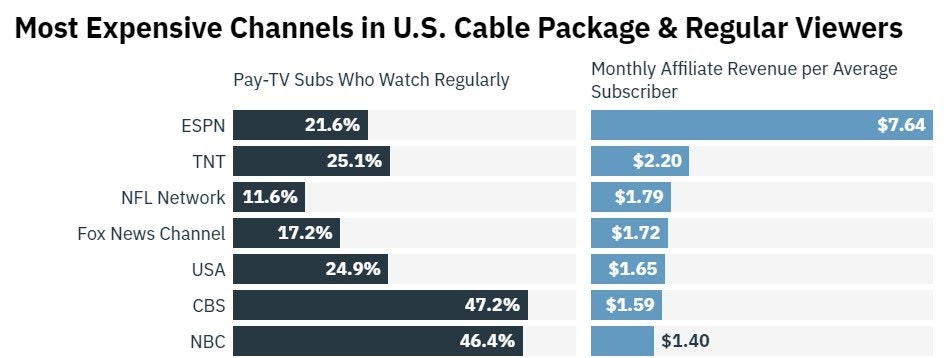
Here’s how it works. Cable companies pay “carriage fees” to networks for the right to carry their channel. These fees are then passed on to users in their monthly bills. In 2020, Fox News made more money from carriage fees ($1.6 billion) than advertisements ($1.2 billion). 

Other channels, of course, also receive carriage fees for their content. But the Murdochs have negotiated exorbitant fees for Fox News that are far greater than any other non-sports programming. 

According to a survey conducted late last year, about 14% of cable TV subscribers watch Fox News regularly. But every cable TV subscriber pays an average of $1.72 a month to receive Fox News. In contrast, 31% of cable TV subscribers regularly watch FX (owned by Disney) but the channel adds just $0.81 to an average cable bill.

https___bucketeer-e05bbc84-baa3-437e-9518-adb32be77984.s3.amazonaws.com_public_images_c4dfce0c-eb70-4916-aa61-efa2d4f1a0f5_951x358

This means, for every actual viewer, Fox News receives a $7.75 subsidy from people who never watch Fox News. This is a higher subsidy than other non-sports channels, like FX ($1.79), CNN ($3.18), and TBS ($2.79), receive. And none of those channels regularly spreads white nationalist talking points to millions of viewers. 

So how can Americans who don’t watch Fox News and find Carlson’s conduct repugnant stop subsidizing his $10 million salary? One option would be for major cable operators like Comcast, Spectrum, and AT&T to offer cable TV packages that exclude Fox News. This would allow people the choice of whether to pay for Fox News, just as people choose whether to pay for HBO. 

But, for the moment, corporate America seems loathe to take on the Murdochs or alienate Fox News’ passionate fan base. So the only way to stop sending cash to the Murdochs is to “cut the cord” and find a combination of streaming services that doesn’t include Fox News.

Unquote.

If you want to stop paying for cable TV but still want your local stations (which include ABC, CBS, NBC, PBS and even Fox, but not Fox News), there’s a not-for-profit streaming service called Locast. It’s now available in 31 major TV markets around the country (plus Puerto Rico):

Get the local channels you love [note: or hate] without a monthly bill. Locast is a not for profit service offering users access to broadcast television stations over the internet. It’s time to shred those cable bills and contracts!

If you’re part of the international elite who rub shoulders with the odious, 90-year-old Rupert Murdoch and his evil spawn Lachlan, you can treat them with the disrespect they deserve. You might tell them to stop the propaganda and then spit in their soup.