Police Reform and Fake Capitalism (They’re Not Related)

Calling the police can be dangerous. New Jersey is doing something about it. The state created a program called ARRIVE Together. A mental health professional accompanies the police when they go out on a call involving someone in mental distress. A study showed that in 342 such cases, only 3% resulted in the use of force and only 2% resulted in an arrest (usually because of an unrelated issue, such as an outstanding warrant). The program is being expanded and should serve as a model for police departments around the country (see this report from the Brookings Institution).

So much for some good news. Now back to harsh reality. From The Guardian:

One of the most deeply held and frequently heard propositions about capitalism is that it revolves around private companies and individuals taking risks. When, earlier this year, the US government arranged a rescue package for Silicon Valley Bank, for instance, among the many objections to it was the claim that the rescue contravened capitalism’s risk norms.

This view of the world directly informs wide swaths of economic policymaking today….But examine the economy, and it becomes clear: capitalism has become less and less about corporate risk-taking in recent decades. To be sure, many businesses do take significant risks. The independent small business owner who opens a new cafe in London generally faces intense competition and massive risk. But as political scientist Jacob Hacker has argued, business in general has been enormously skilled in recent times at offloading risk – principally by dumping it on those least able to bear it: ordinary households.

… The best example of a business usually regarded as being fundamentally about risk-taking, but which in fact is not, is … alternative asset management, an umbrella term for hedge funds, private equity and the like. (“Alternative” here means anything other than publicly listed stocks and bonds.) Asset managers are anything but marginal, exotic firms – they manage more than $100 trillion of clients’ money globally and control everything from [Benihana to PetSmart to Westinghouse].

But let’s look at what asset management companies in places like Britain and the US actually do. Three considerations are paramount.

First, there is the matter of whose capital is put at risk when alternative asset managers such as Citadel, Blackstone and KKR invest. In large part, it’s not theirs. The proportion of equity invested by a typical hedge or private equity fund that is the asset manager’s own is usually between 1% and 3%. The rest is that of their external investor clients (the “limited partners”), which include pension funds.

Second, consider how an asset manager’s investments are designed. For one thing, its own financial participation in, and management of, its investment funds is usually through a vehicle (the “general partnership”) that is constituted as a separate entity, precisely in order to insulate the firm and its professionals from liability risk.

Furthermore, the fund and its manager is generally distanced from underlying investments by a chain of intermediary holding companies that protect it from the risk inherent in those investments. In leveraged buyouts, where money is borrowed to help finance a deal,the debt goes on to the balance sheet of the company the fund has acquired. This means if trouble arises in repaying the debt, it is not the investment fund that is on the hook, still less its manager.

Third and last, fee structures also distance asset managers from risk. If a fund underperforms, they may earn no performance fee (based on fund profits), but they do have the considerable consolation – a form of risk insurance, if you like – of the guaranteed management fee, usually representing about 2% of limited partners’ committed capital, year after year. Essentially, management fees pay asset managers’ base salaries; performance fees pay bonuses.

In short, then, it would be far-fetched to suggest that what hedge funds and the like do amounts substantially to risk-taking. The only meaningful risk they themselves face is that of losing customers if fund returns prove underwhelming…. In reality, the business of alternative asset management is less about taking on risk than, in Hacker’s terms, moving it elsewhere. So when things go wrong, others bear the brunt….

Why does this matter? Because unless elected policymakers understand how risk is produced and distributed in modern economies, they will not be in a position to act appropriately and proportionately. That is why vague talk from politicians of being “pro-business” or “entrepreneurship” mean so little; the point is to learn from economic realities as they actually are, as opposed to how economics textbooks say they could or should be.

There is one very obvious policy recommendation for alternative asset management that flows from our understanding what they actually do with “risk”: taxing them more.

The main performance fee earned by alternative asset managers is “carried interest” – effectively, a profit share. In the UK and US, most asset management firms pay tax on this revenue at the capital gains rate, rather than the usually higher income tax rate. This is because the asset manager has typically been understood to be “taking on the entrepreneurial risk of the [investment]” – a standard justification for taxation as capital gain.

But as we have seen, this simply does not hold water. In 2017, the New York Times called the beneficial tax treatment of carried interest “a tax loophole for the rich that just won’t die”. It’s time to close it….

Note: To pass Biden’s Inflation Reduction Act last year, Democrats needed Sen. Kyrsten Sinema’s vote. But she wouldn’t vote for the bill unless Democrats dropped the provision that would have closed the carried interest loophole. She insisted on preserving the tax break that favors the securities and investment industry. Wouldn’t you know that hedge fund managers and private equity executives gave her more than $2 million between 2018 and 2022? Since then, she left the Democratic Party to run in Arizona as an “Independent” [CNBC].
Why They Stick With Him

What can stop the Republican Party’s slide into fascist insanity? The Murdochs and Fox “News” turning away from propaganda? Democrats finding a politician as popular as Franklin Roosevelt? Lots of un-American “patriots” and un-Christian “Christians” dying off? America’s most famous criminal defendant losing the power of speech?

History professor Thomas Zimmer doesn’t discuss those possibilities. Instead, he explains why they’re sticking with the crook:

Republican [politicians] are not simply cowards. It’s worse.

The least plausible answer that nevertheless features prominently in the political discourse is that … they don’t dare stand up to the demagogue, fearing his wrath and that of his supporters. Fear might certainly play a role in individual cases, … but as an overall explanation, the narrative that Republicans are just scared and cowardly is still highly problematic….

For the news media, the cowardice tale provides justification for clinging to the notion that the [Republican Party] is a “normal” party – just struggling with an authoritarian insurrection, with a hostile takeover engineered by a few extremists who don’t represent the party’s true nature. Liberals may find comfort in the idea that everyone is committed to democracy, that deep down, we really all want the same thing for the country, even when some are just too scared of the mean demagogue and his cult followers to act on their beliefs.

Such an approach is completely oblivious to – or deliberately tries to obscure – the fact that no such consensus exists, that there is no fundamental agreement on which to build. It is entirely misleading because it negates the actual nature of the conflict and what is at stake. And by conveniently ignoring the longstanding anti-democratic tendencies on the Right, we can tell a story that begins (and possibly ends!) with Txxxx.

If not cowardice, then what?

… Republican elites understand they can’t win without the base, and the base remains committed to Txxxx-ism. But there is more to consider than just opportunism. Almost every time the Right is at a crossroads, they choose the path of radicalization, even when it’s not at all clear that’s a reasonable choice from a purely electoral standpoint.

… It is crucial to grapple with the underlying ideas and dynamics that have animated the Republican Party’s path for a long time. They have led to a situation in which moments of brief uncertainty almost always result in a further radicalization … What happened after the 2012 election defeat that shook conservatives to the core is an instructive example: The Republican National Committee famously released an “Autopsy” report that called for moderation and outreach to traditionally marginalized groups. But instead, the [party] doubled down – and went with Txxxx-ism.

About a decade later, Republicans – elites and base alike – are so deep into the Txxxx experience, that it’s worth turning the question around: How could they not close ranks behind [him] now, no matter what happens, after all they have accepted, supported, justified, and condoned so far? … If you leave now, was it all for nothing? … And the people who you have painted as the radically “Un-American” enemy, … are you ultimately going to let them win?

… And so, they stick with Txxxx – and have to find ever more extreme justifications for why he is, at worst, the lesser evil compared to the “leftist” enemy. That is partly why rightwingers – politicians, reactionary intellectuals and pundits, media activists – are constantly playing up the threat of “woke” radicalism and the “illiberal Left.” It has become dogma on the Right to define “Us” (conservative white Christians) as the sole proponents of “real America” – and “Them” (Democrats, liberals, “the Left”) as a dangerous “Other.” The Democratic Party, in this understanding, is not just a political opponent, but an “Un-American” enemy – a fundamentally illegitimate political faction captured by the radical forces of leftism, liberalism, wokeism, and multiculturalism.

The Right [sees] the struggle between Republicans and Democrats … as an existential conflict over whether or not the only version of the country they are willing to accept as “America” will survive and endure. Rightwingers have decided that they *are* the country…. In that sense, choosing the Republican Party *is* choosing the country.
Within the confines of such a worldview, … it constantly privileges the more radical over the more “moderate” forces within the [party]…. There’s always permission to escalate, hardly ever to pull back.

This underlying permission structure is absolutely key: It states that “Real Americans” are constantly being victimized, made to suffer under the yoke of crazy leftist politics, besieged by “un-American” forces of leftism…. In the minds of conservatives, they are never the aggressors, always the ones under assault. Building up this supposedly totalitarian, violent threat from the “Left” allows them to justify their actions within the long-established framework of conservative self-victimization. It allowed them to support Dxxxx Txxxx in the first place.

Do Republicans *really* believe this – or is this all just a cynical game? … Many on the Right don’t necessarily believe in the specifics of this conspiracy theory or that chimera of stolen elections. But they are still “true believers” … in the political project Txxxx-sm stands for: the white grievance politics that seeks to forever preserve America as a place of traditional hierarchies of race, gender, religion, and wealth.

And so, the permission structure of conservative politics remained fully intact even after January 6, and it quickly allowed for a realignment behind Txxxx….

But wait, maybe it’s different this time? What about the Republicans – like Bill Barr, for instance, who plainly defended the indictment as “very, very damning” and made it clear that the “idea of presenting Txxxx as a victim here, a victim of a witch hunt, is ridiculous” – who have acknowledged the severity of his wrongdoing: Aren’t they taking the exit ramp?

… In fact, Bill Barr has in many ways provided the starkest example of how a perverted version of “patriotism,” of supposedly choosing loyalty to America, can serve as the justification for falling in line behind Txxxx despite personal misgivings: Because “the Left” is seen as the greater evil, and nothing has been able to change that…. When confronted with how he could possibly support another Txxxx presidency during his book promotion tour in 2022, Barr replied: “Because I believe that the greatest threat to the country is the progressive agenda being pushed by the Democratic Party.”

This is the perfect encapsulation of the permission structure that governs conservative politics: Anything is justified in defense against what they constantly play up as a radically “Un-American,” extremist “Left” that has supposedly taken over the Democratic party….

We are now at the point where an attack on the Capitol was not nearly enough to break this logic of escalation or dislodge Dxxxx Txxxx as the leader of the Republican Party. That dynamic continued to shape the Right after January 6 – and [continues] in June 2023… In moments when it looked like there could have been an alternative path, an exit ramp, Republicans radicalized instead. Until we get a lot of hard evidence that something drastic has changed, this should shape our expectations going forward and our understanding of what American democracy is up against.

Truth vs. Fantasy in Today’s Politics, Part 2

My previous post dealt with false talking points Republican presidential candidates are repeating over and over. It may not be a surprise that these clowns are ignoring reality regarding the economy, immigration and crime. But there are even bigger myths worth noting. Here are two big differences between reality and Republican bullshit.

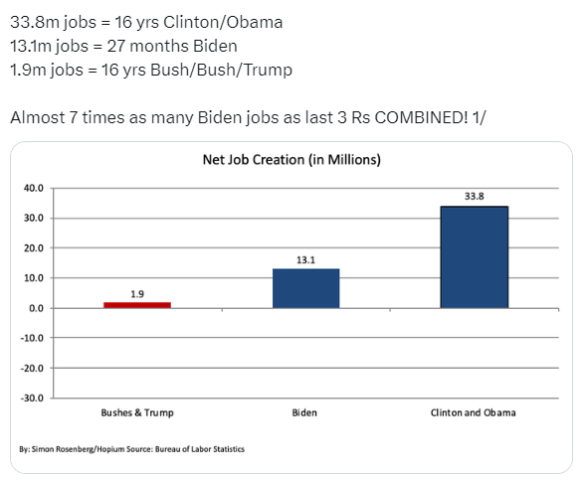
Republicans have convinced many voters that they’re better at handling the economy than Democrats. Is it because Republicans claim to love capitalism, especially big business, so much? Here’s the job growth under the most recent Democratic and Republican presidents. The difference is rather amazing and certainly not well-known. Under the last three Democrats, the economy added 46.9 million jobs. Under the last three Republican presidents, the ones who supposedly know how to nurture the economy, the increase was a pathetic 1.9 million (from the Bureau of Labor Statistics and Simon Rosenberg):

Untitledx

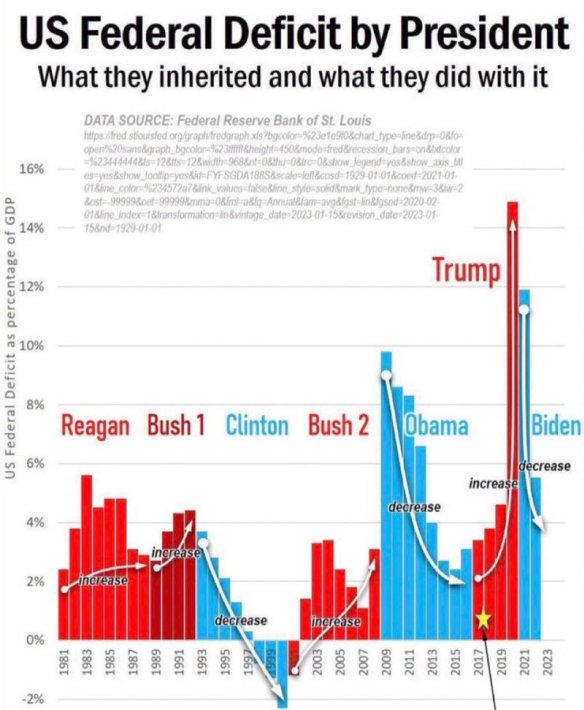
But wait! Does the economy grow under Democrats because they’re the party of “borrow and spend”? Hardly. It’s because Democrats try to spread the wealth, not concentrate it at the top. Since Reagan was president, Republicans have added red ink through reckless, unproductive tax cuts, while Democrats have restored fiscal sanity (from the Federal Reserve Bank of St. Louis and the Tennessee Holler site):

FxtUCW6WAAAeCuy

Deficits went up under Reagan, the two Bushes and the last guy. They’ve gone down under Clinton, Obama and Biden. It’s no surprise that cutting taxes for the rich and corporations increases the national debt but a healthier economy under Democratic presidents makes deficits go down.

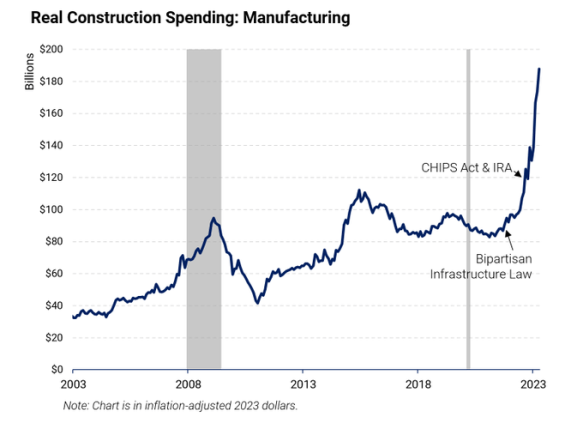
Here’s one last chart. Politicians have been talking about bringing back American manufacturing jobs for as long as I can remember. Now it looks like it’s actually happening. This chart shows spending on factory construction (adjusted for inflation). To the left is the second Bush presidency, showing factory construction increasing until the 2008 financial crisis (the vertical gray line) that started in Bush’s second term. Construction recovered in Obama’s first term, was stagnant or declined during the last president’s single term, and then took off with Biden in the White House.  From the Bureau of Labor Statistics, the Census Bureau and Steven Rattner:

Fx9O131XsBEDGif

From Yahoo Financial News:

President Obama tried to revitalize American manufacturing, with little to show for it. President Txxxx tried too, with similarly unimpressive results.

Under President Biden, however, a manufacturing boom finally seems to be getting started. Since the beginning of 2022, construction spending on new factories has more than doubled, from an annualized rate of $91 billion in January 2022 to $189 billion in April 2023, the latest data available. That’s the biggest jump, by far, in data going back to 2002….

Private-sector firms are building more US factories to cash in on an unprecedented spate of legislation Biden has signed providing federal funding and incentives for infrastructure development, a massive green-energy buildout, and a revitalized semiconductor industry. Three separate bills passed by the Democratic Congress in 2021 and 2022, and signed by Biden, will provide well over $1 trillion in federal spending, tax breaks, and other incentives meant to build more important products in the United States and reduce reliance on importers, mostly China.

Republicans would have you believe the American economy is in deep trouble and they’d do a better job with it than Democrats. The evidence says otherwise. Republican economic competence is a myth.

Truth vs. Fantasy in Today’s Politics

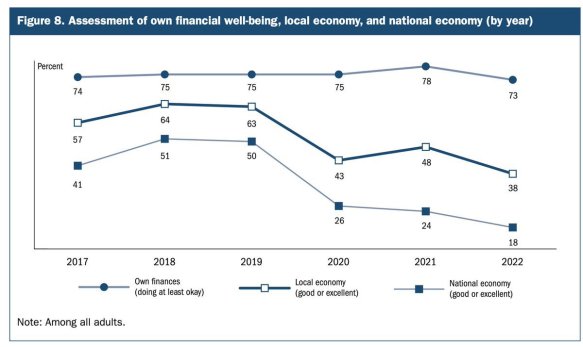
A recent poll showed that most Americans think they’re doing okay economically speaking, but think the national economy is in terrible shape. This chart is from a recent Federal Reserve report on the economic well-being of U.S. households.

FwxLu-9XoAAvEWr

The top line shows that around 75% of us have been relatively satisfied with our own finances since 2017, despite the pandemic. That 75% includes people who thought their own finances were “okay” or better. The bottom two lines, however, show that people’s opinion of their local economies and the national economy went down quite a bit during the pandemic, with lots of people thinking the country’s economy is even worse than where they live.

What’s very odd is that those negative sentiments from 2020 have lingered, or even gotten worse, even though the percentage of us who think our own finances are okay or better hasn’t changed much at all.

Another oddity is that, although people aren’t thrilled about their local economy — only 38% saying it’s good or excellent — hardly anybody likes the national economy — only 18% saying it’s good or excellent.

Why would so many of us think we ourselves aren’t suffering economically although people who live near us are and the nation as a whole is even worse off? The obvious answer is that the national media have convinced people that the country is in deep economic trouble, much worse than where they live and work, and despite the fact that they themselves are in pretty good shape. (It shouldn’t be a surprise that Republicans have the worst opinion of other people’s economic situation, given where they get their news and what their favorite politicians tell them.

This brings me to an article in The Washington Monthly: “Republicans Say Inflation, Crime, and Immigration Are Out of Control. The Numbers Disagree”.

The Republican presidential candidates are on the same page regarding Joe Biden: He’s a disaster on inflation, immigration, and crime.

“We have no borders. We have inflation. We have everything going wrong,” said [their leading candidate] … in his apocalyptic fashion…. “Everybody is being murdered.”

Former Vice President Mike Pence … began a CNN-hosted town hall event with a pithy critique: “Literally, we have a crisis at our border. We have inflation at a 40-year high. We have a crime wave in our cities.” Pence suggested Biden’s border policies are to blame for “a flood of fentanyl coming into every city.” 

There’s one problem with this Republican portrayal of a Democratic president presiding over chaos: None of it is true.  

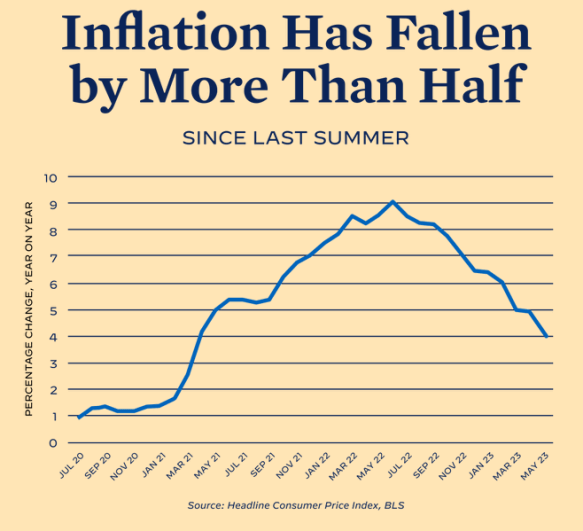
Inflation was at a 40-year high. During 2022, the inflation rate started at 7.5 percent, peaked in June at 9.1 percent, and ended the year at 6.5 percent, a mark that hadn’t been cleared since June 1982.  

But 2023 is a different story. The inflation rate for May is down to 4 percent, less than half of the June 2022 peak. But even back in March, when it fell to 5 percent, the “40-year high” talking point was obsolete. In July 2008, during the George W. Bush administration, inflation was 5.6 percent. And in October and November 1990, during the George H. W. Bush administration, it was 6.3 percent.

From the Bureau of Labor Statistics:

Fyg2RC_XoAU7ydL

As we get further away from the pandemic and the Federal Reserve keeps raising interest rates, the rate of inflation should continue to fall (despite the fact that corporations have used inflation as an excuse to increase their prices and profits even more than they needed to, as reported by The New York Times). Back to the article:

Has southern border security collapsed? Hardly. Unlawful entries have dropped by 70 percent in the last few weeks, according to the Department of Homeland Security, after Biden implemented a new border management policy.  

… Border crossings spiked just before Biden ended “Title 42,” the public health emergency rules that Txxxx enacted in 2020, using the COVID-19 pandemic to expedite the removal of asylum-seekers…. Many skeptics … assumed that the end of Title 42 would prompt a surge of migrants. The opposite happened. 

If the current pace of border crossings—about 3,700 per day—remains stable throughout June, the monthly total would be 111,000, … somewhat higher than the 93,000 in the last full month of Txxxx’s presidency.  

When assessing those numbers, remember that while Title 42 made it easier for the Border Patrol to send back asylum seekers, it did nothing to prevent those removed from trying again. In turn, many of the illegal crossings in Biden’s first two and a half years—under policies designed by Txxxx—were made by repeat offenders. Between 2019 and 2022, the recidivism rate jumped from 20 to 49 percent.

In Biden’s new system, those illegally crossing the border can be banned from applying for asylum for five years and risk jail time if they violate the ban. We saw a spike in crossings just before the administration implemented the smart new policy because migrants hoped to avoid the Biden ban.To tame an unruly border, Biden is steering asylum seekers away from treacherous desert treks and towards a more orderly online application process.

What about fentanyl coming over the southern border? … Biden’s administration has intercepted more fentanyl than Txxxx’s ever did…. According to PolitiFact, Biden deserves partial credit for the higher seizure numbers because his administration is employing more and better detection technology at the border. Besides, immigration across the southern border has little to do with the fentanyl crisis. Eighty-six percent of people arrested for trafficking fentanyl are American citizens, as “the vast majority of fentanyl being smuggled in comes through ports of entry, not people trying to sneak into the country.”  

Republicans may talk up crime, and there are no shortages of alarming anecdotes, but there is no Biden crime wave. “Murder is down about 12 percent year-to-date in more than 90 cities that have released data for 2023, compared with data as of the same date in 2022,” according to …The Atlantic, a trend that could lead to “one of the largest annual percent changes in murder ever recorded.” … In fact, over the past five years, the worst month for homicides was July 2020—when Txxxx  was president.  

Another set of promising data comes from the Violent Crime Survey by the Major Cities Chiefs Association, which looked at data from 70 cities. During the first quarter of 2023, homicides, rapes, and robberies dropped about 8 percent from the first quarter of 2022….  

Where Republicans have the best argument is in the category of stolen cars: up 21 percent from 2021 and a whopping 59 percent from 2019. But they haven’t argued that we’re only suffering from a wave of car thefts. They assert America is suffering a collapse of law and order, on every front, solely on Biden’s watch. That’s not true. A mixed picture is not a crime wave.  

Republicans are not updating their talking points to reflect this new data, preferring to insist that America is falling apart. They’re betting that either the data trajectories will reverse course, belatedly validating Republican attack lines, or Americans will be so convinced everything is terrible that additional positive data won’t “feel” true, and voters will disregard it. At least, that is the Republican hope….

We can’t know what these metrics will be in the run-up to Election Day. But in the meantime, reporters and voters should not allow Republican candidates to paint a dystopian picture of America without being forced to address the numbers that don’t fit their narrative. 

November 5, 2024, is more than 500 days away. Let’s hope more of the good news sinks in by then.

I Find the Former President’s Criminal Case Very Interesting, Maybe Too Interesting

Our former president (hereafter “the defendant”) will be in court tomorrow afternoon to formally be told what crimes he’s accused of. He may be ready to enter a plea of guilty or not guilty as well. It turns out that the proceedings won’t be conducted by the biased and incompetent Judge Aileen “Loose” Cannon, even though she’s been assigned to handle his trial (for now). A magistrate judge, one step below a full-fledged, lifetime-appointment federal judge like Cannon, will be in charge tomorrow. That’s the normal procedure. It’s possible the magistrate judge will set some conditions for the defendant’s release, like telling him not to leave the country. I rather doubt the judge will lock him up.

There’s talk that he’s having trouble finding a lawyer willing to represent him. Would you want to be his lawyer, given how challenging it is to represent him? But he’s already got Florida lawyers who can go with him to court tomorrow, whether or not they represent him in further proceedings.

Judge Cannon being selected to handle this case raises two interesting questions. Why was she selected? Will she step aside or be forced to?

[A personal note/warning: I worked in the Los Angeles County Superior Court system for five years, so may find the following much more interesting than you do.]

Cannon’s assignment was random but not as random as it could have been. The New York Times described the process:

Under the district court’s procedures, new cases are randomly delegated to a judge who sits in the division where the matter arose or a neighboring one, even if it relates to a previous case. That Judge Cannon is handling [the defendant’s] criminal indictment elicited the question of how that had come to be.

Asked over email whether normal procedures were followed and Judge Cannon’s assignment was random, Ms. Noble [the chief clerk of the court] wrote: “Normal procedures were followed.”

Mar-a-Lago is in the West Palm Beach division, between the Fort Lauderdale division and the Fort Pierce division, where Judge Cannon sits. The district court’s website shows that seven active judges have chambers in those three divisions, as do three judges on senior status who still hear cases‌.

Ms. Noble wrote that certain factors increased the chances that the case would land before Judge Cannon.

For one, she said, senior judges are removed from the case assignment system, or wheel, once they fulfill their target caseload for the year. At least one of the senior judges is done, she wrote, adding that she was highly confident that the other two “are very likely at their target,” too.

In addition, she wrote, one of the seven active judges with chambers in Fort Lauderdale is now a Miami judge for the purpose of assignments. Another is not currently receiving cases.

A third active judge … draws 50 percent of his criminal cases from the Miami division, she wrote, decreasing his odds…. Judge Cannon, Ms. Noble wrote, “draws 50 percent of her cases from West Palm Beach, increasing her odds.”

Given the clerk’s explanation, my rough estimate is that there was a 1-in-4 chance that Cannon would receive the case, assuming the district’s normal process was followed. There could have been as many as 10 judges available, but it turns out there were only 5. In addition, one of those 5 had less of a chance and Cannon had more of a chance, so it was around 1-in-4.

Presumably, Special Counsel Jack Smith was aware of the likelihood that Cannon would get the case, but chose to file the case in Florida anyway, given that the alleged crimes took place in West Palm Beach. I’m pretty sure Smith wouldn’t choose Judge Cannon, given what happened last time she got involved. This is from the same Times article:

The news of Judge Cannon’s assignment raised eyebrows because of her role in an earlier lawsuit filed by [the defendant] challenging the F.B.I.’s search of his Florida club and estate, Mar-a-Lago. In issuing a series of rulings favorable to him, Judge Cannon, [whom the defendant chose to be a federal judge], effectively disrupted the investigation until a conservative appeals court ruled she never had legitimate legal authority to intervene.

One of the mistakes she made was to say the defendant deserved special consideration, since he is an ex-president. That’s not how the law is supposed to work.

The second question is whether Cannon will preside over the pre-trial proceedings and an eventual trial, all of which will go on for months (unless the defendant pleads guilty, is incapacitated, etc.). The New Yorker has an interview with Stephen Gillers, a professor emeritus at N.Y.U. Law and an expert on judicial matters. He says the answer to that question should be “No”, according to the law that covers judicial assignments.

Going forward, what can the government do if it feels like a judge will not give it a fair shake?

It raises the question of recusal. There’s a statute dealing with federal judge recusal—it’s 28 U.S.C. § 455…. The very first sentence … says that a judge should recuse if the judge’s impartiality “might reasonably be questioned.”

Now, the fact that a judge’s impartiality might reasonably be questioned doesn’t mean that the judge is partial. The public may simply not trust the impartiality of the judge. Because public trust in the work of the court is a value as important as the work itself, the rule says that the judge should not sit when we can’t fairly ask the public to trust what the judge does. That rule is especially important in this case. One thing the prosecution can do is move to recuse Judge Cannon on the ground that, in light of her experience in the search-warrant case last year, her impartiality might reasonably be questioned.

And who would make that judgment if the government does push for this recusal?

The judge herself gets to make that decision in our system. If she denies the recusal, the government could go to the Eleventh Circuit and ask it to order her to recuse herself, and that’s a process called mandamus….In effect, you’re suing the judge to force the judge to recuse….

There’s one other thing the government can do, aside from doing nothing, and that is to write a letter to the judge suggesting the reasons she should consider recusing herself without being formally asked to do so. That’s done also, so as not to create a formal motion….

One factor to consider in deciding whether recusal is necessary is how important the case is to the public and to the need for public trust. If the [Court of Appeals] were to reverse Cannon’s recusal decision, one thing they might say is “We are not questioning the probity or the fairness or the competence of the judge, but we don’t think we can ask the public to accept her rulings.”

So, if the government decides that it’s not going to get a fair shake from Cannon based on its previous experience with her, we will end up with this three-judge panel.

Here, the questions are: Will they initially just write a letter suggesting that she recuse? If she does, that’s the end of it. If she doesn’t, will they make a formal motion to recuse? If she grants it, that’s the end of it. If she doesn’t, then they have to decide whether to seek mandamus. If they do, then the three judges, who are randomly chosen and who hear that mandamus petition, will have to decide whether she should be removed. If they decide that she should not, that’s the end of it. If they decide that she should, then there’ll be a reassignment….

Is there some advantage for the government to wait and see how the trial is going before it pushes for a recusal? Would it have a stronger case for recusal that way?

If there is a basis to move to recuse, you can’t wait around. You have to do it quickly. You can’t wait around to see whether the judge rules on motions in your favor.

Are there downsides to going for recusal right away?

The problem with going for recusal right off the bat is that you may lose in the circuit, and now you’re trying a case before a judge you’ve accused of being unable to appear impartial—and that’s not pleasant. So the government may decide that it’s just better to make the strongest case they can and hope that she behaves like a judge.

Given what we saw regarding Cannon’s behavior during the previous case, do you think that the government will or should go for a recusal?

Given the importance of this case, perhaps the most important criminal trial in the history of the United States—certainly the most watched—and in light of what Judge Cannon did in the search-and-seizure case last year, I think she must step aside. I think she must grant a motion to recuse herself, unless she does it before a motion is even made.

And the reason I say that is that she treated [the defendant] as special, or, to put it another way, she was partial to [him] as a former President, which should not have any influence on the way this trial is conducted…. The partiality she expressed in her decisions last year creates a reasonable perception in the mind of a fair-minded person that she is not impartial—which is the test. Her behavior when she was ruling on the search-and-seizure case creates a reason to doubt her impartiality.

But when you say “must,” you mean from an ethical sense.

No, “must” in a rule sense. There’s a rule.

O.K., but there’s also no way to enforce the rule, right?

Except through mandamus.

That suggests to me that [unless Cannon recuses herself] you think the government should or will go to mandamus.

… If the government does so, she must grant the recusal, and if she doesn’t the Eleventh Circuit must order it.

That’s “must” according to the law. Other legal experts have said the same thing. But it’s judges who decide what the laws mean.

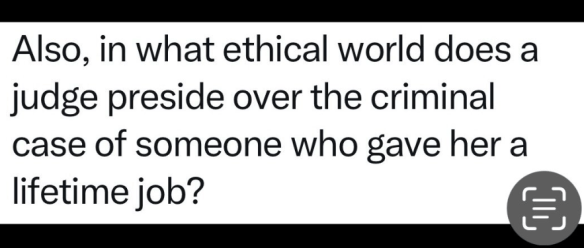
As far as I can tell, the experts aren’t too concerned that the defendant chose Cannon to become a federal judge. Maybe they don’t want to imply that judges tend to favor the politicians who got them their jobs. For us mortals, however, we might ask, as someone did:

Untitled