This Week’s Elections Don’t Mean the Sky Is Falling

Rachel Maddow is often an oasis of sanity in the barren wasteland of corporate media. Last night, she identified an historical pattern that nobody else seems to have paid much attention to (I recommend watching what she had to say, but I’m writing about it anyway).

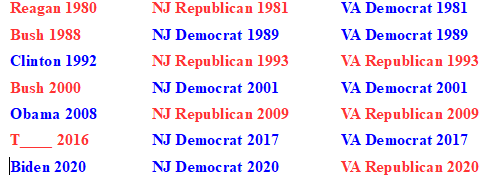
Here’s the pattern in pictorial form. The first column is a president’s first year in office. The second column is the winner of the New Jersey governor’s race later that year. The third column is the winner of the Virginia governor’s race held the same day.
Untitled

It’s an oddity of the political calendar that New Jersey and Virginia hold their elections for governor one year after presidential elections. That means when a new president is elected, like Reagan in 1980 and Biden in 2020, the governor’s races in New Jersey and Virginia are the first chance voters get to choose their state’s leader but also, less obviously, to react to there being a new person in the White House. This explains why NJ and VA governor’s elections are viewed as a referendum on a president’s first year in office.Ā 

Looking at the chart, you’ll notice that in three of the seven years (1988, 2000 and 2016), when aĀ  Republican won the presidency, his party lost the two governor’s races.

Likewise, in two of the seven years (1992 and 2008), when a Democrat won the presidency, his party also lost the two governor’s races.

It was only in 1981, and again this year, that a new president’s party won even one of the two governor’s races.

In other words, Biden and his party did better this week than any president has done since Ronald Reagan, forty years ago.

As a matter of fact, in 1981, with Reagan now in the White House, the Republican gubernatorial candidate beat the Democrat by fewer than 2,000 votes (an exception that almost proves the rule that the president’s party loses these elections). If the Democrat had done a bit better, Joe Biden would have been the first brand-new president to hold onto the NJ or VA governorship in 44 years. (Winning a second term makes NJ Governor Phil Murphy the first Democrat to win two elections since then. He currently leads his Republican opponent by 44,000 votes).

As Maddow pointed out, the New Jersey and Virginia governor’s races are the first opportunity for voters who opposed the new president to register their anger at the polls, while the voters who helped elect the new president are (less passionately) waiting to see what the new president can deliver. That’s why a new president’s party ordinarily loses both the New Jersey and Virginia governor races.

The fact that a Democrat won New Jersey this year is, therefore, a good sign, not a bad one. You wouldn’t know that from reading a paper or watching TV (maybe that’s because those in the media who comment on elections are surprised that Democrats don’t do even better, given the Republican Party’s descent into fascism).

Finally, Maddow also points out that in two special elections this year, Democrats did quite well. A Democrat was elected to Congress with 60% of the vote in New Mexico, even though Republicans claimed they had a great chance to win. Three months later, California’s Democratic governor won that ridiculous recall election, also with 60% of the vote. The 2022 election will almost certainly be difficult, but the sky is not falling based on this year’s results.

An Expert Says It’s Typical Fascism

Jason Stanley, a professor at Yale University and the author of How Fascism Works: The Politics of Us and Them, analyzes a new piece of fascist propaganda disseminated by Fox News:Ā Ā 

Patriot Purge, Tucker Carlson’s new three-part series, is propaganda built around D____ T____’s Big Lie of a stolen 2020 election and buttressed by a bizarro world, alt-right and alt-reality retelling of the January 6th insurrection. But Carlson’s message being profoundly dishonest doesn’t stop it from being profoundly dangerous: both because it contains kernels of tough truths the country has been scared to face, and because it follows a classic template of propaganda that has brought down democracies before.

The conceit of Patriot Purge is that the real ā€œAmericansā€ — the country’s greatest Patriots — were those who went to Washington on January 6 to join what was to be a peaceful rally protesting the supposed stealing of the 2020 US Presidential Election. They were a multi-racial group of patriotic Americans coming to the capital to voice their concerns. But then Antifa, apparently working in tandem with the FBI, disrupted the peaceful protests with agents provocateurs who urged participants into the capital building. The seditious ā€œdeep stateā€ has in this way entrapped the country’s warriors, who are now the subject of government targeting that was honed during the War on Terror.

The message of the series is clear: a great wrong has been done. The government and media have engineered a false narrative directed in the first instance towards discrediting the patriots who seek to address it, and, ultimately, with the goal of hunting down and violently suppressing them. Our media’s complicity is demonstrated by their differential coverages of the BLM protests, which are here portrayed as senseless violent riots, and the events of January 6. The patriots are innocent Americans seeking only to preserve democracy in the face of a fraudulent election. The forces arrayed against them are almost impossibly powerful. It is a repeat of the war on terror, by the same forces who engineered it, but directed against the most representative of our citizens, the ā€œrealā€ Americans.

It is impossible to accept this message in total without taking it to justify violent mass action against the current government, or something like a police and military coup.

Carlson’s Patriot Purge finds a martyr for its movement in Ashli Babbitt, who was shot trying to get past a Capitol Police barrier near the House chamber. Her death, in great and gruesome detail, comprises the final shots of Part I.

Babbitt’s assigned role is familiar to anyone who has seen or studied Twentieth Century fascist propaganda. Martyrs are ideally pure and innocent, and killed in a noble attempt to defeat enemies of the nation. In fascist ideology, these enemies are communists and liberals, who are represented as subverting the will of the ā€œtrueā€ people, whose only goal is to install their beloved leader, the true father of the nation. Honoring the memory of the martyr is to worship the leader, and give all in the quest to defeat his enemies and place him as the leader of the nation.

This series is a further contribution to the months long narrative construction of Babbitt as the T____ movement’s Horst Wessel, the Nazi stormtrooper killed in a brawl in 1930, most probably by communists (but for unclear reasons), and elevated to martyrdom status by Nazi propagandist Joseph Goebbels. In this case, the martyr is an innocent, patriotic white woman. . . .

The unquestioned premise of this series is the ā€œBig lieā€, that the election was stolen, and that T____ won. The Big Lie structures the entire narrative here. It is only on this assumption that we should grant a movement that promulgates this lie full political legitimacy, and equal weight in government decisions and media representation. It is only on this assumption that those who promulgate this lie can be represented as innocent victims.

Key to fascist propaganda is an overwhelming sense of danger, one that threatens to make the country’s dominant majority into a powerless and endangered minority. T____ loyalists in this series appear only as targeted victims, at existential peril, without representation in. any branch of government or media. Throughout, law is represented as merely an instrument in the service of power. The series does not discuss what these attitudes have justified – the wave of laws sweeping Republican dominated state governments enabling the mass disenfranchisement of minority voters on the basis of dubious claims of fraud, the stacking of election commissions by T___ loyalists, or the nationwide targeting of educators associated with Critical Race Theory or Black Lives Matter. The series does not mention the mass targeting of democratic institutions, from elections to schools, the curtailing of voting rights and speech, that are the calling card of the T____ist Republican Party in its current fascist phase. And the series does not, of course, discuss the fearsome power of Fox News.

In the inverted world of the series, those who support the authoritarian cult of the leader, his base, are the democratic patriots. Those who seek to preserve fair elections are the fascists. Fascist propaganda is relentless projection, justified by lies. Carlson has proven to be a master in its use. . . .

Throughout, Carlson is correct about several important matters. He is right about the dangers of mass surveillance. He is right about the moral obscenity of the war on terror, which has created an ugly toolkit that can be used to target relatively powerless American citizens. It is past time for these to be shared bipartisan assumptions. Embedding these truths within a larger framework in the service of destabilizing democracy makes it dangerous propaganda indeed. . . .

I share his view that ordinary fellow citizens who fall under the sway of propaganda should not be demonized. Our opprobrium should instead be directed at those leading the assault, billionaires . . . [like Rupert Murdoch], elite Ivy League-trained [politicians] like Ted Cruz and Josh Hawley, and, of course, wealthy and powerful mainstream media propagandists like Tucker Carlson.

Unquote.

Unlike Professor Stanley, however, I think the “ordinary” citizens who are so open to right-wing propaganda deserve plenty of opprobrium too. But our leaders aren’t comfortable saying that.

Keeping Yesterday’s Election in Perspective

A recent opinion poll suggested the Democratic governor of New Jersey, Phil Murphy, would easily win yesterday’s off-year election. But instead of winning 55% to 45%, as the poll indicated, it looks like he’ll win 50% to 49%. Why? Because all kinds of people answer opinion polls, but it’s the angry ones who tend to vote in low turnout elections. And who is angriest today (although their anger isn’t justified)?

Paul Waldman of The Washington Post explains and offers some advice to Biden and congressional Democrats:

One of the most pervasive biases among the political media is the bias toward dramatization, interpreting every event as startling, extraordinary, and signaling a reshaped political landscape.

That is how many are interpreting the results of Tuesday’s elections, especially Glenn Youngkin’s win in the Virginia gubernatorial race. The truth is more mundane — but its implications for how Democrats should think about their future are no less profound.

Let’s begin with the context in which these elections took place. First and most important,Ā there’s a Democrat in the White House. It is impossible to overstate how that one simple fact puts Democrats in a position to lose and lose big, not just in this election but in next year’s midterms as well.

Here’s what happens when a president gets elected: He tries to do a bunch of things, some of them work out and some of them don’t, but nobody’s life is really transformed, at least in the short term. Meanwhile, the opposition party’s voters areĀ utterly enragedĀ by the mere fact that someone they hate is now running the country.

So at the first opportunity (and probably the second and the third), those opposition voters rush to the polls, while voters from the president’s party are not nearly so motivated.

Now add in the fact that we’re still in a pandemic, the delta variant has slowed the recovery, supply chain problems are producing inflation, and President Biden’s approvalĀ ratingsĀ are in the low 40s.

Given all that, it would have been absolutely stunning if Democrats hadn’t gotten their clocks cleaned in these elections, just as Republicans did in 2017 after D____ T____’s election and Democrats did in 2009 after Barack Obama’s election. The president’s party lost both the Virginia and New Jersey governor’s races in those years as well. Yes, the particulars of a campaign can make a difference at the margins — Republicans certainly waged a skillful if repugnant campaign in Virginia — but the basic pattern will hold.

Plenty of people will now tell you that a different strategy or a clever bit of rhetorical jujitsu could have changed the outcome in these races, and the fact that both were so close makes it at least possible, if unlikely. But here’s the reality for 2022: Only something truly earthshaking will prevent the almost inevitable outcome of Democrats losing the House and probably the Senate as well.

There were only two times in recent decades that the president’s party didn’t suffer significant losses in the midterms. The first was 1998, a year dominated by the Republican impeachment of Bill Clinton, which led to its own backlash against Republicans. Approval of the GOPĀ plungedĀ to depths only matched when they shut down the government five years later.

The second was 2002. Amid the aftermath of Sept. 11 the atmosphere of fear and panic reigned; President Bush’s approvalĀ ratingsĀ were in the 60s, and Republicans successfullyĀ arguedĀ that Democrats were terrorist-loving traitors who wanted Americans to die.

Could something that momentous happen in the next twelve months to turn the situation in Democrats’ favor, either defusing Republican anger or elevating Democratic anger to the point where more Democrats turn out than Republicans? It’s always possible.

But ordinary good news — the passage of important bills, the fading of the pandemic, a strong economic rebound — probably won’t be enough. All that would produce a situation in which Democratic voters say, ā€œThings are going pretty well,ā€ and Republican voters say, ā€œI am enraged!ā€, if only because a Democrat is still president and Democrats still control Congress.

So when Democrats are told that they must pass the Build Back Better bill or some other piece of legislation to have any chance of holding the House and Senate, it isn’t exactly right. If they don’t pass worthwhile bills they’ll certainly lose, since their own supporters will see them as weak and ineffectual. But even if they do pass the bills, it [very likely!] won’t be enough.

So they have to widen their view beyond 2022. Accept that they have one more year to legislate, and ask: What can we accomplish in that time? How many people can we help? How much can we improve the basic conditions in which Americans lead their lives? How much progress can we make on our agenda, not because we think there will be short-term political dividends but becauseĀ it’s the reason we got into politics in the first place. Or at least it should have been.

It’s not that there will be no political ramifications to what they do and don’t accomplish now. But many of them will take years to play out. For example, passing the Affordable Care Act only exacerbated the struggles they had in the 2010 midterms, since it became a focus of Republican anger and mobilization. But eventually it became a political advantage; eight years later, voters punished Republicans for trying to repeal it.

More importantly, imperfect though it was, the ACA helped enormous numbers of people. It eliminated the nightmare of being denied health coverage because of preexisting conditions, and gave millions of Americans insurance for the first time. It was an extraordinary achievement.

So Democrats should ask themselves: What can we do now that we’ll proudly tell our grandchildren about years from now? If we really only have a year to make a difference, what are we going to do with that time?

Unquote.

It’s highly likely the Democrats will lose the House of Representatives in 2022, since they have such a small majority today and House races are affected by gerrymandering, which Republicans are real good at. But the outlook for the Senate isn’t so bad. Democrats will be defending 14 seats, while Republicans will be defending 20, and 5 Republican senators have already announced they’re retiring. Democrats could conceivably pick up seats in Pennsylvania, North Carolina and Wisconsin, even if they’re likely to lose in Georgia. Gaining one seat would make either Manchin or Sinema less important. Gaining two would make both of them less important.

“Largely Inevitable As Economies Try To Restart After Epic Disruptions”

Now that the US is recovering from the pandemic, demand has outstripped supply in some parts of the economy, resulting in inflation. This shouldn’t be a surprise. Something else that shouldn’t be a surprise is that Republicans blame Biden, as if any of them would do better.

The economist Paul Krugman summarizes the situation in his newsletter:Ā 

It’s been a troubled few months on the economic front. Inflation has soared to a 28-year high. Supermarket shelves are bare, and gas stations closed. Good luck if you’re having problems with your home heating system: Replacing your boiler, which normally takes 48 hours, now takes two or three months. President Biden really is messing up, isn’t he?

Oh, wait. That inflation record was set not in America but inĀ Germany. Stories about food and gasoline shortages are coming fromĀ Britain. The boiler replacement crisis seems to be hittingĀ FranceĀ especially hard.

And one major driver of recent inflation, in America and everywhere else, has been a spike in energy prices — prices that are set in world markets, on which any one country, even the United States, has limited influence. D____ T____ has been claiming that if he were president, gas would be below $2 a gallon [in fact, America would be an earthly paradise, just like when he left office]. How exactly does he imagine he could achieve that, when oil is traded globally and America accounts for only about a fifth of the world’s oil consumption? [Answer: he doesn’t imagine how he’d achieve it, but he thinks doing it would make him look good, and that’s enough reason to say he’d do it].

In other words, the problems that have been crimping recovery from the pandemic recession seem, by and large, to be global rather than local. That’s not to say that national policies are playing no role. For example, Britain’s woes are partly the result of a shortage of truck drivers, which in turn has a lot to do with the exodus of foreign workers after Brexit. But the fact that everyone seems to be having similar problems tells us that policy is playing less of a role than many people seem to think. And it does raise the question of what, if anything, the United States should be doing differently. . . .

Many observers have been drawing parallels with the stagflation of the 1970s. But so far, at least, what we’re experiencing doesn’t look much like that. Most economies have been growing, not shrinking; unemployment has been falling, not rising. While there have been some supply disruptions — Chinese ports have sufferedĀ closuresĀ as a result of Covid outbreaks, in March aĀ fireĀ at a Japanese factory that supplies many of the semiconductor chips used in cars around the world hit auto production, and so on — these disruptions aren’t the main story.

Probably the best parallel is not with 1974 or 1979 but with theĀ Korean War, when inflation spiked, hitting almost 10 percent at an annual rate, because supply couldn’t keep up with surging demand.

Is demand really all that high?Ā Real final salesĀ (purchases for consumption or investment) in the United States hit a record high but are roughly back to the prepandemic trend. However, the composition of demand has changed. During the worst of the pandemic, people were unable or unwilling to consume services like restaurant meals, and they compensated by buying more stuff — consumer durables like cars, household appliances and electronics. At their peak, purchases of durable goods were an astonishingĀ 34 percentĀ above prepandemic levels; they’ve come down some but are still very high. Something similar seems to have happened around the world.

Meanwhile, supply has been constrained not just by clogged ports and chip shortages but also by the Great Resignation, the apparent reluctance of many workers to return to their old jobs. Like inflation and shortages of goods, this is an international phenomenon.Ā Reports from Britain, in particular, sound remarkably like those from the United States: Large numbers of workers, especially older workers, appear to have chosen to stay at home and perhaps retire early after having been forced off their jobs by Covid-19.

. . . What could or should U.S. policymakers be doing differently? As I’ve already suggested, energy prices are largely out of U.S. control.

A few months ago, there were widespread claims that enhanced unemployment benefits were discouraging workers from accepting jobs. Many states rushed to cancel these benefits even before they expired at a national level in early September. But there has been no visible positive effect on labor supply.

Should current shortages inspire caution about Democratic spending plans? No. At this point, the Build Back Better agenda, if it happens at all, will amount to only about 0.6 percent of G.D.P. over the next decade, largely paid for by tax increases. It won’t be a significant inflationary force . . .

Other things might help. I’ve argued in the past thatĀ vaccine mandates, by making Americans feel safer about going to work and buying services rather than goods, could play a role in unclogging supply chains.

What’s left? If inflation really starts to look as if it’s getting embedded in the economy, the Federal Reserve should head it off by tightening policy, eventually by raising interest rates. . .

The most important point, however, may be not to overreact to current events. The fact that shortages and inflation are happening around the world is actually an indication that national policies aren’t the main cause of the problems. They are, instead, largely inevitable as economies try to restart after the epic disruptions caused by Covid-19. It will take time to sort things out — more time than most people, myself included, expected. . . .

As If What’s True Matters to Them

Charles Pierce of Esquire covers one more case in which the truth couldn’t compete with right-wing fantasy and paranoia (as originally reported in more detail by The New York Times). Mr. Pierce’s conclusion regarding who is ultimately responsible for this nonsense is important:

. .. . Some local boosters in the central part of Montana wanted to arrange for the area to be declared a National Heritage Area. This, they believed, would boost the tourist economy in that beautiful, but lonely, place. It also would bring in some much-neededĀ FREE MONEY!Ā from the federal government. This sounded like a plan to many of the people living there, and especially to the local mover-and-shaker communities. But they did not reckon with the power of the Intertoobz, and one citizen’s willingness to believe anything she read there. . . .

For seven years, beginning in 2013, the proposal went along swimmingly behind the work of a retired Forest Service officer. There were town meetings, and the process was largely peaceful. And then D____ T____ ran for re-election and hell followed after him.

Rae Grulkowski [a 56-year old businesswoman who had never been involved in politics] heard a local candidate speak against the proposal, and she thereafter went so far off the diving board that said candidate disowned her and her work. Like that even matters.

At the time, [Grulkowski] was becoming engrossed in the online world of far-right media. From her home on 34 acres in Stockett, a farming community of 157 people south of Great Falls, she watched videos from outlets like His Glory TV, whereĀ hosts refer to President BidenĀ as ā€œthe so-called president.ā€ She subscribed to the Telegram messaging channel of Seth Keshel, a prolific disinformation spreader. And she came across a vein of conspiratorial accusations that national heritage areas were a kind of Trojan horse that could open the door to future federal land grabs.

When Ms. Grulkowski, who owns a septic cleaning company, tried using Ms. [Jeni] Dodd’s group to push the idea that Montanans’ property rights were at risk, Ms. Dodd kicked her out for promoting lies. ā€œI’m not happy with people saying it will seize your property, because that is disingenuous,ā€ Ms. Dodd said. ā€œI said to her, ā€˜I think you need to be careful about the message. It isn’t actually the way that it works, what you’re saying.ā€™ā€

But Ms. Grulkowski plowed ahead.

. . . She collected addresses from a list of voters and spent $1,300 sending a packet denouncing the proposed heritage area to 1,498 farmers and ranchers. She told them the designation would forbid landowners to build sheds, drill wells or use fertilizers and pesticides. It would alter water rights, give tourists access to private property, create a new taxation district and prohibit new septic systems and burials on private land, she said.

None of this was true.

Like that matters anymore.

Grulkowski found powerful allies to support her fantasies. The head of the Montana Farm Bureau, a muscular lobbying group, signed onboard. . . The Farm Bureau guy sounds like a real prize.

In two hours of talking at his farm, Mr. Bandel could offer no evidence to back up that claim. He said he distrusted assurances that there were no such designs. ā€œThey say, ā€˜Don’t worry, we’re going to do it right. Don’t worry, we’ll take care of you. I think Adolf Hitler said that, too, didn’t he?ā€ Mr. Bandel said. ā€œThe fear of the unknown is a huge fear.ā€ Mr. Bandel said he trusted Ms. Grulkowski with the details.

And why wouldn’t you? I mean, it’s not like Ms. Grulkowski would believe anything that comes out of the pixelverse, right?

Outside of a poultry coop, as her chickens and ducks squawked, Ms. Grulkowski ticked through the falsehoods she had read online and accepted as truths in the past year: The Covid vaccine is more dangerous than the coronavirus. Global child-trafficking rings control the political system. Black Lives Matter was responsible for the Jan. 6 attack on the Capitol. The United Nations is plotting to control world population and seize private land. Mr. T____ was the rightful winner of last year’s election. Even in Cascade County, where Mr. T____ won 59 percent of the vote, Ms. Grulkowski argued that 3,000 illegal votes were cast.

ā€œWe didn’t believe in any of that stuff until last July,ā€ Ms. Grulkowski said. ā€œThen we stumbled on something on the internet, and we watched it, and it took us two days to get over that. And it had to do with the child trafficking that leads to everything. It just didn’t seem right, and that was just over the top. And then we started seeing things that are lining up with that everywhere.ā€

She started seeing things. I have no doubt of that.

Pretty soon, . . . thanks to the cowardice and stupidity of the Montana political establishment—right up to and including Governor Greg (Body Slam) Gianforte and U.S. Senator Steve Daines—there were power players joining the fight against this non-existent threat.

Yet it soon became accepted as truth by enough people to persuade Montana’s leading Republican figures and conservative organizations, including the farm bureau, Gov. Gianforte and Senator Daines, to oppose the proposal and enact a state law forbidding the federal government to create any heritage area in Montana.

It is a ban that the state has no authority to enforce.

Like that even matters any more.

The dispute has split communities, become a wedge issue in this fall’s political campaigns and left proponents of the heritage area flummoxed at their collective inability to refute falsehoods once they have become accepted wisdom. ā€œWe’ve run into the uneducable,ā€ Ellen Sievert, a retired historic preservation officer for Great Falls and surrounding Cascade County, said. ā€œI don’t know how we get through that.ā€

I have a Pro Tip for these folks: you can’t defeat the imaginary with either logic or reason. Delusions have their own physical laws, and you don’t know what they are.

Rae Gulkowski is not the problem. Rae Gulkowskis have been with us always.Ā I wrote a book onceĀ that had as one of its central themes that the United States is the best country in the history of the world to be completely out of your mind. It is the powerful interests—political, social, financial; local and national—who are willing to pretend to swallow any fantastical codswallop for their own dark purposes who are the real sources of peril to the republic’s existence. It’s the people who should know better, and who clearly don’t, and worse, who don’t give a damn.

Unquote.

It doesn’t look like taking Fox News and Facebook out of the picture would have made a difference in this case, but unless we do something about the way Facebook and Fox News feed right-wing fantasy and paranoia, it’s fair to conclude that the Republican Party will become even more divorced from reality and Republican politicians will become even worse than they are now.