We Need To Declare Independence from the Founding Fathers

Washington Post columnist Paul Waldman is one of the most sensible people writing about politics today. (Is it a coincidence that I almost always agree with him?) This Fourth of July, he advises us to respect the Founding Fathers but not worship them (and not pretend to worship them like some of our most prominent right-wingers do):

Two hundred and forty-six years ago, Americans did something extraordinary, declaring their independence from a colonial rule enforced from a great distance with the cruel and arbitrary hand of oppression. And now it’s time for us to declare our own independence, from Founding Father fetishism.

This is not a call to repudiate the men who signed the Declaration of Independence and crafted the Constitution. We don’t have to tear down every statue of them (though frankly the statues don’t do anyone much good), or cast them only as villains in our national story.

But we need to liberate ourselves from the toxic belief that those men were perfect in all things, vessels of sacred wisdom that must bind our society today no matter how much damage it might cause.

As we’ve seen recently, the American right has found in the framers an extraordinarily effective tool with which they can roll back social progress and undermine our democracy. It may have found its most ridiculous manifestation in the tea party movement that emerged when Barack Obama was president, when people started prancing around in tricorn hats and every Republican was supposed to have a favorite Founder. But today it has gone from an affectation to a weapon, and a brutally effective one.

We saw it in the recent Supreme Court decisions that supercharged the legal philosophy of “originalism” on abortion and guns. Reproductive rights, said Justice Samuel A. Alito Jr., are neither found in the explicit words of the Constitution nor “deeply rooted in the Nation’s history and traditions,” so they don’t exist as rights. As for states that want to regulate guns, said Justice Clarence Thomas, only regulations that have “a distinctly similar historical regulation” from the 18th century will be allowed. The America of 1789 becomes a prison the conservative justices can lock us all in whenever it suits them.

Originalism was a scam from the start, a foolproof methodology for conservatives to arrive at whatever judicial result matches their policy preferences: Cherry-pick a few quotes from the Federalist Papers, cite an obscure 1740 ordinance from the Virginia colony one of your clerks dug up, then claim that scripture leads us inexorably to only one outcome.

By happy coincidence, that outcome is always the one Republicans seek. Anyone who disagrees, or who shows how absurd the right’s historical analysis is even on its own terms, simply isn’t respecting the divine will of the framers.

I am no spirit medium, able to communicate with the framers through the mists of time, and neither is anyone on the Supreme Court. But I suspect they themselves would find the originalist project as practiced on the right to be utterly absurd. Imagine you could travel back and describe to them the idea that hundreds of years hence we’d all be bound to their utterances and the condition of their society. They’d probably say, “That sounds insane.”

But this is the conceit of today’s right: The Founders were essentially perfect, and only we conservatives are capable of interpreting their will.

One of the lies conservatives tell — and to which they cling all the more fiercely in the face of new understandings of history — is that the founding and the men who drove it were straightforward and easy to understand.

But like the country they shaped, they were complicated. They were brilliant and visionary, and weak and compromised. It does not diminish their accomplishments to see that they were human beings.

So what do you do about a figure such as Thomas Jefferson? He had one of the most extraordinary minds of his age, capable of crafting brilliant works of political philosophy we read to this day and designing structures that still stand. Yet he also owned other human beings.

The answer conservatives have is that we must shield our eyes from Jefferson’s shortcomings (along with those of the other enslavers among the Founders). If you’re Gov. Ron DeSantis of Florida, you bring public school teachers to a “civics education” seminar where they’re told to instruct children that Jefferson and George Washington were principled in their opposition to slavery; maybe the kids won’t bother asking why that opposition was never so firmly held that it extended to the men, women and children they held in bondage.

But trust me, kids can handle complexity. They want complexity. They walk every day through a rapidly changing world, and they deal with that change much better than adults do.

That’s the thing about America: It’s all about change, and always has been. At its best, it’s about imagination, and dynamism, and progress. That’s what it was in 1776, and that’s what it is now.

We are a country filled with achievements and shortcomings, virtues and vices. We have more Nobel Prize winners than any other nation, yet we’re the only highly developed country that doesn’t provide health coverage to all its citizens. We invent new sports and musical genres and see them spread throughout the world, yet alarmingly few of us speak more than one language. People everywhere thirst for American culture and dream of coming here, yet they look at our unreal levels of carnage and don’t understand how we can live in a society drowning in guns.

I’ve never been more fearful for the future of America than I am today; there are good reasons to believe that the democracy we began to fashion two and a half centuries ago may not survive the next decade. And the people most eager to strangle it are the same ones who most loudly proclaim their devotion to the Founders.

So we need to liberate ourselves from those men. We should study them, and understand them, and honor the great things they did. But they were not gods. They can’t take us to a future of freedom and justice. We have to do it for ourselves.

They’re Not Going To Help Deal With the Climate Crisis

Our local air quality has improved to “Poor” now that some of the Canadian smoke has drifted elsewhere. The climate crisis is manifesting itself in ever more disheartening ways. Wildfires are becoming more frequent and severe. Ninety percent of Antarctic ice is gone. Mosquitoes that spread malaria are moving north.

At the same time, people who call themselves “conservative” are opposed to conserving a climate we humans have evolved to live in. The environmentalist David Roberts has an explanation for their opposition:

I have a fairly unpopular opinion that has grown stronger throughout my career, to wit: Conservative opposition to acknowledging and acting on climate change is not a contingent accident of history. The two — climate change and modern conservatism — are intrinsically at odds. 

In other words, the situation wouldn’t have been substantially changed by Al Gore not making his movie, or John McCain winning, or environmentalists talking more about national security and less about polar bears, or any of the other glib explanations that have been offered over the years. 

[There are] two basic reasons. First, at a more abstract level, solving (or just dealing with) climate requires a) concern for people distant in space and/or time, b) global cooperation across lines of race/nationality/etc., c) short-term sacrifice for future benefits, and d) planning. It requires that we think and plan as a species. It requires solidarity and cooperation. That’s just not compatible with nationalism amd other forms of in-group/out-group tribalism. It’s not compatible with extreme “there is no such thing as society” individualism. 

Slightly more concretely, clean energy is, relative to fossil fuels, more networked and infrastructure-based, more distributed, more about sharing, more reliant on long-term contracts, more reliant on solidarity and social trust

Basically, the structure of the climate problem and its solutions require more cooperation and solidarity and planning, less competition and nationalism and trust in markets. There’s no clever rhetorical way around that. And yes, I realize that conservatives can acknowledge climate change and still double down on reactionary shit like hoarding and wall-building — that is, in effect, what they’re currently doing — but that’s not a solution. Conservatism has no solution. 

“The two tasks – preventing Earth systems collapse and preventing the rise of the far right – are not divisible. We have no choice but to fight both forces at once.”  It’s a little crazy that George Monbiot is the only one saying this clearly.

Georoge Monbiot writes for The Guardian. Here are the first and last paragraphs of the column Roberts quoted from:

Round the cycle turns. As millions are driven from their homes by climate disasters, the extreme right exploits their misery to extend its reach. As the extreme right gains power, climate programmes are shut down, heating accelerates and more people are driven from their homes. If we don’t break this cycle soon, it will become the dominant story of our times….

It is easy to whip up fascism. It’s the default result of political ignorance and its exploitation. Containing it is much harder, and never-ending. The two tasks – preventing Earth systems collapse and preventing the rise of the far right – are not divisible. We have no choice but to fight both forces at once.

The Republicans on the Supreme Court Screw America Again

It was only this week that I learned there are wedding websites. I don’t mean the kind that tell you how to have the perfect wedding. I mean websites devoted to a specific wedding, i.e., the one you and your prospective spouse plan to have. A site for brides explains:

A wedding website provides a hub for important information regarding a couple’s big day. It can house venue details, dress code specifics, and your registry wishes. Plus, it provides a space to keep guests easily updated and to collect wedding RSVPs. But with a number of options out there, which are the best wedding websites?

Okay, that makes sense. We use the internet for a whole lot of stuff these days.

But if you’re not a web designer, how do you get a site for your wedding, something like, say, (don’t click on it) http://www.Mary_and_John_Are_Having_a_Wedding.org? Fortunately, there are lots and lots of companies that make it easy to do just that. If you visit the link above for brides, you’ll find this list:

8 Best Wedding Websites of 2023

The first one on the list, Joy, offers this:

  • Price: Free
  • No. of templates: 601
  • Custom domain? Yes, separate domain purchase required

So you can use the site for free, they have 601 designs to choose from, and if you want a designated domain name (like Mary_and_John_Are_Having_a_Wedding) you have to give them a nominal sum, maybe $20 a year.

As I said above, there are lots of companies that offer this service to people getting married. And it doesn’t look like there’s a lot of money to be made by doing so.

Yet, a woman in Colorado with a web design business called 303 Creative apparently decided that she wanted to begin offering this service. But wait! Wouldn’t that require her company to sell her services to prospective spouses who happen to be gay? Yes, it would.

Gay people are one of the “protected classes” referred to in federal and/or state laws. In particular, Colorado has a “public accommodations” law that says:

It is a discriminatory practice and unlawful for a person, directly or indirectly, to refuse, withhold from, or deny to an individual or a group, because of disability, race, creed, color, sex, sexual orientation, gender identity, gender expression, marital status, national origin, or ancestry, the full and equal enjoyment of the goods, services, facilities, privileges, advantages, or accommodations of a place of public accommodation.

And a “place of public accommodation” includes any business that sells its services to the public.

So what? Well, the owner of 303 Creative claims to be the kind of non-Christian “Christian” who abhors the idea of gay marriage. She says she could never bring herself to sell her services to a gay couple. What to do?

A reasonable person might say to themselves, all right, given my particular (albeit peculiar) religious beliefs, I guess I’ll skip the wedding web design business. There are weddings I wouldn’t want to handle and I don’t want to break the law.

This is where the Alliance Defending Freedom enters the picture. (I don’t know if this Colorado woman contacted them or they contacted her — maybe they went looking for a web designer with a hatred for gay marriage — it doesn’t really matter.) Here’s what the Southern Poverty Law Center says about the ADF:

Founded by some 30 leaders of the Christian Right, the Alliance Defending Freedom is a legal advocacy and training group that has supported the recriminalization of sexual acts between consenting LGBTQ adults in the U.S. and criminalization abroad; has defended state-sanctioned sterilization of trans people abroad; has contended that LGBTQ people are more likely to engage in pedophilia; and claims that a “homosexual agenda” will destroy Christianity and society.

ADF also works to develop “religious liberty” legislation and case law that will allow the denial of goods and services to LGBTQ people on the basis of religion. [ADF was] one of the most influential groups informing the [previous] administration’s attack on LGBTQ rights.

The ADF helped 303 Creative’s owner file a lawsuit to stop the state of Colorado from enforcing its public accommodation law against her, assuming that (1) she one day began offering wedding website design services, (2) a gay couple tried to buy her services, (3) she refused to sell to them and (4) the state of Colorado was interested enough to prosecute her.

Apparently, it’s an interesting legal question whether 303 Creative had “standing” to sue. Usually, you need to say you’ve suffered an injury in order to sue somebody. But the six reactionaries on the Supreme Court don’t worry much about details like that anymore. They decided the Dobbs forced-birth case in favor of doctors who said they might one day have patients who were upset after they had an abortion.

To make this long story shorter, 303 Creative’s owner sued Colorado in federal court; she lost; she appealed that decision; she lost again; and (as ADF hoped all along) the Supreme Court decided to accept the appeal, after which the Renegade Six decided in her favor. As usual it was 6-3. The majority’s main “justification” for voting that way was that making her accept a gay couple as customers would somehow interfere with her First Amendment right to free speech. Whatever.

Here’s some of Justice Sotomayor’s response to the Six’s radical decision (her dissent begins on page 33):

Five years ago, this Court recognized the “general rule” that religious and philosophical objections to gay marriage “do not allow business owners and other actors in the economy and in society to deny protected persons equal access to goods and services under a neutral and generally applicable public accommodations law”.

… Today, the Court, for the first time in its history, grants a business open to the public a constitutional right to refuse to serve members of a protected class. Specifically, the Court holds that the First Amendment exempts a website design company from a state law that prohibits the company from denying wedding websites to same-sex couples…. The Court also holds that the company has a right to post a notice that says “no [wedding websites] will be sold if they will be used for gay marriages”.

… “What a difference five years makes.” Around the country, there has been a backlash to the movement for liberty and equality for gender and sexual minorities. New forms of inclusion have been met with reactionary exclusion. This is heartbreaking. Sadly, it is also familiar. When the civil rights and women’s rights movements sought equality in public life, some public establishments refused. Some even claimed, based on sincere religious beliefs, constitutional rights to discriminate. The brave Justices who once sat on this Court decisively rejected those claims. 

Now the Court faces a similar test. A business open to the public seeks to deny gay and lesbian customers the full and equal enjoyment of its services based on the owner’s religious belief that same-sex marriages are “false.” The business argues, and a majority of the Court agrees, that because the business offers services that are customized and expressive, the Free Speech Clause of the First Amendment shields the business from a generally applicable law that prohibits discrimination in the sale of publicly available goods and services.

That is wrong. Profoundly wrong…. The law in question targets conduct, not speech, for regulation, and the act of discrimination has never constituted protected expression under the First Amendment. Our Constitution contains no right to refuse service to a disfavored group….

The people of Colorado have adopted the Colorado Anti-Discrimination Act… A public accommodations law has two core purposes. First, the law ensures “equal access to publicly available goods and services”…. For social groups that face discrimination, such access is vital…. Second, a public accommodations law ensures equal dignity in the common market. Indeed, that is the law’s “fundamental object”: “to vindicate ‘the deprivation of personal dignity that surely accompanies denials of equal access to public establishments.’

… Preventing the “unique evils” caused by “acts of invidious discrimination in the distribution of publicly available goods, services, and other advantages” is a compelling state interest “of the highest order”…

A public accommodations law does not force anyone to start a business, or to hold out the business’s goods or services to the public at large. The law also does not compel any business to sell any particular good or service. But if a business chooses to profit from the public market, which is established and maintained by the state, the state may require the business to abide by a legal norm of nondiscrimination.

In particular, the state may ensure that groups historically marked for second-class status are not denied goods or services on equal terms.
The concept of a public accommodation thus embodies a simple, but powerful, social contract: A business that chooses to sell to the public assumes a duty to serve the public without unjust discrimination….

The unattractive lesson of the majority opinion is this: What’s mine is mine, and what’s yours is yours. The lesson of the history of public accommodations laws is altogether different. It is that in a free and democratic society, there can be no social castes. And for that to be true, it must be true in the public market. For the “promise of freedom” is an empty one if the Government is “powerless to assure that a dollar in the hands of [one person] will purchase the same thing as a dollar in the hands of [another]”. Because the Court today retreats from that promise, I dissent.

Republicans outnumber Democrats by six to three on the Supreme Court. With even five votes, they can do whatever they want. One way to fix this problem is to expand the Court. We now have thirteen federal judicial districts, instead of nine. We should have at least thirteen justices on the Court to handle the additional workload and, more importantly, restore some sanity to the institution. Together, the Congress and the President can add justices. We need to keep a Democrat in the White House and add motivated Democrats to Congress. Otherwise, the renegades will keep whittling away at our society. There’s nothing to stop them as long as they have enough votes.

If You’ve Got At Least Five Votes, You Can Do Whatever You Want

The reactionary 2/3 of the Supreme Court announced today that the kind of affirmative action that favors black college applicants, simply because they’re black, is no longer legal. That’s not what earlier Supreme Courts thought, but legal precedent doesn’t matter if you’ve got enough votes.

Race-based affirmative action has always been controversial and even with the Court’s 6-3 decision today, what’s legal and what isn’t will remain murky. The Court now says race can be a factor in college admissions if it played a sufficiently significant role in the applicant’s life. Obviously, this isn’t the end of the matter.

The decision (full text here) talks a lot about the 14th Amendment to the Constitution. That’s the one that says “no state shall … deny to any person within its jurisdiction the equal protection of the laws”. The amendment was adopted after the Civil War to protect black Americans, especially former slaves, from discrimination.

But the notion of “equal protection” is vague. When a college admits somebody based on their athletic prowess, are applicants with no athletic skills being equally protected? How about the children of alumni or university staff? Are applicants whose parents never went to college or don’t work at the university in question equally protected?

I was trying to answer this question for myself when the internet led me to the Civil Rights Act of 1964. It famously prohibits discrimination on the basis of race, color, religion, sex or national origin. That seems to be a clearer, although not necessarily clear, rule to follow than the 14th Amendment’s equal protection clause. In fact, Wikipedia says the Civil Rights Act was enacted in order to clarify the meaning of “equal protection”.

Looking to see what today’s decision said about the Civil Rights Act, I found a concurring opinion from Justice Gorsuch (a prominent reactionary). This is what Gorsuch says:

For some time, [Harvard and the University of North Carolina] have decided which applicants to admit or reject based in part on race. Today, the Court holds that the Equal Protection Clause of the Fourteenth Amendment does not tolerate this practice. I write to emphasize that Title VI of the Civil Rights Act of 1964 does not either. [p. 107]

… a clear rule emerges. Title VI prohibits a recipient of federal funds from intentionally treating one person worse than another similarly situated person because of his race, color, or national origin. It does not matter if the recipient can point to “some other … factor” that contributed to its decision to disfavor that individual… It does not matter if the recipient discriminates in order to advance some further benign “intention” or “motivation”. [p. 109]

Gorsuch concludes that since the Civil Rights Act doesn’t mention, for example, athletic prowess or whether your parents ever went to college, it’s fine to discriminate against lousy athletes and applicants whose parents only finished high school. That makes a certain amount of sense, although there are devils in the details.

If you want to hire somebody to teach Chinese, it is discrimination if you favor somebody born in Shanghai over somebody born in Iowa? If the drama club is casting Hamlet, is it discrimination to lean toward a woman playing Ophelia instead of a man? The blunt language of the law suggests it would be illegal to do so.

Presumably, a college can still favor an applicant who grew up in Alabama or Compton over one from Darien, Connecticut, or Malibu. That’s one way to indirectly and haphazardly consider race in college admissions.

But this is why we have legislators and judges, to clarify such matters (it’s really too bad so many of them are Republicans).

Even though Gorsuch thinks the Civil Rights Act presents a clear rule — not simply a clearer one — the six reactionaries included this exception in their decision:

The United States [government] contends that race-based admissions programs further compelling interests at our Nation’s military academies….This opinion … does not address the issue, in light of the potentially distinct interests that military academies may present.

In other words, our military academies may continue to factor race into who they admit, the rationale for this exception being that the officer corps shouldn’t be a lot whiter than the regular troops. Yet having a racially diverse officer corps is just one of those “other factors” or “benign intentions or motivations” that Gorsuch says are irrelevant.

Is having a racially diverse student body a factor to be considered when deciding who gets to attend and graduate from our nation’s most prestigious universities? Apparently not.

So much for right-wing consistency (but, after all, they have the votes).

PS: The Court also issued a decision today in a case involving a Christian who worked for the post office. When the post office began making deliveries on Sundays, this employee told his supervisor that he couldn’t work that day of the week because of his religious beliefs (he sought a religious “accommodation”).

With Groff unwilling to work on Sundays, USPS made other arrangements. During the peak season, Sunday deliveries that would have otherwise been performed by Groff were carried out by the rest of the [local] staff, including the postmaster, whose job ordinarily does not involve delivering mail. During other months, Groff ’s Sunday assignments were redistributed to other carriers assigned to the [region]. Throughout this time, Groff continued to receive “progressive discipline” for failing to work on Sundays. Finally, he resigned.

He then sued the post office. The Supreme Court unanimously sent the case back to a lower court for further proceedings. But weren’t the non-Christian employees forced to work on Sunday being discriminated against for not being Christians? Wouldn’t their treatment violate the Civil Rights Act of 1964, which outlaws discrimination based on religion? Thank heavens we have distinguished jurists to answer these questions.

The U.S. Economy Is in Better Shape Than You Might Realize

It isn’t commonly known, but we have the highest post-pandemic growth among the G7 nations, the group that includes the U.S., Canada, France, Germany, Italy, Japan and the United Kingdom.

Fzpz_smX0AIIZKt

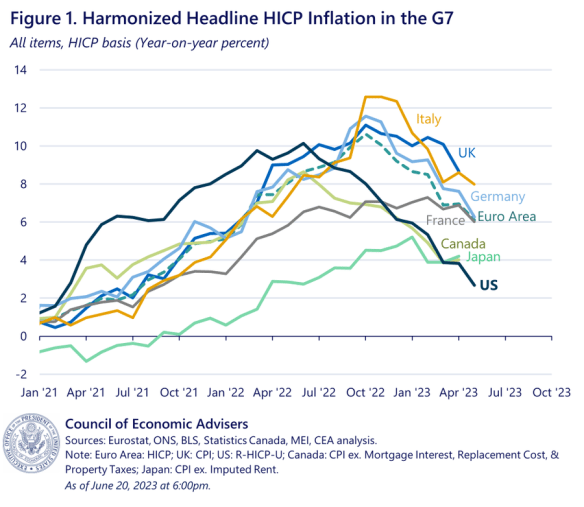
We also have the lowest inflation.

Fzpzxv1XsAIHUrJ

Could last year’s biggest piece of legislation, the Inflation Reduction Act — which passed with zero Republican support — have helped reduce inflation?

Fzp-2vsakAMzWMG

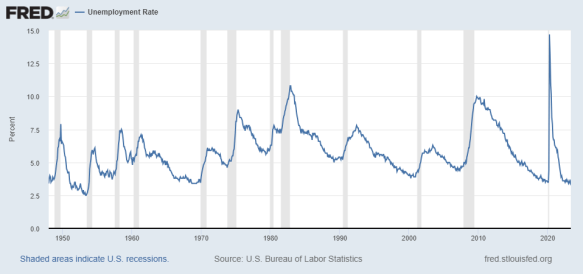
We also have our lowest unemployment rate since 1970, more than 50 years ago.

fredgraph

Perhaps more voters will understand how well the economy is doing by next year’s election — unless, of course, they’re locked into the right-wing media/propaganda bubble. For them, the country is in horrible shape and there is no hope for a better tomorrow unless their favorite felon is returned to office.