The Dangerous Extremists We’re Facing, Part 2

Article 4, Section 4 of the Constitution says:

The United States shall guarantee to every State in this Union a Republican Form of Government . . .

They weren’t referring to a government run by the Republican Party (there weren’t any political parties in America in 1789). They meant that every state should be a republic, not a monarchy. We, the people, along with our elected representatives, should hold supreme power.

The 14th Amendment, Section 1 says that laws should treat us all equally:

No State shall make or enforce any law which shall abridge the privileges or immunities of citizens of the United States; . . . nor deny to any person within its jurisdiction the equal protection of the laws.

Taking those two requirements together, it seems to say that people who live in the same state should be treated equally when it comes to electing their representatives. A state’s laws should not discriminate between voters.

However, Article 1, Section 4 of the Constitution gives state legislatures power to set the borders of congressional districts (and, by implication, of state legislative districts as well). This allows state legislatures to decide which voters live in a particular district, although Congress can overrule how those decisions are made:

The Times, Places and Manner of holding Elections for Senators and Representatives, shall be prescribed in each State by the Legislature thereof; but the Congress may at any time by Law make or alter such Regulations . . .

This creates a situation the authors of the Constitution probably didn’t foresee. A state’s legislators are responsible for determining the boundaries of their own legislative districts, meaning they decide which voters will be responsible for electing them. They are also responsible for setting the boundaries of congressional districts, the areas in the state that elect particular members of the House of Representatives (senators are elected by the whole state).

Gerrymandering has been the result. Legislators design legislative and congressional districts to give themselves and their parties as much power as possible. Voters who tend to vote for the other party are corralled into certain districts, meaning that those districts are guaranteed to elect members of the other party. But it also means there will be relatively few of those lopsided districts.

The upshot is that most districts in a gerrymandered state will have voters who reliably elect members of the party that controls the state legislature. Suppose, for example, a district in Houston, Texas, might always give tremendous victories (80% of the vote) to a Democrat, while two districts near Houston always give smaller, but still reliable, 60% victories to Republicans. This means that even if Democratic candidates get 50% of the total vote in those three districts, Republicans will almost always win two of them and the Democrats will only win one. In a nutshell, allowing legislators to design legislative districts allows them to pick their voters, when the citizens of a republic are supposed to pick their legislators.

That’s obviously not fair. The voters in those three districts in Texas aren’t being treated equally. Practically speaking, the Democrats who live in those districts will never be able to elect more than one Democrat to the state legislature or the House of Representatives, while the equal number of Republicans who live in the same districts will be able to elect two Republicans.

But wait! Congress could change the rules (such as where the district boundaries are) so that the three elections would be competitive. Sometimes one party would win more seats; sometimes the other party would. Except that the very same legislators are responsible for setting the boundaries for Congressional districts. The result is that, in the example above, gerrymandering would allow the state legislature to arrange the boundaries so that more Republicans are guaranteed to win elections, even if the region is equally divided between Republicans and Democrats. Why would a gerrymandered Congress use its authority to undo the gerrymandering that helped get many of its members elected? And even if the House of Representatives agreed to do something about it, the Senate probably wouldn’t, since the Senate is the bastion of minority rule (given the existence of the Senate filibuster and the fact that the Constitution gives two senators to every state, even the smallest or most rural that frequently vote Republican).

But we have federal courts to intervene! The Supreme Court is ultimately responsible for making sure the nation’s laws at both the state and federal level are constitutional. Given the republican (small-r) government guarantee in Article 1, and the equal protection clause in the 14th Amendment, the courts could fix the gerrymandering problem.

Well, the Supreme Court could, but that’s not what the Republican majority on the Court decided two years ago. From NPR:

In a 5-4 decision along . . . ideological lines, the Supreme Court ruled that partisan redistricting is a political question — not reviewable by federal courts — and that those courts can’t judge if extreme gerrymandering violates the Constitution.

The ruling puts the onus on the legislative branch, and on individual states, to police redistricting efforts.

“We conclude that partisan gerrymandering claims present political questions beyond the reach of the federal courts,” Chief Justice Roberts wrote for the conservative [i.e. reactionary] majority. 

Roberts noted that excessive partisanship in the drawing of districts does lead to results that “reasonably seem unjust,” but he said that does not mean it is the court’s responsibility to find a solution.

To which Elena Kagan, appointed to the Court by a Democrat, responded:

For the first time ever, this Court refuses to remedy a constitutional violation because it thinks the task beyond judicial capabilities.

And not just any constitutional violation. The partisan gerrymanders in these cases [before the Court] deprived citizens of the most fundamental of their constitutional rights: the rights to participate equally in the political process, to join with others to advance political beliefs, and to choose their political representatives. In so doing, the partisan gerrymanders here debased and dishonored our democracy, turning upside-down the core American idea that all governmental power derives from the people.

These gerrymanders enabled politicians to entrench themselves in office as against voters’ preferences. They promoted partisanship above respect for the popular will. They encouraged a politics of polarization and dysfunction. If left unchecked, gerrymanders like the ones here may irreparably damage our system of government.

And checking them is not beyond the courts. The majority’s abdication comes just when courts across the country, including those below, have coalesced around manageable judicial standards to resolve partisan gerrymandering
claims. . . . They limit courts to correcting only egregious gerrymanders, so judges do not become omnipresent players in the political process.

But yes, the standards used here do allow—as well they should—judicial intervention in the worst-of-the-worst cases of democratic subversion,
causing blatant constitutional harms. In other words, they allow courts to undo partisan gerrymanders of the kind we face today from North Carolina and Maryland. In giving such gerrymanders a pass from judicial review, the
majority goes tragically wrong.

In sum, state legislators are allowed to rig elections, the Supreme Court says it’s up to Congress to stop them and Congress won’t, not unless enough Democrats are elected to state legislatures and Congress, but that’s unlikely because Republican state legislatures have rigged the game.  

Jamelle Bouie of The New York Times summarizes the current situation:

Not content to simply count on the traditional midterm swing against the president’s party, Republicans are set to gerrymander their way to a House majority next year.

Last week, North Carolina’s Republican-controlled statehouse passed a new map that would, in an evenly divided electorate, give it 10 of the state’s 14 congressional seats. To overcome the gerrymander and win a bare majority of seats, according to the Princeton Gerrymandering Project, Democrats would have to win an unattainably large supermajority of votes.

A proposed Republican gerrymander in Ohio would leave Democrats with two seats out of 15 — or around 13 percent of the total — in a state that went 53-45 for T____ in 2020.

It is true that Democrats have pursued their own aggressive gerrymanders in Maryland and Illinois, but it is also true that the Democratic Party is committed, through its voting rights bills, to ending partisan gerrymandering altogether.

The larger context of the Republican Party’s attempt to gerrymander itself into a House majority is its successful effort to gerrymander itself into long-term control of state legislatures across the country. In Michigan, Wisconsin, Pennsylvania and other states, Republicans have built legislative majorities sturdy enough to withstand all but the most crushing “blue wave.”

And in the age of D___ T___, they are using their majorities to seize control of election administration in states all over the country, on the basis of an outlandish but still influential claim that the Constitution gives sovereign power over elections to state legislatures [Note: which it doesn’t, according to Article 1, Section 4 of the Constitution].

These are the dangerous extremists we’re facing.
The Dangerous Extremists We’re Facing, Part 1

Paul Waldman of The Washington Post summarizes the Republican Party’s “violence problem”:

. . . Let’s take a quick tour around the day’s news.

In new audio released by . . .  ABC News, D____ T____ is asked about his supporters chanting “Hang Mike Pence!” on Jan. 6 as they rampaged through the Capitol in search of the vice president. T____ was unconcerned, both because he thought Pence was “well-protected” and because the protesters were justified in their rage: “It’s common sense” that Pence should have attempted to overturn the results of the election so T____ could remain president, he said, so the rioters’ pursuit of Pence was understandable. . . . .

In other news, members of the House are debating what to do about Rep. Paul A. Gosar (R-Ariz.), who recently tweeted an animated video in which he is depicted killing Rep. Alexandria Ocasio-Cortez (D-N.Y.). Gosar’s defense is that the video was merely a symbolic representation “of a battle between lawful and unlawful policies.”

Meanwhile, in Kenosha, Wis., the trial of Kyle Rittenhouse, who became a hero of the right after he went to a protest with an AR-15-style rifle and killed two people, is nearing its end.

And if you’re a Republican who does so much as vote for a bipartisan bill to bring infrastructure spending to your district, you can expect death threats. The quickest way for Republican candidates to demonstrate their bona fides is by shooting guns in an ad.

The thread running through all these events and controversies is the belief that liberals are so wicked that violence and the threat of violence are reasonable responses to the possibility of them getting their way. Right along with that belief is a fantasy, that of a man (almost always a man) who rather than being an ordinary schlub at the mercy of a world in which he has no power is actually bursting with testosterone and potency, someone who can and perhaps should become a killing machine.

That’s the story of the Jan. 6 rioters, who believed they could break down doors and smash windows and the American system of government would bend to their will.

It’s Rittenhouse’s story, too: When you go to a protest with a rifle, you’ve cast yourself as a potential killer in a righteous cause, and a killer was what he became. He’s now being cheered on by all those who stockpile weapons and say our country is headed for a civil war.

And, of course, no one embodies that fantasy more than T____ himself. He may be a corpulent senior citizen who dodged the draft, but in his own mind he’s Jack Bauer or Jason Bourne, just waiting for the opportunity to display his deadly skills and save the day. After the school shooting in Parkland, Fla., he mused that had he been on the scene, “I really believe I’d run in there even if I didn’t have a weapon,” so brave and capable is he.

His most ardent supporters absolutely love that fantasy of T____ as someone who dishes out violence to their enemies. Check out the wares sold outside his rallies, and you’ll see him transformed on T-shirts and posters into a muscle-bound warrior wielding a rifle . . . 

There are moments when Republican politicians grow a bit uneasy at their supporters’ thirst for violence, particularly when it’s aimed at them. After Jan. 6, one Republican member of Congress wrote about a colleague who voted to overturn the election because they “feared for family members, and the danger the vote would put them in,” if they didn’t give in to the mob. The Republican leader in the Pennsylvania state Senate said last December that if she didn’t support T____’s efforts to overturn the state’s election results, “I’d get my house bombed tonight.”

But before the threats turn back on them, Republicans encourage those violent impulses and apocalyptic beliefs, figuring that they can be exploited without spinning out of control. Are local election officials and school board members being driven from their jobs by death threats? If it means they’ll be replaced by conspiracy theorists, Republicans are happy to watch it happen. . . . 

Unquote:

The New York Times has a report on the same topic. Some selections:

At a conservative rally in western Idaho last month, a young man stepped up to a microphone to ask when he could start killing Democrats. “When do we get to use the guns?” he said as the audience applauded. “How many elections are they going to steal before we kill these people?” The local state representative, a Republican, later called it a “fair” question.

In Ohio, the leading candidate in the Republican primary for Senate blasted out a video urging Republicans to resist the “tyranny” of a federal government that pushed them to wear masks and take F.D.A.-authorized vaccines. “When the Gestapo show up at your front door,” the candidate, Josh Mandel, a grandson of Holocaust survivors, said in the video in September, “you know what to do.”

 . . . School board members and public health officials have faced a wave of threats, prompting hundreds to leave their posts. A recent investigation by Reuters documented nearly 800 intimidating messages to election officials in 12 states. And threats against members of Congress have jumped by 107 percent compared with the same period in 2020, according to the Capitol Police. 

. . . Historians and those who study democracy say what has changed [in recent years] has been the embrace of violent speech by a sizable portion of one party, including some of its loudest voices inside government and most influential voices outside. In effect, they warn, the Republican Party is mainstreaming menace as a political tool. . . . 

Even with the former president largely out of the public eye and after a deadly attack on the Capitol where rioters tried to overturn the presidential election, the Republican acceptance of violence has only spread. Polling indicates that 30 percent of Republicans, and 40 percent of people who “most trust” far-right news sources, believe that “true patriots” may have to resort to violence to “save” the country — a statement that gets far less support among Democrats and independents.

Such views, routinely expressed in warlike or revolutionary terms, are often intertwined with white racial resentments and evangelical Christian religious fervor . . . as the most animated Republican voters increasingly see themselves as participants in a struggle, if not a kind of holy war, to preserve their idea of American culture and their place in society.

Notably few Republican leaders have spoken out against violent language or behavior since Jan. 6, suggesting with their silent acquiescence that doing so would put them at odds with a significant share of their party’s voters. . . .  The ranking Republican lawmakers, Senator Mitch McConnell and Representative Kevin McCarthy, did not respond to repeated requests for comment.

Unquote.

If that weren’t enough, the Times points out that the former president, who’s been accused of rape more than once, has endorsed several Republican candidates accused of domestic violence. Herschel Walker, running for the Senate in Georgia, “is accused of repeatedly threatening his ex-wife’s life”; Max Miller, running for congress in Ohio, “faces allegations of violence from his ex-girlfriend”; and Sean Parnell, a Senate candidate in Pennsylvania, has been accused by his “estranged wife . . .  of choking her and physically harming their children”.

This is today’s Republican Party.

Why Hasn’t Rupert Murdoch Damaged Australia Like He Has America?

Brian Leiter, philosophy professor at the University of Chicago, has a blog and asks “Why hasn’t Rupert Murdoch’s media empire destroyed Australia the way it has destroyed America?”

“Destroyed” is an exaggeration, so let’s rephrase it: Why hasn’t Murdoch destroyed the right-wing in Australia like he has in the US?

The rise of Murdoch’s Fox News in America since 1996 has coincided with the complete crazification of the Republican Party in the U.S., with the result that America is now ungovernable and teetering towards collapse as a democracy (I discussed some of this development in this recent paper). 

Yet Murdoch’s media empire has not had such deleterious effects in his native Australia.  Here’s the program of the Australian Liberal Party, the party of the right in Australia.  With only a couple of exceptions, it’s a set of proposals that would be associated with the more progressive end of the Democratic Party in the U.S.:  spend money on infrastructure, on the elderly, on families, on healthcare, on women.  Of course, Australian politics started from a different baseline, but the question that naturally arises is: why didn’t the Murdoch media wreck Australia too?

I was discussing this with a friend who recently relocated to Australia, and her explanation was striking: mandatory voting.  Everyone has to vote, which means elections (and, in the US, especially primary elections) aren’t dominated by highly motivated partisans.   Most people, so the hypothesis goes, are interested in stability, peace, and services, and since everyone must vote, that’s what they vote on, with the result that even the right-wing party has to stand for a program that delivers stability, peace, and services.  The Murdoch media rant and rave, as they do here, but since most people (including in the US) ignore the Murdoch media, their effect in Australia is muted by the fact that everyone is voting.

He asked what his readers think. One answer was:

Yes, mandatory voting is part of the difference. But I suspect that the preferential voting system is also important, and tends to select more sensible, stable legislators.

The Australian government explains its system of preferential voting:

Elections that use a simple majority, or “first-past-the-post” systems, elect a candidate who has received the most number of votes in a contest after a single count. This is regardless of whether or not the number of votes for the successful candidate represents a majority of the total amount of votes.

First-past-the-post voting systems are used in many countries including the United States, the United Kingdom, Canada and India.

Preferential voting

There are many different types of preferential voting systems in use across Australia and the world.

Some preferential voting systems make it compulsory for voters to mark a preference for every single candidate on the ballot paper, some require a certain number of preferences to be indicated and others are optional preferential.

Australian federal elections use a preferential voting system where voters are required to:

  • mark a preference for every candidate on the green ballot paper (House of Representatives)
  • mark a preference for a designated number of preferences on the white ballot paper (Senate)

Note: voters in Australia are subject to a small fine if they don’t vote.

Of course, we could never institute mandatory voting in America, because, you know, FREEDOM!

In other words, a right-wing minority is free to destroy American democracy because, you know, a Constitution ratified 232 years ago.

When Will We Build Back Better? And What Will We Do?

“Build Back Better”. It’s not a great slogan, but Biden’s BBB bill will be passed eventually. It won’t be as sensible as what Biden originally proposed. A few “conservative” or flaky congressional Democrats insisted on making it worse. But it will make a difference in millions of lives when it finally becomes law.

Democrats in the House say they want to pass it this coming week, which means by Thursday, November 18. Then, however, both the House and Senate take another much needed break until the end of November. Assuming House Democrats do their job next week, Senate Democrats will then have two weeks to do theirs, before it’s break time again.  Unless Senate Democrats approve it by December 10, it won’t get done until 2022 (we really are living in the future). 

Almost all the news about BBB has been about the spending side of the bill, leaving out the popular offsetting taxes the bill would impose on corporations and people with plenty of cash to spare. The other thing the news has mostly ignored is what the bill would do. A relatively objective and nonpartisan group called the Committee for a Responsible Federal Budget has kindly provided the list below. The CFRB concludes it would have a small effect on the federal deficit in its present form. In the long run, they say it would have a bigger effect, assuming all the temporary parts of the bill are made permanent. But there’s no doubt whatsoever these things are worth doing and we can afford to do them (unlike the last Republican tax cut, for example, which wasn’t worth doing and made good things like BBB less easy to afford).

What’s in the Build Back Better Act?

Policy Cost/Savings (-)
Family Benefits  $585 billion
Provide universal pre-k & establish an affordable child care program (6 years) $390 billion
Establish a paid family and medical leave program $195 billion
Climate & Infrastructure  $555 billion
Invest in clean energy & climate resilience $220 billion
Establish or expand clean energy & electric tax credits $190 billion
Establish or expand clean fuel & vehicle tax credits $60 billion
Establish or expand other climate-related tax benefits $75 billion
Enact infrastructure & related tax breaks $10 billion
Individual Tax Credits & Cuts $210 billion
Extend Child Tax Credit (CTC) increase to $3,000 ($3,600 for kids under 6) for one year $130 billion
Make CTC fully refundable for 2023 & beyond $55 billion
Extend expanded Earned Income Tax Credit (EITC) for one year  $15 billion
Other individual tax changes $10 billon
Health Care  $335 billion
Strengthen Medicaid home- and community-based services $150 billion
Extend expanded Affordable Care Act (ACA) premium tax credits & make premium tax credits available to those in Medicaid coverage gap through 2025 $125 billion
Establish Medicare hearing benefit $30 billion
Invest in the health care workforce $30 billion
Other Spending & Tax Cuts  $310 billion
Build & support affordable housing $170 billion
Increase higher education & workforce spending $40 billion
Other spending & investments $100 billion
Reduce or Delay TCJA Base Broadening $290 billion
Increase SALT deduction cap to $80,000 through 2025 $285 billion+
Delay amortization of research & experimentation expenses until 2026 $5 billion’
Enact Immigration Reform  ~$100 billion
Subtotal, Build Back Better Act Spending & Tax Breaks  $2.4 trillion
Increase Corporate Taxes -$830 billion 
Impose a 15 percent domestic minimum tax on large corporations -$320 billion
Impose a 15 percent global minimum tax & reform international taxation -$280 billion
Impose a 1 percent surcharge on corporate stock buybacks -$125 billion
Enact other corporate tax reforms -$105 billion
Increase Individual Taxes on High Earners  -$640 billion
Expand the 3.8 percent Net Investment Income Tax -$250 billion
Impose a 5 percent surtax on income above $10 million & an 8 percent surtax on income above $25 million -$230 billion
Extend and expand limits on deductibility of business losses -$160 billion
Other Revenue -$170 billion
Reduce the tax gap by funding IRS & other measures -$125 billion*
Reinstate superfund taxes on oil -$25 billion
Expand nicotine taxes -$10 billion
Reform tax treatment of retirement accounts -$10 billion
Health Care -$250 billion
Repeal Trump Administration drug rebate rule -$150 billion
Reform Part D formula, cap drug price growth, & allow targeted drug price negotiations -$100 billion
Establish $80,000 SALT deduction cap from 2026 through 2030 & $10,000 cap in 2031 -$300 billion+
Subtotal, Build Back Better Act Offsets  -$2.2 trillion
Net Deficit Increase, House Build Back Better Act  ~$200 billion

Where We’re Heading

Ronald Reagan. They called him “the Great Communicator”, but he was a horrible president. When he was seeking a second term in 1984, one of his campaign ads began with the phrase: “It’s morning again in America”.

The idea was that after four years of his leadership, the US was in good shape again. The head of the Federal Reserve, Paul Volcker (a Democrat), had killed the high inflation of the late 70s by raising interest rates to stratospheric levels. And Republicans had juiced the economy by going on a tax-cutting and spending spree based on the ludicrous theory that massive tax cuts would pay for themselves (a doctrine famously labeled “Voodoo Economics” by a future, less dangerous Republican president).

But a poll taken two months ago showed only 29% of country think the US is on the right track.

Well, Democrats and the new media need to get the word out. Biden should reuse that famous phrase: “It’s morning again in America”.

In less than 10 months, the Democrats have have cut child poverty in half, added more than 5 million jobs, managed the most ambitious vaccine rollout in the nation’s history, and passed a $1.2 trillion investment in the water, roads, bridges and broadband. (The broadband provisions of the infrastructure bill will help some of the most conservative parts of America — rural areas that struggle with unreliable, expensive connectivity.)

1.44 million vaccinations were administered yesterday. 70% of adults are fully vaccinated.

Pfizer says its anti-viral pill reduces the risk of death or hospitalization by 89% in people who take it within three days of symptoms starting.

Progress:

  • January 2021: Unemployment rate is 6.3%.
  • February 2021: Nonpartisan Congressional Budget Office projects we will get to 4.6% unemployment by the end of 2023.
  • March 2021: Democrats pass the American Rescue Plan with ZERO REPUBLICAN VOTES.
  • October 2021: Economy reaches 4.6% unemployment two years ahead of schedule, declining more this year than any other year on record.

The initial August jobs number of 235,000 started a wave of economic panic in the press. It was actually 483,000. September’s 194,000, which signaled malaise, has been revised to 312,000.

531,000 jobs were added in October, beating all expectations. Leisure and hospitality gained 164,000 jobs, as restaurants continued to staff up amid the decrease in coronavirus cases. Professional and business services added 100,000 jobs, manufacturing added 60,000, construction 44,000, health care 37,000, and transportation and warehousing 54,000. . . .

The US has now added 5.5 million jobs since President Biden took office. Approximately 80% of the jobs lost during the pandemic have been recovered. The labor market is recovering much faster than it did after the 2008 recession.

The number of Americans applying for unemployment benefits fell to a new pandemic low.

Average wages are up $2 an hour. Wages for production workers are up 5.8% and 12.4% for restaurant workers.

Home values are up. Family debt is down. The S&P 500 is up 23% since Biden took office, 32% since he was elected (we’re still waiting for the crash the previous president predicted).

In October, consumer confidence, “the engine of the U.S. economy”, rose after months of decline. Consumers were also the most optimistic since 2000 about their own prospects to find jobs. 

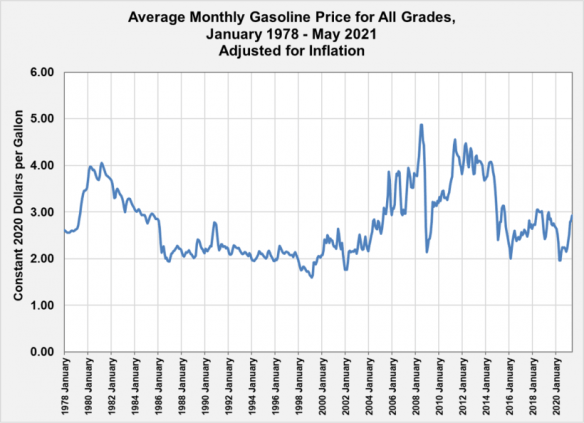
It’s true, the average price of gasoline has gone up. It always goes up and down, given the price of oil and how much people drive. It was almost $5.00 a gallon in 2008 (when a Republican was president) and $4.00 in 2014. It’s around $3.40 today.

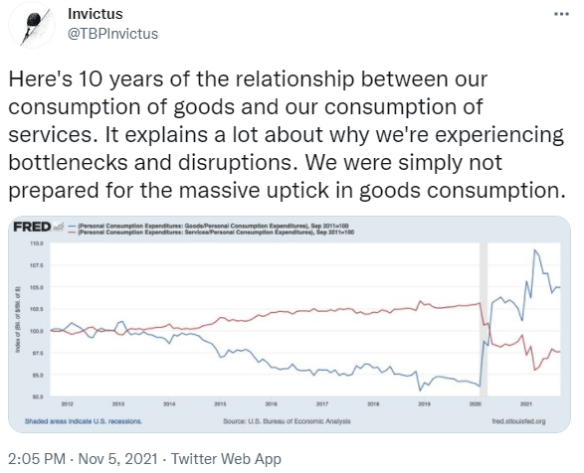
fotw1199Since we’re coming out of a pandemic-infused recession, problems should be expected.
Untitled

What’s next?

Democrats, again with ZERO REPUBLICAN VOTES, will pass parts of Biden’s “Build Back Better” social policy bill, fulfilling some of the promises he ran on in 2020 (not because  Alexandra Ocasio-Cortez has hypnotized him).

Biden describes it in two sentences, “The build back better framework lowers your bills for health care, child care, prescription drugs, and preschool. And families get a tax cut.”

Paul Krugman used one sentence: “Tax the rich, help America’s children”.

Democrats may — may — finally be about to agree on a revenue and spending plan. It will clearly be smaller than President Biden’s original proposal, and much smaller than what progressives wanted. It will, however, be infinitely bigger than what Republicans would have done, because if the G.O.P. controlled Congress, we would be doing nothing at all to invest in America’s future.

But what will the plan do? Far too much reporting has focused mainly on the headline spending number — $3.5 trillion, no, $1.5 trillion, whatever — without saying much about the policies this spending would support. . . 

So let me propose a one-liner: Tax the rich, help America’s children. This gets at much of what the legislation is likely to do: Reporting suggests that the final bill will include taxes on billionaires’ incomes and minimum taxes for corporations, along with a number of child-oriented programs. And action on climate change can, reasonably, be considered another way of helping future generations.

Republicans will, of course, denounce whatever Democrats come out with. But there are three things you should know about both taxing the rich and helping children: They’re very good ideas from an economic point of view. They’re extremely popular. And they’re very much in the American tradition.

I hope what comes soon after that is an all-out push to convince two or three misguided Democratic senators to reform the filibuster in order to protect voting rights, because, all around the country, Republicans are doing whatever they can to insure minority, right-wing rule.

Biden and his team are restoring reasonable regulations for business and trying to address the climate crisis. They’re reuniting immigrant families instead of tearing them apart. They had the guts to finally end our longest, stupidest war. They’re getting respect around the world, not losing it. They want women to control their bodies. They believe it should be easy for Americans to vote. 

Maybe him and other Democrats know what they’re doing. Maybe more of us will figure that out.