Whereof One Can Speak 🇺🇦

Nothing special, one post at a time since 2012

Hitting Voters in the Gut

Paul Waldman of The Washington Post says Democrats need messages that “hit voters in the gut“:

Faced with demands to do something about the right-wing revolution the Supreme Court is inflicting on the country, congressional Democrats will hold votes on bills guaranteeing marriage equality and the right to contraception. These are protected at the moment, but many fear the court and Republicans will move to attack them sometime in the near future.

Since these bills will fall to Republican filibusters in the Senate, they are demonstration votes, meant … in large part to force Republicans to vote against them and thereby reveal themselves to be out of step with public opinion. As many a Democrat has said, “Let’s get them on the record.”

But “getting them on the record” doesn’t accomplish much if you don’t have a strategy to turn that unpopular vote into a weapon that can be used to actually punish those Republicans. And there’s little evidence Democrats have such a strategy.

Sure, they’ll issue some news releases and talk about it on cable news. And here or there the vote might find its way into a campaign mailer (“Congressman Klunk voted against contraception! Can the women of the Fifth District really trust Congressman Klunk?”). But I fear that too many Democrats think getting them on the record is enough by itself.

The reason is that unlike their Republican counterparts, Democrats tend to have far too much faith in the American voter.

People in Washington, especially Democrats, suffer from an ailment that is not confined to the nation’s capital. It plays out in all kinds of places and in politics at all levels. It’s the inability to see politics from the perspective of ordinary people.

… It’s hard to put yourself in the mind of someone whose worldview is profoundly different from your own. If you care about politics, it’s almost impossible to understand how the average person — even the average voter — thinks about the work you do and the world you inhabit.

If you’re reading this, politics is probably a daily reality for you. You almost certainly have a deep well of both foundational knowledge and day-to-day awareness of the political world. You know who the major players are and what their jobs entail. You can explain what a “filibuster” is, or how a bill becomes a law. And because you follow the news, you know what the issues of the moment are and where the two parties stand on them.

Here’s the problem: Most Americans have only a fraction of the understanding you do about these things — not because they’re dumb or ignorant but mainly because they just don’t care. They worry about other things, especially their jobs and their families. When they have free time they’d rather watch a ballgame or chat with a friend than read about whether certain provisions of Build Back Better might survive in some process called “reconciliation.”

If you are the kind of weirdo who cares about politics, you may find it difficult to communicate effectively to those regular people about something they neither know nor care much about.

Like many people, I discovered this disconnect the first time I volunteered on a campaign and went door to door trying to convince people to vote for my candidate. Most didn’t know who he was, didn’t know who he was running against, and didn’t much care about the issues I raised.

In fact, the very idea of “issues” — where a thing happening in the world is translated into something the government might implement policies to address — was somewhat foreign to them. Because I was young and enthusiastic but not schooled in subtle communication strategies, I couldn’t get beyond my own perspective and persuade them of anything.

In the years since, I’ve spent plenty of time trying to understand how normal people think about politics, but that understanding is always incomplete. And most Democrats I know are still captive to the hope that politics can be rational and deliberative, ultimately producing reasonable outcomes.

Republicans have no such illusions. They usually start from the assumption that voters don’t pay attention and should be reached by the simplest, most emotionally laden appeals they can devise. So Republicans don’t bother with 10-point policy plans; they just hit voters with, “Democrats want illegals to take your job, kill your wife, and pervert your kids,” and watch the votes pour in.

Of course, sometimes those appeals fall flat, and Democrats win plenty of elections. And every once in a while, a vote in Congress gets so much attention and discussion that even regular people hear about it and might even form an opinion.

But like most such demonstration votes, the ones on contraception and marriage equality … won’t be one of those times. Turning them into something that moves the electorate will require a lot of planning and work to execute. It will mean concerted and coordinated effort. If Democrats think “getting them on the record” will get the job done all by itself, they’re going to be disappointed once again.

Unquote.

If I was a Democratic politician, I’d try to hit my constituents in the gut with stories like these and remind them which side Republicans are on:

Just 3 Weeks Post-Roe, the Stories Emerging Are Worse Than Anyone Imagined (Jezebel)

United Kingdom smashes its all-time, hottest-day record, 100 million Americans under alerts in global heat emergency (CNN)

The Screams of the Children Have Been Edited Out (Counterpunch)

They Have Really Pretty Graphs

A big way our antiquated political system has let us down (way down) in recent years is the growth of inequality. It all goes back to the Reagan Revolution:

In August 1981, President Reagan signed the Economic Recovery Tax Act of 1981, which enacted a 27% across-the-board federal income tax cut over three years, as well as a separate bill that reduced federal spending, especially in anti-poverty programs [Wikipedia].

The Tax Reform Act of 1986 was the top domestic priority of President Reagan’s second term. The act lowered federal income tax rates, decreasing the number of tax brackets and reducing the top tax rate from 50 percent to 28 percent [Wikipedia].

Income tax rates have fluctuated since then under Republican and Democratic administrations without much change to Reagan’s policies. And when we consider the many deductions, exemptions and loopholes that tax lawyers and accountants are paid to take advantage of for their moneyed clients, effective tax rates have always been lower than the official rates.

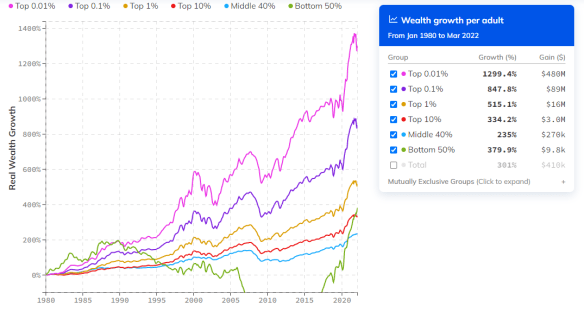
I was reminded of this history when somebody linked to a new site called Realtime Inequality. It was created by three UC Berkeley economists in order to show how different “income and wealth groups” benefit or fall behind when new growth numbers come out each quarter”:

Realtime Inequality provides timely and high-frequency estimates of the distribution of income and wealth in the United States. Our statistics distribute the totality of national income and household wealth across socio-economic groups and are updated each quarter when new macroeconomic numbers are published. (National income is similar to Gross Domestic Product and a better indicator of income earned by US residents.)

This makes it possible to estimate economic growth by socio-economic groups consistent with quarterly releases of macroeconomic growth, and to track the distributional impacts of government policies during and in the aftermath of recessions in real time. 

The site has graphs for both income and wealth that you can play around with for different groups and time periods. Thus, one measure of income growth between January 1980 and March 2022 shows that income (corrected for inflation) rose 333% for the top tenth of one percent and 26% for the bottom fifty percent.

x

While one measure of wealth for the same period grew by $89 million for the upper tenth of one percent and less than $10,000 for the bottom fifty percent.

y

It’s kind of fun to play with if you don’t think about it too hard.

More from Ezra Klein on Reforming the Supreme Court

Last week I shared most of Ezra Klein’s article about the Supreme Court and the way today’s politics is more about power than norms. He revisited the topic this week. Here’s most of what he wrote:

Late in the lead-up to the 2020 presidential election, as Mitch McConnell rushed to replace Ruth Bader Ginsburg with Amy Coney Barrett, the left began pushing Joe Biden to endorse adding seats to the Supreme Court. Biden, in response, did what politicians do when faced with an issue they don’t want to think about: He promised to create a commission to study the issue.

That commission submitted its report in December 2021, and as far as I can tell, Biden’s lack of interest has been confirmed. For all the fury at the Supreme Court in recent weeks, the Biden administration doesn’t seem to have mentioned the report or any of the options it raised. Perhaps that’s just an admission of political reality. Democrats don’t have the votes to change the court.

But the Biden administration needs to change political reality, not just accept it….. One such [response] might be a plan to repair the court — one that goes beyond restoring Roe v. Wade and demonstrates a deeper vision for reimagining America’s political system in an era of crisis….

The commission’s report doesn’t endorse any particular plan. Instead, over nearly 300 pages, it considers several plans and airs the arguments for and against them. At times it’s pathologically evenhanded, bordering on naĂŻve….But in total, the report is a thorough … tour through ways the court could be restructured….

In Federalist No. 78, Alexander Hamilton wrote that the judiciary has “… neither FORCE nor WILL, but merely judgment”. The debate over the Supreme Court tends to revolve around the word “legitimacy.” The fear is that the court will lose its legitimacy, whatever that means. But the word Hamilton uses is more interesting: judgment.

I take the problem with the current Supreme Court to be that there’s no reason to trust its judgment, and many reasons to mistrust it. The process for picking appointees is thoroughly politicized. The process by which seats come open and the court is refreshed is thoroughly politicized, save when death intervenes with a justice’s preferred moment of retirement. Critical cases are decided again and again on party-line votes, making a hash of the idea that the court speaks as an institution, on behalf of the Constitution, rather than as nine ideologically predictable political appointees.

As I argued last week, the court — like the rest of our political system — wasn’t designed for an era of polarized political parties. It is supposed to be a check on the other branches, not an amplifier of the power the parties wield across them. Its problem is a mismatch between the political system for which it was designed and the political system we actually have. And so the question is, what might the court look like if it were designed for this era? What reforms would make the court’s judgment more, rather than less, trustworthy?

In my view, court packing, the idea that arguably launched the commission, fails that test…. You can’t fix the court by adding justices. You’re shifting the balance of power by contributing to the underlying problem: turning the court into an untrustworthy institution and setting off a cycle of reprisals with unknown consequences…. [Note: I disagree. This is an emergency. If the Democrats in Washington wanted to, they could add four justices to match the number of federal circuit courts. There used to be nine circuits. Now there are thirteen. Then let the Democrats propose a way to make the court more balanced in the future. See below.]

Let’s start with the easy one: term limits. Lifetime appointment did not mean, for most of American history, what it means today. The commission notes that until the 1960s, the average length of service on the court was 15 years. Now it’s 26 years — and perhaps rising. As the partisan stakes of Supreme Court nominations have sharpened, life span has become one more variable to game: Parties are looking for the youngest justices they can credibly pick in order to ensure their nominees hold power far into the future.

Worse, because justices retire strategically, power in the court now builds power in the court later. As the commission notes, Trump “appointed three Justices in his single four-year term; his immediate Democratic predecessors, Presidents Barack Obama, Bill Clinton, and Jimmy Carter, made only four appointments total in a combined twenty years in office.” Lifetime appointments were intended to insulate the justices from politics. Instead, they have become a driver of the court’s politicization.

Limiting justices to 18-year terms has collected a fair amount of bipartisan support over the years…. When the National Constitution Center convened separate groups of liberal and conservative legal scholars to consider court reform, both ended up proposing 18-year terms. It also has the force of international practice behind it. This, from the report, is worth reflecting on:

The United States is the only major constitutional democracy in the world that has neither a retirement age nor a fixed term limit for its high court Justices….  In light of this contrast, one scholar who testified before the Commission opined that, “were we writing the United States Constitution anew, there is no way we would adopt the particular institutional structure that we have for judicial tenure. No other country has true lifetime tenure for its justices, and for good reason.”

… Eighteen-year terms would mean, over time, that presidents could expect two appointments per term. A two-term presidency would see four appointments — … enough to make sure the court doesn’t fall too far out of step with the American people. It would also lower the stakes on any one vacancy or any one decision, because vacancies would become predictable and commonplace.

But there’s also a need to depoliticize the court and protect it from politics. It now seems unlikely that vacant seats can ever be filled when the White House and the Senate are controlled by opposing parties … [No, the evidence is that would only happen if Republicans controlled the Senate, like they did in 2015. As Mr. Klein adds parenthetically…] (In case you thought Merrick Garland a one-off, McConnell has already said it’s “highly unlikely” he’d let Biden fill a Supreme Court seat if Republicans retake the Senate in 2022.)

But the commission has an interesting idea for that. If the Senate fails to act on, or otherwise confirm, two Supreme Court nominees in a set amount of time, the deadlock could trigger a new process in which the chief judges of the federal Courts of Appeals would vote on the next nominee….

More radical is the idea for a “balanced bench.” The commission does not discuss this idea at any length… The balanced bench is a proposal by Daniel Epps and Ganesh Sitaraman, both law professors, to divvy up Supreme Court seats in a new way: Both parties would get five justices, and then those 10 justices would be called upon to unanimously or near-unanimously agree on another five justices.

The merits of the balanced bench proposal are perfectly, if accidentally, encapsulated in the commission’s critique of the idea:

An explicit requirement that Justices be affiliated with particular parties would constrain the pool of potential nominees and reinforce the notion that Justices are partisan actors….This close identification of Justices with political party could undermine the perception of judicial independence, which is important to the acceptance of and compliance with the Court’s decisions.

Yes, it would be a shame to reinforce the accurate perception that Supreme Court nominees, chosen by political parties, extensively vetted for ideological reliability, might be, on some level, partisan actors. [This is] extraordinary: Even if it is true that the justices have “ideological motivations,” we must act like it isn’t true, because an accurate understanding of the judiciary might undermine “acceptance of and compliance with” its decisions.

This is an argument for denial, when what we require is a reckoning…. A central question in any political system is how to balance power so all sides have an interest in the system’s continued success. The problem in our system is that we are balancing the power of places rather than parties. The framers believed the politics of states would structure our politics. “Many considerations … seem to place it beyond doubt that the first and most natural attachment of the people will be to the governments of their respective States,” wrote James Madison in Federalist No. 46. And so the Senate balances the power of states equally, and the [Electoral College] gives rural areas a boost in political representation.

But the framers were wrong. Political parties are our primary political attachments, and that’s been true for decades. Perhaps the Supreme Court should be a place that balances their power rather than another venue through which they compete for dominance.

Taking parties seriously means recognizing who is left out by party competition, too. Many Americans … find themselves utterly unrepresented by the current nominations process. There should be a path to the Supreme Court that does not rely on proving yourself a loyal foot soldier, decade after decade, to the party likeliest to sponsor you, a path that relies on building the best reputation for judgment among peers of all political persuasions. The “balanced bench” idea would create that path, too…. The proposal is a provocative sketch rather than a fully worked-through plan. But provocations are what we need.

We treat the creaking, cracking structure of American government with a strange mix of awe and fatalism; either we think it somehow heretical to question, or we’re so pessimistic about the prospect of change that we don’t even bother. But to dive into the history of court reform, as the commission does, is to be reminded that the Supreme Court was imagined by human minds, and made and remade by human hands. We honor the idea of the American experiment, but we have lost the spirit of experimentation that made it work. We did not discover the ideal structure for the Supreme Court, once and for all, in 1869 [when the number of justices was set to nine]. Our forerunners did their best for the times in which they lived. It is time we did ours.

You Know They Shoot Fast. Here’s the Other Thing They Do.

The other thing is the damage they do to a human body. This video features a ballistics test starting around 1:25 that shows what’s it like to get shot with one of these AR-15 type weapons compared to a pistol. What else do we need to know in order to make these things illegal?

How To Be a Reactionary

I happened to finish a book called The Rhetoric of Reaction around the same time I read a Twitter thread regarding the “reactionary worldview”. The book and the thread don’t cover the same ground, but they might be helpful if you aspire to be a reactionary (it’s the latest thing: there could be a Supreme Court seat in your future).

First, the thread from David Roberts of the Volts newsletter and podcast:

… The fundamental feature of the reactionary worldview is that life/culture is a zero-sum contest of tribe vs. tribe. Your tribe is either being dominated and humiliated or dominating and humiliating other tribes. There are no other options. Your average liberal has genuine difficulty wrapping their mind around: to a reactionary, talk about non-hierarchical relationships — equality, mutual respect — is literally fantastical, like talk about unicorns. They can only hear it as a scam, i.e., as someone trying to get one over on them. That’s the only way they can interpret liberals: as just another tribe, using “equality” talk as a sneaky means of domination. They experience calls for tolerance and mutual respect as attacks. Thus, you get this bizarre dynamic of reactionaries thinking of liberals as tyrannical, as a force imposing, uh, tolerance. “They want everyone to think the same!” Where “the same” is, “allow everyone to think and behave how they want as long as they don’t hurt others.”

Or as I once opined, maybe to myself: When Republicans hear a Democrat say we’re all in this together, they think it’s a threat.

Next, the book. It was written by the economist Albert O. Hirschman. Published in 1991, The Rhetoric of Reaction deals with three typical arguments made by reactionaries (or the milder reactionaries known as “conservatives”). He labeled them the Perversity, Futility and Jeopardy arguments:

According to the perversity thesis, any purposive action to improve some feature of the political, social, or economic order only serves to exacerbate the condition one wishes to remedy.

The futility thesis holds that attempts at social transformation will be unavailing, that they will simply fail to “make a dent”.

The jeopardy thesis argues that the cost of the proposed change or reform is too high as it endangers some previous, precious accomplishment.

Hirschman discusses various instances of these arguments, beginning with the 18th century. Near the end of the book, he has a chapter on progressive counterarguments:

By demonstrating that each of the reactionary arguments has one or more progressive counterparts, I generated contrasting pairs of reactionary and progressive statements about social action.

PERVERSITY — Reactionary: The contemplated action will bring disastrous consequences [in particular, the opposite of what was intended].

— Progressive: Not to take the contemplated action will bring disastrous consequences [the opposite of what was intended].

JEOPARDY — Reactionary: The new reform will jeopardize the older one.

— Progressive: The new and the old reforms will mutually reinforce each other.

FUTILITY —  Reactionary: The contemplated action attempts to change permanent structural characteristics (“laws”) of the social order; it is therefore bound to be wholly ineffective, futile.

— Progressive: The contemplated action is backed up by powerful historical forces that are already “on the march”; opposing them would be utterly futile.

Hirschman then draws a conclusion regarding the possibility of a stable democracy:

What I have ended up doing, in effect, has been to map the rhetorics of intransigence as they have long been practiced by both reactionaries and progressives….

Yet my purpose is not to cast “a plague on both your houses.” Rather, it is to move public discourse beyond extreme, intransigent postures of either kind, with the hope that in the process our debates will become more “democracy friendly”….

Recent reflections on democracy have yielded two valuable insights, a historical one on the origins of pluralistic democracies and a theoretical one on the long-run conditions for stability and legitimacy of such regimes. Modern pluralistic regimes have typically come into being, it is increasingly recognized, not because of some preexisting wide consensus on “basic values,” but rather because various groups that had been at each other’s throats for a prolonged period had to recognize their mutual inability to achieve dominance. Tolerance and acceptance of pluralism resulted eventually from a standoff between bitterly hostile opposing groups.

This historical point of departure of democracy does not bode particularly well for the stability of these regimes. The point is immediately obvious, but it becomes even more so when it is brought into contact with the theoretical claim that a democratic regime achieves legitimacy to the extent that its decisions result from full and open deliberation among its principal groups, bodies, and representatives. Deliberation is here conceived as an opinion-forming process: the participants should not have fully or definitively formed opinions at the outset; they are expected to engage in meaningful discussion, which means that they should be ready to modify initially held opinions in the light of arguments of other participants and also as a result of new information which becomes available in the course of the debate.

If this is what it takes for the democratic process to become self-sustaining and to acquire long-run stability and legitimacy, then the gulf that separates such a state from democratic-pluralistic regimes as they emerge historically from strife and civil war is uncomfortably and perilously wide. A people that only yesterday was engaged in fratricidal struggles is not likely to settle down overnight to those constructive give-and-take deliberations.

Far more likely, there will initially be agreement to disagree, but without any attempt at melding the opposing points of view—that is indeed the nature of religious tolerance. Or, if there is discussion, it will be a typical “dialogue of the deaf”—a dialogue that will in fact long function as a prolongation of, and a substitute for, civil war. Even in the most “advanced” democracies, many debates are, to paraphrase Clausewitz, a “continuation of civil war with other means.” Such debates, with each party on the lookout for arguments that kill, are only too familiar from democratic politics as usual.

There remains then a long and difficult road to be traveled from the traditional internecine, intransigent discourse to a more “democracy-friendly” kind of dialogue. For those wishing to undertake this expedition there should be value in knowing about a few danger signals, such as arguments that are in effect contraptions specifically designed to make dialogue and deliberation impossible. I have here attempted to supply a systematic and historically informed account of these arguments on one side of the traditional divide between “progressives” and “conservatives”—and have then added, much more briefly, a similar account for the other side. As compared to my original aim of exposing the simplicities of reactionary rhetoric alone, I end up with a more even-handed contribution—one that could ultimately serve a more ambitious purpose.

Unquote.

Hence, to be a reactionary, consider dividing the world into tribes all out to take advantage of each other (your tribe being the best) and using the same arguments over and over again: doing something won’t work, it will backfire and it will undo what’s already been done.