Moe Should Have Watched “The Wire”

David Simon, the creator of The Wire, spoke recently at a conference in Australia. The Guardian has an edited transcript of his talk here. Some selected paragraphs:

You know if you’ve read Capital or if you’ve got the Cliff Notes, you know that [Marx’s] imaginings of how classical Marxism – of how his logic would work when applied – kind of devolve into such nonsense as the withering away of the state and platitudes like that. But he was really sharp about what goes wrong when capital wins unequivocally, when it gets everything it asks for.

That may be the ultimate tragedy of capitalism in our time, that it has achieved its dominance without regard to a social compact, without being connected to any other metric for human progress.

From this moment forward unless we reverse course, the average human being is worth less on planet Earth. Unless we take stock of the fact that maybe socialism and the socialist impulse has to be addressed again; it has to be married as it was married in the 1930s, the 1940s and even into the 1950s, to the engine that is capitalism.

Mistaking capitalism for a blueprint as to how to build a society strikes me as a really dangerous idea in a bad way. Capitalism is a remarkable engine again for producing wealth. It’s a great tool to have in your toolbox if you’re trying to build a society and have that society advance. You wouldn’t want to go forward at this point without it. But it’s not a blueprint for how to build the just society. There are other metrics besides that quarterly profit report.

And that’s what The Wire was about basically, it was about people who were worth less and who were no longer necessary, as maybe 10 or 15% of my country is no longer necessary to the operation of the economy. It was about them trying to solve, for lack of a better term, an existential crisis. In their irrelevance, their economic irrelevance, they were nonetheless still on the ground occupying this place called Baltimore and they were going to have to endure somehow.

Moe really should have watched The Wire.

One Reason Our Democracy Is In Trouble

A recent paper by three political scientists argues that American voters don’t nicely divide between liberals and conservatives. There are also populists and libertarians. In order to understand the American electorate, therefore, we need two dimensions, not one. This observation isn’t new, but it’s worth keeping in mind when thinking about our dysfunctional political system.

Instead of the standard left/right dimension, we need a left/right social dimension and a left/right economic dimension. Polling data indicates that the electorate is rather evenly distributed between four ideological tendencies:

04edsall-chart-popup

At the lower left, liberals are liberal on both social and economic issues. That’s the official Democratic party position. At the upper right, conservatives are conservative on both social and economic issues. That’s the official Republican position (although “conservative” is a misnomer for today’s Republican Party).

Meanwhile, populists are liberal on economic issues and conservative on social issues, while libertarians are the opposite of populists, being conservative on economic issues and liberal on social ones.

On a social issue like gay marriage, for example, liberals and libertarians tend to be in favor of it. I mean, who cares if gay people get married? Well, populists (say, a truck driver who belongs to the Teamsters) and the conservatives at the Republican National Committee aren’t happy about it.

On an economic issue like the minimum wage, however, liberals and populists like the idea that people with jobs should have a relatively decent standard of living. Conservatives and libertarians, on the other hand, think it’s wrong to force business owners to pay their employees an artificially high wage.

The authors of the article identify a fifth group, the moderates in the middle, whose ideology isn’t especially liberal or conservative. They represent some of the infamous “swing” voters who don’t know who to vote for (Obama, Romney, who can decide?).

What the diagram shows, however, is that the populists and libertarians will also tend to swing between the two major parties, since their views don’t match up nicely with either the liberal/liberal Democratic candidates or the conservative/conservative Republican ones.

It may also be the case that the moderates, populists and libertarians will tend to avoid voting altogether, since the major candidates don’t fully represent their views.

Would it be better if there were four major parties instead of two? That might result in more people voting, which is supposedly a good thing in a democracy. But that would seem to require making our political system more representative, for example, by moving away from winner-take-all and allowing minority parties to gain more power. The authors of the paper don’t expect much to change any time soon:

There is no great mystery as to why American political parties can’t get beyond the left-right divide. Parties are by nature risk-adverse organizations … tightly moored to the status quo. Only under the most extreme circumstances—for parties, that means repeated losses at the polls—do they adopt changes in their electoral strategy. Thus, as long as both parties can plausibly convince themselves that their ideological appeals are not responsible for their electoral defeats, they will avoid making any fundamental changes in their basic strategies.

At the same time, … neither Republicans nor Democrats will be able cultivate a majority by only focusing on their core ideological supporters. There are simply not enough additional conservative and liberal votes to be harvested to produce an electoral majority. So, for the time being, both parties are caught in fundamental dilemma—they lack the incentive to move beyond their ideological anchors and yet they cannot become a majority party by becoming more closely tied to these anchors. They are thus set adrift in a sea of future uncertainty.

I read about this paper in an article in the New York Times. The author of the Times article is mainly interested in the idea of a middle-of-the-road third party. I think a middle-of-the-road third party might satisfy fewer people than the two we already have.

Criticizing Israel and the Fundamental Problem

Max Blumenthal is the 35-year-old son of former Clinton adviser Sidney Blumenthal. The younger Blumenthal published his second book in October. It’s called Goliath: Life and Loathing in Greater Israel.

In an interview at Salon, he discusses the right-ward shift in Israeli politics, the rise of some scary racism and the reaction to his book. The Amazon reviews indicate the reaction the book is getting:

5 stars…………71
4 stars…………..7
3 stars…………..3
2 stars…………..4
1 star…………..65

That’s what’s called a “distinct pattern”.

What interested me most about the interview was Blumenthal’s description of Israel as a “settler colonial ethnocracy”. That is, after all, an accurate description of colonial America’s treatment of both the native population and African slaves. It’s doubtful that the Indians or slaves would have considered the United States to be a straightforward constitutional democracy.

Blumenthal points out an important difference between America and Israel, however. He says that the Israeli government’s official policy is to maintain a Jewish population in the country of at least 70%. The United States has controlled immigration, but has never had a policy aiming at a specific percentage of the population being, for example, white Christians.

This demographic policy, Blumenthal argues, leads to oppressive policies toward Palestinians, non-Jewish Africans and, most recently, Bedouins:

The Jewish state requires [holding non-Jews] in detention centers like the Saronim, where thousands of non-Jewish Africans are staying right now in shipping containers in the Negev desert; or the Prawer Plan, which mandates the removal of 30- to 40,000 veteran [Bedouin] citizens of Israel to Indian reservation-style communities from their ancestral lands; or the fact that Palestinians face constant home demolitions — we’re talking about 26,000 home demolitions since 1967. The Jewish state mandates the creation of the separation wall, which is said to prevent “demographic spillover”; and it requires the Gaza Strip to be under siege perpetually, because 80 percent of its population is refugees who have legitimate claims to the land and property inside what is now the state of Israel.

(Note: Demonstrations against the Prawer Plan were in the news recently.)

I haven’t been able to confirm Israel’s 70% demographic target, but did find an article by Israel’s most respected demographer, Sergio DellaPergola, a professor at Hebrew University. He lays out the basic existential issue Israel faces (putting aside any threats from its neighbors):

…it has been suggested that [Israel] faces a conundrum because it has three fundamental goals, but can achieve only two of the three at the same time. The three goals are to preserve the Israeli state’s Jewish identity, democratic character, and territorial extent.

Thus, Israel can choose to apply a Jewish cultural identity to the whole territory and population between the Mediterranean Sea and the Jordan River, but in that case it cannot be a democracy. Israel can opt for the same territorial extension and apply to all residents the democratic principle of “one man, one vote,” but in that case it will not be a Jewish state. Or Israel can choose to be a Jewish and democratic state, but in that case it will have to withdraw sovereignty from significant parts of the territory and population.

Professor DellaPergola points out that 1947’s U.N. resolution 181 called for the establishment of a Jewish state, an Arab state and a U.N.-administered area around Jerusalem (in the diagram below, the proposed Jewish state is yellow and the Arab state is gray). The 1948-49 war resulted in Israel expanding its borders beyond those in the U.N. resolution. DellaPerfogla believes that “the real bone of contention is what happened in 1947-1949, not the outcome of the Six Day War in June 1967”.

MFAG007y0

If the non-Jews living in Palestine and surrounding regions back in 1947 had welcomed the creation of Israel, the Middle East would be a much calmer place today. They didn’t and it isn’t.

Finally, the Perfect Healthcare System!

Breaking news from Washington:

House of Representatives Republican leaders ripped the Affordable Care Act, known as Obamacare, and Majority Whip Kevin McCarthy, R-Calif., urged a “patient-driven health care system, not a government-driven health care system.”

So, House Speaker John Boehner, R-Ohio, was asked at a news conference, what does that mean?

“Well,” he said, “When you look at “Obamacare,” what you see is a government-centered health care delivery system. That’s not what the American people want.

“The American people want to be able to pick their own type of health insurance; they want to be able to pick their own doctor; they want to be able to pick their own hospital. That’s what a patient-centered health care system looks like.”

Asked if that was likely to come to a vote next year, Boehner said, “We’ll see.”

Finally, no more in-network-out-of-network! No more we-don’t-accept-Blue-Cross-Medicare-or-Medicaid! No more United-Healthcare-is-no-longer-offered-by-your-company! No more if-I-get-this-job-I’ll-get-health-insurance! No more reasonable-and-customary-charges!

The American people will be able to choose whatever doctor they want and any kind of health care insurance they want. It won’t matter if you’re homeless, you’ll be able to go to the best doctors on Park Avenue. If you stock shelves at Walmart, you’ll be able to get high-quality care at the Mayo Clinic. If your company offers health insurance plans A, B and C, you’ll be able to choose D.

It won’t make any difference to anyone how much doctors, hospitals or insurance companies charge, because the Republicans now have a plan, the ideal plan that nobody else had the courage or insight to propose. In retrospect, however, it’s clearly the only way to guarantee everyone’s right to whatever health care they want without interfering with the free market: 

Every American citizen will have an unlimited supply of money to spend on healthcare! It’s the MONEY IS NO OBJECT plan! (MINO, for short.)

It’s the perfect “conservative” free-market solution, since everything for sale in the healthcare marketplace will be as good as free for consumers, while providers will retain the right to make as much money as possible.

(Note: Aside from replacing the words “government-centered” with “patient-centered”, details of the plan are, to be polite, “sketchy”.)

Meanwhile, here on Earth, there is an informative article in a recent New York Review of Books called “Obamacare: How It Should Be Fixed”. It’s by Arnold Relman, Professor Emeritus at Harvard Medical School. Unfortunately, you have to pay to read the whole thing (after MINO is in effect, we’ll all be able to afford it). But Dr. Relman concludes that our best hope of getting a high-quality, affordable health care system would be a single-payer system built on Accountable Care Organizations, i.e. private medical groups that would be paid by the government, not for every service performed, but for their patients’ overall care:

The only type of ACO [Affordable Care Organization] that has been proven to satisfy patients and physicians is multispecialty group practice. According to the American Medical Group Association, there are now well over 430 such group practices and their number is increasing rapidly as more physicians seek group employment….

Data from the Medical Group Management Association indicate that average staff earnings in groups are fully competitive with earnings in solo or small partnership practice, particularly if the generous fringe benefits that groups usually offer are also considered (for example, office expenses, malpractice insurance, paid vacation, pension plans). And judging from their low turnover rate, physicians who choose employment in successful, well-managed groups are usually satisfied with their job.

However, only a few medical groups currently avoid the inflationary incentives of fee-for-service by contracting with insurance plans that pay them on a per capita basis for comprehensive care of some or all of their patients; and even fewer pay their medical staff by salary….

… I have described in detail how a single-payer system sponsored by the federal government would function when coupled with a reorganized medical care system based on independent multispecialty group practices with salaried physicians. Replacement of all public and private insurance and elimination of itemized bills with a public tax-funded system that simply paid medical groups per capita for comprehensive care would avoid much of the expense and many of the other problems with the current system. The enormous savings could ensure adequate compensation for all the facilities and physicians needed for universal care.

The loss of jobs in the eliminated private insurance industry would probably be more than compensated by increased employment in a greatly expanded public-payer system, and by the new jobs created by the emerging business opportunities created when employers no longer need to pay the health costs of their employees. Government would be able to contain the rise in total health expenditures by its power to set prices and determine the level of taxation required to fund the system, but it need not micromanage medical care. Medical decisions should remain in the hands of physicians and their patients, where they belong.

Most important, this revolution in our health care system would make universal access to good care affordable. It is a revolution that seems inevitable, even though it is not yet on the political horizon.

I’d say it’s far, far beyond the horizon, but at least it’s on planet Earth. Meanwhile, we’ve got the ACA, which is significantly better than what we’ve had.


A Different View of “Peace For Our Time”

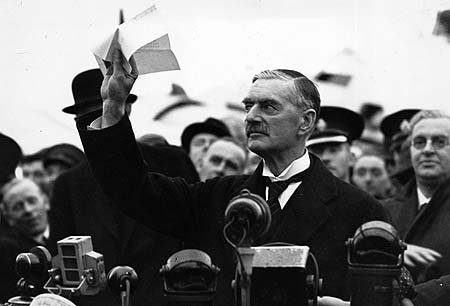
The recent deal regarding Iran’s nuclear program evoked lots of references to Prime Minister Neville Chamberlain negotiating with Hitler in 1938. Chamberlain infamously came back from Munich, waved a “scrap of paper” and promised “peace for [not “in”] our time”. Germany immediately absorbed part of Czechoslovakia and eleven months later invaded Poland.

How could Chamberlain have been such a fool? If only he had stood up to Hitler! Was he a coward? What happened in Munich was appeasement at its worst.

chamberlain-plane-ticket-pic-collect-178249005

As is often the case with famous or infamous historical events, the common view isn’t necessarily correct. Historians who suggest a new interpretation of the past are called “revisionists”. Sometimes they’re right, especially when their revisions are based on new evidence.

I’m not qualified to judge the merits of the standard view of the Munich Agreement, but, according to this article at Salon:

… among historians, that view changed in the late 1950s, when the British government began making Chamberlain-era records available to researchers. “The result of this was the discovery of all sorts of factors that narrowed the options of the British government in general and narrowed the options of Neville Chamberlain in particular,” explains David Dutton, a British historian who wrote a recent biography of the prime minister. “The evidence was so overwhelming,” he says, that many historians came to believe that Chamberlain “couldn’t do anything other than what he did” at Munich. Over time, Dutton says, “the weight of the historiography began to shift to a much more sympathetic appreciation” of Chamberlain.

The author suggests several reasons why, in his opinion, Chamberlain made the right decision: (1) most historians believe the British military wasn’t prepared for war with Germany in 1938; (2) Chamberlain’s military advisors told him that British forces couldn’t stop Germany from invading Czechoslovakia, but could eventually defeat Germany given time to prepare; (3) by 1938, Australia, New Zealand and Canada were no longer required to participate in a British war; (4) the Soviet Union was considered a potential enemy, not an ally; (5) America’s neutrality laws made it unlikely that America would join the fight; (6) although France was a likely major ally, British authorities had a very low opinion of France’s unstable government and the French military; (7) the British public, still traumatized by World War I, was strongly in favor of negotiation; (8) preserving the territorial integrity of Czechoslovakia wasn’t seen as justification for war, partly because Czechoslovakia had only existed for 20 years and many ethnic Germans in Czechoslovakia wanted to be part of a Germany; (9) the British generally believed that Hitler was similar to Mussolini, a fascist leader they knew, who was “more bravado than substance”.

The Munich agreement between the United Kingdom, France, Germany and Italy was greeted in Britain as a success: “cheering crowds filled the streets and the press rejoiced”. The French reaction was similar. When Germany took more of Czechoslovakia six months later, however, Chamberlain realized that war was inevitable, increased the pace of British rearmament and instituted Britain’s first peacetime draft.

Maybe Chamberlain and his supporters should have known better. After all, some of the British, as well as observers in other countries, correctly predicted that Hitler’s ultimate goal was the subjugation of Europe. We know the rest.

Still, it’s impossible to say whether Hitler would have been stopped sooner or more easily if Chamberlain (and the French president Daladier) had never made a deal in Munich. Nick Baumann, the author of the Salon article, concludes:

The story we’re told about Munich is one about the futility and foolishness of searching for peace. In American political debates, the words “appeasement” and “Munich” are used to bludgeon those who argue against war. But every war is not World War II, and every dictator is not Hitler. Should we really fault Chamberlain for postponing a potentially disastrous fight that his military advisers cautioned against, his allies weren’t ready for, and his people didn’t support?

At any rate, removing some economic sanctions in exchange for limits on Iran’s nuclear program isn’t the same as letting Hitler take part of Czechoslovakia in exchange for a promise of peace. 

By the way, the author of The Atheist’s Guide to Reality, the book I’ve been writing about recently, argues that we can learn nothing from history, since circumstances are always changing. In other words, history is bunk. But that’s consistent with his view that science is the only true path to knowledge. A more reasonable view is that there are recurring patterns in history, even if history doesn’t repeat itself. Looking back, it’s reasonable to conclude that negotiation is generally better than war.