A Bit More on the Cost of Health Insurance

A Vox article cites a report from the Center for American Progress that helps explain why many employees who get health insurance at work don’t like the Affordable Care Act and believe it’s causing the cost of health insurance to go up:

In recent years, the growth in overall health care costs has slowed dramatically. But for millions of Americans with employer-sponsored insurance…, this slowdown is illusory. From 2008 through 2013, the average annual growth rate of employees’ monthly premium contributions and out-of-pocket expenses, adjusted for inflation, was more than double that of average annual growth in real per-capita national health care spending, which was less than 2 percent per year. This growth has also outpaced employers’ costs of offering these benefits by more than 40 percent.

Employees experiencing higher health care costs tend to blame the Affordable Care Act, or ACA, even though the law largely leaves the employer-based system alone….The actual reason why employee and employer costs are increasing at different rates is because employers have, over time, shifted greater responsibility for health care expenses to their employees through higher deductibles, higher copayments, and higher coinsurance—a practice that began long before the passage of the ACA. Other employers pay smaller shares of their employees’ health care premiums….

In other words, almost everyone in the health care system is realizing savings, but employees’ costs are rising.

Or as Vox puts it, in still other words:

Your company’s health insurance costs are going down. But yours are going up.

This is in addition to many companies incorrectly telling their employees that the ACA is to blame for rising costs.

We Need to Pay Attention, But That’s Not All

Senator Bernie Sanders was in Iowa at Drake University a few weeks ago. This paragraph from an account of his visit caught my eye:

At first it was unclear who the bigger enemy of the people were to Sanders — the Kardashians or the Koch brothers.  The Kardashians, or rather our public fascination with them, represents America’s apathy. Sanders was clear that nothing progressive can happen until people start paying attention.  Sanders told his audience that Americans are getting screwed, and that we had better pay attention and get off our asses.

What the Senator said about paying attention brings to mind one of his colleagues, Senator Elizabeth Warren. The journalist Matthew Yglesias wrote this about her under the heading “What Makes Elizabeth Warren So Great”:

At Janet Yellen’s monetary policy hearing, Warren took aim at the Federal Reserve’s General Counsel, Scott Alvarez. Alvarez is one of the people with the highest importance-to-fame ratios in the whole American government. His existence — to say nothing of his work — is incredibly obscure. But Warren used her considerable celebrity and her dorky charisma to shine a light on it.

And she has a unique knack among today’s elected officials for seizing on things that are languishing in obscurity and making them blow up. The greatest trick the special interests ever played was getting the world to stop paying attention. Warren makes people pay attention, and it’s great.

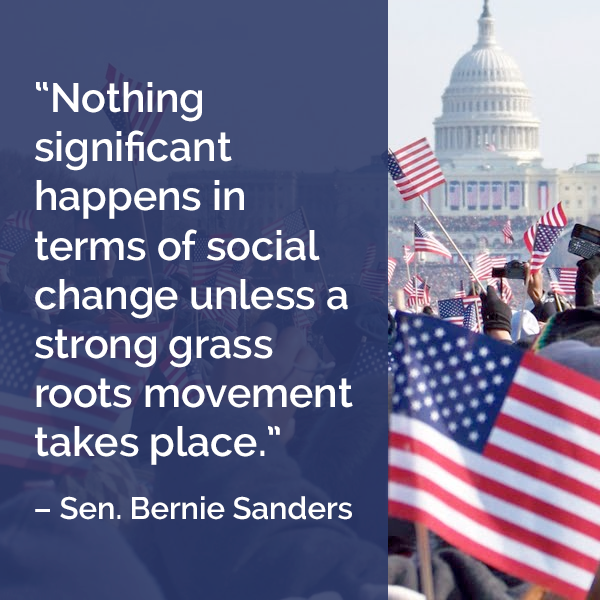
Senator Warren is terrific. We need more politicians who speak truth to power and are heard when they speak. But Senator Sanders makes a key point in an image on his Facebook page:

996123_10153117955982908_1042319750649523248_n

We need to both pay attention and get organized.

A Month of Unwritten Posts Condensed Into One

It’s not as if there’s a shortage of reading material on the Internet. Nevertheless, since I haven’t done my part lately:

You might hear of a new Quinnipiac University poll, according to which Fox News is the most trusted network news in America. The poll found that 29% of American voters trust the news on Fox more than any other network. However, the poll also found that 57% of American voters trust either CNN, ABC, CBS, NBC or MSNBC more than Fox. In other words, 29% of us trust the right-wing propaganda “news” delivered by Rupert Murdoch, and twice as many of us trust the other kind, the “mainstream media” news that Rupert doesn’t own. So it’s bad enough, but not as bad as it sounds.

Meanwhile, a Pew Research Center poll found that 53% of Americans disapprove of the Affordable Care Act, even though the ACA has resulted in more people getting health insurance than the Obama administration predicted, while contributing to slower growth in overall healthcare spending. A Bloomberg article helps explain this discrepancy. First, many people think they can do without the comprehensive health insurance the law mandates and resent paying for services they’ll never need (like maternity care) or don’t think they’ll ever need (like rehabilitation). Second, more than half of the big companies in America have told their employees that the ACA is forcing them to pay even more for health insurance.

The Bloomberg article says that the coverage mandates aren’t making health insurance more expensive. The mandates are merely “pooling the cost of that coverage across more people”, which is why fewer people are having trouble paying for healthcare. Furthermore, employers are blaming an ACA provision (the so-called “Cadillac” tax) for immediate cuts in benefits and higher insurance payments, even though it’s unlikely that these employers will ever be subject to that provision.

But does it matter what the facts are? According to a very interesting article by Heather Cox Richardson, Professor of History at Boston College, America’s right-wing doesn’t accept the importance of empirical evidence or rational argument. She traces this amazing attitude back to William F. Buckley Jr.’s 1950s book God and Man at Yale. Richardson says that:

Buckley rejected the principles that had enabled social progress for centuries and laid out a mind-boggling premise: The Enlightenment, the intellectual basis of Western Civilization, was wrong.

Rational argument supported by facts did not lead to sound societal decisions, Buckley claimed; it led people astray. Christianity and an economy based on untrammeled individualism were truths that should not be questioned. Impartial debate based in empirical facts was dangerous because it led people toward secularism and collectivism—both bad by definition, according to Buckley. Instead of engaging in rational argument, Buckley insisted, thinkers must stand firm on what he called a new “value orthodoxy” that indoctrinated people to understand that Christianity and economic individualism were absolute truths.

If we accept the premise that Christianity and economic individualism (the idolatry of the “free market”) are absolute truths, it makes sense to reject any contradictory ideas, however well-founded those ideas are given the empirical evidence.

For example, the governor of Minnesota, Mark Dayton, inherited a $6 billion deficit from his predecessor, a self-styled “fiscal conservative” who wouldn’t raise taxes. Dayton convinced the legislature to raise taxes on the rich and increase the minimum wage. Republicans predicted, as always, that businesses would leave the state and unemployment would rise. What actually happened was that the deficit turned into a surplus, unemployment went down and Minnesota now has one of the best economies of any state. Forbes Magazine (a bastion of capitalism) recently ranked Minnesota as having the 7th best “economic climate” and the 2nd best “quality of life” in the nation.

But if you believe that higher taxes on the rich and a higher minimum wage are absolutely wrong, since they conflict with your “understanding” of morality and economics, it’s understandable that you’ll reject the evidence. Nothing that conflicts with absolute truth can possibly be true.

To end on a positive note, however, consider that Larry Summers, a leading economist and Wall Street-friendly Democrat, is now arguing for a relatively progressive set of policies. According to an encouraging article by Thomas Edsall of the New York Times, Summers has concluded that “free market capitalism, as now structured, is producing major distortions”:

In order to stem the disproportionate share of income flowing to corporate managers and owners of capital, and to address the declining share going to workers, the report calls for tax and regulatory policies to encourage employee ownership, the strengthening of collective bargaining rights, regulations requiring corporations to provide fringe benefits to employees working for subcontractors, a substantial increase in the minimum wage, sharper overtime pay enforcement, and a huge increase in infrastructure appropriations – for roads, bridges, ports, schools – to spur job creation and tighten the labor market…. Summers also calls for significant increases in the progressivity of the United States tax system.

Summers has advised both President Obama and Hillary Clinton on economic matters, so it’s a positive sign that he now advocates more worker-friendly policies.

Finally, with our harsh winter finally winding down, I want to express my sincere appreciation for everyone who has to work outside or travel to their jobs during terrible winter weather. Many such people aren’t able to take a day off or “work at home”, because you can’t drive a snowplow or staff your boss’s restaurant from your living room. I also want to express my profound appreciation for whoever devised the snow shovel with a bent handle. I’ve used one for years and there’s nothing better for shoveling snow while avoiding back pain!

backsaver-shovel2

A Few Reasons We’re Getting Screwed

It’s one thing to get screwed. It’s another thing to know why. From recent reading:

Instead of raising wages, hiring more workers or investing in research and new equipment, corporations are increasingly accumulating cash and buying their own stock. This raises the corporation’s stock price, enriching the people in charge (who receive much of their compensation in the form of stock and stock options) and shareholders (who tend to be the wealthiest among us), but does little to improve the lives of most Americans. Some statistics from The Atlantic‘s “Stock Buybacks Are Killing the American Economy”:

Over the past decade, the companies that make up the S&P 500 have spent an astounding 54 percent of profits on stock buybacks. Last year alone, U.S. corporations spent about $700 billion, or roughly 4 percent of GDP, to prop up their share prices by repurchasing their own stock.

Instead of doing something productive.

The Atlantic article is by Nick Hanauer, a very successful capitalist who acknowledges that inequality is a problem that needs to be addressed. A poorly-named article from Salon called “Let’s All Screw the 1 Percent” cites an article Hanauer wrote last year about overtime pay.

We all know that wages have stagnated for many workers or even declined when adjusted for inflation. In order to have the same buying power it had in 1968, the federal minimum wage would have to be raised from $7.25 to almost $11.00 (see this attempt at myth-busting from the Department of Labor). What isn’t as well-understood and what Hanauer pointed out is that millions of workers would and should be receiving overtime pay, even though they aren’t paid by the hour (declaring workers to be “exempt” and giving them a salary is, of course, a great way to force people to work long hours without extra compensation). From the Salon article by Paul Rosenberg:

…there’s a wage level below which everyone qualifies for mandatory time-and-a-half overtime, even if they’re on a salary, and that level has only been raised once since 1975, with the result that only 11 percent of salaried Americans are covered today, compared to over 65 percent of them in 1975. If you make less than $23,660 a year as a salaried worker, you qualify for mandatory overtime—if not, you’re out of luck.  … Just adjusting the wage level for inflation since 1975—an act of restoration, not revolution—would be as significant an income increase for millions of middle-class Americans as a $10.10 or even $15 minimum wage is for low-wage workers.  It would cover an additional 6.1 million salaried workers (by one account) up to $970 per week, about $50,440 annually—the vast majority of those it was originally designed to protect, but who have slowly lost their protections since the 1970s. Hanauer proposes a slightly greater increase, intended to cover roughly all the workforce that was covered in 1975. That would raise the threshold to $69,000 annually, and would cover an added 10.4 million workers.

What was also surprising to me is that the President can raise the $23,660 threshold without the approval of Congress. Last year, in fact, President Obama promised to do just that. This website for Human Resources specialists predicts that the threshold for overtime pay will be increased in 2016, but only to around $45,000 (they also predict that the rules for declaring an employee to be “exempt” will be tightened, making more workers eligible for overtime pay).

In a related article at the Alternet site, a postal worker explains why the people delivering your mail during the week or a package from Amazon on Sunday may not look as official as they used to (jeans and a sweatshirt seem to have replaced those blue uniforms in my neighborhood). Paul Barbot says that he is a City Carrier Assistant:

City Carrier Assistants are a brand new classification of employee within the postal ranks; we are the low-wage, non-career, complement workforce at the USPS. Before [a 2013] reclassification, we were called Transitional Employees and made a respectable $23.52 hourly rate, only several dollars per hour less than what the average career employee made. But with the USPS management’s financial woes … a low-wage workforce was needed to help entice big business into choosing the postal service to partner up with. City Carrier Assistants now perform the same work they did when they were called [“Transitional Employees”], but now they get to do that work for 31 percent less pay ($16.68 per hour)….Newly hired CCAs will make even less —starting at $15 per hour.

Barbot argues that this lower-wage workforce helped the Postal Service and Amazon reach a “Negotiated Service Agreement” regarding special treatment for Amazon packages. 

And finally, The Guardian reports (no surprise) that:

Poor Americans are less likely to vote and more likely to distrust government, study shows… Political engagement, it appears, is a privilege for those who aren’t struggling to make ends meet…

while the right-wing Koch brothers, who aren’t struggling at all (not even with their consciences), plan to spend almost $900 million in 2016 in support of reactionary candidates, almost twice what they spent in 2012.

Summarizing the Torture Report

I personally know only one person who has read all 499 unclassified pages of the Senate Select Subcommittee on Intelligence’s Study of the Central Intelligence Agency’s Detention and Interrogation Program, popularly known as the “torture report”. It’s available here if you want to take a look or start reading.

In lieu of those 499 pages, you might read this excellent interview given by Mark Danner. He’s the Chancellor’s Professor of English and Journalism at the University of California at ­Berkeley and James Clarke Chace Professor of Foreign Affairs and the Humanities at Bard College. Danner has become an expert on the so-called “War on Terror”. He knows what he’s talking about. Some selections:

The relentlessness, day in day out, of these techniques … and the totality of their effect when taken together is recounted in numbing, revolting detail. The effect can only be conveyed by a full reading, through page after awful page of this five-hundred-page document, which is after all less than 10 percent of the report itself.

What I think is strictly speaking new is, first, how amateurish the torture program was. It was really amateur hour, beginning with the techniques themselves, which were devised and run by a couple of retired Air Force psychologists who were hired by the CIA and put in charge though they had never conducted an interrogation before. They had no expertise in terrorism or counterterrorism, had never interrogated al-Qaeda members or anyone else… They were essentially without any relevant experience….

The second revelation is the degree to which the CIA claimed great results, and did so mendaciously. Sometimes the attacks they said they had prevented were not serious in the first place. Sometimes the information that actually might have led to averting attacks came not from the enhanced interrogation techniques but from other traditional forms of interrogation or other information entirely. But what the report methodically demonstrates is that the claims about having obtained essential, lifesaving intelligence thanks to these techniques that had been repeated for years and years and years are simply not true. And the case is devastating….

Because the Democratic majority on the committee agreed [with the Republican minority] to limit the report to the CIA … we still have no report on how decisions were made in the executive branch…

What is fascinating is what seems to have led the CIA to resort to this improvised, amateurish program. It was the utterly mistaken conviction that Abu Zubaydah was withholding information about attacks that would have killed thousands of people….

The CIA officers are convinced that Abu Zubaydah … is this very important guy who would have this most vital information on current planning. But he’s not. He’s not even a member of al-Qaeda…. But because the CIA was convinced that he was at the pinnacle of the organization, they thought that even though he seemed to be cooperating with these FBI interrogators, he was actively withholding what they really needed: information about an impending “threat.”

Eventually … he was put under forced sleep deprivation for 180 hours and waterboarded eighty-three times….So even though the interrogators are saying he’s compliant, he’s telling us everything he knows—even though the waterboarding is nearly killing him, rendering him “completely non-responsive,” as the report says—officials at headquarters were saying he has to be waterboarded again, and again, because he still hadn’t given up information about the attacks they were convinced had to be coming….

And finally, grudgingly, after the eighty-second and eighty-third waterboardings, they came to the conclusion that Abu Zubaydah didn’t have that information. So when they judged the use of enhanced interrogation techniques on Abu Zubaydah a “success,” what that really meant was that the use of those techniques, in this brutal, appalling extended fashion, had let them prove, to their satisfaction, that he didn’t know what they had been convinced that he did know. It had nothing to do with him giving more information…. The use of these techniques let them alleviate their own anxiety [which] was based on complete misinformation. Complete ignorance about who this man actually was….

This kind of corruption through mendacity has continued, and we see it clearly now, in this cheerleading society organized by the CIA, consisting mostly of ex-officials, who have come out publicly not only to defend the agency but also to defend torture itself  … which used to be illegal, which used to be anathema, has now become a policy choice.

It’s a deeply perverse situation that goes beyond the original choice to use torture itself. It’s also a result of the ambivalent way this choice was treated by Barack Obama… Though President Obama formally abolished torture with an executive order …, his refusal to … approve investigations, prosecutions … means that only his signature on that executive order stands between us and the possibility of more torture in the future. If this issue is raised in the Republican primaries in 2016, I’d expect that most politicians on that stage will declare themselves firmly in favor of “enhanced interrogation techniques.” We may not torture now, but because torture has become a recognized policy choice, it is perfectly conceivable that our political masters, depending on who they are, might well decide to do so in the future. This is where we find ourselves, a dozen years after Abu Zubaydah first was strapped down to that waterboard.

We sometimes hear that America was traumatized by the 9/11 attack. But that’s not true. It wasn’t America as a whole that was traumatized. What happened was that Americans who were already especially fearful of the outside world became even more fearful, and Americans with the worst instincts, people like Dick Cheney, were freed to act on those instincts. We didn’t all go off the deep end, but many of us did. Now it’s up to the rest of us to exert control over the worst and weakest among us.