A Smart, Informed Journalist Interviews Hillary Clinton

Ezra Klein, the editor-in-chief of Vox, interviewed Hillary Clinton for 51 minutes this week. I thought she avoided answering one question. It was something like, how would you rate American voters in general? Aside from that, I was tremendously impressed. It is a tragedy that she lost.

A few topics discussed:

16:00  How the media handled the presidential campaign

17:45  Healthcare, including the important distinction between universal care, which should be our goal, and single-payer, which is only one way, and probably not the best way, to get universal care

26:30  American politics today

36:00  The 2016 election

42:00  How women voted

44:50   The effect of the Comey letter plus the Electoral College, voter suppression and dangers ahead.


Reading About Hitler Makes Me Think of Someone Else

I’m about halfway through Hitler: Ascent 1889 – 1939 by the German historian Volker Ullrich. It’s 1932 and Hitler is on the verge of becoming the German chancellor. I’ve learned a lot about Hitler’s rise to power. At the same time, I can’t stop noticing similarities between Hitler and our president.

I wish I’d been taking notes all along, so I could be specific, but it’s hard not to be reminded of the president when reading about Hitler’s lies, exaggerations, insecurities, misconceptions, exorbitant promises and celebration of violence. There’s his successful use of the media, his ability to excite a crowd of admirers, his reliance on certain emotional catchphrases, his need for total loyalty, the way he pits his underlings against each other and, of course, his targeting of scapegoats to explain all of the world’s ills.

There is also the reaction of some contemporary observers to the possibility that a man like him might rule the nation. Paul von Hindenburg, a military commander in World War I, had been the German chancellor since 1925. He was 84 and ill when he agreed to seek the office again in 1932, partly because he was thought to be the only candidate who could beat Hitler. The left-wing Social Democrats didn’t even nominate a candidate. They threw their support to Hindenburg, even though Hindenburg was a right-winger, because they were so afraid of the alternative. From the Social Democratic Party’s newspaper:

Hitler in place of Hindenburg means chaos and panic in Germany and the whole of Europe, an extreme worsening of the economic crisis and of unemployment, and the most acute danger of bloodshed within our own people and abroad. Hitler in place of Hindenburg means the triumph of the reactionary part of the bourgeoisie over the progressive middle classes and the working class, the destruction of all civil liberties, of the press and of political, union and cultural organizations, increased exploitation and wage slavery.

The declaration ended with: “Defeat Hitler! Vote for Hindenburg!”

A journalist noted: 

What a bizarre country. Hindenburg as the pet of the pro-democracy camp. Years ago when I heard of his election … I threw up out of fear and horror. Today, in the face of the fascist threat, a democrat has to anxiously hope for Hindenburg’s re-election.

The Nazis attacked Hindenburg on the basis that leftists were supporting his candidacy (“Tell me who praises you and I’ll tell you who you are!”), as if the leftists truly admired Hindenburg and weren’t supporting him simply as the lesser of two evils. A leader of the Social Democrats responded: 

If there is one thing we admire about National Socialism, it’s the fact that it has succeeded, for the first time in German politics, in the complete mobilization of human stupidity.

That reminds me of the present moment too.

It’s Not the Reactionaries So Much as the Elites They Listen To

Twitter isn’t the best place for reasoned discussion, but depending on who you follow, it isn’t a vast, superficial wasteland either. One of the cool things it offers is the occasional tweetstorm that benefits from directness and immediacy.

Here, slightly edited, is what David Roberts, who writes about climate and energy for Vox, had to say in thirty or so tweets yesterday:

Ever since climate became a political issue in the US, one of the most ubiquitous topics of climate discussion has been “how can conservatives be persuaded to accept climate science and join in the productive search for solutions?” I have read, no joke, MILLIONS of words on that subject. Been following that conversation long enough to notice it has certain recurring features.

The weirdest aspect is that it almost always treats conservatives and their denial as a kind of feature of the landscape, like a mountain. It’s something that just IS, something other people have to maneuver around, or overcome, or otherwise deal with. It is not treated as a CHOICE, made by grown-ass adults who could choose differently, for which they are responsible.

Another (related) weird aspect is, it’s almost always treated as something that the right’s political opponents *caused*. Al Gore caused it. Strident rhetoric or “alarmism” caused it. Enviro aversion to nuclear power (or CCS [Carbon Capture and Storage], or geoengineering) caused it.

It’s always discussed as a result of something enviros or the left did–and something they could undo, if they just acted/talked right. “If environmentalists stopped doing [thing that personally annoys me], they’d be winning over the right” is a *ubiquitous* template.

But it’s bullshit. The question of what shapes conservative opinion is not some deep mystery about which your gut impulses carry any insight. It’s an intensely studied question in social science and has been, as least to a decent approximation, answered. I recommend this post, summarizing John Zaller’s book The Nature & Origins of Mass Opinion. To *very* briefly summarize: people don’t know anything; they don’t have strong opinions on political “issues”; they form opinions by following the cues of leaders in their various social tribes. We are social creatures; tribal ties (not “issues”) are primary.

So conservatives believe what conservatives believe. And they find out what conservatives believe from conservative elites.That means conservative politicians, celebs, and local leaders, but especially, in US conservatism circa 2017, *media figures*. Conservative media plays an *enormous* role in shaping conservative opinion and has dragged it steadily rightward.

So we can say with confidence that conservatives deny climate change because that’s what conservative political/media elites do. Elite cues are what matter. It follows that the *only* reliable way to get conservatives to stop denying climate change is for conservative political/media elites to stop. That’s it.

You might think that Al Gore should STFU, enviros should support nuclear, green journalists should avoid “doomism” and all the other things that VSPs [Very Serious Persons] are always scolding greens for. Fine. Think what you want. Scold away.

But there is no evidence, and no reason to think, that any of those changes would have any material effect on conservative climate denialism. Conservatives will change their tune on climate when the people they see on Fox & Breitbart change their tune. Until then, clever arguments and magic words (“national security!” “conserving God’s gift!”) are futile for everything except meeting think-piece word counts.

Conservative elites and media are to blame for conservative ignorance and obstruction on climate. Not greens, not Democrats, not Al Gore, not That Guy on Twitter. What they are doing is a monstrous crime that will directly result in enormous suffering. And they are grown-ass adults fully capable of understanding the consequences. They are responsible for their own actions and deserve to be called out for them.

Basically, conservative elites are to blame for climate paralysis and only conservative elites can change it. I don’t like it, but there it is. Step one for everyone ought to be telling the damn truth about it. Quit finding “clever,” “counterintuitive” ways to blame others, FFS. As Ornstein and Mann said (more broadly, but it applies here as well), “Republicans are the problem”.

Of course, in the case of global warming, Republicans are only part of the problem. The big problem is global warming itself, combined with how unlikely it is that we will stop it from getting worse. What scientists have predicted for decades is coming to pass. The world is getting hotter; the atmosphere has more moisture in it; the oceans are rising; the ice is receding; the permafrost is melting; storms and heat waves are intensifying. We are polluting the planet to a dangerous degree and it’s coming back to bite us, too quickly for us to stop it, yet too slowly to make everyone feel the urgency of the problem. 

Later, I saw that David Roberts presented his thoughts more formally in an article with a long title: “As Hurricanes and Wildfires Rage, US Climate Politics Enters the Realm of Farce: Climate Denial Is Less Credible, But More Powerful, Than Ever”.

But if you want to get really depressed, take a look at The Guardian‘s “This Is How Your World Could End”. If the author is correct, it’s not out of the question that the earth’s surface may become too hot for mammals. The good news is that many other living things would survive, including birds, who handle heat better than we do.
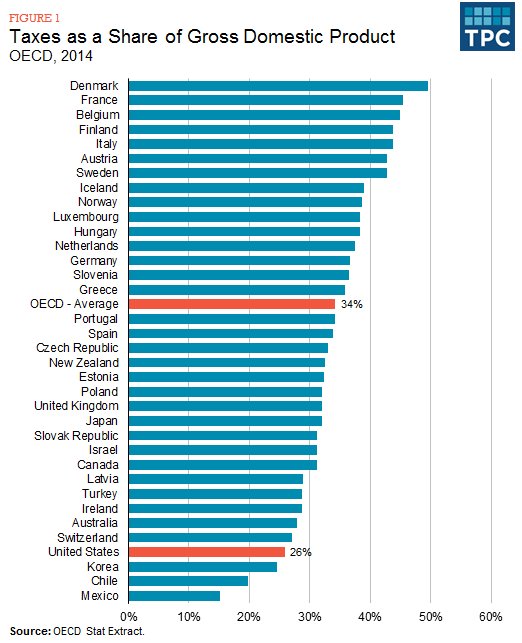
The Truth Still Matters

Will be going to North Dakota today to discuss tax reform and tax cuts. We are the highest taxed nation in the world – that will change.

— Donald J. Trump (@realDonaldTrump) September 6, 2017

But the truth still matters:

oecd tax burdens

The chart includes individual and corporate taxes, as well as local taxes, as reported by the 35-nation Organisation for Economic Co-operation and Development.

For some historical perspective, consider “When the Rich Said No to Getting Richer” by from David Leonhardt of The New York Times:

A half-century ago, a top automobile executive named George Romney — yes, Mitt’s father — turned down several big annual bonuses. He did so, he told his company’s board, because he believed that no executive should make more than $225,000 a year (which translates into almost $2 million today).

He worried that “the temptations of success” could distract people from more important matters, as he said to a biographer, T. George Harris. This belief seems to have stemmed from both Romney’s Mormon faith and a culture of financial restraint that was once commonplace in this country.

Romney didn’t try to make every dollar he could, or anywhere close to it. The same was true among many of his corporate peers. In the early 1960s, the typical chief executive at a large American company made only 20 times as much as the average worker, rather than the current 271-to-1 ratio. Today, some C.E.O.s make $2 million in a single month.

The old culture of restraint had multiple causes, but one of them was the tax code. When Romney was saying no to bonuses, the top marginal tax rate was 91 percent. Even if he had accepted the bonuses, he would have kept only a sliver of them.

The high tax rates, in other words, didn’t affect only the post-tax incomes of the wealthy. The tax code also affected pretax incomes. As the economist Gabriel Zucman says, “It’s not worth it to try to earn $50 million in income when 90 cents out of an extra dollar goes to the I.R.S.”

The tax rates helped create a culture in which Americans found gargantuan incomes to be bizarre.

A few years after Romney turned down his bonuses from the American Motors Corporation, Lyndon B. Johnson signed legislation that lowered the top marginal tax rate to 70 percent. Under Ronald Reagan, it dropped to 50 percent and kept falling. Since 1987, the top rate has hovered between 30 percent and 40 percent.

For more than 30 years now, the United States has lived with a top tax rate less than half as high as in George Romney’s day. And during those same three-plus decades, the pay of affluent Americans has soared. That’s not a coincidence. Corporate executives and others now have much more reason to fight for every last dollar.

And fight they do (it’s called “class warfare”).

Meanwhile, the president* is unnecessarily threatening hundreds of thousands of young people brought to this country by their parents and another extremely dangerous hurricane is on its way. This is further evidence that Republicans are evil and global temperatures are rising, but you already knew that.

Update:  John McCain, the Republican senator who talks a good game but can’t be relied on, has changed his mind about repealing the Affordable Care Act. He now says he’d vote Yes on what is “in may ways … the most radical” repeal bill yet. Further evidence for [see above]. 

2nd Update: McCain now says he would only vote for repeal if the legislation survived committee hearings and was subject to amendments proposed by both sides. That’s not what the 81-year old senator implied earlier today. This latest announcement is good news, because the repeal legislation is extremely unlikely to pass if it’s subject to “normal order” in the Senate instead of being rushed through. 

Please Mr. Mueller (A Musical Entreaty)

You know he and his crack team of lawyers are working as quickly but carefully as they can. Still, this is by the Anonymous Sources: