This Passed for a Sermon Tonight

We decided to deliver our own Christmas Eve sermons this year. This was mine:

It was on November 19, 1863, four and a half months after the Battle of Gettysburg, that Abraham Lincoln spoke at the dedication of the Soldier’s National Cemetery, where 3,512 soldiers who died in the battle were still in the process of being buried.

Four score and seven years ago our fathers brought forth on this continent, a new nation, conceived in Liberty, and dedicated to the proposition that all men are created equal.

Now we are engaged in a great civil war, testing whether that nation, or any nation so conceived and so dedicated, can long endure. We are met on a great battle-field of that war. We have come to dedicate a portion of that field, as a final resting place for those who here gave their lives that that nation might live. It is altogether fitting and proper that we should do this.

But, in a larger sense, we can not dedicate — we can not consecrate — we can not hallow — this ground. The brave men, living and dead, who struggled here, have consecrated it, far above our poor power to add or detract….

It is for us the living, rather, to be dedicated here to the unfinished work which they who fought here have thus far so nobly advanced. It is rather for us to be here dedicated to the great task remaining before us — that from these honored dead we take increased devotion to that cause for which they gave the last full measure of devotion — that we here highly resolve that these dead shall not have died in vain — that this nation, under God, shall have a new birth of freedom — and that government of the people, by the people, for the people, shall not perish from the earth.

Not everyone agreed with Lincoln’s speech. In his book, Lincoln At Gettysburg: The Words That Remade America, Garry Wills quotes an article from the Chicago Times published a few days after Lincoln spoke. The author of that article pointed out that the U.S. Constitution made no mention of equality and accepted the institution of slavery. Lincoln, therefore, was supposedly betraying the soldiers who fought to defend the Constitution as it was written and adopted. From that article:

It was to uphold this constitution, and the Union created by it, that our officers and soldiers gave their lives at Gettysburg. How dare he then, standing on their graves, misstate the cause for which they died, and libel the statesmen who founded the government? They were men possessing too much self-respect to declare that negroes were their equals, or were entitled to equal privileges.

Garry Wills, on the other hand, argues that Lincoln’s words were important because they gave new meaning to the Constitution, to the battle at Gettysburg and to the entire Civil War. Lincoln avoided “all local emphasis”. His speech “hovered far above the carnage”. He mentioned “no particulars” — “no names of men or sites or units, or even sides”. Lincoln didn’t even mention slavery.

Listening to Lincoln, it was as if the Southerners, against their will and without realizing it, were also engaged in the “unfinished work” of making sure government of, by and for the people would not “perish from the earth”.

In addition, Lincoln claimed that America had been founded on the proposition that all men, and perhaps all women, were created equal, despite the obvious fact that some people, including women, weren’t born with the same rights as the men who wrote the Constitution. And by expressing the hope that government of, by and for the people should not perish, he implied that such a government already existed.

Despite Lincoln’s exaggeration or imprecision, Wills concludes that the Gettysburg Address was a tremendous success. It “cleared the infected atmosphere of American history … tainted with official sins and inherited guilt”. Lincoln’s words changed the meaning of the Constitution in the minds of most Americans:

The crowd departed with a new thing in its ideological luggage, that new constitution Lincoln had substituted for the one … they brought with them. They walked off, from those … graves on the hillside, into a different America.

I n fact, how different was it? Did America become as different as Lincoln would have wanted it to be after the Civil War, or in the 20th century or the 21st? We all know that progress has been made, but it hasn’t been enough.

From The Atlantic last month:

One hundred thirty-nine years since Reconstruction, and half a century since the tail end of the civil-rights movement, a majority of white voters backed a candidate who explicitly pledged to use the power of the state against people of color and religious minorities, and stood by him as that pledge has been among the few to survive the first year of his presidency. Their support was enough to win the White House, and has solidified a return to a politics of white identity that has been one of the most destructive forces in American history. This all occurred before the eyes of a disbelieving press and political class, who plunged into fierce denial about how and why this had happened. That is the story of the 2016 election.

Maybe we will never cure humanity of tribalism, the tendency to favor people who look and sound like we do. Fear of strangers was probably built into us through thousands of years of evolution. But we have made progress. There is less slavery in the world. There is more equality, even with the economic inequality that’s increased since the 1980s. But we all have more work to do. Lincoln’s implied promise of a government of all the people, by all the people and for all the people has not been fulfilled. In recent years, we seem to have gone backward.

So it’s worthwhile at this time of the year, when “joy to the world” is proclaimed, “peace on earth” and “good will to men” are sung, and A Christmas Carol always ends with “God bless us, everyone”, to remember the words and the challenge delivered by a real president, 154 years ago, at the dedication of a new cemetery in Gettysburg, Pennsylvania.
Suckers!

Although Trump voters, on average, had higher incomes than Clinton voters, many of his supporters were and continue to be working class or even poor (and predominantly white, of course). He may have been rich, the epitome of a city slicker, but millions of average people (also known as “suckers”) believed that he’d fight for them.

From Ezra Klein of Vox:

Tax cuts for wealthy Americans have long been the fulcrum atop which Republican Party politics rests. But Donald Trump was supposed to be a different kind of Republican. On 60 Minutes, for instance, Trump said he would raise taxes on “the very wealthy,” and warned that the plan would cost him “a fortune” in higher taxes.

“My whole life I’ve been greedy, greedy, greedy,” Trump said in January of 2016. “I’ve grabbed all the money I could get. I’m so greedy. But now I want to be greedy for the United States.”

The whole Trump pitch was that he was a cutthroat businessman who knew the tricks, had paid off the politicians, had made his billions, and now was going to use his accumulated knowledge to unrig the system, to make it benefit you, the little guy. American politics, he said, was corrupted — by special interests, by self-dealing politicians, by weak negotiators. He was going to fix it all. And many believed him.

In Trump’s inaugural address he said, “What truly matters is not which party controls our government, but whether our government is controlled by the people. January 20, 2017, will be remembered as the day the people became the rulers of this nation again. The forgotten men and women of our country will be forgotten no longer.”

This rhetoric continued after the election: Both Trump’s Treasury secretary and the director of his National Economic Council said the plan wouldn’t cut taxes on the rich. As recently as a few weeks ago, Trump told Senate Democrats, “The deal is so bad for rich people, I had to throw in the estate tax just to give them something.”

In reality, by 2027, 62.1 percent of the tax bill’s benefits go to the top 1 percent, and 42.3 percent of the benefits go to the top 0.1 percent [while millions of lower income taxpayers will see their taxes increase].

The moral of this story is: Never trust a con man when he says he’s on your side.

(But if you insist on trusting a con man, don’t inflict him on the rest of us.)

One of Those Charts

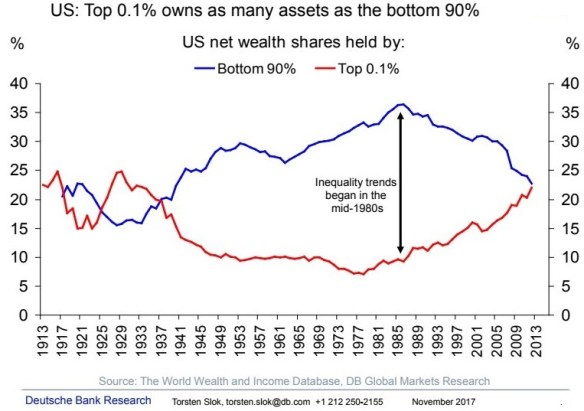
The last time we had a big overhaul of the federal tax code was in 1986. Back then, the poorest 90 percent of the population owned 3 1/2 times as much as the richest 1/10th of 1 percent. I’ll say that again. In 1986, the net worth of the least wealthy 90% of Americans was 3.5 times the net worth of the richest 0.1%.

That’s not the America we live in today. As of 2013, the richest 1/10th of 1 percent owned as much as the poorest 90 percent. To repeat: the net worth of the richest 0.1% was the same as the net worth of the poorest 90%. 

DQ9rJW2XcAAzXuK

I’m sure the red line goes even higher now and the blue line goes lower. We should keep this astounding economic inequality in mind when we have the opportunity to vote eleven months from now. That will be eleven months after the Republicans ram through another overhaul of the tax code, one that helps the richest Americans get even richer.

A Selection of Stuff You’d Rather Not Read About

Four articles that made an impression this week, from least to most depressing, that didn’t even mention Jerusalem, Puerto Rico, healthcare or starving polar bears.

One hundred and eighty-seven people are facing felony charges for participating in a demonstration in Washington D.C. that turned violent. The demonstration was on the day Trump was inaugurated. A trial is now underway. The depressing aspect of this story is that none of the six defendants are accused of doing anything aside from being there:

What jurors haven’t heard, and prosecutors don’t intend to offer, is evidence that any of the six individuals currently on trial … actually engaged in any property damage or violence. Under the government’s theory of the case, in which anyone arrested in the group is part of a conspiracy and is responsible for any actions taken by others, the lack of individualized wrongdoing doesn’t matter.

Maybe the jury will have the sense to acquit everyone and convince the government to stop these prosecutions.

Elsewhere in Washington, Republicans from the House and Senate are trying to reconcile the terrible tax bills they’ve recently passed. Could any of them read this article from The New York Times and say they were proud of their efforts so far?

… for the first time since the United States adopted an income tax, a higher rate would be applied to employee wages and salaries than to income earned by proprietors, partnerships and closely held corporations….

“We’ve never had a tax system where wage earners were substantially penalized” relative to other types of income earners, said … a former Treasury Department official….

Indeed, economists and tax experts across the political spectrum warn that the proposed system would invite tax avoidance. The more the tax code distinguishes among types of earnings, personal characteristics or economic activities, the greater the incentive to label income artificially, restructure or switch categories in a hunt for lower rates….

“The more you look at any of the major rules, the more ambiguities, glitches, clearly unintended consequences and tax planning opportunities you see,” said Michael L. Schler, a lawyer in the tax department of Cravath, Swaine & Moore. He has written a 50-page summary of the more glaring problems …

From Georgia Southern University, a professor named Jared Yates Sexton, who grew up in the South, writes about the fascism that runs in his family.

Eventually I left for college and found my own people who didn’t express such fascist and ignorant beliefs. I visited for the occasional holiday, kept in decent enough touch, but I felt confident knowing that people like my family would never be in charge of the country they understood so poorly….

They hoard weapons, supplies, and daydream about the day the government will fall and they’ll be free to remake the country as they see fit.

I cannot say they are fascists, but I can definitely say they hold fascist ideas. This is why they hardly blink when Donald Trump quickly erodes the normal order of the government, why they’re not concerned when he undermines the Freedom of the Press or cozies up to authoritarian leaders. They love it when he tells policemen to be rough on suspects. They want someone who plays nuclear chicken with a despot while the lives of hundreds of million innocent people lie in the balance.

Finally, speaking of nuclear chicken, Jeffrey Lewis, a “scholar at the Middlebury Institute of International Studies”, shares some really scary thoughts in The Washington Post. He imagines how a confrontation between North and South Korea might escalate, helped along by a morning tweet from the president, into nuclear war.

And so, facing what he believed was a massive American military invasion, Kim gave the order. The thread of history winds along on twists of fate, like Archduke Ferdinand’s driver missing a turn…

The U.S. Missile Defense Agency would later say this was a sign that the system had worked well, downing about a third of the missiles — although experts would argue that the low intercept rate resulted from problems that the Los Angeles Times had reported in 2017…. It seemed more likely, the experts said, that five of the missiles had simply broken up as they reentered the earth’s atmosphere.

The remaining seven nuclear warheads landed in the United States. These missiles were no more accurate than the others — but with 200-kiloton warheads, 10 times the power of the bomb that destroyed Hiroshima, close was enough to count in most cases.

I told you so.

My Country, ‘Tis of Thee

I was thinking about writing a post based on recent statements by Sen. Orrin Hatch (Republican, Utah) and Sen. Charles Grassley (Republican, Iowa), but an actual writer beat me to it.

From Paul Waldman of The Washington Post:

With Republicans well on their way to passing a dramatic overhaul of the tax code, they have presented to the public a sweeping, comprehensive vision not just of what taxes should look like, but of what government is there for, what our obligations are to one another, and even how each of us should think about our value as human beings. This is a moment of uncommon clarity.

…. Let’s start with Iowa’s Chuck Grassley, who made this comment on the estate tax:

“I think not having the estate tax recognizes the people that are investing,” Grassley said, “as opposed to those that are just spending every darn penny they have, whether it’s on booze or women or movies.”

Right now, the first $5.5 million of any estate is not subject to the tax. Because of that, fewer than one in 500 estates owes any tax at all. So Grassley is saying that 99.8 percent of Americans lead contemptible lives of waste and folly, while only that remaining sliver of the extra-wealthy have shown the virtue that should win their heirs the ability not to pay taxes on the fortunes bequeathed to them. The Senate bill would double the tax’s exemption, while the House bill would eliminate the tax entirely; depending on how the final version turns out, Eric Trump may finally be free of the fear that he’ll have to pay taxes on his inheritance.

Now let’s turn to Utah’s Orrin Hatch, who explained why, despite his support of a bill offering trillions of dollars in tax breaks to the wealthy and corporations, we absolutely must start slashing the social safety net immediately:

“I have a rough time wanting to spend billions and billions and trillions of dollars to help people who won’t help themselves, won’t lift a finger, and expect the federal government to do everything.”

… There isn’t much political advantage in saying that if you die with less than $5.5 million in assets, like nearly all Americans do, that means you were lazy and self-indulgent, while only the wealthy have proven their moral worth by the size of their bank accounts. So when someone says something like that, you can be pretty sure he’s expressing his actual beliefs….

Those are value judgments, rooted in how Republicans tend to view the worth of different people. They operate on the presumption that the economic system is fair, and the results of that system provide a measure of different people’s virtue. If you’re rich — even if you got rich by choosing the right parents — they presume that you deserve to be taxed as lightly as possible, while if you’re in need of the kinds of help we offer low-income people, then it reflects a moral failing. If we give you any help at all, it should be as grudging as possible, accompanied by stern lectures and even rituals of humiliation like drug tests.

Their tax bill, and their upcoming assault on the safety net, will weave these principles more deeply into our laws. And these principles are their real rationale; ignore all the practical claims they make about the explosion of economic growth these tax cuts will supposedly produce, and how the benefits will trickle down to everyone, and how it will all pay for itself. Those arguments are transparently bogus. A recent survey of 38 prominent economists found that only one said the tax bill would significantly increase growth…

Confronted with this comprehensive debunking of their practical claims, Republicans are undeterred and undaunted. That’s because they’re driven by a moral imperative, one that says that no matter what effect cutting taxes on the wealthy and corporations might have on the economy, it’s just the right thing to do. It rewards the virtuous, and you can tell who the virtuous are by how much money they have. If you’re asking why they wrote the bill the way they did, that’s just about all you need to know.

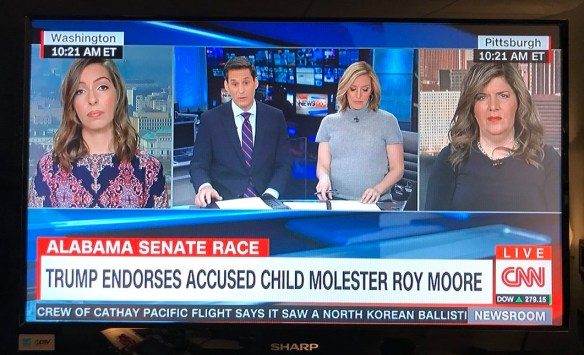
Meanwhile, our law-and-order president (sexual predator D. Trump) has endorsed former judge Roy Moore, who will probably join Grassley and Hatch in the Senate later this month:

DQNlvbQW0AEcCWY

My country, ’tis of thee,
Sweet land of liberty,
Of thee I sing….