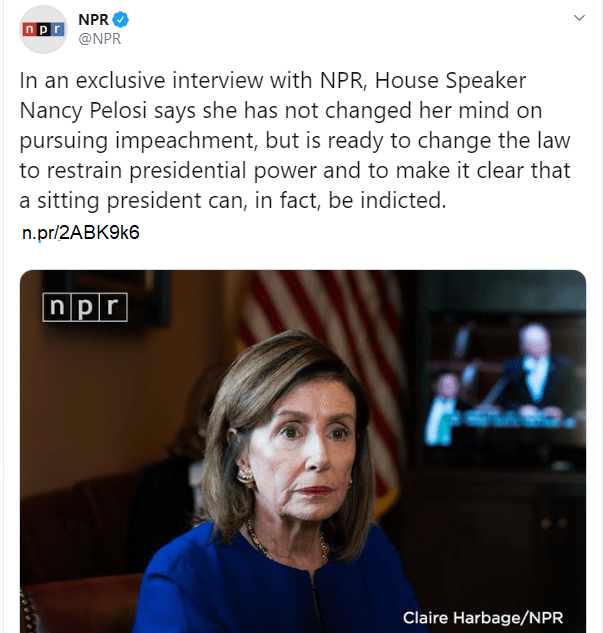
How about letting her know how you feel about impeachment? It’s so easy to send her an email. Simply click here.
How about letting her know how you feel about impeachment? It’s so easy to send her an email. Simply click here.
Things are not getting better in Washington. To put it mildly. The T@@@p administration continues to resist any congressional oversight. Democrats direct witnesses to appear, sometimes issue subpoenas, the administration refuses to cooperate and the disputes vanish into the glacially-slow bowels of the federal courts.
The Treasury Department has refused to give the president’s tax returns to Congress, as required by law. The Director of National Intelligence is refusing to transmit a whistle blower’s complaint to Congress, even though it pertains to national security and the law says Congress shall receive it. The Judiciary Committee finally got a T@@@p associate to appear yesterday and it got very little coverage, even though the witness confirmed that the president obstructed justice. There is now more evidence that the administration’s last appointment to the Supreme Court lied to Congress and the FBI’s vetting investigation was a sham. The leading Democrat in the Senate doesn’t want to talk about it.
Congressional committees can hold people in contempt and fine them thousands of dollars a day or put them in jail. They have gone to court instead. The Speaker of the House could create a special committee devoted to impeaching the president, but she resists even saying the word “impeachment”. Meanwhile, the Judiciary Committee’s impeachment inquiry is just one item on their agenda. They may have another hearing next week.
Meanwhile, the president is using money Congress appropriated for the Defense Department to build his wall. It’s going to damage environmentally-sensitive areas along the border. The Justice Department is investigating automakers because they agreed with the state of California to protect air quality. Now the president wants to remove California’s ability to set its own air quality standards, as California has been permitted to do for decades. T@@@p is also threatening to round up homeless people in Los Angeles and put them who knows where, even though he has no authority to do so. His Immigration and Customs Enforcement police force is training for urban warfare. And there may be war around the Persian Gulf.
There are too many scandals and other offenses for most mortals to keep track of. Unlike Hillary’s emails, which were beaten to death, journalists and pundits jump from one topic to the next. Los Angeles writer Amy Siskind continues to document as much as she can at The Weekly List, but there is too much to digest (if you’re interested, she accepts small donations to support her work).
So is there a bright spot on the horizon? Here’s a hint.




She gave a speech in New York this week. Up to 20,000 people attended. She called for big, structural change to address the corruption in our politics (she called our president “corruption in the flesh”). She believes that corruption is the fundamental reason Washington doesn’t work for average people. She spent four hours after the speech having her picture taken with a very long line of people. When complimented on her stamina, she said she stayed for four hours but so did the last guy in line. Polls now show her in second place for the Democratic nomination. The latest poll in Iowa, where the first votes will be cast, has her in the lead. Her campaign slogan is “Dream Big, Fight Hard”. She’ll make a great president if we make it that far.
Prof. Paul Krugman summarizes where things stand with the economy and Our Dear Leader.
[DT] marked the anniversary of 9/11 by repeating several lies about his own actions on that day [Note: the New York Times cowardly referred to them as “exaggerations”]. But that wasn’t his only concern. He also spent part of the day writing a series of tweets excoriating Federal Reserve officials as “Boneheads” and demanding that they immediately put into effect emergency measures to stimulate the economy — emergency measures that are normally only implemented in the face of a severe crisis.
Trump’s diatribe was revealing in two ways. First, it’s now clear that he’s in full-blown panic over the failure of his economic policies to deliver the promised results. Second, he’s clueless about why his policies aren’t working, or about anything else involving economic policy.
Before I get to the economics, let’s talk about one indicator of Trump’s cluelessness: his remarks about federal debt.
In addition to demanding that the Fed cut interest rates below zero, Trump declared that “we should then start to refinance our debt,” because “the USA should always be paying the lowest rate.” Observers were left scratching their heads, wondering what he was talking about.
Actually, however, it’s fairly obvious. Trump thinks that federal debt is like a business loan, which you can pay down early to take advantage of lower interest rates. He’s clearly unaware that federal debt actually consists of bonds, which can’t be prepaid (which is one reason interest rates on federal debt are always lower than, say, rates on home mortgages). That is, he imagines that the government’s finances can be managed as if the U.S. were a casino or a golf course, and it never occurred to him to ask anyone at Treasury whether that’s how it works.
But back to the economy. Why is Trump panicking?
After all, while the economy is slowing, we’re not in a recession, and it’s by no means clear that a recession is even on the horizon. There’s nothing in the data that would justify radical monetary stimulus — stimulus, by the way, that Republicans, including Trump, denounced during the Obama years, when the economy really needed it.
Furthermore, despite Trump’s claims that the Fed has somehow done something crazy, monetary policy has actually been looser than Trump’s own economic team expected when making their rosy forecasts.
In the summer of 2018 the White House’s economic projections envisioned that this year three-month interest rates would average 2.7 percent, while 10-year rates would be 3.2 percent. The actual rates as I write this are 1.9 and 1.7 percent, respectively.
But while there’s no economic emergency, Trump apparently feels that he’s facing a political emergency. He expected a booming economy to be his big winning issue next year. If, as now seems likely, economic performance is mediocre at best, he’s in deep trouble.
Remember, Trump’s two signature economic policies were his 2017 tax cut and his rapidly escalating trade war with China. The first was supposed to lead to a decade or more of rapid economic growth, while the second was supposed to revive U.S. manufacturing.
In reality, however, the tax cut delivered at most a couple of quarters of higher growth. More specifically, huge tax breaks for corporations haven’t delivered the promised surge in wages and business investment; instead, corporations used the windfall to buy back stocks and pay higher dividends.
At the same time, the trade war has turned out to be a major drag on the economy — bigger than many people, myself included, expected. Until last fall the general expectation was that Trump would deal with China the way he dealt with Mexico: make a few mainly cosmetic changes to existing arrangements, claim victory, and move on. Once it became clear that he was really serious about confrontation, however, business confidence began falling, dragging investment down with it.
And voters have noticed: Trump’s approval rating on the economy, while still higher than his overall approval, has started to decline. Hence the panicky demands that the Fed pull out all the stops.
But while Trump realizes that he’s in trouble, there’s no indication that he understands why [Note: Prof. Krugman is being unnecessarily polite]. He’s not the kind of person who ever admits, even to himself, that he made mistakes; his instinct is always to blame someone else while doubling down on his failed policies.
Even actions that look like a slight policy softening, like his announcement of a two-week delay in implementing some China tariffs, betray a deep incomprehension of the problem — which has as much to do with his capriciousness as with the tariffs per se. Policy zigzags, even if they involve delaying tariffs, just add to the will-he-or-won’t-he uncertainty that’s causing companies to put investment on hold.
So what happens next? Trump could reverse course, and do what most people expected a year ago, reaching a deal with China that more or less restores the status quo. But that would be a de facto admission of defeat — and at this point it’s not clear why the Chinese would trust him to honor any such deal past Election Day.
Unquote. “It’s not clear why the Chinese would trust him” is an understatement of cosmic proportions.
It isn’t making much news, but the House Judiciary Committee finally announced their plan to hold the president accountable. They will vote on Wednesday to institute special procedures designed to investigate and publicize the president’s numerous impeachable offenses. The Washington Post has an analysis of this long-awaited development. Public hearings are supposed to begin next week. The committee chairman says they may be able to vote on articles of impeachment by the end of the year. Any articles approved by the committee will be sent to the full House of Representatives. Nobody knows what will happen after that, but this is a positive step.
Here is most of the press release the committee issued this morning:
Today, House Judiciary Committee Chairman Jerrold Nadler announced the House Judiciary Committee will consider procedures on Thursday for future hearings related to its investigation to determine whether to recommend articles of impeachment with respect to President Donald Trump….
The new procedures provide that:
Chairman Nadler released the following statement:
“President Trump went to great lengths to obstruct Special Counsel Mueller’s investigation, including the President’s attempts to remove the Special Counsel and encourage witnesses to lie and to destroy or conceal evidence. Anyone else who did this would face federal criminal prosecution.
“The Mueller report resulted in 37 criminal indictments, 7 guilty pleas, and revealed 10 possible instances where President Trump obstructed justice. At least five of which we now know to be clearly criminal. Trump’s crimes and corruption extend beyond what is detailed in the Mueller report. The President is in violation of the emoluments clauses of the Constitution as he works to enrich himself, putting the safety and security of our Nation at risk. He has dangled pardons, been involved in campaign finance violations and stonewalled Congress across the board, noting that he will defy all subpoenas.
“No one is above the law. The unprecedented corruption, coverup, and crimes by the President are under investigation by the Committee as we determine whether to recommend articles of impeachment or other Article 1 remedies. The adoption of these additional procedures is the next step in that process and will help ensure our impeachment hearings are informative to Congress and the public, while providing the President with the ability to respond to evidence presented against him. We will not allow Trump’s continued obstruction to stop us from delivering the truth to the American people.”
I wish every voter in the country would read this article. Okay, relatively few will, but I’m convinced she’ll be our next president anyway. From “The Education of Elizabeth Warren” in the New York Times, here’s a much shorter version:
By 1981, Ms. Warren and her husband had secured temporary teaching posts at the University of Texas, where she agreed to teach bankruptcy law. She quickly earned a reputation for lively lectures, putting students on the spot and peppering them with questions and follow-up questions…
Even visitors to her class got the treatment. One of them was Stefan A. Riesenfeld, a renowned bankruptcy professor who had come to lecture on the Bankruptcy Reform Act of 1978. The law, which had expanded bankruptcy protection for consumers, was already under attack by the credit industry, which argued that it made personal bankruptcy too attractive.
Even so, Mr. Riesenfeld explained to Ms. Warren’s class, those who filed personal bankruptcy were “mostly day laborers and housemaids who had lived at the economic margins and always would,” she wrote in her 2014 memoir.
“I asked the obvious follow-up question: ‘How did he know?’” Ms. Warren wrote. After more questioning, it became clear that not only did Mr. Riesenfeld have no real answer, he was irritated by Ms. Warren’s probing.
The subject struck close to home. When she was growing up in Oklahoma, her father’s heart attack had thrown their household into precarious financial territory, forcing her mother to take a minimum-wage job answering telephones at Sears.
She remembers being fearful as she lay in bed at night listening to her mother cry. “She thought I had gone to sleep. I didn’t know for sure the details of why she was crying, but I knew it was bad and that we could lose everything,” Ms. Warren said.
(Later, the oil glut of the 1980s would destroy her brother David’s once-thriving business delivering supplies to oil rigs. Her brother John, a construction worker, would also struggle after the oil market collapsed….)
She wanted answers, more than Professor Riesenfeld could provide….
Dozens of people would eventually be involved in the … analysis of a quarter million pieces of data gathered from bankruptcy cases filed from 1981 through 1985.
Among the researchers was Kimberly S. Winick, then a University of Texas law student … While Ms. Warren didn’t talk a lot about her views, Ms. Winick said she believed that the project’s initial theory was that, “If you filed bankruptcy, you must be cheating.”
“Liz was from a more conservative place,” Ms. Winick said. “And she was somebody who had worked very, very, very hard all her life. And she had never walked away from a debt. And I think she kind of started with the view — let’s see what people are doing and how they’re cadging on their debts and screwing their creditors.”
That was the conventional thinking of the day….
While the [bankruptcy files] did not tell the whole story, they provided enough evidence for Mr. Warren and her co-authors to write, “Repeatedly, we have been surprised by the data and forced to rethink our own understanding of bankruptcy”.
… Over the years, the research elevated Ms. Warren’s status, from little-known Texas professor to sought-after lecturer, writer and consultant in bankruptcy law. It also set the stage for her career in politics.
In 1995, Mike Synar, a former Democratic congressman from her home state, asked Ms. Warren, by then a Harvard professor, to advise a special commission reviewing the bankruptcy system….
It was during that period, in 1996, that she switched her party affiliation from Republican to Democrat, though she insists that her essential conversion was from “not political” to “political”.
“I didn’t come from a political family,” she said. “I hadn’t been political as an adult. I was raising a family, teaching school and doing my research,” she said.
Then she went to Capitol Hill.
“I quickly discovered that every single Republican was on the side of the banks and half the Democrats were,” she said. “But whenever there was someone who would stand up for working families, it was a Democrat.”
She added, “I picked sides, got in the fight, and I’ve been in the fight ever since”.
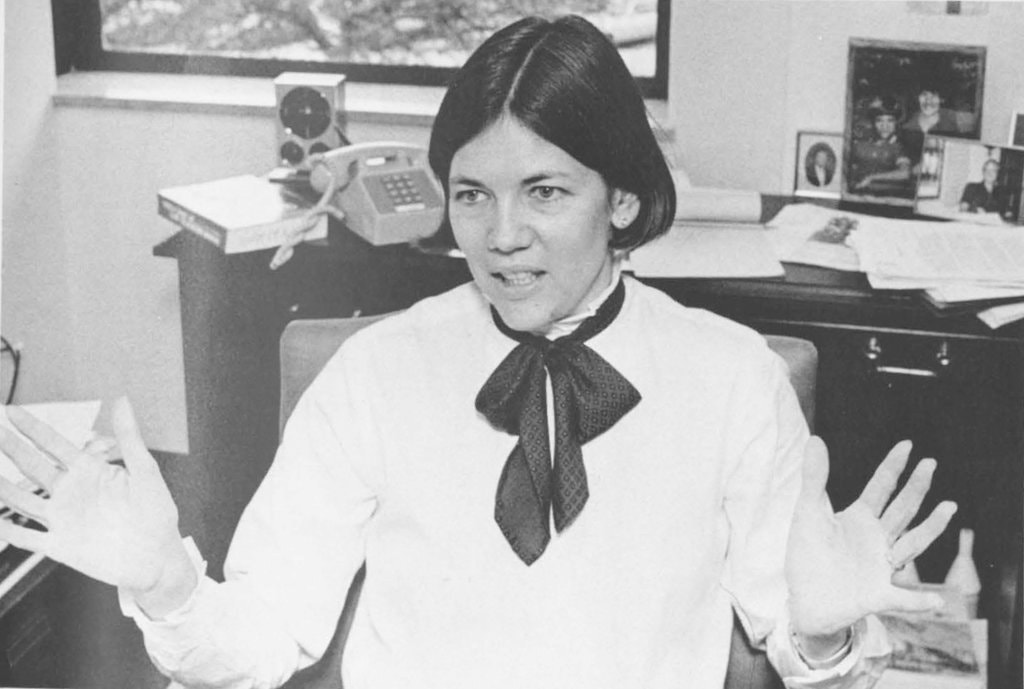 University of Texas, 1985.
 Whereof One Can Speak 🇺🇦
You must be logged in to post a comment.