Politics and Markets One More Time

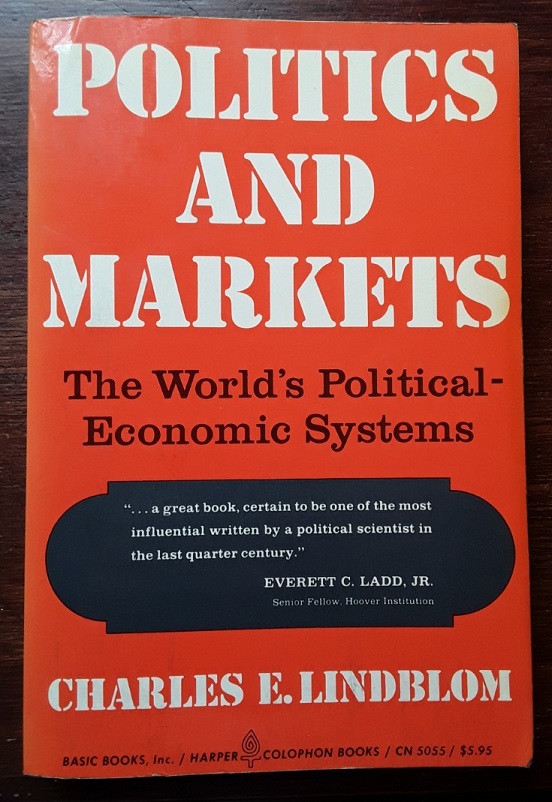
Around 40 years ago, I bought a book called Politics and Markets: The World’s Political-Economic Systems. It was written by Yale professor Charles Lindblom. I read about half of it before putting it aside. I don’t know why I stopped reading, because I thought it was excellent and intended to finish it. Instead, I treated the book like a kind of talisman. For some time, I kept it on my desk at work. It was there so long that someone asked me if I was still reading “that book”. I suppose I didn’t have the mental energy to finish it, but having it around was nice. Maybe it reminded me of my aborted attempt at an academic career.
thumbnail_20200807_142201

A few days ago, I thought I might go around the house and find books I’ve always thought about reading but never did. An obvious candidate was a biography of Ralph Waldo Emerson called Emerson: The Mind on Fire. Just like Politics and Markets, I read about half of it years ago and have often thought of finishing it. Unlike Politics and Markets, however, Emerson still had a decades-old bookmark showing where I stopped reading (it wasn’t even at the start of a chapter).

I’m now reading Politics and Markets again. I was immediately impressed.

This is how the 1977 edition above begins:

Relentlessly accumulating evidence suggests that human life on the planet is headed for a catastrophe. Indeed, several disasters are possible, and if we avert one, we will be caught by another. At present rates of population growth, another century will put 40 billion people on Earth, too many to feed. If industrial production grows at present rates during the next century, resource requirements will multiply by a thousand. And energy emission, some scientists say, will over a longer period of time raise Earths’ temperature to a level unsuitable for human habitation. All this assumes that a nuclear catastrophe does not spare us the long anguish of degeneration.

However fearful one may be that the fallible and dilatory intelligence of the human species will somehow either end human life or reduce it to unbearable squalor, the decline of the human condition is not inevitable. It is for us to decide whether we will continue to reproduce at disastrous rates, plunder the planet of resources, or burn ourselves from the face of the earth through either thermal pollution or a few quick blasts. The world is man’s doing, not something done to him.

Assuming that men and women wish to give some thought to their futures, what are the fundamental politico-economic mechanisms they can employ in order to maintain — indeed greatly enlarge — the humane qualities of life on Earth? That is the question of this book. Some will doubt that political and economic mechanisms matter. They will say that man’s future hinges on a moral regeneration. Or science and technology. Or inner awareness. Or a new form of family or other small-group association. Or organic foods — the list is open to nominations. This book is for those who believe that politics and economics will turn out to matter.

Well, some good news is that world population isn’t climbing as fast as people expected in 1977. It was 4.2 billion back then. Now it’s 7.8 billion, but the rate of increase is going down. It’s projected that there will be 10 billion of us by 2077, not 40 billion. And since the fertility rate is expected to keep dropping, world population may actually decline in the next century (even without the help of killer viruses, nuclear wars, giant meteors, etc.).

Along with population, resource requirements continue to grow, although some experts believe that we won’t run out of the things we need, since as resources become scare, they’ll become more expensive and we’ll find substitutes (I don’t know what the substitute for oxygen or water would be).

The bad news, of course, is that the “energy emission” that “some scientists” were worried about in 1977 is now out of control. If you want a scary update, see Bill McKibben’s article “130 Degrees” at the New York Review of Books site:

What [the 10 to 15% drop in emissions during the pandemic] seems to indicate is that most of the momentum destroying our Earth is hardwired into the systems that run it. Only by attacking those systems—ripping out the fossil-fueled guts and replacing them with renewable energy, even as we make them far more efficient—can we push emissions down to where we stand a chance.

As for “nuclear catastrophe”, it’s easy to think that the danger subsided with the end of the Cold War. That’s not the message from “The New Nuclear Threat”, an article by Jessica Matthews in the same issue of The New York Review of Books (I’ve subscribed for a long time — the subscription is almost worth the price):

In part because of effective deterrence, fear of their destructiveness, and a growing taboo against their use, and in part because of dumb luck, nearly a century has passed without nuclear weapons being used again in conflict. . . . But we are not safer today—quite the reverse. . . . A second nuclear arms race has begun—one that could be more dangerous than the first. . . .

The single step from which profound policy change could flow, domestically and internationally, would be formal endorsement by the five original nuclear powers—the US, Russia, the UK, France, and China—of the Reagan-Gorbachev principle, jointly articulated by the two leaders at their 1985 summit. It states simply, “a nuclear war cannot be won and must never be fought.” International adoption would simultaneously indicate the nuclear powers’ recognition of the rising dangers of nuclear conflict and the need to move toward nuclear forces around the world that are structured for deterrence, not war fighting. . . .  Eventually, these eleven words could underlie the next generation of arms control negotiations, strengthen the global nonproliferation regime, and help short-circuit a second nuclear arms race.

I don’t know if Prof. Lindblom’s old book might help with any of this. I’ll let you know if I finish it.

“Nobody likes me. It can only be my personality.”

From The Lincoln Project, made by Republicans for Republicans:

From a group calling themselves Republican Voters Against Txxxx:

They call themselves MeidasTouch:

I bet lots of his supporters would appreciate seeing these.

Note: “Nobody likes me”.

How It Beat Us

If you want a deep analysis of how this country screwed up its response to Covid-19 and what we need to do better next time, read this long article by Ed Yong for The Atlantic Monthly. It’s been recommended by intelligent people. I don’t intend to read the whole thing. The first 700 words were enough (by the way, Dr. Fauci says we need to get new cases down to 10,000 a day from the current 50 or 60 thousand or else the fall is going to be very bad):

America has failed to protect its people, leaving them with illness and financial ruin. It has lost its status as a global leader. It has careened between inaction and ineptitude. The breadth and magnitude of its errors are difficult, in the moment, to truly fathom.

In the first half of 2020, SARS CoV 2—the new coronavirus behind the disease COVID 19—infected 10 million people around the world and killed about half a million. But few countries have been as severely hit as the United States, which has just 4 percent of the world’s population but a quarter of its confirmed COVID 19 cases and deaths. These numbers are estimates. The actual toll, though undoubtedly higher, is unknown, because the richest country in the world still lacks sufficient testing to accurately count its sick citizens.

Despite ample warning, the U.S. squandered every possible opportunity to control the coronavirus. And despite its considerable advantages—immense resources, biomedical might, scientific expertise—it floundered. While countries as different as South Korea, Thailand, Iceland, Slovakia, and Australia acted decisively to bend the curve of infections downward, the U.S. achieved merely a plateau in the spring, which changed to an appalling upward slope in the summer. “The U.S. fundamentally failed in ways that were worse than I ever could have imagined,” Julia Marcus, an infectious-disease epidemiologist at Harvard Medical School, told me.

Since the pandemic began, I have spoken with more than 100 experts in a variety of fields. I’ve learned that almost everything that went wrong with America’s response to the pandemic was predictable and preventable.

A sluggish response by a government denuded of expertise allowed the coronavirus to gain a foothold. Chronic underfunding of public health neutered the nation’s ability to prevent the pathogen’s spread. A bloated, inefficient health-care system left hospitals ill-prepared for the ensuing wave of sickness. Racist policies that have endured since the days of colonization and slavery left Indigenous and Black Americans especially vulnerable to COVID 19. The decades-long process of shredding the nation’s social safety net forced millions of essential workers in low-paying jobs to risk their life for their livelihood. The same social-media platforms that sowed partisanship and misinformation during the 2014 Ebola outbreak in Africa and the 2016 U.S. election became vectors for conspiracy theories during the 2020 pandemic.

The U.S. has little excuse for its inattention. In recent decades, epidemics of SARS, MERS, Ebola, H1N1 flu, Zika, and monkeypox showed the havoc that new and reemergent pathogens could wreak. Health experts, business leaders, and even middle schoolers ran simulated exercises to game out the spread of new diseases. . . . [They showed that] the U.S. was not ready for a pandemic, [sounding] warnings about the fragility of the nation’s health-care system and the slow process of creating a vaccine. But the COVID 19 debacle has also touched—and implicated—nearly every other facet of American society: its shortsighted leadership, its disregard for expertise, its racial inequities, its social-media culture, and its fealty to a dangerous strain of individualism.

SARS CoV 2 is something of an anti-Goldilocks virus: just bad enough in every way. Its symptoms can be severe enough to kill millions but are often mild enough to allow infections to move undetected through a population. It spreads quickly enough to overload hospitals, but slowly enough that statistics don’t spike until too late. These traits made the virus harder to control, but they also softened the pandemic’s punch. SARS CoV 2 is neither as lethal as some other coronaviruses, such as SARS and MERS, nor as contagious as measles. Deadlier pathogens almost certainly exist. Wild animals harbor an estimated 40,000 unknown viruses, a quarter of which could potentially jump into humans. How will the U.S. fare when “we can’t even deal with a starter pandemic?,” Zeynep Tufekci, a sociologist at the University of North Carolina . . . asked me.

Despite its epochal effects, COVID 19 is merely a harbinger of worse plagues to come. The U.S. cannot prepare for these inevitable crises if it returns to normal, as many of its people ache to do. Normal led to this. Normal was a world ever more prone to a pandemic but ever less ready for one. To avert another catastrophe, the U.S. needs to grapple with all the ways normal failed us. It needs a full accounting of every recent misstep and foundational sin, every unattended weakness and unheeded warning, every festering wound and reopened scar.

Homeland Insecurity

From Will Bunch of The Philadelphia Inquirer:

Even in the hazy, flag-waving days surrounding the Sept. 11, 2001 terror attack on the United States [Note: when America had a nervous breakdown], there was something about [our] rush to create a massive state apparatus called the Department of Homeland Security that made some people’s skin crawl — and not just the usual patchouli-scented, granola-sated, leftist suspects.

“The word ‘homeland’ is a strange word,” George W. Bush’s Defense Secretary Donald Rumsfeld told staffers in a memo after some floated the idea of combining federal functions around immigration, customs, domestic intelligence, and law enforcement into one vast department even before 9/11. “‘Homeland’ Defense sounds more German than American.”

The USA had functioned just fine for 226 years without a Department of Homeland Security, and the decision to create DHS was never cast in stone. Even the hawkish Bush administration wasn’t sure it was needed — politically, the pressure came from centrist Democrats . . . eager to show their post-9/11 cojones. Yet once planted in the ground, DHS has grown wildly like choking, invasive kudzu, causing even the libertarian, Koch-Brothers-funded Cato Institute to call it wasteful and declare “Americans are not safer.”

Donald Rumsfeld was very wrong about many, many things . . . but his qualms about a homeland-security state on U.S. soil were right on the money. The bureaucratic waste and the nation’s failure to confront its real threats from stronger hurricanes to a global pandemic have been bad enough. But the real risk of creating a state-security force was that it would follow the beaten-down, jackbooted pathway of every state security force before it and get turned against the American people.

It would be trite and arguably wrong to label as “unthinkable” the scenes out of Portland, Ore., over the last several weeks involving unbadged and anonymous federal agents hiding behind their dark visors and layers of camouflage. They fire choking tear gas at protesters demanding racial justice, or just-barely-less-than-lethal rubber bullets that can fracture skulls. Meanwhile their comrades take activists off the streets in unmarked vans, or arrest them so a judge can order them to avoid protests . . .

These DHS agents from militarized units within Customs and Border Patrol or Immigration and Customs Enforcement (ICE) have become a kind of secret police accountable only to [the president], some 3,000 miles away, and his appointed lackey now running DHS — even as public officials in Oregon . . . begged them to leave.

. . .  The first wave of serious-but-threat-obsessed Republicans who initially ran Homeland Security for Bush 43 [claimed] to be shocked by the nightly footage out of Portland. “It would be a cold day in hell before I would consent to a unilateral, uninvited intervention into one of my cities,” Tom Ridge, the former Pennsylvania governor who was Bush’s initial DHS Secretary, told a radio interviewer. . . . A U.S. government agency waging war on American people was never the idea!

It never is … at first.

“This is an experiment that has failed and needs to be radically rethought,” Elizabeth Goitein told me. She is co-director of the liberty and national security program at the Brennan Center for Justice . . . [She urges Congress] . . . to insist on major reforms, as well as the naming of a permanent secretary after acting chiefs for the last 15 months.

Those of us who warned about a Portland-style scenario in . . . the early 2000s were called alarmists, cranks, dirty [bleeping] hippies and much worse. The November 2002 vote to consolidate 22 federal agencies into the massive, now-240,000-employee DHS passed the Senate 90-9, as few listened to then-Wisconsin Sen. Russ Feingold . . . warn we were “weakening protections against unwarranted government intrusion into the lives of ordinary Americans.”

To be sure, the 3,000 deaths on 9/11 exposed flaws that required a major tune-up. The CIA and the FBI didn’t talk to each other, NORAD (North American Aerospace Defense Command) was caught flat-footed, and airport security — then close to nonexistent — needed the overhaul that’s been a bumpy success in the 19 years since. But the massive changes wrought by DHS — largely in response to an international terrorism threat that now seems greatly diminished — were just part of a broader “homeland security” mind-set. It saw every problem in America, from desperate refugees on the border to marginalized people demanding jobs and justice, as a nail to be jackhammered by a harsh, militaristic response, powered by armored personnel carriers (APCs) and private prison cells.

Just as Feingold tried to warn us, the homeland-security state began spying on everyday Americans from Day One, first demanding to see your library card and moving up to bulk collection of your emails, enabled by fear-inspired bills like the Patriot Act that seem impossible to get rid of once they’re on the books.

The panic-stricken notion that al-Qaeda would throw America a curveball by attacking some remote town in Idaho or the Pumpkin Festival in Keene, N.H., which obtained one of the Pentagon’s surplus APCs, was the spark that led to the rise of the militarized warrior cop wielding those spare weapons of war. I’m pretty sure it was Chekhov who advised writers never to introduce body armor or rubber bullets in Act One unless someone’s going to use them in Act Three — even if Act Three is Americans marching against systemic racism.

The surge of new, young recruits who signed up to become Border Patrol or ICE agents in post-9/11 America found there weren’t that many al-Qaeda terror plots to thwart — but they fostered an authoritarian culture that found other outlets (no group more enthusiastically backed [the president’s] 2016 election than the union representing Border Patrol agents) and shared a distrust of immigrants, liberals, and dissent.

They’ve been saying this quiet part out loud for years, and it’s getting louder in the George Floyd era. Txxxx’s Pentagon is now training soldiers to see protesters and journalists as “adversaries.” At DHS, it was inevitable that 77 local “fusion centers” that were supposed to help federal, state and local officials cooperate on terrorism would increasingly monitor legitimate dissent like antiwar activists, Occupy Wall Street, or Black Lives Matter. Or that 15 cities, including Philadelphia, would ask the feds for help spying on protests with its high-powered drones.

For everyday Americans who weren’t paying attention as the frog of free speech sat in this pot of boiling water, Txxxx’s immigration crackdown at the southern border should have been the alarm whistle. Again, there were voices back in 2002 that tried to warn us about the militarized, punitive regime that would be created with the formation of ICE, and with viewing immigration not as a social issue but a national security threat.

Goitein told me that some “mission creep” seemed inevitable with DHS, but the arrival of a president without respect for the rule of law has taken things to today’s current dark place. “Customs and Border Patrol — he has let them off the leash, although there’s a culture there that’s predisposed to [his]“strongman” approach.

Bill Ong Hing, now a professor at the University of San Francisco School of Law, testified back in 2002 against putting ICE under DHS and says today that “Congress created a monster” that conflates immigration and terrorism. Now that monster is putting peaceful protest and legitimate dissent under that same umbrella — and this approach is bleeding down to the local cop on the beat. . . .

Enough already! America had muddled through much of its glorious history without tear gas,or camouflaged robocops — or a massive, now out-of-control Department of Homeland Security . . . one of America’s first great mistakes of the 21st Century.

DHS should be abolished — its component parts rethought, then rebuilt from scratch — not only because the department is wasteful, inefficient, and ineffective against actual threats, but because we’ll be tearing down a neo-fascist mind-set that slowly corrupted America society until it crawled fully formed from the sewers near a Portland courthouse.

It would help in that mission if our policy leaders began to think deeper and realize that DHS wasn’t only one spectacularly bad idea, but symbolic of a militaristic society that can find the directions to send armed forces to Iraq and then to El Paso and finally Portland — yet utterly lacks a moral compass. Yes, even deluded Donald Rumsfeld got one thing right: “Homeland Security” was a dumb concept that sounded worse in the original German.

Question [from a reader]: How can [the president] send troops to Portland without the consent of the governor and mayor?

Answer: Well, that’s the thing. As many of you know, the Posse Comitatus Act of 1878 aims to bar the government from deploying soldiers on U.S. soil in many (but not all) scenarios — but those green men with the heavy weaponry in Oregon’s largest city [weren’t] “troops,” not technically. There’s no ban on creating these paramilitary outfits in the Department of Homeland Security.

Unquote.

You can sign up for Will Bunch’s occasional newsletter here.

Un-Christian Christians

From Matt Hanson writing for The Baffler:

After a set in Tennessee, the story goes, a couple of locals confronted the Texas-born comic [Bill Hicks] and declared that they were Christians and they didn’t like his act. Without missing a beat, Hicks responded with “well then, forgive me.” Instead, they broke his arm.

You might think reacting in such a spirit of vengeance is pretty much the exact opposite of how any self-professed Christian is supposed to behave. Yet there were deeper and more distinctly American pathologies at work: the guys who supposedly beat up Hicks were responding politically, not theologically. It wasn’t an attempt to defend Jesus’ honor or the tenets of whatever church they might have belonged to—it was to show that little punk who was really boss. They probably didn’t even notice the irony; and why would they? They may have grown up in an evangelical culture, but that culture glorifies what we now refer to as toxic masculinity. This “muscular Christianity” encourages both aggression and victimhood, emboldening believers, especially men, to impose their collective will on the rest of the public whenever they suddenly feel empowered or aggrieved.

In Jesus & John Wayne: How White Evangelicals Corrupted A Faith and Fractured a Nation, the historian Kristin Kobes Du Mez explores this moral schizophrenia. We know there are legions of people on the religious right who talk a good game about following Christ but end up voting overwhelmingly for venal, crass, blustering wannabe tough guys like the current president and his enablers in Congress. But much of the evangelical leadership is this way, too . . .

The question is often asked . . . why the white evangelical community consistently supports people who don’t practice what the Gospels preach. Du Mez argues, using an extensive amount of research, that white evangelical culture often glorifies the aggressive, patriarchal idea of manhood, which has become intertwined with what it means to be a conservative Christian in the modern age. They conflate a guy like John Wayne with Jesus because their idea of evangelical Christianity rejects the gentle, egalitarian aspects of Jesus’ teachings in favor of all the usual culture war gripes about big government, gun control, immigration, and gay rights. Thus, “a nostalgic commitment to rugged, aggressive, militant white masculinity serves as the thread binding them together into a coherent whole.”

It’s not hard to see that religion has always been one of the most effective ways of enforcing the social order, especially in a relatively young and wide open country like America. It’s more effective to tell the weirdos and the sissies—those pesky un-American types—to get off your lawn when you assume that the creator of the universe is in your corner. In [a country]obsessed with religion and rugged individualism, where holding your own and taking no shit is considered a cardinal virtue, sticking to your guns (metaphorically and literally) is how you define the rules of the game and make sure you win it in the end. Harold Bloom once quoted Spinoza’s comment that one must love God without having any expectation that he loves you back, which he called the most un-American idea ever. . . .

One of the book’s . . . insights is that being evangelical isn’t just about agreeing to a certain set of theological principles—that’s just where the rest of the lifestyle management begins. . . .

You don’t have to go very far in the evangelical world to see how a “God made boys to be aggressive” mentality is more or less taken for granted. Even if physical purity, restraint, and accountability are supposed to be the name of the game, plenty of pastors brag about how hot their wives are, and how the Bible encourages women to submit to their husbands sexually, and if their hubby strays, it’s their fault for not keeping him interested or satisfied. When notorious televangelist Jimmy Swaggart was caught with a hooker for the second time he refused to confess and told his congregation “the Lord told me it’s flat none of your business.”

Such confidence is seductive to a certain kind of white evangelical male. Du Mez points out that for many white men,

to obey God was to obey patriarchal authorities within a rigid chain of command, and God had equipped men to exercise this authority in the home and in society at large. Testosterone made men dangerous, but it also made them heroes. Within their own churches and organizations, evangelicals had elevated and revered men who exhibited the same traits of rugged and even ruthless leadership that President Txxxx now paraded on the national stage.

For anyone who still wonders why the president’s base seems to hold fast no matter what he says or does, we should recall that inflicting the merciless cruelty—to dominate, as he often says—is the point. . . .

Zooming out from the hierarchical model of the nuclear family, we then have divinely inspired conservative government, which now shows its attitudes toward discipline by deploying military might against rebellious citizens. Then, naturally, at the top of the social pyramid is the Lord God almighty, whose ways may be mysterious and capricious (and quite harsh at times) but since he’s the almighty master of the universe, he is the ultimate giver of Law and Order. Best get with the program in this so-called Christian nation. Call it “God’s chain of command” in a trickle-down theocracy.

So today all that wounded pride and self-assumed authority make large swaths of the religious voting public want to vicariously identify with the loudest, crassest, most ignorant and arrogant, and least constrained president in modern history. And if the ravages of Late Capitalism have left you feeling emasculated, since your job isn’t paying what it used to and it’s hard to get a new one, then the thrill of identifying with a very rich playboy who promises to stick it to the people who did you wrong becomes pretty obvious. . . .

If you actually believe, as some Christians do, the Biblical principle that the devil is stalking the earth looking to devour vulnerable souls (1 Peter 5:8) then you’re not going to think twice about lining up to do political battle by way of spiritual battle. The difference between the two is almost nil. And the right wing has always known how to make that kind of paranoia work for them. The idea that money is spiritually corrupting is discarded, because money equates with political power and spiritual endorsement. Survival and success are all that matters, and it doesn’t come from being meek and poor.