It May Not Be Absolutely Good, But It’s Pretty Darn Neat

Philosophers disagree (as usual) on whether there is anything in the world that is absolutely good. By that, I mean “good, period” or “just plain good” or “not good for any reason other than its very nature”. For example, some philosophers have argued that pleasure, knowledge, beauty, virtue, friendship or human life are absolutely good.

Immanuel Kant thought that the only thing that is absolutely good, with no qualification at all, is a “good will”. Not a “will” in the legal sense, of course, but in the sense in which a person can will to behave in a good way. That sounds circular, since one might reasonably ask: “Aren’t you defining a good will in terms of wanting to do good things?” Kant’s answer, however plausible or not, is that a good will is one that conforms to the “Moral Law”, which can be expressed this way: 

Act in such a way that you treat humanity, whether in your own person or in the person of any other, never merely as a means to an end, but always at the same time as an end.

According to Kant, following that rule will guarantee that you have a good will, and having a good will is the very best thing in the whole world. 

Now, I’m only bringing this up because I bumped into something a few days ago that impressed me so much that my almost immediate thought was: “That is such a good thing that maybe it qualifies as absolutely good.”

Unfortunately, my less than immediate thought was “No, it’s not really the kind of thing that could be absolutely good, but it’s still awfully damn wonderful”. That is, it’s only good in the sense that a hammer or a bag of popcorn can be good – it’s a terrifically good thing of its kind because it serves its purpose really well.

And here it is:

It’s called Departure Vision. Our local commuter railway, New Jersey Transit, now has a simple webpage that allows you to see the very same departure screen that in years gone by you could only see right in the train station! That means you don’t have to pull out a big folded paper schedule or use your phone to peruse the full online schedule when you want to see when the next train is. You simply bring up this Departure Vision page, select the station you’re traveling from, and there it is:

NJT-Secaucus-Upper-Lvl-Departures-big

My semi-sincere apologies to anyone who thinks this really good thing is extremely disappointing or anti-climactic. Clearly, you don’t know how often I and thousands of other people have wanted to know if we had enough time to catch the next train. 

Much more seriously, writing this post about a really nice, relatively simple thing some unknown people did has allowed me to avoid thinking about Ukraine, the Gaza Strip, the House of Representatives or other bothersome subjects for a fairly substantial period of time. Maybe reading it (and visiting the Departure Vision page) has had a similar benefit for you. I hope so. That wouldn’t be absolutely good, and it clearly wouldn’t be as good as Departure Vision itself, but it would still be pretty good in a small kind of way.

new_dv

That God Playing Dice With the Universe Thing Again

Quanta has an article with the intriguing title: “Have We Been Interpreting Quantum Mechanics Wrong This Whole Time?”. Far be it from me to interpret quantum mechanics at all, so I’ll merely quote:

…That nature is inherently probabilistic — that particles have no hard properties, only likelihoods, until they are observed — is directly implied by the standard equations of quantum mechanics. But now a set of surprising experiments with fluids has revived old skepticism about that worldview. The bizarre results are fueling interest in an almost forgotten version of quantum mechanics, one that never gave up the idea of a single, concrete reality.

The experiments involve an oil droplet that bounces along the surface of a liquid. The droplet gently sloshes the liquid with every bounce. At the same time, ripples from past bounces affect its course. The droplet’s interaction with its own ripples, which form what’s known as a pilot wave, causes it to exhibit behaviors previously thought to be peculiar to elementary particles — including behaviors seen as evidence that these particles are spread through space like waves, without any specific location, until they are measured.

Particles at the quantum scale seem to do things that human-scale objects do not do. They can tunnel through barriers, spontaneously arise or annihilate, and occupy discrete energy levels. This new body of research reveals that oil droplets, when guided by pilot waves, also exhibit these quantum-like features.

Assuming that continued experimentation confirms that the probabilistic behavior of these droplets and fluids mirrors the behavior of quantum-level particles, the question would be: Is this similarity a mere coincidence or does it indicate that there is an underlying deterministic basis for apparently spooky, indeterministic quantum events? 

To some researchers, the experiments suggest that quantum objects are as definite as droplets, and that they too are guided by pilot waves — in this case, fluid-like undulations in space and time. These arguments have injected new life into a deterministic (as opposed to probabilistic) theory of the microscopic world first proposed, and rejected, at the birth of quantum mechanics.

“This is a classical system that exhibits behavior that people previously thought was exclusive to the quantum realm, and we can say why,” said John Bush, a professor of applied mathematics at the Massachusetts Institute of Technology who has led several recent bouncing-droplet experiments. “The more things we understand and can provide a physical rationale for, the more difficult it will be to defend the ‘quantum mechanics is magic’ perspective.”

The great French physicist Louis De Broglie first proposed a deterministic pilot-wave theory in the 1920s. David Bohm famously proposed a later version. According to the article, John Stewart Bell, the author of Bell’s Theorem, which supposedly shows that quantum mechanics cannot be deterministically explained by “hidden variables”, was also a proponent:

In 1986, [Bell] wrote that pilot-wave theory “seems to me so natural and simple, to resolve the wave-particle dilemma in such a clear and ordinary way, that it is a great mystery to me that it was so generally ignored.” 

Of course, many physicists are skeptical, as they should be. Overturning the standard interpretation of quantum mechanics (the indeterministic “Copenhagen” interpretation) would be a very big deal. But doing so would make our universe much less mysterious (no more God playing dice). And it would allow physicists to give up the increasingly popular idea that there are many, many universes (the “multiverse” interpretation of QM). We might then go back to thinking of the universe as a unique, cozy place where everything happens for a reason.

It

I finally got around to watching Her, also known as “that movie where the guy falls in love with his computer”.

It was like being trapped in a futuristic greeting card. Which doesn’t mean it’s a bad movie. It’s an excellent movie, but not easy to watch. It’s disturbing. And also provocative.

Theodore lives in downtown Los Angeles. It’s the near future, one that is amazingly pleasant. Future L.A. is extremely clean, with lots of big, shiny buildings and terrific mass transit, but seemingly uncrowded. Theodore has a job in a beautiful office writing very personal letters for people who can’t express their feelings as well as he can.

But Theodore is lonely and depressed. He’s going through a divorce and avoiding people. One day, he hears about a new, artificially intelligent computer program, brilliantly designed to tailor itself to the customer’s needs. Theodore assigns it a female voice, after which it gives itself the name “Samantha”.

It’s easy to understand how Theodore falls in love with Samantha. It’s intuitive and funny and loving, a wonderful companion that’s constantly evolving. Besides, it does a great job handling Theodore’s email and calendar.

Complications eventually ensue, of course, but in the meantime, Theodore and Samantha get to know each other, spending lots of time expressing their deeply sensitive feelings. It’s very New Age-ish, although the two of them can’t give each other massages and can’t go beyond what amounts to really good phone sex.

Watching Her, you are immersed in a loving but cloying relationship in which one of the entities involved expresses lots of feelings but doesn’t actually have any. That’s my opinion, of course, because some people think a sufficiently complex machine with really good programming will one day become conscious and have feelings, not just express them. 

Maybe that’s true, but I still lean toward the position that in order to feel anything the way living organisms do, whether the heat of the sun or an emotion like excitement, you need to be built like a living organism. A set of programming instructions, running on a computer, even if connected to visual and auditory sensors, won’t have feelings because it can’t really feel.

Although the movie is built on the dubious premise that Samantha can always say the right thing, appropriately displaying joy, sorrow or impatience, perfectly responding to whatever Theodore says and anticipating all of his emotional needs, there is no there there. 

I don’t mean to suggest that Theodore is wrong to cherish Samantha. It’s an amazing product. But when he and it are together, he’s still alone. He’s enjoying the ultimate long distance relationship.

The Big Piece of Chicken

In honor of responsible fathers past, present and future, here are a few minutes of wisdom from one of America’s most insightful philosophers, Chris Rock:

PS – Mr. Rock acknowledges elsewhere that many mothers work outside the home, but that doesn’t affect his point. Now where’s my big piece of chicken?

Isaac Asimov Meets the Terminator and Guess Who Wins

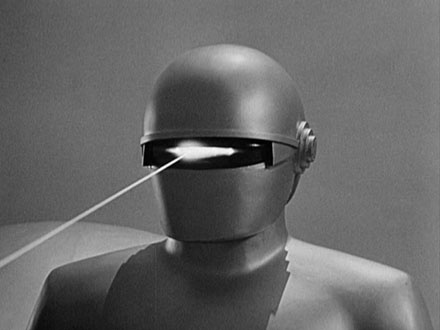
According to The Atlantic, the Pentagon is going to award $7.5 million for research on how to teach ethics to robots. The idea is that robots might (or will) one day be in situations that demand ethical decision-making. For example, if a robot is on a mission to deliver ammunition to troops on the battlefield but encounters a wounded soldier along the way, should the robot delay its mission in order to take the wounded soldier to safety? Or risk the deaths of the soldiers who need that ammunition?

Since philosophers are still arguing about what ethical rules we should follow, and ethical questions don’t always have correct answers anyway, futuristic battlefield robots may need a coin flipping module. That way they won’t come to a halt, emit clouds of smoke and announce “Does not compute!” over and over.

Of course, the talented software developers who program these robots with a sense of right and wrong will avoid really poor error processing like that (presumably, they’ll have seen Star Trek too, so they’ll know what situations to code for). The big question isn’t whether robots can eventually be programmed to make life-and-death decisions, but whether we should put robots in situations that require that kind of decision-making.

the-day-the-earth-stood-still-special-edition-20081204031732410-000

Fortunately, Pentagon policy currently prohibits letting robots decide who to kill. Human beings still have that responsibility. However, the Pentagon’s policy can be changed without the approval of the President, the Secretary of Defense or Congress. And although a U.N. official recently called for a moratorium on “lethal autonomous robotics”, it’s doubtful that even a temporary ban will be enacted. It’s even more doubtful that the world leader in military technology and the use thereof would honor such a ban if it were.

After all, most politicians will prefer putting robots at risk on the battlefield instead of men and women, even if that means the robots occasionally screw up and kill the wrong men, women and children. And, of course, once the politicians and generals think the robots are ready, they’ll find it much easier to unleash the (automated and autonomous) dogs of war.

(PS – The actual quote from Julius Caesar is “‘Cry Havoc!’, and let slip the dogs of war”. Serves me right for trying to be a bit poetic.)