Cutting the Cord (the Saga Continues)

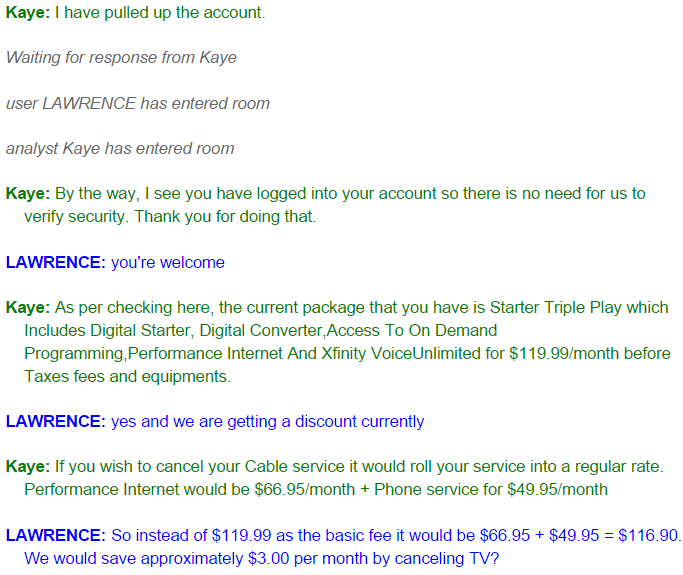
A couple days ago, I went to the Comcast website to ask about eliminating our cable television service (the two online chats that resulted are recorded in an earlier post).

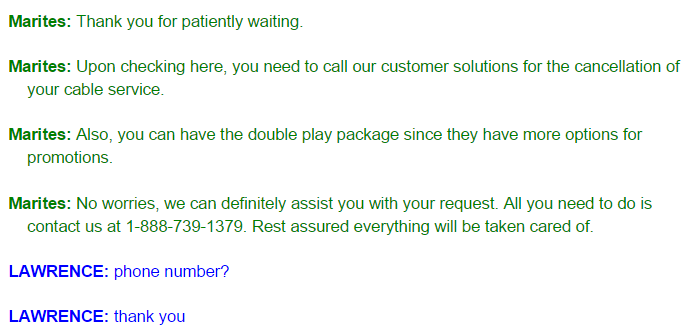
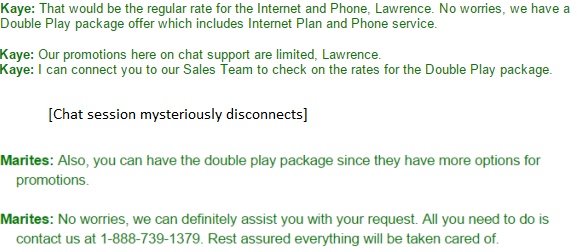
The two “analysts” with whom I chatted, Kaye and Marites, said the same thing: If I wanted to save money by canceling cable TV while keeping our phone and internet service (as part of a so-called “Double Play” package), I’d simply need to get in touch with some other Comcast employee:

com 111

Having gathered my strength for almost 48 hours, I called 888-739-1379 today.

As the pessimistic (i.e. realistic) part of my mind expected, it wasn’t quite as easy as Kaye or Marites promised. In fact, Matthew explained that it would not be possible to get a “Double Play” discount by speaking to him or anyone else on the phone.

According to Matthew, my only option would be to visit the Comcast website, because, in his words (and the words of Marites too!): “they have more options for promotions”. Unfortunately, the best Matthew could do was offer me the “standard” arrangement for phone and Internet service. That would reduce my basic bill by – to quote from that earlier chat with Kaye – hardly anything at all:

com 444

It never occurred to me before that one of the benefits of a huge monopolistic corporation providing support to its customers by phone and also by website is that (1) employees who answer the phone can tell customers to use the website and (2) employees who chat on the website can tell customers to use the phone.

It really is an elegant solution to the Customer Service Problem.

Next stop: Investigate getting phone service from one of the smaller companies that do that these days, as preparation for finally cutting the cable television cord. 

By the way, I know I should tell Comcast I want to cancel everything in order to get a better deal, but I’d prefer to end our relationship completely (even though Verizon isn’t a wonderful alternative). And I know that when the time comes for us to go our separate ways, I need to tell them I’m moving to Iceland. Or that I’m dead. According to this interesting article, Comcast doesn’t have answers for situations like that:

Save Attempt is Not Applicable in the Following Scenarios:
1) Customer is moving in with an existing Comcast customer (CAE [i.e. Comcast Retention Specialist] must verify Comcast services active at new address)
2) Customer is moving to a non-Comcast area (CAE must verify by looking up zip code)
3) Account holder is deceased / incapacitated
4) Temporary / seasonal disconnect and Seasonal Suspend Plan is not available in their area
5) Natural disaster
6) Customer doesn’t know what address they’re moving to.

Cutting the Cord (the Saga Begins)

I didn’t think it would be possible via an online chat to give Comcast less money, but decided to start there anyway.

com 1com 2

com 000

Twenty minutes and one reconnect later:

com 4

com 5com 6Well, I didn’t expect anything else. But sometimes it’s good to get confirmation.

In fact, I’m very familiar with everything you can do at this site: http://customer.comcast.com. For one thing, you can add services but you can’t cancel them….

How To Live: Or a Life of Montaigne in One Question and Twenty Attempts at an Answer by Sarah Bakewell

Michel de Montaigne was a 16th century French nobleman who was active in politics but mostly concerned with writing essays. He may have been the first blogger. Bakewell portrays Montaigne as having a modern sensibility, although he followed the Stoics and Epicureans in some ways. Montaigne wrote about all kinds of topics (including his kidney stones) and always tried to see both sides of an issue. He even tried to see life from his cat’s perspective. Much of his writing seems to have been thinking out loud as he mulled over his topics and went off on tangents. In that regard, she compares his essays to Tristram Shandy. I wonder if the actual essays are as good as advertised (all 1,000 pages of them).

What’s It All About, Woody?

In Woody Allen’s latest movie, Irrational Man, Joaquin Phoenix plays Abe, a moody philosophy professor, while Emma Stone plays Jill, a cheerful undergraduate, who etc. etc. etc.

New York Times critic Manhola Dargis describes Jill as “an eager A student who’s attracted to Abe because that’s how she was written”. That’s very nicely put, but our topic isn’t cinema or gender. Our topic is whether life is meaningless.

From the Times review of Irrational Man:

In Woody Allen’s 1987 drama “September,” a writer and a physicist walk into a room … when the writer asks the physicist, “Is there anything more terrifying than the destruction of the world?” The physicist, sunk deep in gloomy shadow, answers, “Yeah, the knowledge that it doesn’t matter one way or the other — that it’s all random, radiating aimlessly out of nothing and eventually vanishing forever.” The physicist says that he’s not talking about the world. “I’m talking about the universe,” adding, “all space, all time, just a temporary convulsion.”

The exchange is in keeping with Mr. Allen’s oft-repeated insistence, on-screen and off, that life is meaningless, which may be true even if he seems feverishly bent on refuting it with his prodigious cinematic output.

Nobody has ever accused me of always, or even generally, looking on the bright side of things, but I don’t see any connection at all between the end of the universe and the meaning of life. So maybe Woody Allen, who is rather intelligent and can be relatively funny, is having a bit of fun when he suggests that life is meaningless because, meaningless because, in the distant future, the whole shebang will come to nothing.

Apparently not. It was easy to find videos in which Allen, speaking as himself, not through one of his characters, expresses an extremely bleak view of our situation. In one video, for example, when asked to comment on Macbeth’s complaint that life is “full of sound and fury, signifying nothing”, Allen offers this:  

You die and eventually the sun burns out … eventually all the planets and all the stars … the entire universe goes, disappears, and nothing is left at all … and you think to yourself, it is a lot of noise and sound and fury and where is it going? It’s not going anyplace.

He then imagines a cycle in which all of humanity is replaced every 100 years. Each time, people take their lives very seriously, yet “it seems like a big meaningless thing”. Strangely, however, he concludes that “even knowing the worst … it’s still worthwhile …it’s still important to go on”. Further, it’s the artist’s job to help the rest of us understand why this is so.

Not that it makes any difference, but physicists aren’t really sure how the universe will end. Will there be a Big Freeze? Big Rip? Big Crunch? Big Bounce? One reason they’re not sure is that they don’t know enough about dark energy, the strange force that seems to be making the universe expand more quickly. But however it ends, the universe should keep going for billions of years. Its ultimate destination may be nowhere at all, but in the meantime, a whole lot of stuff, including us, will be traveling every which way.

Citing events like the end of the universe or the explosion of the sun as reasons for the meaninglessness of life could be the most ridiculous thing I’ve ever heard a public figure say. It’s like saying that traveling around the world or visiting the Moon is pointless because you’re going to end up back in your own bed and, besides, you’re not going to live forever. 

Life has meaning for anyone who finds it meaningful. None of our experiences, memories, expectations, accomplishments or relationships are inherently meaningful – meaningful in themselves – but they are often meaningful to us and other people. That’s why we say things like “that really meant a lot to me” or (as I heard in a movie this week) “you mean nothing to me”.

To be meaningful in this sense is to be significant. It’s true that we sometimes perceive significance where there really isn’t any, but we don’t always get it wrong. Was it meaningful to you when you finished that task, visited that place, played that song, met that person? Well, no it wasn’t, because billions of years from now, there won’t be anything in the universe except black holes, and they’ll eventually disappear too! Making this supposed connection explicit – “life can only have meaning if the universe lasts forever” – shows what an absurd, lazy idea it is.

To be fair to Woody Allen, however, he might have another idea in mind. When people say life is meaningless, they sometimes mean that life has no ultimate purpose. Our individual purposes (putting food on the table, learning how to surf, becoming a banker) don’t seem important enough in the grand scheme of things. Isn’t there a bigger purpose to all of this?

Perhaps we’re here to propagate the species (until there’s no room on Earth for one more person?). Or help the universe or the Absolute become aware of itself (good one, Hegel). Or to fulfill a divine plan, like glorifying the supreme being forever and ever (the ego!). Or maybe we humans are only here as unwitting contestants in a vast competition run by the rulers of the galaxy to see which planet can produce the best muffins? That’s a possibility.

In addition to the difficulty of identifying which particular cosmic purpose we’re here to serve, there’s another big problem with this idea. Whatever purpose we’re serving, it most likely isn’t ours (especially if we don’t know what it is). Living in order to serve someone or something else’s higher purpose means that we are being treated as a means, not an end. That’s the opposite of what Kant argued is the basis of morality: to treat people as ends in themselves, not as means to achieving something else. Unless we can correctly identify a higher purpose and then adopt it as our own, the desire to serve a higher purpose is the desire to be used. 

In a similar context, Nietzsche criticized what he called “the ascetic ideal”, a way of thinking that helps the less psychologically advanced among us (the “herd”) avoid “suicidal nihilism”. The ascetic ideal, as embodied by Christian morality, requires that:

there is nothing on earth of any power which does not first have to receive a meaning, a right to existence, a value from it, as a tool to its work, as a way and means to its goal [On the Genealogy of Morality, III, 23).

Knowing that we were being used to serve an overriding purpose in the way Nietzsche describes service to the ascetic ideal would certainly add meaning to our lives. That’s true. But whether it would be a desirable meaning is another question.

The world in which we find ourselves should make us wonder what higher purpose would justify or explain what goes on around here. Nature is red in tooth and claw for most living beings. We humans do have Beethoven and Michelangelo, as Woody Allen often says, and surprisingly many people around the world are fairly satisfied with their lives, but consider all the horrendous crap we have to deal with (often at the hands of other humans).

Finding out that all of humanity’s pain and suffering happens for a reason would be adding insult to injury. The world is like this on purpose? It’s more agreeable and understandable that it just worked out this way. If I learned that this whole enterprise was set in motion by some higher-ups (or -up), I’d be very surprised, but also very disappointed. Couldn’t they do a better job? Are we living in a beta version?

They better damn well enjoy our muffins.

Postscript of 7/27/15:

From the 16th century French essayist Michel de Montaigne: “Life should be an aim unto itself; a purpose unto itself” (Essays, III, 12).
Eyes on the Street

I used to work near the big Family Court building in Brooklyn. One afternoon, as I was walking by, I saw a woman punch a little boy in the stomach. Presumably, it was her son and he’d made her angry. Maybe she had to go to court and was stressed out. I can’t remember if I said something, but I probably did, because I remember walking away and wondering if I’d made the little boy’s situation even worse by embarrassing his mother. Would she be even harder on him when they got home? Should I have done more or less?

Something that happened online this week made me remember that moment in Brooklyn. Somebody made a comment on a discussion board, claiming that supporting same-sex marriage means you probably aren’t a Christian. The comment wasn’t directed at me, but I thought I should respond and set the record straight. So I found a recent poll that says same-sex marriage is supported by most Catholics and white mainline Protestants. It’s evangelical Christians and black Protestants who are mostly opposed.

So I left my comment and hoped (but doubted) that would be the end of it. When I visited the site again later that night, it wasn’t a big surprise to see that the person I’d responded to had apparently responded to me. I don’t know for sure, since I didn’t read what he or she had to say. I didn’t want to get involved in one of those unpleasant “discussions”.

The next day, the whole thread was gone. Apparently, things had gotten ugly and the moderator had deleted my post and everyone else’s. Which was fine with me. I figured I’d done my bit and it was just as well the moderator had stepped in.

Online forums are like city streets. The moderators (the police) sometimes intervene when things get bad. But the rest of us (the people in the neighborhood or passersby) have a responsibility to keep an eye on things and sometimes get actively involved. It’s an idea called “eyes on the street”. Jane Jacobs wrote about it in her great book The Life and Death of American Cities:

… there must be eyes upon the street, eyes belonging to those we might call the natural proprietors of the street. The buildings on a street equipped to handle strangers, to insure the safety of both residents and strangers, must be oriented to the street. They cannot turn their backs or blank sides on it and leave it blind…. the sidewalk must have users on it fairly continuously, both to add to the number of effective eyes on the street and to induce the people in buildings along the street to watch the sidewalks in sufficient numbers. Nobody enjoys sitting on a stoop or looking out a window at an empty street. Almost nobody does such a thing. Large numbers of people entertain themselves, off and on, by watching street activity.

Eyes on the street discourage bad behavior and sometimes lead people to speak up (or call the authorities). It’s the same on a discussion board, except for two differences. Nobody on a discussion board is in immediate danger of being robbed or physically assaulted. And the sole purpose of discussion boards, unlike city streets, is to allow people, even strangers, to speak up.

My tendency is to say something when I see a significant factual error. For example, claiming that support for same-sex marriage means a person isn’t a Christian. Of course, not every error (like being mistaken about when a TV show went on the air) needs to be corrected, but some deserve to be, even at the risk of getting into an argument. Preferring to avoid online warfare, I avoid getting personal in my response. I’ll say “X is Y”, but avoid “You are Z” (the third person is less personal than the second person).

And then I’ll usually go away. That means I may miss out on some fruitful discussion, or be corrected myself (unthinkable as that might be!), but reading further responses often leads to more of the same. It seems sufficient to make my point and then disappear, even though this allows someone else to get in the all-important Last Word! Will my silence suggest that I’ve given up? It probably will to some people, but you can’t have everything. And maybe the cops will show up.