From The New Yorker:
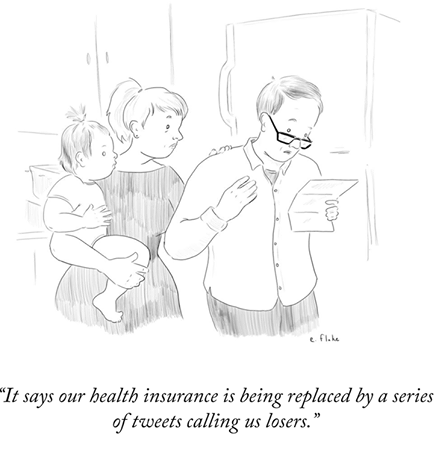
From The New Yorker:
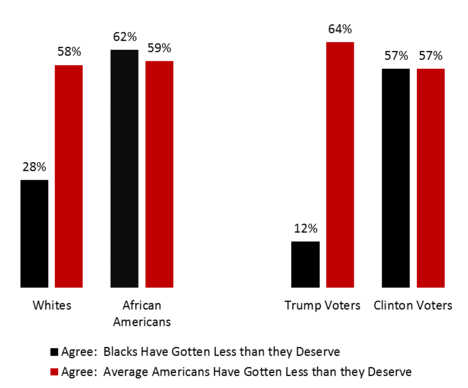
The chart below is the result of a poll of 1,000 Americans who mirror the population of the country as a whole. The question they were asked was:
Do you agree or disagree with the following statements?
The results:
Most blacks and Clinton voters are in very close agreement: neither group has gotten what they deserve.
By the same percentage, whites think that average (i.e. mostly white) Americans haven’t gotten what they deserve. Blacks, however, have done well.
Trump voters also agree that average Americans haven’t gotten what they deserve. They’re very sure, however, that blacks have been living on easy street.
The political scientist who reported the results concludes:
It appears, then, that Trump voters weren’t simply motivated by their widespread belief that average Americans are being left behind. Rather, their strong suspicion that African Americans are getting too much—a belief held by the overwhelming majority of Trump voters—was a much stronger predictor of their vote choices in last month’s election.
Racially resentful beliefs that African Americans are getting more than they deserve were so strongly linked to support for Trump, in fact, that their impact on both the 2016 Republican Primary and the general election were larger than they had ever been before.
Another conclusion we should draw is that America’s race problem and America’s politics won’t improve much until there are fewer of us white people around.
“Plutocracy” and “kleptocracy” are inadequate to the present moment. So it was a pleasant surprise to learn there’s a word that means “rule by the worst”. Assuming the Electoral College doesn’t do its duty tomorrow, we now have terminology that fits the bill.
I was so happy to find fitting language for phrases like “America is now ruled by a …” and “The Orange Menace is a true …” that I wrote about it on Daily Kos. That’s a busy site where liberals and progressives discuss current events, such as the end of the world as we know it.
If you want to know more, please visit my post over there. Thank you and good luck.
Did a powerful being create the universe? If so, does that being know absolutely everything about its creation? And could that being change the way its creation works with no difficulty at all? Damned if I know.
Of course, many of us claim to know. I never have. When I was little, I was impressed by the miracle stories. Later on, I learned that stories about miracles are much more common than miracles themselves.
Eventually, I concluded that I was an agnostic. It seemed like the only reasonable position to hold. Take the proposition that God exists. The possible responses are:
Choosing (2) means you’re an agnostic. (You could also say (4) “I don’t know what ‘God exists’ means”, but let’s put that aside as overly argumentative.)
But consider a proposition like “The Easter Bunny exists”. If we replace “God” with “the Easter Bunny” in those three sentences, it feels easier to choose (3): “I know that the Easter Bunny doesn’t exist”. Why? Well, because I know there’s no Easter Bunny.
Seriously, only little children believe in the Easter Bunny; there is no worldwide religion devoted to believing in the Easter Bunny; no philosophers or theologians have argued for the existence of the Easter Bunny (well, some have in a way, but not many). Under pressure, I might agree that it’s not completely impossible that the Easter Bunny exists, but I’m much closer to believing (3) “it doesn’t” than (2) “I don’t know”.
As I was thinking about writing these posts, I came across something called the Dawkins Scale. It’s from a book by the biologist Richard Dawkins. It’s also known as the Spectrum of Theistic Probability. In theory, each of us belongs somewhere on this scale:

Although I usually think of myself as an agnostic, Dawkins would say I’m an atheist, i.e. (6) “De-Facto Atheist: I cannot know for certain, but I think God is very improbable”. Not everyone agrees with the way Dawkins defines the word “atheist”; some of his critics think that to be an atheist, you have to be completely sure that God doesn’t exist.
I’d forgotten, however, that ten years ago, when I stood in front of the congregation at the Unitarian Church, reading my “theology” or “credo”, this is what I said:
This leaves me as either an atheist or an agnostic, depending on how those words are defined. Using language from the biologist Richard Dawkins, my position is that I cannot know for certain, but I think God is very improbable, and I live my life on the assumption that God is not there.
Hence, ten years later, still number 6 on the Dawkins Scale.
Even so, I recently began watching a Public Broadcasting program called “From Jesus to Christ: The First Christians”. Most of the program was familiar from books I read years ago, and it was a little annoying how often they stopped the narrative for ethereal singing and beautiful video of the sun and clouds. But listening to how the New Testament was written and cobbled together decades after Jesus lived, it occurred to me that it might be interesting to read the “books” of the New Testament in chronological order.
I don’t mean “chronological” in the sense of “as the events supposedly occurred or will occur”. That would mean starting with the birth of Jesus and continuing on to the Apocalypse. I mean reading the parts of the New Testament in the order in which they were written. (There is at least one version of the New Testament, called Evolution of the Word, arranged that way. The book’s description says it “reveals how spiritually and politically radical the early Jesus movement began and how it slowly became domesticated”.)
Scholars believe the first book of the New Testament was written by Paul the Apostle roughly 20 years after Jesus died. That’s 1 Thessalonians, written around the year 50. That was followed by six or seven other letters written by Paul. The first gospel, Mark, wasn’t written until the year 70 or so. The first gospel that appears in the New Testament, Matthew, was written around 20 years after that (60 years after Jesus died).
Maybe reading the New Testament in the order it was written will show something important about how Christianity began. So far, I’ve read three of Paul’s letters. He comes across as a true proselytizer, someone saying whatever he can to turn his audience into followers of Jesus. I’m not sure I’d have trusted him, since he seems like such a self-promoter, although it would have been a relief to hear him say it wasn’t necessary to follow the Jewish dietary laws or be circumcised in order to become a Christian.
In 1 Thessalonians, Paul blames his fellow Jews for killing Jesus. I assumed that was an accusation from later times created in order to foster anti-Semitism. In Galatians, he calls the world “evil”. Paul emphasizes that faith in Jesus is the one true path to salvation. When Jesus returns, the faithful will be lifted up into the clouds, after which they’ll live with the Lord forever.
I don’t know if I’ll keep reading, or if I’ll share what I read. One thing I’m pretty sure of is that I won’t be moving higher or lower on the Dawkins Scale.
Somewhere along the way, I got interested in the philosophy of Baruch Spinoza, the great rationalist thinker of the 17th century. Spinoza argued that “God” and “Nature” are two names for the same thing. That one thing is the universe as a whole. It’s the only thing that truly exists. Everything else (atoms, thoughts, you, me) is a mode or modification of that one infinite substance, God or Nature (Deus sive Natura).
Reading Spinoza made me try to think about the universe (the whole of nature) in a religious sense, as a sacred thing, a worthy object of worship. Obviously, there have been nature religions since prehistoric times. But the idea didn’t work for me. The universe is totally amazing and the Earth is our treasured home, but I never got close to thinking of nature in religious terms.
Neither of us being drawn to any of the standard religions, my wife and I began attending a local chapter of what’s often called the Ethical Culture Society. That was in the 1980s. The organization’s actual name is the American Ethical Union. It was founded in New York City in 1877 by a former rabbinical student named Felix Adler. Here’s an explanatory paragraph from their site:
Ethical Humanism, also called Ethical Culture, is an evolving body of ideas that inspires Ethical Societies. Humanism is a progressive philosophy of life that, without supernaturalism, affirms our ability and responsibility to lead ethical lives of personal fulfillment that aspire to the greater good of humanity (Humanist Manifesto III). For Ethical Humanists, the ultimate religious questions are not about the existence of gods or an afterlife, but rather, “How can we create meaningfulness in this life?” and “How should we treat each other?”
We didn’t stay in the neighborhood long enough to become serious followers of Ethical Culture, but some years later, in the 1990s, we began attending our local Unitarian Church. We both felt at home there. The minister was a scholarly man and an excellent speaker. He also doubted that Jesus was a real person, let alone the son of any god. Like the American Ethical Union, the Unitarian Universalist Association welcomes those who believe in God and those who don’t, because its principal focus is on ethical behavior. From the UUA site and the organization’s bylaws:
We, the member congregations of the Unitarian Universalist Association, covenant to affirm and promote:
- The inherent worth and dignity of every person;
- Justice, equity and compassion in human relations;
- Acceptance of one another and encouragement to spiritual growth in our congregations;
- A free and responsible search for truth and meaning;
- The right of conscience and the use of the democratic process within our congregations and in society at large;
- The goal of world community with peace, liberty and justice for all;
- Respect for the interdependent web of all existence of which we are a part.
… Grateful for the religious pluralism which enriches and ennobles our faith, we are inspired to deepen our understanding and expand our vision. As free congregations we enter into this covenant, promising to one another our mutual trust and support.
The high point of my time as a church-attending Unitarian was ten years ago. The church offered a class called “Building Your Own Theology” (the perfect title for Unitarian adult education). The culmination of the class was supposed to be a personal statement from each of us regarding our fundamental beliefs, which we could then present to the congregation as part of a regular service. I think only two of us chose to address the congregation. The minister helped me with some editing, I put my blue suit on and one Sunday morning I gave it a go. It made me happy that it was well-received.
Here’s some of the conclusion (rearranged a little – consider it a theology that’s still being built):
Is there anything sacred, anything I might revere instead of God? The answer is yes: personal ideals like rationality, curiosity and courage; ethical ideals like generosity, honesty and kindness; and political ideals like justice and democracy. Our ideals and actions, insofar as they exemplify our ideals, can be sacred.
My view is that, if a god existed, it would be a middle-man between us and what is truly sacred, the ideals we hold dear.
I fell away from the church as the years passed. I didn’t feel like I was getting much out of it anymore, especially after my favorite minister retired. But I still love some of the jokes:
Q: How many Unitarians does it take to change a light bulb?
A: We choose not to make a statement either in favor of or against the need for a light bulb. However, if in your own journey, you have found that light bulbs work for you, that is wonderful. You are invited to write a poem or compose a modern dance about your personal relationship with your light bulb. Present it next month at our annual Light Bulb Sunday Service, in which we will explore a number of light bulb traditions, including incandescent, fluorescent, 3-way, long-life, and tinted, all of which are equally valid paths to luminescence.
Q: Why can’t UUs sing very well in choirs?
A: Because they’re always reading ahead to see if they agree with the next verse.
The children in a UU church school class were drawing pictures. The teacher asked one, “What are you drawing a picture of?”
“I’m drawing a picture of God,” was the reply.
“But nobody knows what God looks like,” objected the teacher.
“They will,” said the child, “in a minute.”
And, finally, from the comedian Lenny Bruce: “I know my humor is outrageous when it makes the Unitarians so mad they burn a question mark on my front lawn.”
Again, almost certainly next time: I found a label for what I believe, and have begun reading the New Testament in a way I never thought of before.
 Whereof One Can Speak 🇺🇦
You must be logged in to post a comment.