“You’re On Your Own”

Every now and then, you might find yourself wondering “What’s the deal with these people?” Why are four Republican Congressmen sponsoring a bill that would abolish the Environmental Protection Agency? Why does the President think financial advisers should be free to give advice that favors themselves, not their clients? Why did a wealthy relative of mine strongly resent paying taxes for public schools?

Paul Waldman, writing in The Washington Post, nicely explains the guiding principle behind actions and attitudes like these:

President [D]rump is not an ideologue — not because he’s open-minded, but because he has little in the way of particular beliefs about policy. He does, however, have impulses, inclinations and prejudices. House Speaker Paul Ryan (R-Wis.), on the other hand, is an ideologue, as are many if not most of his compatriots in Congress.

Put that Congress and this White House together, and you get a Republican government with a clear and coherent ideology, one you can sum up in a short declarative statement:

You’re on your own.

This is the driving principle behind nearly everything the Republicans are trying to do in domestic affairs…

He then offers examples. They make very interesting reading if you’ve been trying to understand how people like Drump and Ryan manage to consistently choose the wrong side of every issue.

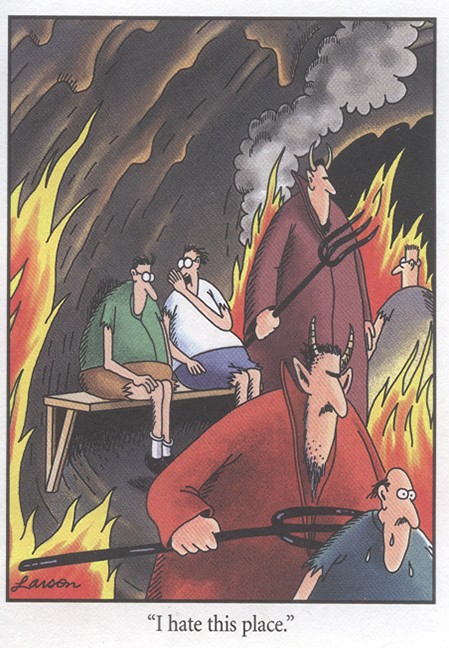
Corporate Life As Depicted On My Old Bulletin Board

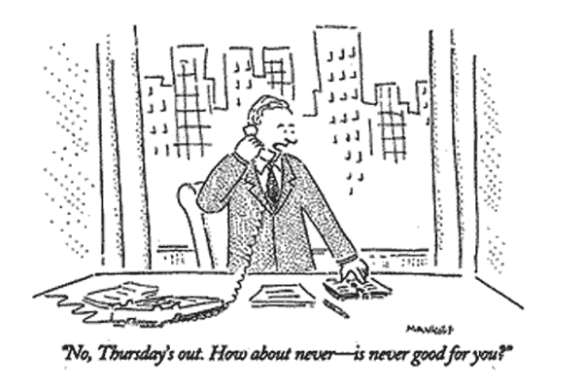
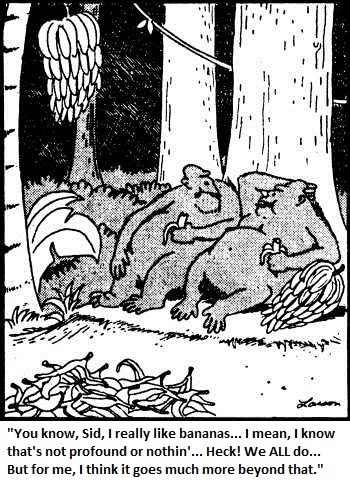
There were four cartoons on the bulletin board in my office for many years, back when I was paid to help the wheels of finance capitalism turn. Maybe there was a theme that united them. Of course, not everyone liked them as much as I did.

The first one was by Bob Mankoff, the cartoon editor of The New Yorker, who recently announced he’s leaving that job. It’s the most famous one he drew.

how-about-never

The other three were by Gary Larson, who drew The Far Side for 15 brilliant years.

7b0668a619c04b1168db8db673846a13

lGPdM1E

4DqHp

So is there a theme here? We have a businessman subverting standard practice; a gorilla who sees himself as more complex than his peers; someone in a horrible situation who thinks it’s worth stating the obvious but is afraid he might make things even worse; and two spiders with very high hopes doomed to failure.

It was a “successful” career, but no wonder I still have bad dreams about the place.

The Simulation Situation

There are smart people who think we’re probably living in a simulation. They question whether we’re flesh and blood creatures inhabiting a physical universe. Instead, we’re mental constructs “living” inside an incredibly sophisticated computer program. Our reality is someone else’s virtual reality.

Adam Gopnik of The New Yorker summarizes the logic:

The argument, actually debated at length at the American Museum of Natural History just last year, is that the odds are overwhelming that ours is a simulated universe. The argument is elegant. Since the advance of intelligence seems like the one constant among living things—and since living things are far likelier than not to be spread around the universe—then one of the things that smart living things will do is make simulations of other universes in which to run experiments….

Since there will be only one “real” universe, and countless simulated ones, the odds that we are living in one of the simulations instead of the one actual reality are overwhelming. If intelligent life exists, then we are surely likely to be living in one of its Matrices. As Clara Moskowitz, writing in Scientific American, no less, explains succinctly, “A popular argument for the simulation hypothesis came from University of Oxford philosopher Nick Bostrum in 2003, when he suggested that members of an advanced civilization with enormous computing power might decide to run simulations of their ancestors. They would probably have the ability to run many, many such simulations, to the point where the vast majority of minds would actually be artificial ones within such simulations, rather than the original ancestral minds. So simple statistics suggest it is much more likely that we are among the simulated minds.”

Mr. Gopnik somewhat jokingly suggests that recent events, in particular, an evil buffoon becoming President, a startling turnaround in the Super Bowl, a dumb mistake at the Oscars, are evidence that someone “up there” is messing with us (“Let’s do this crazy thing and see what happens!”). 

In response, Jesse Singal of New York Magazine argues that recent events seem so bizarre because recent history has been relatively calm:

…part of what’s going on here is that over the last few decades, the world has gotten so much less weird — in mostly good ways — that it’s now easier to highlight and harp upon what are, in the grand scheme of things, relatively minor weirdness flare-ups….

We pay more attention to the Patriots coming back from 28–3 in an impossibly short span of time because we’re less distracted by the U.S. trying to napalm its way out of an inconceivably stupid jungle quagmire. We gawk at the Oscar craziness and dwell on it because it stands out in a saner world than many of our parents and grandparents inhabited. Hell, it’s too early to say, but in the long run, barring an unforeseen catastrophe, maybe even [Donald Drump] — God or superintelligent alien simulators willing — will end up getting a mere footnote, rather than a chapter, in the Book of Weirdness humanity continues writing every moment of every day.

I think Mr. Singal is correct, of course. As some have noted, the Oscar thing was bound to happen (it had already happened once before, in 1964 to Sammy Davis Jr.); sports teams occasionally overcome big deficits, especially when the other team helps; and the Electoral College could have done what the Founders intended and elected a normal person (although I have to admit that, as naturally-occurring events in any possible world go, Drump in the White House is hard to accept).

The idea that we are constructs in some kind of vast computer program isn’t the same as what was depicted in the Matrix movies. In the Matrix, we were good, old-fashioned human beings being manipulated into thinking we were somewhere else. In the simulation hypothesis, we’re software that thinks it’s human. But once you start to imagine possibilities like these, it’s hard to conclude we’re one vs. the other. Would it be easier to create virtual beings who think they’re organisms like us or to trick organisms like us into thinking we’re somewhere else? 

That’s one of the problems I have with the idea of the big simulation. It’s the same problem I have with the idea that our minds could be uploaded onto a computer. In theory, a program could execute the same thoughts that you or I have. For example, it could reach the same conclusions we would if presented with the same evidence. But could a program have the same feelings, the same conscious experience, we have when we touch, hear or see? Maybe so, but it’s hard for me to understand how a program could possibly do that. Would the software include components that made the software believe it was conscious when it really wasn’t? Could the evil demon have tricked Descartes into think he was conscious when he really wasn’t?

Of course, there are other problems with the simulation hypothesis besides my personal lack of imagination. Nobody knows how common life is. How often, for example, do chemical components form single-cell organisms? How often does single-cell life make the transition to multi-cellular life? Assuming complex organisms develop, how often do they form stable societies? And how much technological progress do stable societies make before they destroy themselves or hit some other bump in the cosmic road? We know there are lots of stars in the universe, and now it looks like there are lots of planets too, but beyond that it’s all speculation.

It’s also questionable whether advanced civilizations would decide to run such simulations even if they could. Why assume that beings that advanced would care about creating a world like ours? Wouldn’t they have better things to do?

More than a few philosophers and physicists think there are other universes in addition to ours, maybe even an infinite number of them. In one or more of those many universes, every possibility is real. So maybe the universe we experience is a vast simulation. On the other hand, maybe it’s a simulation being run for an audience of one. How do I know that the simulation I’m witnessing is simulating something for anyone else? It would certainly be simpler to simulate a universe for a single “person” (me) as opposed to billions of them (all of you). At any rate, I’m sure I’m here. Are you?
Minor Mystery Solved

The Drump administration (I’m going with “Drump” for now) and its various sympathizers and enablers are doing their worst, but that didn’t stop the Academy of Motion Picture Arts and Sciences from handing out Oscars last night. Mostly to the winners.

So how did it come about that famous actor Warren Beatty was given the Best Actress envelope before walking on stage to present the Best Picture award, which was followed by famous actor Faye Dunaway announcing the wrong winner?

The accounting firm that handles the envelopes backstage claims the incident is still “under investigation”. It’s now obvious, however, what happened. This paragraph from a Washington Post story provides the answer:

According to Mike Davies, [PriceWaterhouseCoopers] director of global communications, both Cullinan and Ruiz would have had a briefcase on either side of the auditorium to hand out the envelope for the category to be announced. Each briefcase would have had one envelope of [i.e. “for”] each category winner.

So, there were two accountants, Cullinan and Ruiz, backstage. Cullinan was on one side of the stage. Ruiz was on the other. Their job was to hand out the envelopes. But apparently nobody knows which side of the stage the presenters (the people who open the envelopes) will enter from (they’re actors, so who knows where they’ll turn up). That’s why each accountant has an envelope for each award. In other words, there are duplicate envelopes backstage.

That means, of course, that if Cullinan gives out the Best Actress envelope, Ruiz has to put her Best Actress envelope aside. And if Ruiz gives it out, Cullinan has to put his copy aside.

What happened last night, therefore, is that one of the accountants forgot to put the duplicate Best Actress envelope aside. Unfortunately, the forgetful (?) accountant was then called on to hand out the envelope for the next award (Best Picture). Without looking at the envelope to verify that it was indeed for Best Picture, he or she handed the duplicate Best Actress award to Warren Beatty. 

In a better world, Mr. Beatty would have halted the proceedings when he realized he was given the wrong envelope. Or Faye Dunaway would have halted the proceedings when she realized the same thing. But this isn’t a perfect world (as we all know by now), so neither Mr. Beatty nor Ms. Dunaway fixed the problem.

In conclusion: 

Any system in which there are two or more copies of something that should only be processed once has to guard against that thing being processed more than once. In other words, the procedure backstage wasn’t foolproof. It was going to fail eventually. Last night it did.

Hell’s Angels: A Strange and Terrible Saga by Hunter S. Thompson

Before he became famous as the “gonzo” journalist who wrote Fear and Loathing in Las Vegas and Fear and Loathing on the Campaign Trail, and before he became the model for the drug-addled, gun-crazy Uncle Duke in Doonesbury, Hunter S. Thompson spent a year hanging out with the Hell’s Angels, the infamous California motorcycle gang. The resulting book was published in 1966. 

Much of it is devoted to downplaying the media coverage of the group as bloodthirsty savages who left a trail of destruction everywhere they went. On the other hand, Thompson depicts them as violent losers, not very bright, mostly interested in their motorcycles, being part of the gang and getting high. He got to know some of them fairly well, but that didn’t stop one of them from abruptly punching him one day, after which several more joined in, sending Thompson to the emergency room. That experience probably colored the last paragraph of the book:

It had been a bad trip … fast and wild in some moments, slow and dirty in others, but on balance it looked like a bummer….I tried to compose a fitting epitaph. I wanted something original, but there was no escaping the echo of Mistah Kurtz’ final words from the heart of darkness: “The horror! The horror! … Exterminate all the brutes!”

I read Hell’s Angels after reading an article in The Nation that said Thompson had predicted the rise of Trumpism, i.e. a movement of “left-behind people motivated only by ‘an ethic of total retaliation'”. There are, in fact, a few places in the book where Thompson takes a step back and provides that kind of sociological overview. Thus:

… nobody who has ever spent time with the inbred Anglo-Saxon tribes of Appalachia would need more than a few hours with the Hell’s Angels to work up a very strong sense of dĂ©jĂ  vu. There is the same sulking hostility toward “outsiders”, the same extremes of temper and action… [159]

The attack [on a 1965 anti-war demonstration] was an awful shock to those who had seen the Hell’s Angels as pioneers of the human spirit, but to anyone who knew them it was entirely logical. The Angels’ collective viewpoint has always been fascistic. [248]

To see the Hell’s Angels as caretakers of the old “individualist” tradition “that made this country great” is only a painless way to get around seeing them for what they really are – not some romantic leftover, but the first wave of a future that nothing in our history has prepared us to cope with. The Angels are prototypes. Their lack of education has not only rendered them completely useless in a highly technical economy, but it has also given them the leisure to cultivate a powerful resentment … and to translate it into a destructive cult which the mass media insists on portraying as a soft of isolated oddity, a temporary phenomenon… [258]

A toad who believes he got a raw deal before he even knew who was dealing will usually be sympathetic to the mean, vindictive ignorance that colors the Hell’s Angels’ view of humanity. There is not much mental distance between a feeling of having been screwed and the ethic of total retaliation, or at least the kind of random revenge that comes with outraging the public decency….[258-59]

Sociologists call it “alienation” or “anomie”. It is a sens of being cut off, or left out of whatever society one was presumably meant to be a part of…. In the terms of our Great Society the Hell’s Angeles and their ilk are losers – dropouts, failures and malcontents. They are rejects looking for a way to get even with a world in which they are only a problem… The difference between the student radicals and the Hell’s Angels is that the students are rebelling against the past, while the Angels are fighting the future. [260]

Certainly, many Trump supporters are indeed fighting the future. Although the average Trump voter had a higher income than the average Clinton voter, many of Trump’s supporters are struggling and feeling left behind (as are many of Clinton’s). But just as many of his supporters are trying to hold on to what they have (e.g. nice lives in the suburbs) or what they think they deserve as white, “Christian” Americans (i.e. better lives than everyone else).

So the book was usually interesting, if a bit repetitious, and Thompson could certainly write, but as a guide to modern America, it doesn’t deliver much.