Hope vs. Reality, or the Vaccination Blues

From The New York Times:

In April, with hospitals overwhelmed and much of the United States in lockdown, the Department of Health and Human Services produced a presentation for the White House arguing that rapid development of a coronavirus vaccine was the best hope to control the pandemic.

“DEADLINE: Enable broad access to the public by October 2020,” the first slide read, with the date in bold.

Given that it typically takes years to develop a vaccine, the timetable for the initiative, called Operation Warp Speed, was incredibly ambitious. With tens of thousands dying and tens of millions out of work, the crisis demanded an all-out public-private response, with the government supplying billions of dollars to pharmaceutical and biotechnology companies, providing logistical support and cutting through red tape.

It escaped no one that the proposed deadline also intersected nicely with President Txxxx’s need to curb the virus before the election in November.

“Hey, if Operation Warp Speed ‘curbs the virus’ by October, the 200,000 dead will be forgotten and I’ll win a beautiful victory, the biggest win ever!”

Thus our president is hoping. 

I hope his staff doesn’t disappoint him by sharing this from The Washington Post.

In the public imagination [and between the president’s ears], the arrival of a coronavirus vaccine looms large: It’s the neat Hollywood ending to the grim and agonizing uncertainty of everyday life in a pandemic.

But public health experts are discussing among themselves a new worry: that hopes for a vaccine may be soaring too high. The confident depiction by politicians and companies that a vaccine is imminent and inevitable may give people unrealistic beliefs about how soon the world can return to normal — and even spark resistance to simple strategies that can tamp down transmission and save lives in the short term.

Two coronavirus vaccines entered the final stages of human testing last week, a scientific speed record that prompted top government health officials to utter words such as “historic” and “astounding” . . .

As the plotline advances, so do expectations: If people can just muddle through a few more months, the vaccine will land, the pandemic will end and everyone can throw their masks away. But best-case scenarios have failed to materialize throughout the pandemic, and experts — who believe wholeheartedly in the power of vaccines — foresee a long path ahead.

“It seems, to me, unlikely that a vaccine is an off-switch or a reset button where we will go back to pre-pandemic times,” said Yonatan Grad, an assistant professor of infectious diseases and immunology [at Harvard].

Or, as Columbia University virologist Angela Rasmussen puts it, “It’s not like we’re going to land in Oz.”

The declaration that a vaccine has been shown safe and effective will be a beginning, not the end. Deploying the vaccine to people in the United States and around the world will test and strain distribution networks, the supply chain, public trust and global cooperation. It will take months or, more likely, years to reach enough people to make the world safe.

For those who do get a vaccine as soon as shots become available, protection won’t be immediate — it takes weeks for the immune system to call up full platoons of disease-fighting antibodies. And many vaccine technologies will require a second shot weeks after the first to raise immune defenses.

Immunity could be short-lived or partial, requiring repeated boosters that strain the vaccine supply or require people to keep social distancing and wearing masks even after they’ve received their shots. And if a vaccine works less well for some groups of people, if swaths of the population are reluctant to get a vaccine or if there isn’t enough to go around, some people will still get sick even after scientists declare victory on a vaccine — which could help foster a false impression it doesn’t work.

A proven vaccine will profoundly change the relationship the world has with the novel coronavirus and is how many experts believe the pandemic will end. In popular conception, a vaccine is regarded as a silver bullet. But the truth — especially with the earliest vaccines — is likely to be far more nuanced. Public health experts fear that could lead to disappointment and erode the already delicate trust essential to making the effort to vanquish the virus succeed.

The drive to develop vaccines is frequently characterized as a race, with one country or company in the lead. The race metaphor suggests that what matters is who reaches the finish line first. But first across the line isn’t necessarily the best — and it almost certainly isn’t the end of the race, which could go on for years.

“The realistic scenario is probably going to be more like what we saw with HIV/AIDS,” said Michael S. Kinch, an expert in drug development and research at Washington University . . . “With HIV, we had a first generation of, looking back now, fairly mediocre drugs. I am afraid — and people don’t like to hear this, but I’m kind of constantly preaching it — we have to prepare ourselves for the idea we do not have a very good vaccine. My guess is the first generation of vaccines may be mediocre.”

Unquote.

In other words, reality isn’t reality TV.
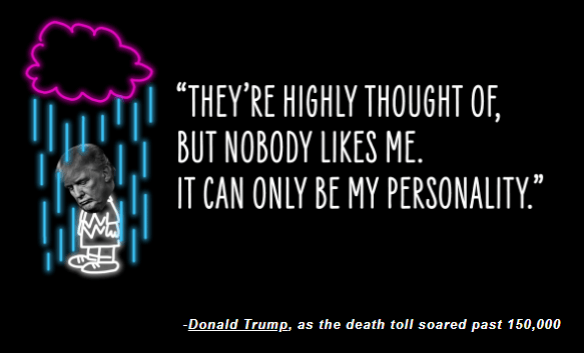
Poor Donald

Yesterday, the president compared his approval rating to the approval ratings of two government experts, Dr. Anthony Fauci and  Dr. Deborah Birx. The moment was captured in the “What a Day” newsletter published by Crooked Media:

Untitled

We have more than 150,000 dead, millions have lost their jobs and we are pitied or mocked by the rest of the world, yet Donald isn’t popular. Life can be so unfair.

How To Vote

Dana Milbank of The Washington Post says we should “stop fretting about Txxxx and do something about it — right now”. Here’s what he says minus the most obvious reasons:

Go to Vote.org, or, if you are reading this in the dead-tree edition, type vote.org/am-i-registered-to-vote into your browser, spend 30 seconds entering your name, address and date of birth, and you’ll find out instantly if your voter registration is current. If not, follow the instructions to register.

Next, click this link or type vote.org/absentee-ballot into your browser, and sign yourself up to receive an absentee ballot for the November election. That takes about two minutes.

Finally, make sure your friends and family do the same. If they’re technology-challenged, help them through it or give them the phone numbers for their states’ elections offices, available here at the U.S. Election Assistance Commission, eac.gov/voters/election-day-contact-information. . . .

[Because more people than usual will be voting by mail,] now is the time to request ballots, before the systems are overwhelmed. . . .  76 percent of American voters can cast ballots by mail in the fall.

Only nine states, an electoral Hall of Shame, make you choose between your health and your right to vote, because they don’t count the pandemic as a valid reason to request an absentee ballot. The nine: Connecticut, New York, Indiana, Kentucky, Louisiana, Mississippi, South Carolina, Texas and West Virginia.

Conversely, if you’re lucky enough to live in Colorado, Washington, Oregon, Hawaii, Utah, California, Vermont or the District of Columbia, all you have to do is make sure you’re registered and your address is correct and you’ll automatically receive a ballot in the mail.

If you live in one of the other 34 states, request your ballot at Vote.org. Delaware, Illinois, Maryland, Massachusetts, Michigan, Wisconsin, Iowa and Ohio say they will automatically send absentee-ballot applications to all registered voters. But in the rest — including battlegrounds Arizona, Florida, Maine, Minnesota, Nevada, North Carolina, Pennsylvania and New Hampshire — it’s all up to you to take action and request your ballot. (Some states let you bring the completed absentee ballot to a polling place or collection spot instead of mailing.)

Vote.org’s chief executive, Andrea Hailey, tells me that for those in the 13 states requiring a “wet” (non-digital) signature to get an absentee ballot (Ohio and Georgia among them), the nonpartisan, nonprofit group will send stamped envelopes. Those who prefer not to use Vote.org can of course go directly to their states’ election offices; other groups doing good work in this area include Rock the Vote, HeadCount, TurboVote and the Voter Participation Center.

Unquote and enough said.

Are You As Mentally Acute As the Leader of the Free World?

President Txxxx has been bragging about how well he did on a test that measures cognitive decline.

The president of the United States, has insisted that a cognitive test he took recently was “difficult”, using the example of a question in which the patient is asked to remember and repeat five words. . . .

Txxxx went on to explain the test, saying that after several questions, the doctor returned to the list of words, asking Trump to repeat them. “And you [remember them and] they say, “That’s amazing. How did you do that?”.

Txxxx has repeatedly referred to the cognitive test in recent interviews. Speaking to Fox news host Chris Wallace on Sunday he insisted the last five questions of the test were hard.

“I’ll bet you couldn’t even answer the last five questions. I’ll bet you couldn’t, they get very hard, the last five questions,” he said. “I guarantee you that Joe Biden could not answer those questions.”

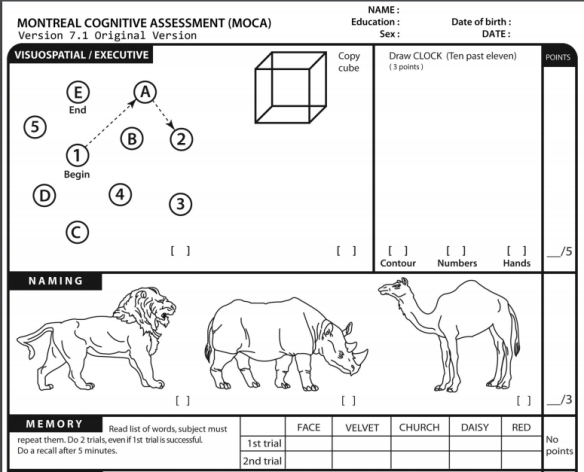
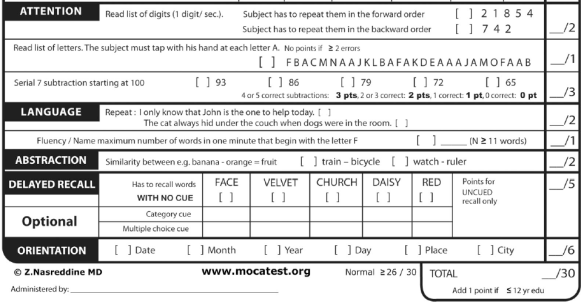
Here’s a version of the test:

Untitled

Untitled2

We shouldn’t make light of people who suffer from dementia or other forms of cognitive decline.

On the other hand, it’s fair to make light of people who (1) exaggerate the test’s difficulty, (2) repeatedly brag about passing it and (3) lie about how the doctor reacted when they answered a question, especially (4) when they occupy a position formerly known as “leader of the free world”.

Changing Course

After talking with someone about the constant stream of bad news assaulting us every day, I decided to do something different with this blog. I’m going to try to post about more positive topics. Given how things are, this will probably mean I’ll have less to say.

The same phenomenon is visible in a political newsletter I get. The section called “Is That Hope?” — which features encouraging news — is always the smallest by far.

My posting less shouldn’t be much of a loss, however, since there is too much to read on the internet anyway (as well as in out of the way places like “books”).

But there’s one qualification: I intend to insert something like the following in every post, as a reminder and because silence might be seen as acquiescence:

The American president is a disaster. He is almost certainly doing something horrendous right now. That’s why we should vote him and every other Republican out of office in November. If you’re willing and able to support Democratic candidates in addition to voting for them, please do.

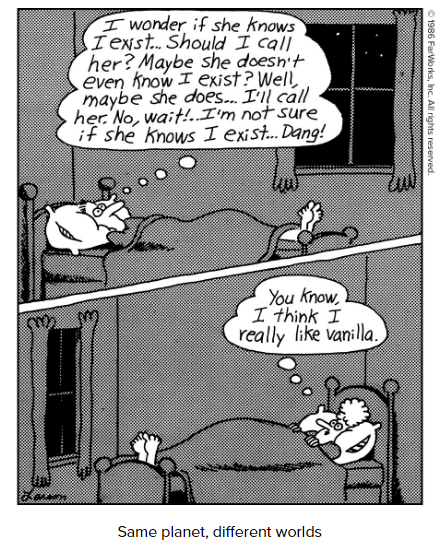
For example, I might point out that Gary Larson, the cartoonist responsible for The Far Side, has a site now. It features a few of his old cartoons every day (and it’s free). They had one of my favorites yesterday:

Untitled

And by the way, the American president is a disaster. He is almost certainly doing something horrendous right now. That’s why we should vote him and every other Republican out of office in November. If you’re willing and able to support Democratic candidates in addition to voting for them, please do.Â