Not Going Postal

The president and his stooges are screwing with the post office, apparently because the president doesn’t like the post office, but also because they think it will help him in the election, when more people will vote by mail than ever before.

Since the post office is the federal government’s most popular agency and most voters prefer getting their mail on time, interfering with delivery in August is probably a really stupid “strategy” (in a rational, non-Fox country, it surely would be).

The Democrats want the post office’s inspector general to investigate, but inspector generals are easy to fire. They also want to give the post office a couple billion dollars as part of the next pandemic relief bill, assuming the Republican Senate eventually agrees to do its job.

The result is that some observers are recommending that as many of us as possible vote in person in November (it will be much easier for some of us than others). Or else that we take our ballots to special “drop boxes” available in some states, although it isn’t clear when those ballots will be counted. 

More from Jamelle Bouie of The New York Times:

There’s no mystery about what President Txxxx intends to do if he holds a lead on election night in November [although I don’t think he will]. He’s practically broadcasting it.

First, he’ll claim victory. Then, having spent most of the year denouncing vote-by-mail as corrupt, fraudulent and prone to abuse, he’ll demand that authorities stop counting mail-in and absentee ballots. . . .

He also seems to be counting on having the advantage of mail slowdowns, engineered by the recently installed Postmaster General Louis DeJoy [delays are already occurring around the country and making people mad]. . . .

If Txxxx is leading on election night, in other words, there’s a good chance he’ll try to disrupt and delegitimize the counting process. That way, if Joe Biden pulls ahead in the days (or weeks) after voting ends — if we experience a “blue shift” like the one in 2018, in which the Democratic majority in the House grew as votes came in — the president will have given himself grounds to reject the outcome as “fake news”.

The only way to prevent this scenario, or at least, rob it of the oxygen it needs to burn, is to deliver an election night lead to Biden. This means voting in person. No, not everyone will be able to do that. But if you plan to vote against Txxxx and can take appropriate precautions, then some kind of hand delivery — going to the polls or bringing your mail-in ballot to a “drop box” — will be the best way to protect your vote from the president’s concerted attempt to undermine the election for his benefit.

Txxxx is the underdog in this year’s race for president. . . . [He] is desperate to hold on to power, but he probably can’t win a fair fight. . . .

A key element of Txxxx’s strategy is to undermine the Postal Service’s ability to deliver and collect mail. The president’s postmaster general has removed experienced officials, implemented cuts and raised postage rates for ballots mailed to voters, increasing the cost if states want the post office to prioritize election mail. And Politico reports that Txxxx’s aides and advisers in the White House have been searching for ways to curb mail-in voting through executive action . . .

If vote-by-mail is the safest option in a pandemic, then the point of the White House’s effort is to create a dilemma for voters who place a premium on safety. . . . Consider the partisan split as well. Fifty-four percent of Biden supporters prefer mail-in voting, according to a July poll from ABC News and The Washington Post, while only 17 percent of Txxxx supporters say the same.

If in-person voters are disproportionately pro-Txxxx, and mail-in voters are disproportionately pro-Biden, then you have the ingredients for an election night standoff, where the president claims victory before all the votes have been counted and tries to secure his “win” by keeping mail-in ballots off the table.

There are reforms that could keep the president from taking this tack. To account for postal delays, states can pledge to count ballots postmarked on or before Nov. 3, so that they’re included in the total even if they arrive late [some states require ballots to be delivered, not postmarked, by Election Day]. To speed up the process, states could permit election officials to verify and count mail-in ballots even before [November 3rd]. They could also decline to release results until all polls close and all votes are in. News organizations, similarly, could set expectations for viewers and bring as much transparency as possible to vote counts and other forms of election analysis [yes, in theory, they could].

Nonetheless, there is a chance that the president takes this path regardless of state officials and the media. And there’s every reason to think that some portion of the Republican Party will back him. The Txxxx campaign and the Republican National Committee are already challenging mail-in voting laws and suing to keep states like Nevada and Pennsylvania from enlarging their scope. . . .

The best defense for the president’s political opponents is, if possible, to vote in person. For some, this will mean going to the polls in November, in the middle of flu season, when the spread of Covid-19 may worsen. In most states, however, there are multiple ways to cast or hand in a ballot. Every state offers some form of early or absentee voting, and 33 states — including swing states like Arizona and Wisconsin — allow absentee voting without an excuse. Txxxx supports absentee voting — it’s how his older supporters in Florida vote — and his opponents should take advantage of the fact that those systems won’t be under the same kind of attack. Many vote-by-mail states also offer drop boxes so that voters can deliver ballots directly to the registrar. And if you must mail in your ballot, the best practice would be to post it as early as possible, to account for potential delays. . . .

There you have it. To head off the worst outcomes, Txxxx must go down in a decisive defeat. He’s on that path already. The task for his opponents is to sustain that momentum and work to make his defeat as obvious as possible, as early as possible. The pandemic makes that a risk, but it’s a risk many of us may have to [actually, should] take.
Winter Is Coming. For Real This Time.

From Helen Branswell, a reporter for Stat who focuses on infectious disease:

The good news: The United States has a window of opportunity to beat back Covid-19 before things get much, much worse.

The bad news: That window is rapidly closing. And the country seems unwilling or unable to seize the moment.

Winter is coming. Winter means cold and flu season, which is all but sure to complicate the task of figuring out who is sick with Covid-19 and who is suffering from a less threatening respiratory tract infection. It also means that cherished outdoor freedoms that link us to pre-Covid life — pop-up restaurant patios, picnics in parks, trips to the beach — will soon be out of reach, at least in northern parts of the country.

Unless Americans use the dwindling weeks between now and the onset of “indoor weather” to tamp down transmission in the country, this winter could be Dickensianly bleak, public health experts warn.

“I think November, December, January, February are going to be tough months in this country without a vaccine,” said Michael Osterholm, director of the Center for Infectious Diseases Research and Policy at the University of Minnesota.

It is possible, of course, that some vaccines could be approved by then, thanks to historically rapid scientific work. But there is little prospect that vast numbers of Americans will be vaccinated in time to forestall the grim winter Osterholm and others foresee.

Human coronaviruses, the distant cold-causing cousins of the virus that causes Covid-19, circulate year-round. Now is typically the low season for transmission. But in this summer of America’s failed Covid-19 response, the SARS-CoV-2 virus is widespread across the country, and pandemic-weary Americans seem more interested in resuming pre-Covid lifestyles than in suppressing the virus to the point where schools can be reopened, and stay open, and restaurants, movie theaters, and gyms can function with some restrictions.

“We should be aiming for no transmission before we open the schools and we put kids in harm’s way — kids and teachers and their caregivers. And so, if that means no gym, no movie theaters, so be it,” said Caroline Buckee, associate director of the Center for Communicable Disease Dynamics at Harvard . . .

“We seem to be choosing leisure activities now over children’s safety in a month’s time. And I cannot understand that tradeoff.”

While many countries managed to suppress spread of SARS-CoV-2, the United States has failed miserably. Countries in Europe and Asia are worrying about a second wave. Here, the first wave rages on, engulfing rural as well as urban parts of the country. Though there’s been a slight decline in cases in the past couple of weeks, more than 50,000 Americans a day are being diagnosed with Covid-19. And those are just the confirmed cases.

To put that in perspective, at this rate the U.S. is racking up more cases in a week than Britain has accumulated since the start of the pandemic.

Public health officials had hoped transmission of the virus would abate with the warm temperatures of summer and the tendency — heightened this year — of people to take their recreational activities outdoors. Experts do believe people are less likely to transmit the virus outside, especially if they are wearing face coverings and keeping a safe distance apart.

But in some places, people have been throwing Covid cautions to the wind, flouting public health orders in the process. Kristen Ehresmann [of the] Minnesota Department of Health, points to a large, three-day rodeo that was held recently in her state. Organizers knew they were supposed to limit the number of attendees to 250 but refused; thousands attended. In Sturgis, S.D., an estimated quarter of a million motorcyclists were expected to descend on the city this past weekend for an annual rally that spans 10 days.

Even on smaller scales, public health authorities know some people are letting down their guard. Others have never embraced the need to try to prevent spread of the virus. Ehresmann’s father was recently invited to visit some friends; he went, she said, but wore his mask, elbow bumping instead of shaking proffered hands. “And the people kind of acted like, 
 ‘Oh, you drank that Kool-Aid,’ rather than, ‘We all need to be doing this.’”

Ehresmann and others in public health are flummoxed by the phenomenon of people refusing to acknowledge the risk the virus poses. . . .

Epidemiologist Michael Mina despairs that an important chance to wrestle the virus under control is being lost, as Americans ignore the realities of the pandemic in favor of trying to resume pre-Covid life.

“We just continue to squander every bit of opportunity we get with this epidemic to get it under control,’’ said Mina, an assistant professor [at Harvard] and associate medical director . . . at Boston’s Brigham and Women’s Hospital.

“The best time to squash a pandemic is when the environmental characteristics slow transmission. It’s your one opportunity in the year, really, to leverage that extra assistance and get transmission under control,” he said, his frustration audible.

Driving back transmission would require people to continue to make sacrifices, to accept the fact that life post-Covid cannot proceed as normal, not while so many people remain vulnerable to the virus. Instead, people are giddily throwing off the shackles of coronavirus suppression efforts, seemingly convinced that a few weeks of sacrifice during the spring was a one-time solution. . . .

Osterholm said with the K-12 school year resuming in some parts of the country or set to start — along with universities — in a few weeks, transmission will take off and cases will start to climb again. He predicted the next peaks will “exceed by far the peak we have just experienced. Winter is only going to reinforce that. Indoor air,” he said.

Buckee thinks that if the country doesn’t alter the trajectory it is on, more shutdowns are inevitable. “I can’t see a way that we’re going to have restaurants and bars open in the winter, frankly. We’ll have resurgence. Everything will get shut down again.”

[Anthony Fauci, director of the National Institute for Allergy and Infectious Diseases] favors . . . a strong messaging component aimed at explaining to people why driving down transmission now will pay off later. Young people in particular need to understand that even if they are less likely to die from Covid-19, statistically speaking, transmission among 20-somethings will eventually lead to infections among their parents and grandparents, where the risk of severe infections and fatal outcomes is higher. (Young people can also develop long-term health problems as a result of the virus.)

“It’s not them alone in a vacuum,” Fauci said. “They are spreading it to the people who are going to wind up in the hospital.”

Everyone has to work together to get cases down to more manageable levels, if the country hopes to avoid “a disastrous winter,” he said.

“I think we can get it under much better control, between now and the mid-to-late fall when we get influenza or we get whatever it is we get in the fall and the winter. I’m not giving up,” said Fauci.

But without an all-in effort “the cases are not going to come down,” he warned. “They’re not. They’re just not.”

Politics and Markets One More Time

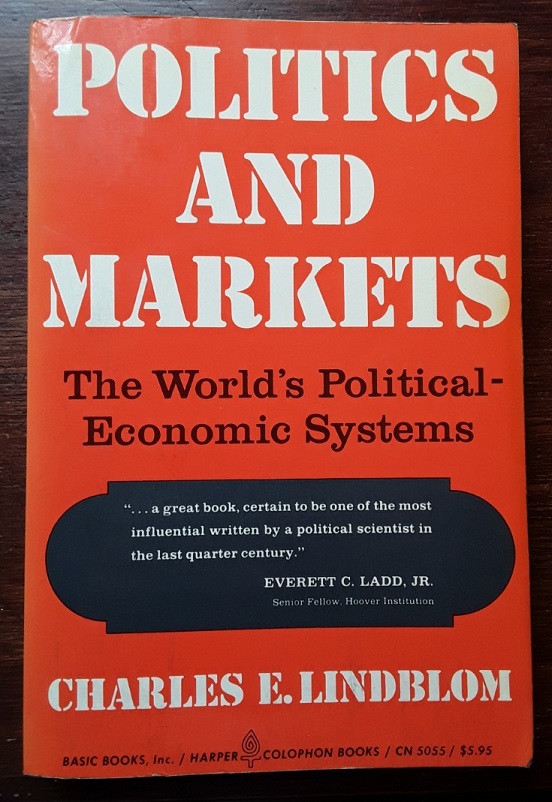
Around 40 years ago, I bought a book called Politics and Markets: The World’s Political-Economic Systems. It was written by Yale professor Charles Lindblom. I read about half of it before putting it aside. I don’t know why I stopped reading, because I thought it was excellent and intended to finish it. Instead, I treated the book like a kind of talisman. For some time, I kept it on my desk at work. It was there so long that someone asked me if I was still reading “that book”. I suppose I didn’t have the mental energy to finish it, but having it around was nice. Maybe it reminded me of my aborted attempt at an academic career.

thumbnail_20200807_142201

A few days ago, I thought I might go around the house and find books I’ve always thought about reading but never did. An obvious candidate was a biography of Ralph Waldo Emerson called Emerson: The Mind on Fire. Just like Politics and Markets, I read about half of it years ago and have often thought of finishing it. Unlike Politics and Markets, however, Emerson still had a decades-old bookmark showing where I stopped reading (it wasn’t even at the start of a chapter).

I’m now reading Politics and Markets again. I was immediately impressed.

This is how the 1977 edition above begins:

Relentlessly accumulating evidence suggests that human life on the planet is headed for a catastrophe. Indeed, several disasters are possible, and if we avert one, we will be caught by another. At present rates of population growth, another century will put 40 billion people on Earth, too many to feed. If industrial production grows at present rates during the next century, resource requirements will multiply by a thousand. And energy emission, some scientists say, will over a longer period of time raise Earths’ temperature to a level unsuitable for human habitation. All this assumes that a nuclear catastrophe does not spare us the long anguish of degeneration.

However fearful one may be that the fallible and dilatory intelligence of the human species will somehow either end human life or reduce it to unbearable squalor, the decline of the human condition is not inevitable. It is for us to decide whether we will continue to reproduce at disastrous rates, plunder the planet of resources, or burn ourselves from the face of the earth through either thermal pollution or a few quick blasts. The world is man’s doing, not something done to him.

Assuming that men and women wish to give some thought to their futures, what are the fundamental politico-economic mechanisms they can employ in order to maintain — indeed greatly enlarge — the humane qualities of life on Earth? That is the question of this book. Some will doubt that political and economic mechanisms matter. They will say that man’s future hinges on a moral regeneration. Or science and technology. Or inner awareness. Or a new form of family or other small-group association. Or organic foods — the list is open to nominations. This book is for those who believe that politics and economics will turn out to matter.

Well, some good news is that world population isn’t climbing as fast as people expected in 1977. It was 4.2 billion back then. Now it’s 7.8 billion, but the rate of increase is going down. It’s projected that there will be 10 billion of us by 2077, not 40 billion. And since the fertility rate is expected to keep dropping, world population may actually decline in the next century (even without the help of killer viruses, nuclear wars, giant meteors, etc.).

Along with population, resource requirements continue to grow, although some experts believe that we won’t run out of the things we need, since as resources become scare, they’ll become more expensive and we’ll find substitutes (I don’t know what the substitute for oxygen or water would be).

The bad news, of course, is that the “energy emission” that “some scientists” were worried about in 1977 is now out of control. If you want a scary update, see Bill McKibben’s article “130 Degrees” at the New York Review of Books site:

What [the 10 to 15% drop in emissions during the pandemic] seems to indicate is that most of the momentum destroying our Earth is hardwired into the systems that run it. Only by attacking those systems—ripping out the fossil-fueled guts and replacing them with renewable energy, even as we make them far more efficient—can we push emissions down to where we stand a chance.

As for “nuclear catastrophe”, it’s easy to think that the danger subsided with the end of the Cold War. That’s not the message from “The New Nuclear Threat”, an article by Jessica Matthews in the same issue of The New York Review of Books (I’ve subscribed for a long time — the subscription is almost worth the price):

In part because of effective deterrence, fear of their destructiveness, and a growing taboo against their use, and in part because of dumb luck, nearly a century has passed without nuclear weapons being used again in conflict. . . . But we are not safer today—quite the reverse. . . . A second nuclear arms race has begun—one that could be more dangerous than the first. . . .

The single step from which profound policy change could flow, domestically and internationally, would be formal endorsement by the five original nuclear powers—the US, Russia, the UK, France, and China—of the Reagan-Gorbachev principle, jointly articulated by the two leaders at their 1985 summit. It states simply, “a nuclear war cannot be won and must never be fought.” International adoption would simultaneously indicate the nuclear powers’ recognition of the rising dangers of nuclear conflict and the need to move toward nuclear forces around the world that are structured for deterrence, not war fighting. . . .  Eventually, these eleven words could underlie the next generation of arms control negotiations, strengthen the global nonproliferation regime, and help short-circuit a second nuclear arms race.

I don’t know if Prof. Lindblom’s old book might help with any of this. I’ll let you know if I finish it.

How It Beat Us

If you want a deep analysis of how this country screwed up its response to Covid-19 and what we need to do better next time, read this long article by Ed Yong for The Atlantic Monthly. It’s been recommended by intelligent people. I don’t intend to read the whole thing. The first 700 words were enough (by the way, Dr. Fauci says we need to get new cases down to 10,000 a day from the current 50 or 60 thousand or else the fall is going to be very bad):

America has failed to protect its people, leaving them with illness and financial ruin. It has lost its status as a global leader. It has careened between inaction and ineptitude. The breadth and magnitude of its errors are difficult, in the moment, to truly fathom.

In the first half of 2020, SARS CoV 2—the new coronavirus behind the disease COVID 19—infected 10 million people around the world and killed about half a million. But few countries have been as severely hit as the United States, which has just 4 percent of the world’s population but a quarter of its confirmed COVID 19 cases and deaths. These numbers are estimates. The actual toll, though undoubtedly higher, is unknown, because the richest country in the world still lacks sufficient testing to accurately count its sick citizens.

Despite ample warning, the U.S. squandered every possible opportunity to control the coronavirus. And despite its considerable advantages—immense resources, biomedical might, scientific expertise—it floundered. While countries as different as South Korea, Thailand, Iceland, Slovakia, and Australia acted decisively to bend the curve of infections downward, the U.S. achieved merely a plateau in the spring, which changed to an appalling upward slope in the summer. “The U.S. fundamentally failed in ways that were worse than I ever could have imagined,” Julia Marcus, an infectious-disease epidemiologist at Harvard Medical School, told me.

Since the pandemic began, I have spoken with more than 100 experts in a variety of fields. I’ve learned that almost everything that went wrong with America’s response to the pandemic was predictable and preventable.

A sluggish response by a government denuded of expertise allowed the coronavirus to gain a foothold. Chronic underfunding of public health neutered the nation’s ability to prevent the pathogen’s spread. A bloated, inefficient health-care system left hospitals ill-prepared for the ensuing wave of sickness. Racist policies that have endured since the days of colonization and slavery left Indigenous and Black Americans especially vulnerable to COVID 19. The decades-long process of shredding the nation’s social safety net forced millions of essential workers in low-paying jobs to risk their life for their livelihood. The same social-media platforms that sowed partisanship and misinformation during the 2014 Ebola outbreak in Africa and the 2016 U.S. election became vectors for conspiracy theories during the 2020 pandemic.

The U.S. has little excuse for its inattention. In recent decades, epidemics of SARS, MERS, Ebola, H1N1 flu, Zika, and monkeypox showed the havoc that new and reemergent pathogens could wreak. Health experts, business leaders, and even middle schoolers ran simulated exercises to game out the spread of new diseases. . . . [They showed that] the U.S. was not ready for a pandemic, [sounding] warnings about the fragility of the nation’s health-care system and the slow process of creating a vaccine. But the COVID 19 debacle has also touched—and implicated—nearly every other facet of American society: its shortsighted leadership, its disregard for expertise, its racial inequities, its social-media culture, and its fealty to a dangerous strain of individualism.

SARS CoV 2 is something of an anti-Goldilocks virus: just bad enough in every way. Its symptoms can be severe enough to kill millions but are often mild enough to allow infections to move undetected through a population. It spreads quickly enough to overload hospitals, but slowly enough that statistics don’t spike until too late. These traits made the virus harder to control, but they also softened the pandemic’s punch. SARS CoV 2 is neither as lethal as some other coronaviruses, such as SARS and MERS, nor as contagious as measles. Deadlier pathogens almost certainly exist. Wild animals harbor an estimated 40,000 unknown viruses, a quarter of which could potentially jump into humans. How will the U.S. fare when “we can’t even deal with a starter pandemic?,” Zeynep Tufekci, a sociologist at the University of North Carolina . . . asked me.

Despite its epochal effects, COVID 19 is merely a harbinger of worse plagues to come. The U.S. cannot prepare for these inevitable crises if it returns to normal, as many of its people ache to do. Normal led to this. Normal was a world ever more prone to a pandemic but ever less ready for one. To avert another catastrophe, the U.S. needs to grapple with all the ways normal failed us. It needs a full accounting of every recent misstep and foundational sin, every unattended weakness and unheeded warning, every festering wound and reopened scar.

Un-Christian Christians

From Matt Hanson writing for The Baffler:

After a set in Tennessee, the story goes, a couple of locals confronted the Texas-born comic [Bill Hicks] and declared that they were Christians and they didn’t like his act. Without missing a beat, Hicks responded with “well then, forgive me.” Instead, they broke his arm.

You might think reacting in such a spirit of vengeance is pretty much the exact opposite of how any self-professed Christian is supposed to behave. Yet there were deeper and more distinctly American pathologies at work: the guys who supposedly beat up Hicks were responding politically, not theologically. It wasn’t an attempt to defend Jesus’ honor or the tenets of whatever church they might have belonged to—it was to show that little punk who was really boss. They probably didn’t even notice the irony; and why would they? They may have grown up in an evangelical culture, but that culture glorifies what we now refer to as toxic masculinity. This “muscular Christianity” encourages both aggression and victimhood, emboldening believers, especially men, to impose their collective will on the rest of the public whenever they suddenly feel empowered or aggrieved.

In Jesus & John Wayne: How White Evangelicals Corrupted A Faith and Fractured a Nation, the historian Kristin Kobes Du Mez explores this moral schizophrenia. We know there are legions of people on the religious right who talk a good game about following Christ but end up voting overwhelmingly for venal, crass, blustering wannabe tough guys like the current president and his enablers in Congress. But much of the evangelical leadership is this way, too . . .

The question is often asked . . . why the white evangelical community consistently supports people who don’t practice what the Gospels preach. Du Mez argues, using an extensive amount of research, that white evangelical culture often glorifies the aggressive, patriarchal idea of manhood, which has become intertwined with what it means to be a conservative Christian in the modern age. They conflate a guy like John Wayne with Jesus because their idea of evangelical Christianity rejects the gentle, egalitarian aspects of Jesus’ teachings in favor of all the usual culture war gripes about big government, gun control, immigration, and gay rights. Thus, “a nostalgic commitment to rugged, aggressive, militant white masculinity serves as the thread binding them together into a coherent whole.”

It’s not hard to see that religion has always been one of the most effective ways of enforcing the social order, especially in a relatively young and wide open country like America. It’s more effective to tell the weirdos and the sissies—those pesky un-American types—to get off your lawn when you assume that the creator of the universe is in your corner. In [a country]obsessed with religion and rugged individualism, where holding your own and taking no shit is considered a cardinal virtue, sticking to your guns (metaphorically and literally) is how you define the rules of the game and make sure you win it in the end. Harold Bloom once quoted Spinoza’s comment that one must love God without having any expectation that he loves you back, which he called the most un-American idea ever. . . .

One of the book’s . . . insights is that being evangelical isn’t just about agreeing to a certain set of theological principles—that’s just where the rest of the lifestyle management begins. . . .

You don’t have to go very far in the evangelical world to see how a “God made boys to be aggressive” mentality is more or less taken for granted. Even if physical purity, restraint, and accountability are supposed to be the name of the game, plenty of pastors brag about how hot their wives are, and how the Bible encourages women to submit to their husbands sexually, and if their hubby strays, it’s their fault for not keeping him interested or satisfied. When notorious televangelist Jimmy Swaggart was caught with a hooker for the second time he refused to confess and told his congregation “the Lord told me it’s flat none of your business.”

Such confidence is seductive to a certain kind of white evangelical male. Du Mez points out that for many white men,

to obey God was to obey patriarchal authorities within a rigid chain of command, and God had equipped men to exercise this authority in the home and in society at large. Testosterone made men dangerous, but it also made them heroes. Within their own churches and organizations, evangelicals had elevated and revered men who exhibited the same traits of rugged and even ruthless leadership that President Txxxx now paraded on the national stage.

For anyone who still wonders why the president’s base seems to hold fast no matter what he says or does, we should recall that inflicting the merciless cruelty—to dominate, as he often says—is the point. . . .

Zooming out from the hierarchical model of the nuclear family, we then have divinely inspired conservative government, which now shows its attitudes toward discipline by deploying military might against rebellious citizens. Then, naturally, at the top of the social pyramid is the Lord God almighty, whose ways may be mysterious and capricious (and quite harsh at times) but since he’s the almighty master of the universe, he is the ultimate giver of Law and Order. Best get with the program in this so-called Christian nation. Call it “God’s chain of command” in a trickle-down theocracy.

So today all that wounded pride and self-assumed authority make large swaths of the religious voting public want to vicariously identify with the loudest, crassest, most ignorant and arrogant, and least constrained president in modern history. And if the ravages of Late Capitalism have left you feeling emasculated, since your job isn’t paying what it used to and it’s hard to get a new one, then the thrill of identifying with a very rich playboy who promises to stick it to the people who did you wrong becomes pretty obvious. . . .

If you actually believe, as some Christians do, the Biblical principle that the devil is stalking the earth looking to devour vulnerable souls (1 Peter 5:8) then you’re not going to think twice about lining up to do political battle by way of spiritual battle. The difference between the two is almost nil. And the right wing has always known how to make that kind of paranoia work for them. The idea that money is spiritually corrupting is discarded, because money equates with political power and spiritual endorsement. Survival and success are all that matters, and it doesn’t come from being meek and poor.