All-American Terrorists

The F.B.I. announced the arrest of 13 members of our species who were planning to make America great again. Here are five of them:
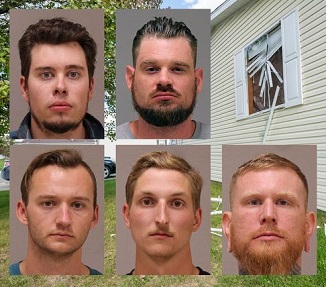
fbb85b87-279b-40fe-b6c4-d7ebbd5ff064-Composite-Kidnap-conspirators

From The New York Times:

Storming the State Capitol. Instigating a civil war. Abducting a sitting governor ahead of the presidential election.

Those were among the plots described by federal and state officials in Michigan on Thursday as they announced terrorism, conspiracy and weapons charges against 13 men. At least six of them, officials said, had hatched a detailed plan to kidnap Gov. Gretchen Whitmer, a Democrat who has become a focal point of anti-government views and anger over coronavirus control measures.

The group that planned the kidnapping met repeatedly over the summer for firearms training and combat drills and practiced building explosives, the F.B.I. said; members also gathered several times to discuss the mission, including in [a basement] accessible only through a “trap door” under a rug.

The men spied on Ms. Whitmer’s vacation home in August and September, even looking under a highway bridge for places they could place and detonate a bomb to distract the authorities, the F.B.I. said. They indicated that they wanted to take Ms. Whitmer hostage before the election in November, and one man said they should take her to a “secure location” in Wisconsin for a “trial,” Richard J. Trask II, an F.B.I. special agent, said in the criminal complaint.

Mr. Trask said that one of those arrested had bought a Taser for the mission last week and that the men had been planning to buy explosives on Wednesday. Court records indicated that at least five of the men had been arrested on Wednesday in Ypsilanti, Mich.; it was not immediately clear if the sixth man had been taken into custody. . . .

The F.B.I. said a leader in the kidnapping plot had reached out to members of an unnamed anti-government group for help, and the state charged an additional seven men, all from Michigan, with providing material support for terrorist activities, being members of a gang and using firearms while committing felonies.

The seven men were said to be affiliated with an extremist group known as the Wolverine Watchmen, and the state’s attorney general accused them of collecting addresses of police officers in order to target them, threatening to start a civil war “leading to societal collapse” and planning to kidnap the governor and other government officials.

The seven men were charged with state crimes, which carry penalties of two to 20 years in prison.

Ms. Whitmer and Dana Nessel, the Michigan attorney general, tied the extremist plot to comments from President Txxxx and his refusal at times . . . to condemn white supremacists and violent right-wing groups. . . . Ms. Whitmer said extremists had “heard the president’s words not as a rebuke but as a rallying cry — as a call to action.”

. . . the F.B.I. director, Christopher A. Wray, said in September that the most pressing threats facing the nation were from anti-government and white supremacist groups, who . . . have carried out the most lethal domestic attacks in recent years.

The F.B.I. investigation of the kidnapping plot began early this year, according to an affidavit, after a social media discussion of violent government overthrow. The F.B.I. used confidential informants, undercover agents and intercepted messages to monitor the group. . . . The six men were charged with conspiracy to commit kidnapping, which can carry a life sentence.

The authorities said that [two of the men] had decided to “unite others” to “take violent action” against state governments that they thought were violating the Constitution . . . . The F.B.I. said [one] had talked of storming the Michigan Statehouse with 200 men and trying Ms. Whitmer for treason. . . .

Ms. Whitmer has been the subject of criticism from right-wing protesters for measures she imposed to try to control the spread of the coronavirus, which has infected about 146,000 Michigan residents and killed about 7,200.

In April, thousands of people gathered at the State Capitol to protest the executive orders she issued shutting down most of the state. Mr. Txxxx openly encouraged such protests, tweeting, “LIBERATE MICHIGAN!”

. . . In May, a man was charged with threatening to kill Ms. Whitmer and Ms. Nessel. And the protests at the Capitol in Lansing featured some signs with swastikas, Confederate flags and demonstrators who advocated for violence against Ms. Whitmer, including one man who carried a doll with brown hair hanging from a noose. Many in the crowd carried semiautomatic weapons, leading some Democrats in the Legislature to call for a ban on guns in the Capitol.

Republicans in the Legislature sued Ms. Whitmer in May over the executive orders, and last week opponents of her lockdown filed petitions with more than 500,000 signatures to repeal a 1945 law that gives governors authority to declare emergencies during times of a public health crisis. The Michigan Supreme Court ruled last week that the law, which Ms. Whitmer had cited, was unconstitutional [deciding it conflicts with another Michigan law regarding emergency declarations]. . . .

The alleged plot in Michigan was infused with elements that have been the focus of anti-government extremists for years, said J.J. MacNab, a fellow at George Washington University’s Program on Extremism, such as accusing government officials of tyranny.

Most of all, Ms. MacNab said, they want their acts to serve as examples — to inspire others to carry out similar attacks.

“Starting a revolution is a common thread in the overall anti-government extremist movement,” Ms. MacNab said.

Homeland Security analysts have warned in recent days of potential attacks from extremists seeking to retaliate against government-ordered social distancing measures and closures. . .

The F.B.I. said it had monitored the kidnapping plot throughout the summer as the target narrowed to the governor’s personal vacation home. The group discussed the governor in vulgar terms and called her a “tyrant.”

“Have one person go to her house. Knock on the door and when she answers it just cap her,” one of the men said in an encrypted group chat, according to the F.B.I. . . .

“I just wanna make the world glow, dude,” the affidavit quoted [one of the men] as saying in a profanity-laced tirade. “We’re gonna topple it all . . . “

As Different Kinds of Capitalism Take Over the World

The New York Review of Books comes in the mail every few weeks. I’ve never been tempted to switch to a digital subscription, partly out of habit, but also because the version on paper is good for reading and also good for looking at. For one thing, I’d miss the book advertisements, which don’t appear online. A yearly subscription to the paper edition is kind of expensive, but we still have libraries and you can still buy a single copy (although those are kind of expensive too). What I didn’t know until just now is that in addition to a regular digital subscription, you can get a Kindle subscription for the low, low price of $3.49 a month (which translates to $2.09 per issue). The world’s richest capitalist is a money grubber (even now!) who treats some of his employees very badly, but he’s made life easier at times.

I’d provide a link to an excellent article in the September 24th NYRB but, except for the latest edition, all of their articles are behind a paywall. The article is “Can We Fix Capitalism?” by Robert Kuttner. Here’s a bit of the article, which is worth reading all the way through:

For enthusiasts of capitalism, democracy and the market are said to be handmaidens. Both depend on the rule of law. Both express aspects of liberty, prizing opportunity and mobility. During the era of classical liberalism, which began in the late eighteenth century, free commerce and political freedom advanced in tandem. Monarchies gave way to republican rule; open markets replaced royal monopolies and inherited privileges. For about a century the franchise gradually expanded, and markets became the primary mode of commerce. The brand of democratic capitalism that emerged in the West after World War II included not just those earlier hallmarks but such liberal values as tolerance, compromise, and enlarged civic participation, as well as regulatory and social welfare policies to buffer the less savory tendencies of markets. Modern capitalism reflected a grand social bargain.

When communism collapsed in 1989, the fall of the Berlin Wall was heralded as ushering in a golden age in which liberal capitalism would be triumphant. Needless to say, things haven’t worked out quite as expected. The social compromises of the postwar welfare state have given way to more primitive forms of capitalism that in turn invite angry reactions by the citizenry. Demagogues have channeled this anger. Today, some form of capitalism is ascendant nearly everywhere. But liberal democracy is in big trouble.

Instead of creating a new golden age, corrupted capitalism has produced alliances between autocrats and oligarchs, epitomized by the regimes of Putin and Txxxx, who both reinforce societies that were already becoming less liberal and more unequal. This is the pattern not just in countries with weak or nonexistent democratic traditions, notably Russia and China, but in the very heartland of liberal democracy, the United States of America. Contrary to standard assumptions about liberalism, autocratic capitalism also coexists and interacts with enlarged global trade, making it harder to defend living standards in democratic nations that once protected their workers and citizens by regulating markets.

In a cycle of reactivity, ordinary people turn not to social democracy—now at its weakest point since World War II—but to the vicarious and counterfeit satisfactions of extreme nationalism. That in turn permits autocrats to pose as populist champions of a mystical People, diverting attention from the economy’s concentrated wealth and rigged rules. This unexpected twist in the fraught relationship between democracy and capitalism is the signal event in the political economy of our age.

In Capitalism, Alone, the economist Branko Milanovic tries to make sense of what has occurred and what the future holds. . . . Milanovic chronicles the rise of authoritarian capitalism, both in nations that once epitomized liberal capitalism such as the US and in countries like China, which are partly capitalist but show no signs of turning liberal. Until recently, as the China scholar James Mann has observed, the widespread hope was that as China’s economy became more capitalistic, the country would become “more like us.” The reality is that we are becoming more like China. . . . 

Milanovic’s first section, on liberal capitalism, offers a smart assessment of how it once worked and why it is now under siege. In the heyday of managed, meritocratic capitalism, societies relied on several mechanisms to equalize income and opportunity. For Milanovic, “strong trade unions, mass education, high taxes, and large government transfers” were essential components. All of these have lost traction as capital has gained more power relative to labor, and globalization has spawned competition to cut taxes, slash wages, and reduce regulation. . . . 

Liberal capitalism, Milanovic concludes, is “reneging on some crucial aspects of [its] implicit value system” via “the creation of a self-perpetuating upper class.” That trend in turn threatens liberal capitalism’s own survival, and makes it less appealing as a model for the rest of the world. . . . 

While Chinese political capitalism is an economic triumph, Russia’s is not. Post-Soviet Russia is basically a petro-state. Its economy has largely failed to generate consumer export industries, the mainstay of China’s success. Vladimir Putin has an understanding with the oligarchs; they can pursue corrupt enterprises as long as they throw some graft his way and don’t make trouble for the regime. His net worth is said to be around $200 billion. In a taxonomy of capitalisms, it would have been interesting to have Milanovic’s insights on why the Russian brand of autocratic capitalism fails while China’s succeeds. . . . 

The most provocative part of the book is the section in which Milanovic addresses a dilemma with no intuitively correct answer: Should we look at the issue of economic inequality as a national or a global question? Most economists and concerned citizens assess it nationally. As Americans, we are troubled that our country has become one of economic extremes. Milanovic insists that the proper lens is global. Income inequality has increased within nearly every nation for the past three decades, substantially driven by globalization. Yet the rise of China, which lifted hundreds of millions of people out of poverty, has rendered the world as a whole more equal.

This cheerful formulation, however, sidesteps the issue of how globalization promotes inequality within nations and thus undermines national democracy. The increased entry of low-wage goods renders high-wage manufacturing labor in wealthy countries uncompetitive. Meanwhile, the greater license for capital in a globalized world promotes deregulation, corruption, the hiding of assets, and exorbitant income for capitalists. The result: greater disparities of income and wealth at both the top and the bottom, and unequal power to make the rules—producing yet more inequality. The consequences for political democracy are grave. As Louis Brandeis was said to have remarked, “We may have democracy, or we may have wealth concentrated in the hands of a few, but we can’t have both.”

Milanovic tends to dismiss the effect of globalization on wealth concentration and democracy within countries in favor of celebrating the rise of China as a gain for global equality. China’s rising GDP, as he points out, has been responsible for about 95 percent of the global reduction in extreme poverty as defined by the World Bank. Milanovic quotes the egalitarian philosopher John Rawls, who argues that if we didn’t know in advance where we would stand in the income hierarchy, we’d favor an income distribution far more equal than the one we have. Why, Milanovic demands, should that principle be applied nationally and not globally? As Rawlsians, don’t we care about the world’s poor and not just the poor in our own land? It’s a good question.

One persuasive rejoinder has been offered by the Harvard economist Dani Rodrik. Nations, he points out, are where policies are made. If we are going to have a socially tolerable income distribution within the polity, that project must be pursued nationally, since there is no global government and no global citizenship. There is an inevitable tension, Rodrik writes, between the policy sovereignty of democratic nations and the logic of globalization. He is emphatic on what should take priority: “Democracies have the right to protect their social arrangements, and when this right clashes with the requirements of the global economy, it is the latter that should give way.”

Continue reading

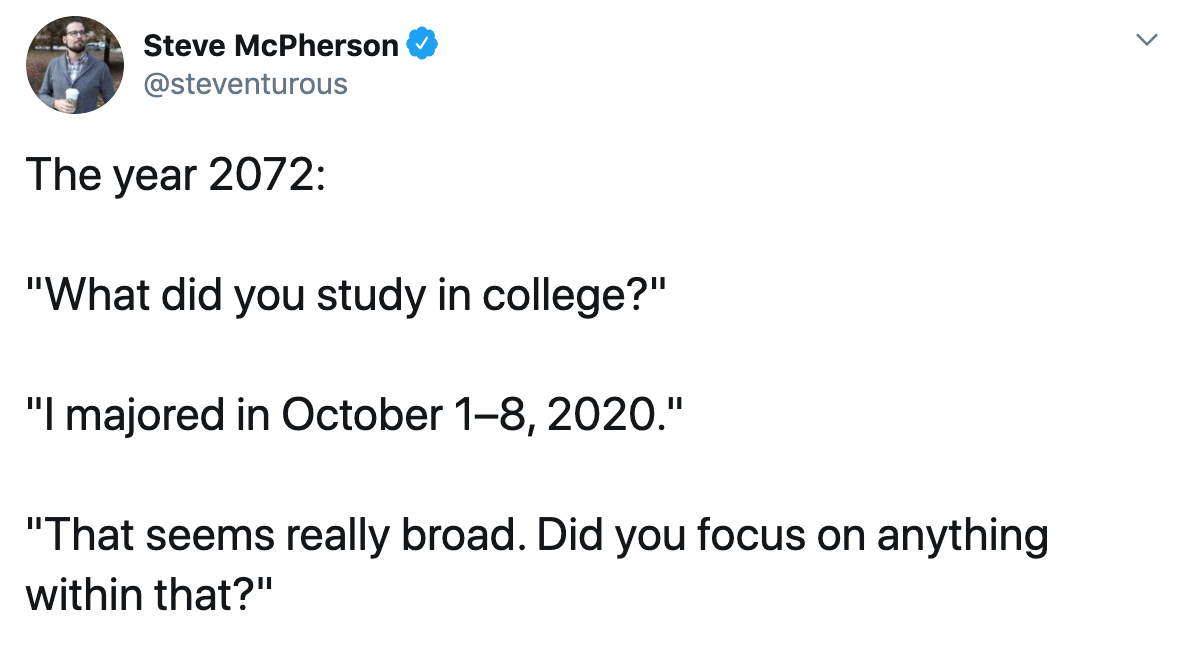
A Day in October 2020

Below is part of the newsletter produced by Crooked Media for October 6, 2020. They produce one every weekday. It’s an excellent way to keep up with the news, if you can stand keeping up with the news. You can subscribe here (it’s free.)

Many of us questioned President Txxxx’s coronavirus-ridden return to the White House, but now that he’s threatened to travel to Miami, reverted to spreading months-old disinformation about COVID-19, and sent the economy into a nosedive, it seems clear the man’s judgement is as sound as ever.

  • Within moments of arriving home, a highly-medicated Dxxxx Txxxx horrified doctors (and also, everyone) by dramatically removing his mask and releasing a bizarre propaganda video that asserted he contracted coronavirus as an act of…leadership. Today Txxxx proved how much he’s learned from his firsthand leadership experience by spreading the same false comparison between coronavirus and influenza he first promoted 210,000 deaths ago. Social media companies censored those posts, leading Txxxx to cryptically call for the destruction of the internet. He’s back, baby!
  • Not content to shed coronavirus around the hard-hit, poorly-ventilated West Wing, Dxxxx Txxxx has announced his intention to take this infectious show on the road. Txxxx’s lying doctor Sean Conley put out a statement that the president, who was visibly gasping for air upon his return to the White House on Monday, today “reports no symptoms,” and the miraculously recovered 74-year-old tweeted that he’s “looking forward to the debate on the evening of Thursday, October 15th in Miami. It will be great!” That townhall-style debate would be just two weeks after Txxxx (purportedly) began experiencing symptoms, and it is beyond insane for him to consider attending it in person.
  • On Monday Conley suggested that Txxxx’s tweets served as a useful gauge of his mental fitness. We would be interested to know what the good doctor thinks about these ones, in which President Deals shut down all hopes of further coronavirus stimulus until after the election and immediately tanked the stock market. Incidentally, here’s a new poll that found 74 percent of voters think the Senate should prioritize coronavirus relief over confirming Amy Coney Barrett. More Coronavirus, Worse Economy: It’s a bold closing argument from Team Txxxx.

e6adc80b-21ae-4ce1-b74b-fbe7d8379a3e

Meanwhile, as more people in the White House’s orbit fall ill, the administration has worked systematically to make sure we never learn when Txxxx last tested negative, or how many people contracted the virus from him or people at his superspreading events.

  • Stephen Miller has it. Nearly all of the Joint Chiefs of Staff are in quarantine after a Coast Guard admiral tested positive. Txxxx’s Coast Guard aide Jayna McCarron has coronavirus, as does one of his active-duty military valets and a third press office aide. New York Times reporter Michael Shear said his wife has now tested positive: “The collateral damage is going to be pretty significant, I think.” White House employees are rightly scared and angry; one source told Axios, “It’s insane that he would return to the White House and jeopardize his staff’s health when we are still learning of new cases among senior staff. This place is a cesspool.”
  • Txxxx’s recklessness and refusal to conduct contact tracing have consequences beyond the White House grounds. Washington, DC, reported 105 new coronavirus cases on Monday, the city’s highest one-day spike since June. That spike may not be a function of the Rose Garden Misadventure alone. John Hagee, a megachurch pastor and Txxxx advisor, has tested positive; he wasn’t present at the Amy Coney Barrett nomination event, but he did attend a September 15 White House event along with hundreds of people who were largely flouting safety measures. 

Our new reality is almost too surreal to fathom: The president and his allies are not only neglecting their responsibility to bring the pandemic under control, they’re now actively and knowingly spreading a deadly virus themselves. What a good time to don the hazmat suit of democracy and escort them out.

Unquote.

Next they have sections called What Else?, Be Smarter and Is That Hope? Today they ended with:

70520dbc-2738-41ec-b3e4-d4e63bea930d

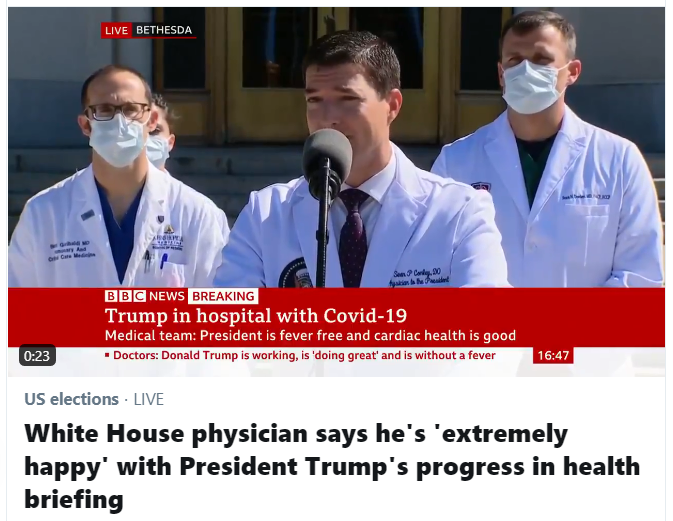
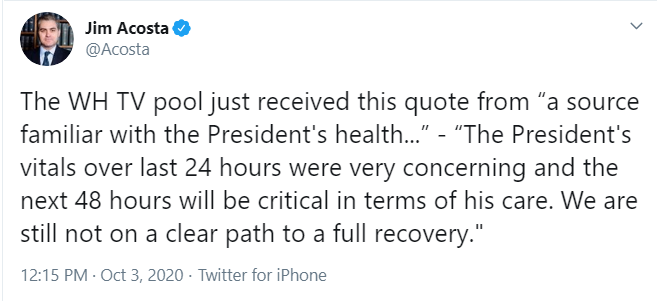
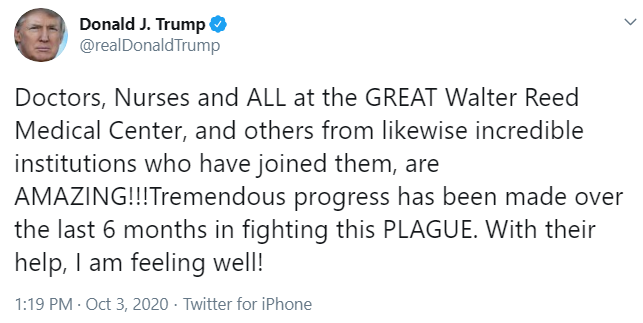
A Study in Contrasts

A few hours ago:Untitled

Fewer hours ago:

Untitled2

An hour ago:

Untitled23

Previously, while in public:

It’s basically the flu.

Now that he has it:

It’s a PLAGUE.

It Was Reckless Endangerment or Worse

At the Rose Garden event last Saturday when they introduced the Republican nominee to the Supreme Court:

Guests mingled, hugged and kissed on the cheek, most without wearing masks. An indoor reception followed the outdoor ceremony.

Seven days later, at least eight people who attended the ceremony have tested positive for the coronavirus, including the president. Several more of the president’s closest aides and advisers have also tested positive.

Then, our president got to work, spreading the joy:

EjavL0-WoAAdOxl

Of course, we’re only heard about some of the famous people who got the virus in the Rose Garden, at the White House, on Air Force One, at the rally or the fundraisers, not the common folk who rubbed shoulders with the rich and famous, or provided security, or served the drinks.

We knew he was a heartless prick who only cares about himself, but I mean, wow.

Postscript:  The White House doctor (i.e. public relations representative) has now “clarified” the timeline, explaining that when he said “72 hours” he meant “day three”, not “three days ago” (?). So it was actually Thursday night, after all the traveling about, when the president knew he had the virus, not Wednesday morning. Of course, everyone who speaks for the president can be trusted to deliver the unvarnished truth, so there’s nothing to see here. Obviously.