A Conservative Confesses

Matthew Sheffield is a conservative journalist who admits there’s something radically wrong with most “conservative” media. He wrote this on Twitter a few days ago:

As a former conservative activist and journalist, it has been so frustrating to see my former compatriots spreading wild and unchecked claims about “voter fraud.”

As the co-creator of NewsBusters, the most prominent anti-media website, I was part of a decades-long tradition of complaining about media elites being “unfair” to conservative views. There is still much to that argument, but eventually I saw that I was missing context.

What I did not realize until I began expanding my work into creating actual media and reporting institutions such as the Washington Examiner (I was the founding online editor) was that U.S. conservatives do not understand the purpose of journalism.

This became evident to me as I saw that conservative-dominated media outlets were MUCH more biased than outlets run by liberals. The latter had flaws that arose from a lack of diversities (note plural) but they operated mostly in good faith. That’s not how the former operated.

I eventually realized that most people who run right-dominated media outlets see it as their DUTY to be unfair and to favor Republicans because doing so would some how counteract perceived liberal bias.

While I was enmeshed in the conservative media tradition, I viewed lefty media thinkers like @jayrosen_nyu as arguing that journalism was supposed to be liberally biased. I was wrong. I realized later that I didn’t understand that journalism is supposed to portray reality.

This thought was phrased memorably by [Stephen Colbert] as “reality has a well-known liberal bias”, which is an oversimplification but is more accurate than the conservative journalist view which is that media should promote and serve conservative politicians.

I also discovered as I rose through the right-wing media ranks that most conservative media figures have no journalism training or desire to fact-check their own side. I also saw so many people think that reporting of information negative to [Republican] politicians was biased, even if it was true.

If you would like to get a great look at the tensions and origins of conservative journalism, there is a wonderful, fabulous book by my friend [Nicole Hemmer], Messengers of the Right: Conservative Media and the Transformation of American Politics, which I cannot commend enough. My career was an updated version of what she chronicled.

People ask sometimes if conservative media figures like Sean Hannity or anyone associated with the Federalist could actually be so credulous as to believe unfounded and non-specific allegations of “voter fraud.” But the reality is that they don’t actually even think that far.

Truth for conservative journalists is anything that harms “the left.” It doesn’t even have to be a fact. Trump’s numerous lies about any subject under the sun are thus justified because his deceptions point to a larger truth: that liberals are evil.

This assumption is behind all conservative media output. They never tell you what their actual motives are. Most center-left people don’t realize just how radical many conservative elites are, largely because they don’t wear it on their sleeves.

Just as a for-instance of this point, most people have no idea that the top two Trump White House figures, Mike Pence and Mark Meadows, think that biological evolution is a lie.

This is an extraordinarily dangerous viewpoint in light of the SARS2 coronavirus epidemic because the entirety of virology and epidemiology is based on evolution. If you think it’s “fake” then you’ll believe ludicrous nonsense like “herd immunity.”

The same thing is happening with right-wing media and specious claims of voter fraud. Conservatives are willing to believe them even if there is no evidence, simply because anything negative about liberals is true. This mentality extends to the very highest ranks.

Newt Gingrich, William Bennett, and a bevvy of GOP elected officials have no problem parroting unverified rumors as fact because conservative journalism is about supporting conservatives, not about finding facts.

I tried for over a decade to inculcate some standards of independence and professionalism among conservative writers but my efforts made me enemies, especially when I argued that the GOP should be neutral on religion, instead of biased toward Christians.

I began work on a manuscript in 2012 fearing that Mitt Romney would lose his election because conservatives had not learned how politics actually works and that we should adapt to serve public needs and make peace with secular people.

I showed my manuscript to several people who I thought were my friends because I wanted to get the perspective of religious conservatives. Instead of helping me, some of them began trying to expel me from the conservative movement.

I eventually realized that many conservative activists were committed to identity rather than ideas. One of my friends literally told me in 2016 that he would support Senator Ted Cruz because “that’s what the Christians are doing.”

We’re at a critical moment in U.S. politics right now because the Christian identity politics that is the edifice of Republican electioneering is teetering. Millions of Americans have for decades thought that their countrymen are evil.

You can watch this play out right now on a television stage when you tune into Fox News as they cover the election. Fact-based journalists have finally realized that the identity rage of the GOP is going into a raging crescendo.

On an hourly basis now outside of the rage-filled lie-fests of primetime, Fox reporters are gently trying to explain to guests that they need actual evidence before accusing people of crimes. The guests, such as Gingrich, have NEVER been challenged like this on Fox.

Bret Baier, Chris Wallace, Martha MacCallum, and others are trying to save conservatism from itself. It’s like watching a modern-day adaptation of Aeschylus or Sophocles. Sadly, the rest of us are not just spectators in this tragedy.

How American conservatism dies is the most important story, by far, of this moment. Conventional media will never tell this story because their business is built on the lie that Trump is an aberration rather than apotheosis. . . .

At the same time, the tens of millions of people who vote Republican are not deplorable. They are misled. And the mocking and tribalistic coverage that lefty media often engage in only makes things worse. Only love can defeat hate.

And just to clarify my point about people who are “misled.” It’s the people that Trump referred to when he said “I love the poorly educated.” They are the people who work hard, go to church, and feel they have no future in a secular America.

Not the leaders, but the led.

Unquote. 

Unfortunately, many of our fellow citizens choose to be misled because it makes them feel better. This is a comment I left after reading “Welcome the Txxxx Voters Back”, a piece by a philosophy professor calling on us to be nicer to the president’s supporters (in my comment, I quote the author of the article while making a few changes):

Speaking for the majority of American voters, I hereby welcome the minority to join us in “[cultivating] an information environment in which people [can] distinguish between truth and falsehood, in which expert claims are [not] treated with suspicion, and in which fringe figures and theories are [not] valued more highly than mainstream ones”.

Unless more of the “conservative” minority are willing to do that, it’s not going to make a damn bit of difference whether we in the majority “appreciate the bond of citizenship” [and welcome them back] more than we already do.
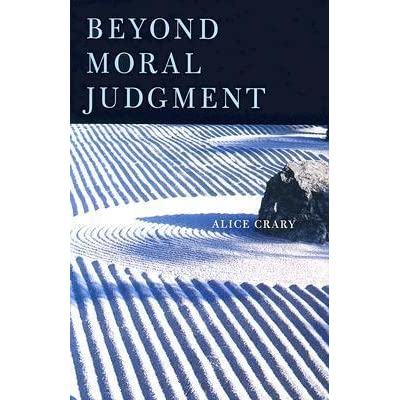

Beyond Moral Judgment by Alice Crary

Sometimes you (I mean me) finish a book and decide you shouldn’t have bothered. I’m not sure about this one.

It began with an interview. Richard Marshall spoke with philosophy professor Alice Crary as part of his End Times series. This is part of what she said (or wrote, since the conversations are at least partly via email):

“Moral realism” is a label that I deliberately don’t use in describing my image of ethics. Not that . . . the term is obviously ill-suited to capture things I believe. It is, for instance, a conviction of mine that that there are morally salient aspects of the world that . . . lend themselves to empirical discovery. A case could easily be made for speaking of moral realism in this connection. But that would likely generate confusion. When I claim that, say, humans and animals have moral qualities that are as such observable, I work with an understanding of what the world is like, and of what is involved in knowing it, that is foreign to familiar discussions of moral realism. These discussions are often structured by the assumption that objectivity excludes anything [related to] human subjectivity. Moral realism is frequently envisioned as an improbable position on which moral values are objective in this subjectivity-extruding sense while still somehow having a direct bearing on action and choice. . . .

A great deal of my work has been devoted to investigating the grip on the contemporary philosophical imagination of conceptions of objectivity—of the sorts operative in these conversations about moral realism—that take the expulsion of everything subjective as their hallmarks. I have repeatedly argued that restrictions these conceptions impose on what kinds of things count as objective are not justified . . . I have tried to show not only that we should reject the restrictions but also that doing so is urgent because necessary for getting morally and politically salient aspects of our lives into view. . . .

 I favor a “wider” conception of objectivity. I mean a conception loose or wide enough to encompass, inter alia, ethical values. . . .

I attack the view—which I describe as narrowly rational—that it is in theory possible to grasp any real connection of thought from an abstract, ethically neutral vantage point. I do so to show that there are ethically decisive considerations that this view leaves us unequipped to recognize, and I take an interest in work in the different humanities, as well as in literature and the other arts, because such work affords resources for uncovering things inaccessible to an abstract gaze. . . .

The upshot is that [for many philosophers, or most] there appears to be no room within ethics for humanistic thinking or artistic expression as such, and this represents a massive and practically catastrophic contraction of ethics. Within my ethical writings, alongside showing that this contraction is philosophically unjustifiable, I bring out how it is morally disastrous—among other things, by identifying harms to human beings and animals that it leaves us incapable of registering.

So I bought and read her book.

575167._UY400_SS400_

To sum it up, if I can, Prof. Crary says that being ethical and understanding ethics both require us to pay more attention to our feelings or “sensitivity”, what might be called our human reactions to what we experience as we go about our lives, and less attention to strictly ethical propositions, concepts and rules. She discusses cases in which people’s pre-existing ethical views (for example, that ethical people must follow certain rules) make it impossible for them to properly appreciate and evaluate people’s behavior, including their own. 

I’m not sure if her views are controversial among philosophers. The idea that feelings underlie ethics has a very long philosophical history, going as far back as ancient Greece (or consider, for instance, the title of Adam Smith’s 1759 book The Theory of Moral Sentiments). That’s one reason I’m not sure I should have read her book.

Another reason is that the book isn’t well-written. It’s repetitious, with lots of descriptions of what she has already argued and what she’s going to argue next. Her sentences also tend to go on and on, requiring frequent backtracking to see how the various clauses relate. I kept reading party because I expected her to show how her approach to ethics yields different ethical views. But the chapters that primarily provide examples amount to saying that various characters in literature deserve more understanding than they get from other characters (works by Jane Austen, Tolstoy and Henry James portray people who are too “moralistic”) and that feminism requires awareness of the social, cultural and economic contexts of women’s lives.

But Prof. Crary may have the (edited) last word (almost):

The idea is that, if the person’s thinking . . . expresses her moral outlook, then, even where it deals with what we are inclined to think of as a “non-moral” topic, it is rightly brought under the heading of moral thinking. . . [Being indifferent] to subject matter . . . allows [moral thought] to range over . . . any topic (e.g. the ways in which humans live and work with animals, the role of luck in human life, the role of . . . games in the cognitive development of children, the manner in which sibling rivalries . . . affect major life choices, etc.) . . . I submit that once we remove ourselves from the artificial atmosphere of academic moral philosophy , where a preoccupation with moral judgments is generally granted the status of a disciplinary requirement, this broad understanding of moral though will strike us as entirely natural . . .

Within contemporary moral philosophy, it is generally assumed that moral differences take the form either of disagreements about whether to apply a moral concept or of disagreements about whether some moral concept . . . is one we ought to operate with in the first place. In contrast, . . . moral differences may exist between people who inherit and develop different ways of thinking and talking about the world even where there is no question of a disagreement of either of these types. . . . 

Once we acknowledge the possibility of these additional kinds of moral differences, we are obliged . . . to consider not only individuals’ moral judgments but also mode of thought and speech that do not employ moral concepts, and the sensibilities that inform these additional modes of thought and speech. What becomes apparent is that proper respect for . . . moral conversation involves concern with . . . individuals’ entire personalities, the whole complicated weave of their lives [44-45].

I don’t disagree.

It’s Still the Union, the Confederacy and the Wild West. And Yet . . .

Assuming that the last few projections hold, Joe Biden won twenty-five states (plus the District of Columbia) and lost twenty-five. Our fifty states are split down the middle.

Back in the 19th century, however, at the start of the Civil War, the United States had only thirty-five states. They were all in the eastern half of the country, except for California, Nevada and Oregon in the far west.

Nineteen of those states didn’t allow slavery and stayed in the Union. They voted for Joe Biden this week fourteen to five.

There were also five “border” states that allowed slavery but didn’t want to or weren’t able to leave the Union (Missouri, Kentucky, West Virginia, Maryland and Delaware). They split as evenly as possible this week, two for Biden and three for his opponent.

Eleven southern states left the Union in 1861, starting a civil war in order to protect (and expand) slavery. Two of them voted for Biden, while nine voted for the racist.

After the Civil War, the US added fifteen more states. Most of them were part of the “Wild West” — the home of assorted rugged individuals. Five voted for Biden, ten for the sociopath. 

Thus, of the twenty-four states that stayed in the Union in the 1860s (the northern, border and Far West states), Biden won nineteen and lost five.

Of the twenty-six states that left the Union or weren’t fully part of the country in the 1861, Biden won seven and lost nineteen.

In some ways, we haven’t progressed much from the 19th century. Divisions between the North, the South and the Wild West remain.

And yet . . . 

From Robin Givhan of The Washington Post:

As the country waited for ballots to be counted, it was Biden — not the occupant of the Oval Office — who was reassuring people that this democracy was intact, that the system was working and that the center would hold. He was the voice of calm optimism in the midst of tumultuous times.

When he became president-elect late Saturday morning, he did something far more herculean than accepting responsibility for a worsening pandemic and a struggling economy. He removed a terrible, suffocating weight from the back of this nation. . . .

His simple dignity and empathy are ballasts for a country that has been teetering between an openhearted, just future and a self-righteous, narrow-minded past. And when he addressed the nation Saturday night, he put his full heft as a statesman and a man of good will to that task.

“What is the will of the people? What is our mandate? I believe it’s this: America called upon us to marshal the forces of decency, the forces of fairness. To marshal the forces of science and the forces of hope in the great battles of our time. The battle to control the virus. The battle to build prosperity. The battle to secure your family’s health care. The battle to achieve racial justice and root out systemic racism in this country. The battle to save our planet by getting climate under control. The battle to restore decency, defend democracy and give everybody in this country a fair shot,” Biden said. “That’s all they’re asking for. A fair shot.”

LOSER!!!

download

By the way, President Biden has won a bigger percentage of the popular vote than Truman, Kennedy, Nixon, Clinton and Bush 43. And roughly the same as Reagan, Bush 41 and Obama.

https://twitter.com/JoeBiden/status/1325118992785223682

The Presidential Election of 2020

Almost half of American voters are creeps or idiots. It’s not polite to say so, but that’s how it looks from here.