The Republicans on the Supreme Court Screw America Again

It was only this week that I learned there are wedding websites. I don’t mean the kind that tell you how to have the perfect wedding. I mean websites devoted to a specific wedding, i.e., the one you and your prospective spouse plan to have. A site for brides explains:

A wedding website provides a hub for important information regarding a couple’s big day. It can house venue details, dress code specifics, and your registry wishes. Plus, it provides a space to keep guests easily updated and to collect wedding RSVPs. But with a number of options out there, which are the best wedding websites?

Okay, that makes sense. We use the internet for a whole lot of stuff these days.

But if you’re not a web designer, how do you get a site for your wedding, something like, say, (don’t click on it) http://www.Mary_and_John_Are_Having_a_Wedding.org? Fortunately, there are lots and lots of companies that make it easy to do just that. If you visit the link above for brides, you’ll find this list:

8 Best Wedding Websites of 2023

The first one on the list, Joy, offers this:

  • Price: Free
  • No. of templates: 601
  • Custom domain? Yes, separate domain purchase required

So you can use the site for free, they have 601 designs to choose from, and if you want a designated domain name (like Mary_and_John_Are_Having_a_Wedding) you have to give them a nominal sum, maybe $20 a year.

As I said above, there are lots of companies that offer this service to people getting married. And it doesn’t look like there’s a lot of money to be made by doing so.

Yet, a woman in Colorado with a web design business called 303 Creative apparently decided that she wanted to begin offering this service. But wait! Wouldn’t that require her company to sell her services to prospective spouses who happen to be gay? Yes, it would.

Gay people are one of the “protected classes” referred to in federal and/or state laws. In particular, Colorado has a “public accommodations” law that says:

It is a discriminatory practice and unlawful for a person, directly or indirectly, to refuse, withhold from, or deny to an individual or a group, because of disability, race, creed, color, sex, sexual orientation, gender identity, gender expression, marital status, national origin, or ancestry, the full and equal enjoyment of the goods, services, facilities, privileges, advantages, or accommodations of a place of public accommodation.

And a “place of public accommodation” includes any business that sells its services to the public.

So what? Well, the owner of 303 Creative claims to be the kind of non-Christian “Christian” who abhors the idea of gay marriage. She says she could never bring herself to sell her services to a gay couple. What to do?

A reasonable person might say to themselves, all right, given my particular (albeit peculiar) religious beliefs, I guess I’ll skip the wedding web design business. There are weddings I wouldn’t want to handle and I don’t want to break the law.

This is where the Alliance Defending Freedom enters the picture. (I don’t know if this Colorado woman contacted them or they contacted her — maybe they went looking for a web designer with a hatred for gay marriage — it doesn’t really matter.) Here’s what the Southern Poverty Law Center says about the ADF:

Founded by some 30 leaders of the Christian Right, the Alliance Defending Freedom is a legal advocacy and training group that has supported the recriminalization of sexual acts between consenting LGBTQ adults in the U.S. and criminalization abroad; has defended state-sanctioned sterilization of trans people abroad; has contended that LGBTQ people are more likely to engage in pedophilia; and claims that a “homosexual agenda” will destroy Christianity and society.

ADF also works to develop “religious liberty” legislation and case law that will allow the denial of goods and services to LGBTQ people on the basis of religion. [ADF was] one of the most influential groups informing the [previous] administration’s attack on LGBTQ rights.

The ADF helped 303 Creative’s owner file a lawsuit to stop the state of Colorado from enforcing its public accommodation law against her, assuming that (1) she one day began offering wedding website design services, (2) a gay couple tried to buy her services, (3) she refused to sell to them and (4) the state of Colorado was interested enough to prosecute her.

Apparently, it’s an interesting legal question whether 303 Creative had “standing” to sue. Usually, you need to say you’ve suffered an injury in order to sue somebody. But the six reactionaries on the Supreme Court don’t worry much about details like that anymore. They decided the Dobbs forced-birth case in favor of doctors who said they might one day have patients who were upset after they had an abortion.

To make this long story shorter, 303 Creative’s owner sued Colorado in federal court; she lost; she appealed that decision; she lost again; and (as ADF hoped all along) the Supreme Court decided to accept the appeal, after which the Renegade Six decided in her favor. As usual it was 6-3. The majority’s main “justification” for voting that way was that making her accept a gay couple as customers would somehow interfere with her First Amendment right to free speech. Whatever.

Here’s some of Justice Sotomayor’s response to the Six’s radical decision (her dissent begins on page 33):

Five years ago, this Court recognized the “general rule” that religious and philosophical objections to gay marriage “do not allow business owners and other actors in the economy and in society to deny protected persons equal access to goods and services under a neutral and generally applicable public accommodations law”.

… Today, the Court, for the first time in its history, grants a business open to the public a constitutional right to refuse to serve members of a protected class. Specifically, the Court holds that the First Amendment exempts a website design company from a state law that prohibits the company from denying wedding websites to same-sex couples…. The Court also holds that the company has a right to post a notice that says “no [wedding websites] will be sold if they will be used for gay marriages”.

… “What a difference five years makes.” Around the country, there has been a backlash to the movement for liberty and equality for gender and sexual minorities. New forms of inclusion have been met with reactionary exclusion. This is heartbreaking. Sadly, it is also familiar. When the civil rights and women’s rights movements sought equality in public life, some public establishments refused. Some even claimed, based on sincere religious beliefs, constitutional rights to discriminate. The brave Justices who once sat on this Court decisively rejected those claims. 

Now the Court faces a similar test. A business open to the public seeks to deny gay and lesbian customers the full and equal enjoyment of its services based on the owner’s religious belief that same-sex marriages are “false.” The business argues, and a majority of the Court agrees, that because the business offers services that are customized and expressive, the Free Speech Clause of the First Amendment shields the business from a generally applicable law that prohibits discrimination in the sale of publicly available goods and services.

That is wrong. Profoundly wrong…. The law in question targets conduct, not speech, for regulation, and the act of discrimination has never constituted protected expression under the First Amendment. Our Constitution contains no right to refuse service to a disfavored group….

The people of Colorado have adopted the Colorado Anti-Discrimination Act… A public accommodations law has two core purposes. First, the law ensures “equal access to publicly available goods and services”…. For social groups that face discrimination, such access is vital…. Second, a public accommodations law ensures equal dignity in the common market. Indeed, that is the law’s “fundamental object”: “to vindicate ‘the deprivation of personal dignity that surely accompanies denials of equal access to public establishments.’

… Preventing the “unique evils” caused by “acts of invidious discrimination in the distribution of publicly available goods, services, and other advantages” is a compelling state interest “of the highest order”…

A public accommodations law does not force anyone to start a business, or to hold out the business’s goods or services to the public at large. The law also does not compel any business to sell any particular good or service. But if a business chooses to profit from the public market, which is established and maintained by the state, the state may require the business to abide by a legal norm of nondiscrimination.

In particular, the state may ensure that groups historically marked for second-class status are not denied goods or services on equal terms.
The concept of a public accommodation thus embodies a simple, but powerful, social contract: A business that chooses to sell to the public assumes a duty to serve the public without unjust discrimination….

The unattractive lesson of the majority opinion is this: What’s mine is mine, and what’s yours is yours. The lesson of the history of public accommodations laws is altogether different. It is that in a free and democratic society, there can be no social castes. And for that to be true, it must be true in the public market. For the “promise of freedom” is an empty one if the Government is “powerless to assure that a dollar in the hands of [one person] will purchase the same thing as a dollar in the hands of [another]”. Because the Court today retreats from that promise, I dissent.

Republicans outnumber Democrats by six to three on the Supreme Court. With even five votes, they can do whatever they want. One way to fix this problem is to expand the Court. We now have thirteen federal judicial districts, instead of nine. We should have at least thirteen justices on the Court to handle the additional workload and, more importantly, restore some sanity to the institution. Together, the Congress and the President can add justices. We need to keep a Democrat in the White House and add motivated Democrats to Congress. Otherwise, the renegades will keep whittling away at our society. There’s nothing to stop them as long as they have enough votes.
Police Reform and Fake Capitalism (They’re Not Related)

Calling the police can be dangerous. New Jersey is doing something about it. The state created a program called ARRIVE Together. A mental health professional accompanies the police when they go out on a call involving someone in mental distress. A study showed that in 342 such cases, only 3% resulted in the use of force and only 2% resulted in an arrest (usually because of an unrelated issue, such as an outstanding warrant). The program is being expanded and should serve as a model for police departments around the country (see this report from the Brookings Institution).

So much for some good news. Now back to harsh reality. From The Guardian:

One of the most deeply held and frequently heard propositions about capitalism is that it revolves around private companies and individuals taking risks. When, earlier this year, the US government arranged a rescue package for Silicon Valley Bank, for instance, among the many objections to it was the claim that the rescue contravened capitalism’s risk norms.

This view of the world directly informs wide swaths of economic policymaking today….But examine the economy, and it becomes clear: capitalism has become less and less about corporate risk-taking in recent decades. To be sure, many businesses do take significant risks. The independent small business owner who opens a new cafe in London generally faces intense competition and massive risk. But as political scientist Jacob Hacker has argued, business in general has been enormously skilled in recent times at offloading risk – principally by dumping it on those least able to bear it: ordinary households.

… The best example of a business usually regarded as being fundamentally about risk-taking, but which in fact is not, is … alternative asset management, an umbrella term for hedge funds, private equity and the like. (“Alternative” here means anything other than publicly listed stocks and bonds.) Asset managers are anything but marginal, exotic firms – they manage more than $100 trillion of clients’ money globally and control everything from [Benihana to PetSmart to Westinghouse].

But let’s look at what asset management companies in places like Britain and the US actually do. Three considerations are paramount.

First, there is the matter of whose capital is put at risk when alternative asset managers such as Citadel, Blackstone and KKR invest. In large part, it’s not theirs. The proportion of equity invested by a typical hedge or private equity fund that is the asset manager’s own is usually between 1% and 3%. The rest is that of their external investor clients (the “limited partners”), which include pension funds.

Second, consider how an asset manager’s investments are designed. For one thing, its own financial participation in, and management of, its investment funds is usually through a vehicle (the “general partnership”) that is constituted as a separate entity, precisely in order to insulate the firm and its professionals from liability risk.

Furthermore, the fund and its manager is generally distanced from underlying investments by a chain of intermediary holding companies that protect it from the risk inherent in those investments. In leveraged buyouts, where money is borrowed to help finance a deal,the debt goes on to the balance sheet of the company the fund has acquired. This means if trouble arises in repaying the debt, it is not the investment fund that is on the hook, still less its manager.

Third and last, fee structures also distance asset managers from risk. If a fund underperforms, they may earn no performance fee (based on fund profits), but they do have the considerable consolation – a form of risk insurance, if you like – of the guaranteed management fee, usually representing about 2% of limited partners’ committed capital, year after year. Essentially, management fees pay asset managers’ base salaries; performance fees pay bonuses.

In short, then, it would be far-fetched to suggest that what hedge funds and the like do amounts substantially to risk-taking. The only meaningful risk they themselves face is that of losing customers if fund returns prove underwhelming…. In reality, the business of alternative asset management is less about taking on risk than, in Hacker’s terms, moving it elsewhere. So when things go wrong, others bear the brunt….

Why does this matter? Because unless elected policymakers understand how risk is produced and distributed in modern economies, they will not be in a position to act appropriately and proportionately. That is why vague talk from politicians of being “pro-business” or “entrepreneurship” mean so little; the point is to learn from economic realities as they actually are, as opposed to how economics textbooks say they could or should be.

There is one very obvious policy recommendation for alternative asset management that flows from our understanding what they actually do with “risk”: taxing them more.

The main performance fee earned by alternative asset managers is “carried interest” – effectively, a profit share. In the UK and US, most asset management firms pay tax on this revenue at the capital gains rate, rather than the usually higher income tax rate. This is because the asset manager has typically been understood to be “taking on the entrepreneurial risk of the [investment]” – a standard justification for taxation as capital gain.

But as we have seen, this simply does not hold water. In 2017, the New York Times called the beneficial tax treatment of carried interest “a tax loophole for the rich that just won’t die”. It’s time to close it….

Note: To pass Biden’s Inflation Reduction Act last year, Democrats needed Sen. Kyrsten Sinema’s vote. But she wouldn’t vote for the bill unless Democrats dropped the provision that would have closed the carried interest loophole. She insisted on preserving the tax break that favors the securities and investment industry. Wouldn’t you know that hedge fund managers and private equity executives gave her more than $2 million between 2018 and 2022? Since then, she left the Democratic Party to run in Arizona as an “Independent” [CNBC].

Truth vs. Fantasy in Today’s Politics

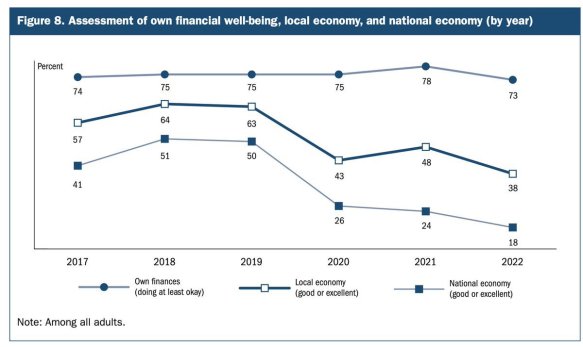
A recent poll showed that most Americans think they’re doing okay economically speaking, but think the national economy is in terrible shape. This chart is from a recent Federal Reserve report on the economic well-being of U.S. households.

FwxLu-9XoAAvEWr

The top line shows that around 75% of us have been relatively satisfied with our own finances since 2017, despite the pandemic. That 75% includes people who thought their own finances were “okay” or better. The bottom two lines, however, show that people’s opinion of their local economies and the national economy went down quite a bit during the pandemic, with lots of people thinking the country’s economy is even worse than where they live.

What’s very odd is that those negative sentiments from 2020 have lingered, or even gotten worse, even though the percentage of us who think our own finances are okay or better hasn’t changed much at all.

Another oddity is that, although people aren’t thrilled about their local economy — only 38% saying it’s good or excellent — hardly anybody likes the national economy — only 18% saying it’s good or excellent.

Why would so many of us think we ourselves aren’t suffering economically although people who live near us are and the nation as a whole is even worse off? The obvious answer is that the national media have convinced people that the country is in deep economic trouble, much worse than where they live and work, and despite the fact that they themselves are in pretty good shape. (It shouldn’t be a surprise that Republicans have the worst opinion of other people’s economic situation, given where they get their news and what their favorite politicians tell them.

This brings me to an article in The Washington Monthly: “Republicans Say Inflation, Crime, and Immigration Are Out of Control. The Numbers Disagree”.

The Republican presidential candidates are on the same page regarding Joe Biden: He’s a disaster on inflation, immigration, and crime.

“We have no borders. We have inflation. We have everything going wrong,” said [their leading candidate] … in his apocalyptic fashion…. “Everybody is being murdered.”

Former Vice President Mike Pence … began a CNN-hosted town hall event with a pithy critique: “Literally, we have a crisis at our border. We have inflation at a 40-year high. We have a crime wave in our cities.” Pence suggested Biden’s border policies are to blame for “a flood of fentanyl coming into every city.” 

There’s one problem with this Republican portrayal of a Democratic president presiding over chaos: None of it is true.  

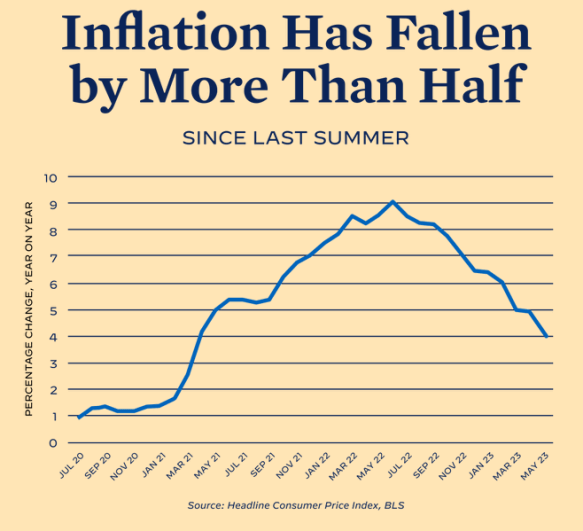
Inflation was at a 40-year high. During 2022, the inflation rate started at 7.5 percent, peaked in June at 9.1 percent, and ended the year at 6.5 percent, a mark that hadn’t been cleared since June 1982.  

But 2023 is a different story. The inflation rate for May is down to 4 percent, less than half of the June 2022 peak. But even back in March, when it fell to 5 percent, the “40-year high” talking point was obsolete. In July 2008, during the George W. Bush administration, inflation was 5.6 percent. And in October and November 1990, during the George H. W. Bush administration, it was 6.3 percent.

From the Bureau of Labor Statistics:

Fyg2RC_XoAU7ydL

As we get further away from the pandemic and the Federal Reserve keeps raising interest rates, the rate of inflation should continue to fall (despite the fact that corporations have used inflation as an excuse to increase their prices and profits even more than they needed to, as reported by The New York Times). Back to the article:

Has southern border security collapsed? Hardly. Unlawful entries have dropped by 70 percent in the last few weeks, according to the Department of Homeland Security, after Biden implemented a new border management policy.  

… Border crossings spiked just before Biden ended “Title 42,” the public health emergency rules that Txxxx enacted in 2020, using the COVID-19 pandemic to expedite the removal of asylum-seekers…. Many skeptics … assumed that the end of Title 42 would prompt a surge of migrants. The opposite happened. 

If the current pace of border crossings—about 3,700 per day—remains stable throughout June, the monthly total would be 111,000, … somewhat higher than the 93,000 in the last full month of Txxxx’s presidency.  

When assessing those numbers, remember that while Title 42 made it easier for the Border Patrol to send back asylum seekers, it did nothing to prevent those removed from trying again. In turn, many of the illegal crossings in Biden’s first two and a half years—under policies designed by Txxxx—were made by repeat offenders. Between 2019 and 2022, the recidivism rate jumped from 20 to 49 percent.

In Biden’s new system, those illegally crossing the border can be banned from applying for asylum for five years and risk jail time if they violate the ban. We saw a spike in crossings just before the administration implemented the smart new policy because migrants hoped to avoid the Biden ban.To tame an unruly border, Biden is steering asylum seekers away from treacherous desert treks and towards a more orderly online application process.

What about fentanyl coming over the southern border? … Biden’s administration has intercepted more fentanyl than Txxxx’s ever did…. According to PolitiFact, Biden deserves partial credit for the higher seizure numbers because his administration is employing more and better detection technology at the border. Besides, immigration across the southern border has little to do with the fentanyl crisis. Eighty-six percent of people arrested for trafficking fentanyl are American citizens, as “the vast majority of fentanyl being smuggled in comes through ports of entry, not people trying to sneak into the country.”  

Republicans may talk up crime, and there are no shortages of alarming anecdotes, but there is no Biden crime wave. “Murder is down about 12 percent year-to-date in more than 90 cities that have released data for 2023, compared with data as of the same date in 2022,” according to …The Atlantic, a trend that could lead to “one of the largest annual percent changes in murder ever recorded.” … In fact, over the past five years, the worst month for homicides was July 2020—when Txxxx  was president.  

Another set of promising data comes from the Violent Crime Survey by the Major Cities Chiefs Association, which looked at data from 70 cities. During the first quarter of 2023, homicides, rapes, and robberies dropped about 8 percent from the first quarter of 2022….  

Where Republicans have the best argument is in the category of stolen cars: up 21 percent from 2021 and a whopping 59 percent from 2019. But they haven’t argued that we’re only suffering from a wave of car thefts. They assert America is suffering a collapse of law and order, on every front, solely on Biden’s watch. That’s not true. A mixed picture is not a crime wave.  

Republicans are not updating their talking points to reflect this new data, preferring to insist that America is falling apart. They’re betting that either the data trajectories will reverse course, belatedly validating Republican attack lines, or Americans will be so convinced everything is terrible that additional positive data won’t “feel” true, and voters will disregard it. At least, that is the Republican hope….

We can’t know what these metrics will be in the run-up to Election Day. But in the meantime, reporters and voters should not allow Republican candidates to paint a dystopian picture of America without being forced to address the numbers that don’t fit their narrative. 

November 5, 2024, is more than 500 days away. Let’s hope more of the good news sinks in by then.

I Find the Former President’s Criminal Case Very Interesting, Maybe Too Interesting

Our former president (hereafter “the defendant”) will be in court tomorrow afternoon to formally be told what crimes he’s accused of. He may be ready to enter a plea of guilty or not guilty as well. It turns out that the proceedings won’t be conducted by the biased and incompetent Judge Aileen “Loose” Cannon, even though she’s been assigned to handle his trial (for now). A magistrate judge, one step below a full-fledged, lifetime-appointment federal judge like Cannon, will be in charge tomorrow. That’s the normal procedure. It’s possible the magistrate judge will set some conditions for the defendant’s release, like telling him not to leave the country. I rather doubt the judge will lock him up.

There’s talk that he’s having trouble finding a lawyer willing to represent him. Would you want to be his lawyer, given how challenging it is to represent him? But he’s already got Florida lawyers who can go with him to court tomorrow, whether or not they represent him in further proceedings.

Judge Cannon being selected to handle this case raises two interesting questions. Why was she selected? Will she step aside or be forced to?

[A personal note/warning: I worked in the Los Angeles County Superior Court system for five years, so may find the following much more interesting than you do.]

Cannon’s assignment was random but not as random as it could have been. The New York Times described the process:

Under the district court’s procedures, new cases are randomly delegated to a judge who sits in the division where the matter arose or a neighboring one, even if it relates to a previous case. That Judge Cannon is handling [the defendant’s] criminal indictment elicited the question of how that had come to be.

Asked over email whether normal procedures were followed and Judge Cannon’s assignment was random, Ms. Noble [the chief clerk of the court] wrote: “Normal procedures were followed.”

Mar-a-Lago is in the West Palm Beach division, between the Fort Lauderdale division and the Fort Pierce division, where Judge Cannon sits. The district court’s website shows that seven active judges have chambers in those three divisions, as do three judges on senior status who still hear cases‌.

Ms. Noble wrote that certain factors increased the chances that the case would land before Judge Cannon.

For one, she said, senior judges are removed from the case assignment system, or wheel, once they fulfill their target caseload for the year. At least one of the senior judges is done, she wrote, adding that she was highly confident that the other two “are very likely at their target,” too.

In addition, she wrote, one of the seven active judges with chambers in Fort Lauderdale is now a Miami judge for the purpose of assignments. Another is not currently receiving cases.

A third active judge … draws 50 percent of his criminal cases from the Miami division, she wrote, decreasing his odds…. Judge Cannon, Ms. Noble wrote, “draws 50 percent of her cases from West Palm Beach, increasing her odds.”

Given the clerk’s explanation, my rough estimate is that there was a 1-in-4 chance that Cannon would receive the case, assuming the district’s normal process was followed. There could have been as many as 10 judges available, but it turns out there were only 5. In addition, one of those 5 had less of a chance and Cannon had more of a chance, so it was around 1-in-4.

Presumably, Special Counsel Jack Smith was aware of the likelihood that Cannon would get the case, but chose to file the case in Florida anyway, given that the alleged crimes took place in West Palm Beach. I’m pretty sure Smith wouldn’t choose Judge Cannon, given what happened last time she got involved. This is from the same Times article:

The news of Judge Cannon’s assignment raised eyebrows because of her role in an earlier lawsuit filed by [the defendant] challenging the F.B.I.’s search of his Florida club and estate, Mar-a-Lago. In issuing a series of rulings favorable to him, Judge Cannon, [whom the defendant chose to be a federal judge], effectively disrupted the investigation until a conservative appeals court ruled she never had legitimate legal authority to intervene.

One of the mistakes she made was to say the defendant deserved special consideration, since he is an ex-president. That’s not how the law is supposed to work.

The second question is whether Cannon will preside over the pre-trial proceedings and an eventual trial, all of which will go on for months (unless the defendant pleads guilty, is incapacitated, etc.). The New Yorker has an interview with Stephen Gillers, a professor emeritus at N.Y.U. Law and an expert on judicial matters. He says the answer to that question should be “No”, according to the law that covers judicial assignments.

Going forward, what can the government do if it feels like a judge will not give it a fair shake?

It raises the question of recusal. There’s a statute dealing with federal judge recusal—it’s 28 U.S.C. § 455…. The very first sentence … says that a judge should recuse if the judge’s impartiality “might reasonably be questioned.”

Now, the fact that a judge’s impartiality might reasonably be questioned doesn’t mean that the judge is partial. The public may simply not trust the impartiality of the judge. Because public trust in the work of the court is a value as important as the work itself, the rule says that the judge should not sit when we can’t fairly ask the public to trust what the judge does. That rule is especially important in this case. One thing the prosecution can do is move to recuse Judge Cannon on the ground that, in light of her experience in the search-warrant case last year, her impartiality might reasonably be questioned.

And who would make that judgment if the government does push for this recusal?

The judge herself gets to make that decision in our system. If she denies the recusal, the government could go to the Eleventh Circuit and ask it to order her to recuse herself, and that’s a process called mandamus….In effect, you’re suing the judge to force the judge to recuse….

There’s one other thing the government can do, aside from doing nothing, and that is to write a letter to the judge suggesting the reasons she should consider recusing herself without being formally asked to do so. That’s done also, so as not to create a formal motion….

One factor to consider in deciding whether recusal is necessary is how important the case is to the public and to the need for public trust. If the [Court of Appeals] were to reverse Cannon’s recusal decision, one thing they might say is “We are not questioning the probity or the fairness or the competence of the judge, but we don’t think we can ask the public to accept her rulings.”

So, if the government decides that it’s not going to get a fair shake from Cannon based on its previous experience with her, we will end up with this three-judge panel.

Here, the questions are: Will they initially just write a letter suggesting that she recuse? If she does, that’s the end of it. If she doesn’t, will they make a formal motion to recuse? If she grants it, that’s the end of it. If she doesn’t, then they have to decide whether to seek mandamus. If they do, then the three judges, who are randomly chosen and who hear that mandamus petition, will have to decide whether she should be removed. If they decide that she should not, that’s the end of it. If they decide that she should, then there’ll be a reassignment….

Is there some advantage for the government to wait and see how the trial is going before it pushes for a recusal? Would it have a stronger case for recusal that way?

If there is a basis to move to recuse, you can’t wait around. You have to do it quickly. You can’t wait around to see whether the judge rules on motions in your favor.

Are there downsides to going for recusal right away?

The problem with going for recusal right off the bat is that you may lose in the circuit, and now you’re trying a case before a judge you’ve accused of being unable to appear impartial—and that’s not pleasant. So the government may decide that it’s just better to make the strongest case they can and hope that she behaves like a judge.

Given what we saw regarding Cannon’s behavior during the previous case, do you think that the government will or should go for a recusal?

Given the importance of this case, perhaps the most important criminal trial in the history of the United States—certainly the most watched—and in light of what Judge Cannon did in the search-and-seizure case last year, I think she must step aside. I think she must grant a motion to recuse herself, unless she does it before a motion is even made.

And the reason I say that is that she treated [the defendant] as special, or, to put it another way, she was partial to [him] as a former President, which should not have any influence on the way this trial is conducted…. The partiality she expressed in her decisions last year creates a reasonable perception in the mind of a fair-minded person that she is not impartial—which is the test. Her behavior when she was ruling on the search-and-seizure case creates a reason to doubt her impartiality.

But when you say “must,” you mean from an ethical sense.

No, “must” in a rule sense. There’s a rule.

O.K., but there’s also no way to enforce the rule, right?

Except through mandamus.

That suggests to me that [unless Cannon recuses herself] you think the government should or will go to mandamus.


 If the government does so, she must grant the recusal, and if she doesn’t the Eleventh Circuit must order it.

That’s “must” according to the law. Other legal experts have said the same thing. But it’s judges who decide what the laws mean.

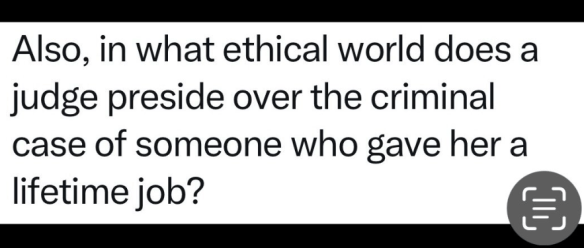
As far as I can tell, the experts aren’t too concerned that the defendant chose Cannon to become a federal judge. Maybe they don’t want to imply that judges tend to favor the politicians who got them their jobs. For us mortals, however, we might ask, as someone did:

Untitled

Former and Current Government Officials Say We Are Not Alone

This is a very big story if it’s true. The people telling it don’t appear to be cranks or easily misled. Far from it. The Guardian, New York Magazine and other outlets have repeated the story. A reporter asked the White House press secretary about it and was referred to the Defense Department, but they’re not talking.

This is from the original article for The Debrief, a site devoted to “science, tech, and defense news”:

A former intelligence official turned whistleblower has given Congress and the Intelligence Community Inspector General extensive classified information about deeply covert programs that he says possess retrieved intact and partially intact craft of non-human origin.

The information, he says, has been illegally withheld from Congress, and he filed a complaint alleging that he suffered illegal retaliation for his confidential disclosures, reported here for the first time.

Other intelligence officials, both active and retired, with knowledge of these programs through their work in various agencies, have independently provided similar, corroborating information, both on and off the record.

The whistleblower, David Charles Grusch, 36, a decorated former combat officer …is a veteran of the National Geospatial-Intelligence Agency (NGA) and the National Reconnaissance Office (NRO). He served as the reconnaissance office’s representative to the Unidentified Aerial Phenomena Task Force from 2019-2021. From late 2021 to July 2022, he was the NGA’s co-lead for UAP analysis and its representative to the task force.

The task force was established to investigate what were once called “unidentified flying objects,” or UFOs, and are now officially called “unidentified anomalous phenomena,” or UAP….

Grusch said the recoveries of partial fragments through and up to intact vehicles have been made for decades through the present day by the government, its allies, and defense contractors. Analysis has determined that the objects retrieved are “of exotic origin (non-human intelligence, whether extraterrestrial or unknown origin) based on the vehicle morphologies and material science testing and the possession of unique atomic arrangements and radiological signatures,” he said.

In filing his complaint, Grusch is represented by a lawyer who served as the original Intelligence Community Inspector General (ICIG).

“We are not talking about prosaic origins or identities,” Grusch said, referencing information he provided Congress and the current ICIG. “The material includes intact and partially intact vehicles.”

… Karl E.Nell, a recently retired Army colonel and current aerospace executive who was the Army’s liaison for the UAP Task Force from 2021 to 2022 and worked with Grusch there, characterizes Grusch as “beyond reproach”.

[Nell said Grusch’s] “assertion concerning the existence of a terrestrial arms race occurring sub-rosa over the past eighty years focused on reverse engineering technologies of unknown origin is fundamentally correct, as is the indisputable realization that at least some of these technologies of unknown origin derive from non-human intelligence. (In a 2022 performance evaluation, Laura A. Potter, Deputy Chief of Staff for Intelligence,  Department of the Army, described Nell as “an officer with the strongest possible moral compass.”)

Christopher Mellon, who spent nearly twenty years in the U.S. Intelligence Community and served as the Deputy Assistant Secretary of Defense for Intelligence, has worked with Congress for years on unidentified aerial phenomena. “A number of well-placed current and former officials have shared detailed information with me regarding thisalleged program”, Mellon said.

… Jonathan Grey … currently works for the National Air and Space Intelligence Center (NASIC), where the analysis of UAP has been his focus….“The non-human intelligence phenomenon is real. We are not alone,” Grey said. “Retrievals of this kind are not limited to the United States. This is a global phenomenon….”

In his statements cleared for publication by the Pentagon in April, Grusch asserted that UFO “legacy programs” have long been concealed within “multiple agencies … without appropriate reporting to various oversight authorities.”

He said he reported to Congress on the existence of a decades-long “publicly unknown Cold War for recovered and exploited physical material – a competition with near-peer adversaries over the years to identify UAP crashes/landings and retrieve the material for exploitation/reverse engineering to garner asymmetric national defense advantages.”

Beginning in 2022, Grusch provided Congresswith hours of recorded classified information transcribed into hundreds of pages which included specific data about the materials recovery program. Congress has not been provided with any physical materials related to wreckage or other non-human objects.

Grusch’s investigation was centered on extensive interviews with high-level intelligence officials, some of whom are directly involved with the program. He says the operation was illegally shielded from proper Congressional oversightand that he was targeted and harassed because of his investigation.

Grusch said that the craft recovery operations are ongoing at various levels of activity and that he knows the specific individuals, current and former, who are involved.

“Individuals on these UAP programs approached me in my official capacity and disclosed their concerns regarding a multitude of wrongdoings, such as illegal contracting against the Federal Acquisition Regulations …”, he stated.

Associates who vouched for Grusch said his information was highly sensitive, providing evidence that materials from objects of non-human origin are in the possession of highly secret black programs. Although locations, program names, and other specific data remain classified, the Inspector General and intelligence committee staff were provided with these details. Several current members of the recovery program spoke to the Inspector General’s office and corroborated the information Grusch had provided for the classified complaint.

Grusch left the government on April 7, 2023, in order, he said, to advance government accountability through public awareness.

Unquote.

The only reason I have for doubting this story is that it’s hard to believe something like this could have been kept secret (or almost secret) for so long. Members of Congress and other journalists need to pursue this. If it’s true, overly secretive officials may be embarrassed, but most people will handle the information just fine.

PS: It might not be correct to say we aren’t alone. Whoever sent this stuff our way may be long gone by now.