Giordano Bruno: Philosopher / Heretic by Ingrid D. Rowland

Giordano Bruno was a 16th century Italian priest and free-thinker. At the age of 28, he left the monastery where he’d lived for 11 years because he was about to be indicted for questioning the divinity of Jesus and owning the banned writings of Erasmus. He then wandered around Europe for 25 years, studying, writing, teaching and trailing controversy wherever he went.

Bruno had a lot of radical opinions. He is best known today for his belief that the Sun is merely one among an infinite number of stars, all of which are circled by their own inhabited planets. He reasoned that God wouldn’t have created anything less than an infinite universe full of other worlds and people. He also believed that everyone, sinners or not, would eventually receive God’s grace (God’s free and unmerited favor).

In 1592, although it’s unclear why, he returned to Italy. He must have thought the Inquisition would no longer be interested in him. Unfortunately, he soon got into trouble with a local dignitary, who had Bruno arrested as a blasphemer and a heretic. The religious authorities in Venice imprisoned and investigated him for a year before transferring him to Rome, where he was imprisoned and interrogated for another seven years.

Bruno cooperated with the Inquisition to some extent, but questioned the Inquisition’s authority and ultimately refused to recant all his beliefs. He was burned at the stake in 1600. Almost three centuries later, over the objections of the Vatican, the city government erected an impressive statue of Bruno in the square where he was executed. 

Bruno, being the person he was and living the life he did, deserves a better biography than this. The author’s descriptions of Bruno’s life and thought are clear enough, but she goes off on tangents way too often. As soon as you think you’re finally going to learn more about Bruno, you get observations on architecture, church history or the life of someone Bruno met in his travels.
Them That Has, Gets

A well-known French economist, Thomas Piketty, has written a big book called Capital in the Twenty-First Century. It’s getting a lot of attention, because Piketty is an expert on wealth and income and he’s reached a disturbing conclusion: 

Modern economic growth and the diffusion of knowledge have allowed us to avoid the Marxist apocalypse, but we have not modified the deep structures of capital and inequality – or in any case not as much as one might have imagined in the optimistic decades following World War II.

When the rate of return on capital exceeds the rate of growth on output and income, as it did in the nineteenth century and seems likely to do again in the twenty-first, capitalism automatically generates arbitrary and extreme inequalities that radically undermine the meritocratic values on which democratic societies are based [1]. 

In other words, those relatively happy years in the 20th century, during which economic inequality declined in the developed world, was an aberration, the result of special circumstances. Global capitalism is now returning to its normal state: an extended Gilded Age in which the rich get richer, workers struggle, inequality grows and democracy suffers. It’s not a pretty picture, but it’s based on a great deal of historical data.

Piketty argues that “there are ways democracy can regain control over capitalism and insure that the general interest takes precedence over private interests” (for example, by instituting a tax on wealth), but that’s not going to be easy, since capitalists are so good at screwing with democracy.

They buy up and consolidate media outlets, make the majority of campaign contributions, hire armies of lawyers and lobbyists, fund political action committees, support “think tanks”, pay for advertising campaigns on “the issues” and keep the “revolving door” between government and business revolving. All of which contributes to low taxes on high incomes, minimal taxes on capital gains and large estates, corporations being treated as “people”, feeble campaign finance laws, weak labor unions, political gridlock, vote suppression, voter apathy and lots of average citizens thinking that the accumulation of vast wealth by a tiny minority is inevitable and/or good for the majority. 

If you’d like to read more about Capital in the Twenty-First Century, including some skeptical comments, take a look at this New Yorker article by John Cassidy. If you want to feel even more depressed, pissed off or motivated to work toward political reform, check out Paul Krugman’s less skeptical “Wealth Over Work” column at the New York Times.

Analyzing Barack Obama

With less than three years remaining in his second term, President Obama has had three major accomplishments: he moved America closer to universal healthcare; he guided the country through the final months of the 2007-2009 financial crisis, keeping the American automobile industry functioning in the process; and he kept the White House out of Republican hands. He also cut the federal deficit by more than 50% — from 9.8% of Gross Domestic Product at the end of 2009 to 4.1% at the end of 2013 — but since it’s a bad idea to reduce the federal deficit when the economy is weak, that doesn’t really qualify as an accomplishment.

Clearly, the rabid Republican opposition in Congress has made it difficult for Obama to accomplish more, but it’s reasonable to ask whether a more gifted politician could have done better. In an article from TomDispatch reprinted at Salon, David Bromwich argues that Obama has accomplished too little because he views himself as “something like a benevolent monarch — a king in a mixed constitutional system, where the duties of the crown are largely ceremonial”.

According to Bromwich, Obama thinks that merely stating his preferences, calmly and eloquently, should be enough to lead the country away from polarization toward rational compromise, without his having to get his hands dirty making deals and confronting the opposition. It should work in the White House because it’s always worked before:

Extreme caution marked all of Obama’s early actions in public life….The law journal editor without a published article, the lawyer without a well-known case to his credit, the law professor whose learning was agreeably presented without a distinctive sense of his position on the large issues, the state senator with a minimal record of yes or no votes, and the U.S. senator who between 2005 and 2008 refrained from committing himself as the author of a single piece of significant legislation: this was the candidate who became president in January 2009.

It’s a good analysis, although it might be difficult to read if you’ve ever been one of the President’s big fans. I didn’t have that problem, because back in 2008, I voted for Hillary.

(Whether she lives up to her promise, we’ll probably find out starting in 2017.)

The View from Ukraine

By pointing out recently that there are a lot of Russian speakers living in Crimea and eastern Ukraine, I didn’t mean to imply that Ukrainians in those areas are pleased with the Russian occupation. The New York Times printed two op-ed pieces today by Ukrainians who dispute the idea that the Russians are welcome anywhere in Ukraine. 

In “The Myth of a Divided Ukraine”, Natalka Sniadanko writes that:

In recent days, in cities across the region, people have gathered to protest Russian aggression. Thanks to Mr. Putin, Ukraine has seen a rise not only in Russian-speaking Ukrainian patriots, but also “Russian-speaking Russophobes,” who identify as Russian but want nothing to do with him.

In “Crimea: Russia’s Next Afghanistan?“, Olga Dukhnich says that she lives and works among ethnic Russians who are deeply worried by the Russian occupation:

The leaders of Russia may be ruthless and determined, but they are not blind. They can try as hard as they can to shut the eyes and ears of the Russian public back home and in the Crimea through shameless propaganda on every TV channel. But — staged rallies and corrupt local quislings aside — the Russians, now that they have landed, surely see that they are not welcome, but feared, even by the ethnic Russians who they thought would embrace them.

Despite Ukraine’s recent political and economic problems, it is hard to imagine that many Ukrainians, ethnically Russian or not, want to go back to being ruled by Moscow instead of staying independent and moving closer to the West. Nevertheless, the most recent indications are that the Europeans, especially the Germans, don’t want to jeopardize their economic relationship with Russia, their principal supplier of energy. For that reason, there may be a very limited Western response to the Russian invasion.

Update:  If you want an excellent summary of Ukraine’s recent dictatorship and revolution, read this article written a few days ago by Timothy Snyder, Professor of History at Yale and the author of a great book called Bloodlands: Europe Between Hitler and Stalin. It’s especially helpful if you’ve heard that the revolution was led by fascists, the story Putin has been pushing.

The Russians in Ukraine

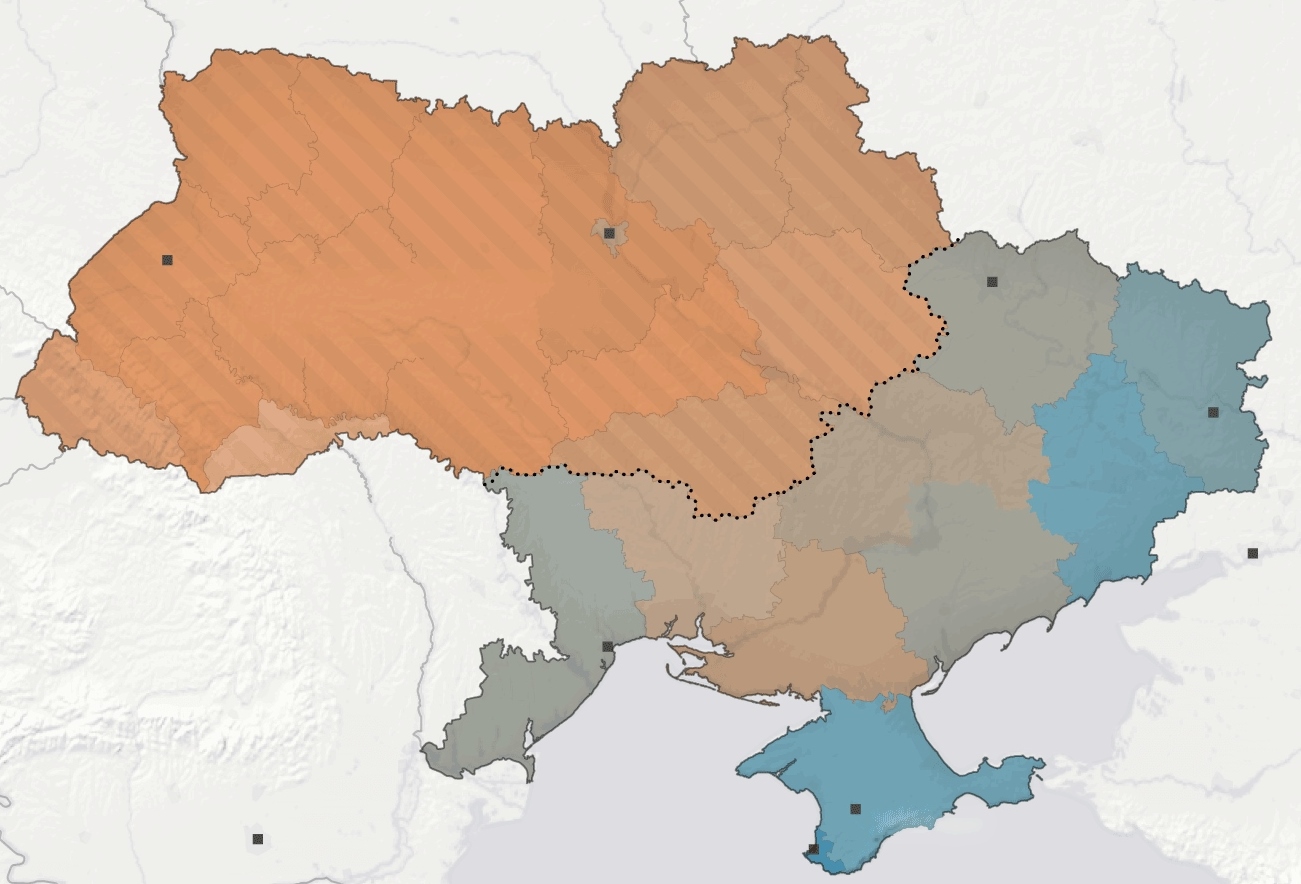
If you want to see what’s probably going to happen to Ukraine, take a look at the New York Times map below. In the orange area to the west, people speak Ukrainian and voted for the opposition in the last election. In the blue areas to the south and east (including the Crimean peninsula), most people speak Russian and voted for the President who was recently impeached.

It shouldn’t be a surprise if Russia eventually absorbs the blue areas. The West will strongly object, but nothing too bad should happen so long as the Russians don’t move too far west and their natural gas keeps flowing through Ukraine to Europe. On the other hand, nothing very bad should have happened after Franz Ferdinand was shot in 1914. (Other maps are here.)

0227_UKRAINE_LANGUAGES-945 (2)