The Bastards Are At It Again

It’s been 51 days since Republican Senator John McCain cast the dramatic “No” vote that sunk the bill that would have sunk the Affordable Care Act. Most of us assumed that was the end of the story. Even Sen. McConnell, the evil Majority Leader, said it was time for the Republicans to “move on”.

But we were wrong. They’re making one more attempt to repeal the Affordable Care Act. They have until September 30th, because the Senate rules say that’s the last day they can pass a bill with only 50 senators, plus the Vice President, voting “Yes”.

Sarah Kliff of Vox calls the latest bill, released by Sens. Bill Cassidy and Lindsey Graham on Wednesday, “the most radical” repeal effort yet:

Work on Cassidy-Graham began in the midst of the chaotic Obamacare repeal effort in July….

The senators are selling this idea as a compromise plan and say it is a way to return power to states, giving local governments more control over how they spend federal dollars….

But the plan does much more than that. The proposal would eliminate the health care law’s subsidies for private insurance and end the Medicaid expansion. States could allow for waivers that let insurers charge sick patients higher premiums and stop covering certain benefits required under the Affordable Care Act, like maternity care or prescription drugs. The health insurance marketplaces would no longer exist as they are envisioned to continue under other Republican proposals.

The federal government would convert some (but not all) of that spending into a lump-sum payment to states. States could choose to spend this money on providing insurance — or they could use it to fund high-risk pools, or do other activities to pay the bills of patients with high medical needs….

The plan hasn’t been scored by the Congressional Budget Office yet, but analysts who have studied Cassidy-Graham estimate it would cut deeply into federal funding for the health law programs, likely resulting in millions losing coverage.

Cassidy-Graham would arguably be more disruptive, not less, to the current health care system than the plans that came before it. It would let money currently spent on health insurance go toward other programs, providing no guarantee that the Affordable Care Act programs individuals rely on today would continue into the future.

Jonathan Cohn of the Huffington Post quotes Aviva Aron-Dine of the Center on Budget and Policy Priorities:

“This bill is far more radical [than previous repeal bills] in that it envisions going back to the pre-ACA world, where the federal government wasn’t in the business of helping low-income adults or moderate-income people without employer coverage get health insurance at all… Compared to pre-ACA, there would be some extra state grant money floating around ― but it would have virtually no requirements attached to it at all and, since the funding wouldn’t adjust based on enrollment or costs, it would be hard for even well-intentioned states to use it to create an individual entitlement to coverage or help.”

Cohn continues:

Oh, and the bill would repeal the Affordable Care Act’s individual mandate, and do so right away ― destabilizing insurance markets and causing premiums to rise right away, according to official projections….

It’s difficult to say where this is all going. After all, the idea that repeal could get another look now, despite its unpopularity, in the form of a proposal that in some respects is more radical than its predecessors, is difficult to fathom. And yet here we are, fathoming it.

So it looks like we need to speak up again. Republican senators need to hear from their angry constituents again. Facebook and Twitter need to heat up again. Activists need to get arrested again, because this is a matter of life and death for many of our fellow citizens and nobody knows if three Republicans will still vote “No”. McCain, who provided the crucial third “No” in July, has changed his tune from day to day (he’s 81 and has a brain tumor). People are saying he might vote “Yes” this time because he and Sen. Graham are very good friends. 

In November 1932, the German government was in disarray. Hitler was demanding to be made chancellor. He had many supporters, but others feared he would immediately institute a murderous dictatorship if given the chance:

Yet it was entirely unclear who would succeed [Franz von Papen] as chancellor or whether a way out of the political crisis could be found. The only thing that was clear, [a German count named Harry Kessler] noted … was the absolute impenetrability and uncertainty of the situation: “Everything more or less depends on chance and the good or bad moods of four or five individuals”.

Hitler became chancellor two months later. 
A Smart, Informed Journalist Interviews Hillary Clinton

Ezra Klein, the editor-in-chief of Vox, interviewed Hillary Clinton for 51 minutes this week. I thought she avoided answering one question. It was something like, how would you rate American voters in general? Aside from that, I was tremendously impressed. It is a tragedy that she lost.

A few topics discussed:

16:00  How the media handled the presidential campaign

17:45  Healthcare, including the important distinction between universal care, which should be our goal, and single-payer, which is only one way, and probably not the best way, to get universal care

26:30  American politics today

36:00  The 2016 election

42:00  How women voted

44:50   The effect of the Comey letter plus the Electoral College, voter suppression and dangers ahead.


Reading About Hitler Makes Me Think of Someone Else

I’m about halfway through Hitler: Ascent 1889 – 1939 by the German historian Volker Ullrich. It’s 1932 and Hitler is on the verge of becoming the German chancellor. I’ve learned a lot about Hitler’s rise to power. At the same time, I can’t stop noticing similarities between Hitler and our president.

I wish I’d been taking notes all along, so I could be specific, but it’s hard not to be reminded of the president when reading about Hitler’s lies, exaggerations, insecurities, misconceptions, exorbitant promises and celebration of violence. There’s his successful use of the media, his ability to excite a crowd of admirers, his reliance on certain emotional catchphrases, his need for total loyalty, the way he pits his underlings against each other and, of course, his targeting of scapegoats to explain all of the world’s ills.

There is also the reaction of some contemporary observers to the possibility that a man like him might rule the nation. Paul von Hindenburg, a military commander in World War I, had been the German chancellor since 1925. He was 84 and ill when he agreed to seek the office again in 1932, partly because he was thought to be the only candidate who could beat Hitler. The left-wing Social Democrats didn’t even nominate a candidate. They threw their support to Hindenburg, even though Hindenburg was a right-winger, because they were so afraid of the alternative. From the Social Democratic Party’s newspaper:

Hitler in place of Hindenburg means chaos and panic in Germany and the whole of Europe, an extreme worsening of the economic crisis and of unemployment, and the most acute danger of bloodshed within our own people and abroad. Hitler in place of Hindenburg means the triumph of the reactionary part of the bourgeoisie over the progressive middle classes and the working class, the destruction of all civil liberties, of the press and of political, union and cultural organizations, increased exploitation and wage slavery.

The declaration ended with: “Defeat Hitler! Vote for Hindenburg!”

A journalist noted: 

What a bizarre country. Hindenburg as the pet of the pro-democracy camp. Years ago when I heard of his election … I threw up out of fear and horror. Today, in the face of the fascist threat, a democrat has to anxiously hope for Hindenburg’s re-election.

The Nazis attacked Hindenburg on the basis that leftists were supporting his candidacy (“Tell me who praises you and I’ll tell you who you are!”), as if the leftists truly admired Hindenburg and weren’t supporting him simply as the lesser of two evils. A leader of the Social Democrats responded: 

If there is one thing we admire about National Socialism, it’s the fact that it has succeeded, for the first time in German politics, in the complete mobilization of human stupidity.

That reminds me of the present moment too.

Time Travel: A History by James Gleick

There are two principal topics in this book: time travel and time. Since time travel is fiction, the history of time travel presented in the book is the history of ideas about time travel, mostly ideas expressed in novels like H. G. Wells’s The Time Machine, short stories like Robert Heinlein’s “By His Bootstraps” and movies like The Terminator. Time travel can be fun to think about, and ideas about time travel are suggestive of what people have thought about time, but I quickly lost interest in the topic. So I ended up skimming those sections of the book.

On the other hand, Gleick’s discussion of time itself was worth reading. He covers both physics and philosophy, and does an excellent job explaining complex, competing ideas about time. For example:

You can say Einstein discovered that the universe is a four-dimensional space-time continuum. But it’s better to say, more modestly, Einstein discovered that we can describe the universe as a four-dimensional space-time continuum and that such a model enables physicists to calculate almost everything, with astounding exactitude, in certain limited domains. Call it space-time for the convenience of reasoning….

You can say the equations of physics make no distinction between past and future, between forward and backward in time. But if you do, you are averting your gaze from the phenomena dearest to our hearts. You leave for another day or another department the puzzles of evolution, memory, consciousness, life itself. Elementary processes may be reversible; complex processes are not. In the world of things, time’s arrow is always flying.

It’s an interesting question whether the calculations of the physicists are so accurate because the universe really is a four-dimensional space-time continuum. And is the passage of time some kind of illusion, like many physicists believe? Gleick leans toward time being quite real and physicists taking their models a bit too seriously. I think this would have been a better book if he spent more time on the physics and philosophy and less time on the fiction.

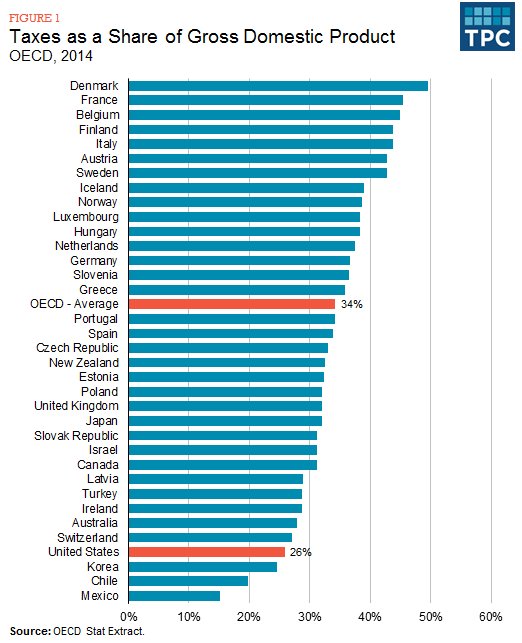
The Truth Still Matters

Will be going to North Dakota today to discuss tax reform and tax cuts. We are the highest taxed nation in the world – that will change.

— Donald J. Trump (@realDonaldTrump) September 6, 2017

But the truth still matters:

oecd tax burdens

The chart includes individual and corporate taxes, as well as local taxes, as reported by the 35-nation Organisation for Economic Co-operation and Development.

For some historical perspective, consider “When the Rich Said No to Getting Richer” by from David Leonhardt of The New York Times:

A half-century ago, a top automobile executive named George Romney — yes, Mitt’s father — turned down several big annual bonuses. He did so, he told his company’s board, because he believed that no executive should make more than $225,000 a year (which translates into almost $2 million today).

He worried that “the temptations of success” could distract people from more important matters, as he said to a biographer, T. George Harris. This belief seems to have stemmed from both Romney’s Mormon faith and a culture of financial restraint that was once commonplace in this country.

Romney didn’t try to make every dollar he could, or anywhere close to it. The same was true among many of his corporate peers. In the early 1960s, the typical chief executive at a large American company made only 20 times as much as the average worker, rather than the current 271-to-1 ratio. Today, some C.E.O.s make $2 million in a single month.

The old culture of restraint had multiple causes, but one of them was the tax code. When Romney was saying no to bonuses, the top marginal tax rate was 91 percent. Even if he had accepted the bonuses, he would have kept only a sliver of them.

The high tax rates, in other words, didn’t affect only the post-tax incomes of the wealthy. The tax code also affected pretax incomes. As the economist Gabriel Zucman says, “It’s not worth it to try to earn $50 million in income when 90 cents out of an extra dollar goes to the I.R.S.”

The tax rates helped create a culture in which Americans found gargantuan incomes to be bizarre.

A few years after Romney turned down his bonuses from the American Motors Corporation, Lyndon B. Johnson signed legislation that lowered the top marginal tax rate to 70 percent. Under Ronald Reagan, it dropped to 50 percent and kept falling. Since 1987, the top rate has hovered between 30 percent and 40 percent.

For more than 30 years now, the United States has lived with a top tax rate less than half as high as in George Romney’s day. And during those same three-plus decades, the pay of affluent Americans has soared. That’s not a coincidence. Corporate executives and others now have much more reason to fight for every last dollar.

And fight they do (it’s called “class warfare”).

Meanwhile, the president* is unnecessarily threatening hundreds of thousands of young people brought to this country by their parents and another extremely dangerous hurricane is on its way. This is further evidence that Republicans are evil and global temperatures are rising, but you already knew that.

Update:  John McCain, the Republican senator who talks a good game but can’t be relied on, has changed his mind about repealing the Affordable Care Act. He now says he’d vote Yes on what is “in may ways … the most radical” repeal bill yet. Further evidence for [see above]. 

2nd Update: McCain now says he would only vote for repeal if the legislation survived committee hearings and was subject to amendments proposed by both sides. That’s not what the 81-year old senator implied earlier today. This latest announcement is good news, because the repeal legislation is extremely unlikely to pass if it’s subject to “normal order” in the Senate instead of being rushed through.Â