Part 1: Trumpism as a Chronic Condition

What follows is a meditation on Trumpism written by Philip Kennicott, an art and architecture critic for The Washington Post, a few days after the election. Later I’ll post what he wrote after the attack on the Capitol:

No matter what happens to Dxxxx Txxxx or who assumes the presidency in January, we can say this: He brought the truth of America to the surface. I’ll leave his policies and his politics — to the extent that he ever had policies or coherent politics — to the pundits. As a critic, I can say that he embodied, embraced or inflamed almost everything ugly in American culture, past, present and perhaps future. He made it palpable and tangible even to people inclined to see the bright side of everything. That this week’s election wasn’t a repudiation of Trumpism, that some 6 million more Americans believe in it now compared with four years ago, is horrifying. But it’s also reality, and it’s always best to face reality.

He also gave our unique brand of ugliness — rooted in racism, exceptionalism, recklessness, arrogance and a tendency to bully our way to power — a name. Trumpism is now rooted in the lexicon, and although white supremacy may be the better, more clinical term for what ails America, Trumpism is a useful, colloquial alternative. It encompasses an even wider category of people that includes not just avowed racists who have publicly supported the president but also those who downplay the problem, or align with it for personal gain, or are simply unwilling to acknowledge its history and persistence. Naming a thing is an essential first step to understanding it . . .

In moments of despair, it’s easy to think that the past four years were a failure of civic discourse, that slightly more than half of America simply failed to convincingly argue against Trumpism. America, in the aggregate, seems just as stupid as it was four years ago, when it became clear that we would have to learn some painful lessons, and learn them the hard way, through the collapse of competent governance, the destruction of civility and, now, the ravages of a grossly mismanaged pandemic.

But if we are stupid in the aggregate, many individual Americans are more clear-eyed and conscious than four years ago. The 2016 election proved that the argument against Trumpism had largely failed, but although losing an argument is maddening, it also makes your argument stronger, clarifies your reasoning and orders your logic. Half of America may be right where it was four years ago, still mired in Trumpism, but some part of the other half of America isn’t just opposed to Txxxx but also smarter and more cognizant of how Trumpism has rooted itself in the society. That’s not a negligible accomplishment.

Grappling with white supremacy, or Trumpism if you prefer, was never going to be easy, because it exists not just in a handful of ugly epithets, the caricatures we see in old movies and statues scattered across the landscape. It is existential, precognitive and pervasive, as fully present in how we conceive of beauty as it is in the assumptions we make about that driver who just cut us off while swerving between lanes.

Changing how we think would be difficult even if we all agreed on the necessity for change. It is even more difficult given that 48 percent of the country resists the project entirely. But for all the damage Txxxx has done, much of which may never be undone, he has inadvertently, accidentally and unintentionally left us with a model for what needs to be done.

Trumpism is embedded in America and can be fought only through rigorous self-discipline, through constant surveillance of the thoughts we think, the words we use and the assumptions we make. There was White supremacy before we started thinking of it as Trumpism, but before Txxxx, there also was a tendency to think of it as “out there” rather than “in here.” Now we know it not as a perverse blemish on American culture but as foundational to American culture. That’s progress.

On a summer morning in 1861, holiday makers, the picnic crowd, the Washington swells went out to the battlefield at Manassas to watch a quick and decisive battle bring an end to the Civil War. Head east past the battlefield on Interstate 66 and you’re roughly retracing the holiday crowd’s steps when they fled back to Washington in panic and disorder after Confederate troops routed Union forces. Some of them, safe again in the nation’s capital, were perhaps slightly less ignorant about the magnitude of the war that awaited them.

Disillusionment isn’t an event — it’s a process. It doesn’t arrive and do its work all at once, like an epiphany. It is a way of living, a perpetual vigilance, a habit of mind. We may wish that Trumpism could be defeated, like an external enemy. But reality requires that we think of it as a chronic condition of American public life — not a virus that can be quarantined and perhaps cured, but a lifestyle disease rooted in sedentary thinking.


Terrorists announce attack on Washington. Federal police agencies allow it to happen.

This was published in The Washington Post yesterday:

Talk of guns and potential violence is rife on the encrypted messaging app Telegram, the conservative social media site Parler and on thedonald.win, an online forum that previously operated on Reddit before the company banned it in June after years of racism, misogyny, anti-Semitism and calls for violence.

Trump’s tweet last month pushing baseless fraud claims and promoting the “big protest” on Jan. 6 — “Be there, will be wild!” — has become a central rallying cry. It was the top post on thedonald.win Tuesday morning, and anonymous commenters saw it as a call to action: “We’ve got marching orders,” the top reply said.

Discussion in the thread followed about how most effectively to sneak guns into Washington, laced with occasional references to using them. . . .

Of carrying guns in D.C., one poster in the thread wrote, “Yes, it’s illegal, but this is war and we’re clearly in a post-legal phase of our society.” Wrote another: “LIVE AS A FREE AMERICAN AND BRING YOUR ARMS!”

Unquote.

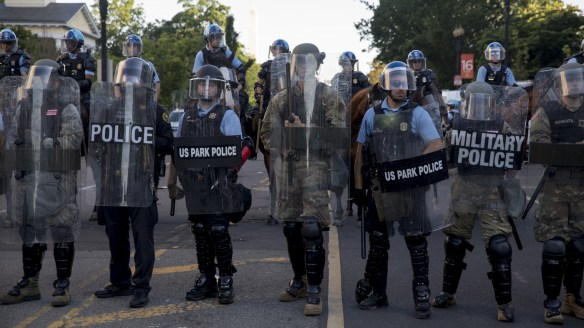
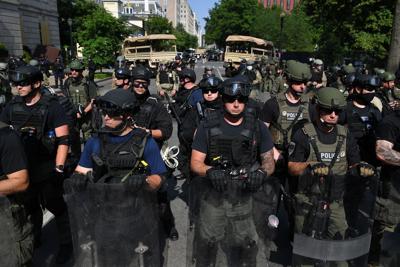
Here are some of the federal police agencies that could have protected the Capitol building today, but weren’t around:

UntitledUntitled2

But if you’re a White male terrorist from the radical right, possibly heavily-armed, you have privileges the rest of us don’t. Much of Trump’s administration is on their side. So are many police officers. The U.S. Capitol Police failed miserably. They apparently didn’t ask for assistance from other agencies, even though the likelihood of an attack was public knowledge. 

In striking contrast, scenes at peaceful Black Lives Matter protests in Washington this year:

images

200601_dcprotest_turner_24

5ed9175dbdc79.image

ErE8IpbWMAIkGcV

One of the Men Who Brought Down Nixon Reacts to the New Tape

A CNN host spoke to Carl Bernstein, one of the reporters who broke the Watergate story, to get his reaction to today’s news:

CNN:  Carl, is this deja vu for you to hear this kind of audiotape of the president of the United States, the sitting president … ?

Bernstein: It’s not deja vu. This is something far worse than what occurred in Watergate. We have both a criminal president of the United States . . . and a subversive president of the United States at the same time. This one person subverting the very basis of our democracy and willing to act criminally in that subversion. But more important, what we hear on this tape — this is the ultimate smoking gun tape — it is . . . the evidence of what this president is willing to do to undermine the electoral system and illegally, improperly and immorally try to instigate a coup in which he remains the president of the United States. 

And in any other presidency, any other presidency, this tape would be evidence enough to result in the impeachment of the president of the United States, his conviction in the Senate of the United States, and, really, an immediate call by the members of Congress, including the members of his own party, that he resign immediately. That’s really what we ought to be hearing from Republicans at this moment. Mr. President, resign. Leave the White House. This is unconscionable, it is wrong and we of your party will not permit it. We’re not going to hear that. We might from a few Republicans, but that’s what’s really called for here.

And the one thing we should recall from Watergate, it is that the heroes of Watergate were Republicans who would not tolerate Richard Nixon’s conduct.

Will It Happen Here?

“It always happens” doesn’t imply “it will always happen”. With that correction in mind, Adam Gopnik makes an interesting point about democracy and autocracy in The New Yorker:

We are told again and again that American democracy is in peril and may even be on its deathbed. Today, after all, a defeated yet deranged President bunkers in the White House contemplating crazy conspiracy theories and perhaps even martial law, with the uneasy consent of his party and the rabid support of his base. We are then told, with equal urgency, that what is wrong, ultimately, is deep, systemic, and Everybody’s Fault. Perhaps there is a crisis of meaning, or of spirit; perhaps it is a crisis caused by the condescension of self-important élites. (In truth, those élites tend to be at least as self-lacerating as they are condescending, as the latest rounds of self-laceration show.)

Lurking behind all of this is a faulty premise—that the descent into authoritarianism is what needs to be explained, when the reality is that . . . it always happens. The default condition of humankind is not to thrive in broadly egalitarian and stable democratic arrangements that get unsettled only when something happens to unsettle them. The default condition of humankind, traced across thousands of years of history, is some sort of autocracy.

America itself has never had a particularly settled commitment to democratic, rational government. At a high point of national prosperity, long before manufacturing fell away or economic anxiety gripped the Middle West—in an era when “silos” referred only to grain or missiles and information came from three sober networks . . .—a similar set of paranoid beliefs filled American minds and came perilously close to taking power. . . . [A] sizable group of people believed things as fully fantastical as the Txxxx-ite belief in voting machines rerouted by dead Venezuelan socialists. The intellectual forces behind Goldwater’s sudden rise thought that Eisenhower and J.F.K. were agents, wittingly or otherwise, of the Communist conspiracy, and that American democracy was in a death match with enemies within as much as without. (Goldwater was, political genealogists will note, a ferocious admirer and defender of Joe McCarthy, whose counsel in all things conspiratorial was Roy Cohn, Dxxxx Txxxx’s mentor.)

Goldwater was a less personally malevolent figure than Txxxx, and, yes, he lost his 1964 Presidential bid. But, in sweeping the Deep South, he set a victorious neo-Confederate pattern for the next four decades of American politics, including the so-called Reagan revolution. Nor were his forces naïvely libertarian. At the time, Goldwater’s ghostwriter Brent Bozell spoke approvingly of Franco’s post-Fascist Spain as spiritually far superior to decadent America, much as the highbrow Txxxx-ites talk of the Christian regimes of Putin and Orbán.

The interesting question is not what causes autocracy (not to mention the conspiratorial thinking that feeds it) but what has ever suspended it. We constantly create post-hoc explanations for the ascent of the irrational. The Weimar inflation caused the rise of Hitler, we say; the impoverishment of Tsarism caused the Bolshevik Revolution. In fact, the inflation was over in Germany long before Hitler rose, and Lenin came to power not in anything that resembled a revolution—which had happened already under the leadership of far more pluralistic politicians—but in a coup d’état by a militant minority. Force of personality, opportunity, sheer accident: these were much more decisive than some neat formula of suffering in, autocracy out.

Dxxxx Txxxx came to power not because of an overwhelming wave of popular sentiment—he lost his two elections by a cumulative ten million votes—but because of an orphaned electoral system left on our doorstep by an exhausted Constitutional Convention. . . .

The way to shore up American democracy is to shore up American democracy—that is, to strengthen liberal institutions, in ways that are unglamorously specific and discouragingly minute. The task here is not so much to peer into our souls as to reduce the enormous democratic deficits under which the country labors, most notably an electoral landscape in which farmland tilts to power while city blocks are flattened. This means remedying manipulative redistricting while reforming the Electoral College and the Senate [or by making the Electoral College irrelevant]. Some of these things won’t be achievable, but all are worth pursuing—with the knowledge that, even if every box on our . . . wish list were checked, no set-it-and-forget-it solution to democratic fragility would stand revealed. The only way to stave off another Txxxx is to recognize that it always happens. The temptation of anti-democratic cult politics is forever with us, and so is the work of fending it off. . . .

Unquote.

It’s hard for most Americans to believe it might happen to us. We haven’t had a king or dictator since the United States was created 240 years ago. That’s why Sinclair Lewis called his novel about fascism coming to America It Can’t Happen Here. Our country isn’t destined to become an autocracy, but the past four years show that we have work to do — to make sure it doesn’t happen here.

Small States and Minority Rule

Every four years we elect a president. Almost every four years, we discuss the Electoral College. From Jesse Wegman of The New York Times:

As the 538 members of the Electoral College gather on Monday to carry out their constitutional duty and officially elect Joe Biden as the nation’s 46th president and Kamala Harris as his vice president, we are confronted again with the jarring reminder that it could easily have gone the other way. We came within a hairbreadth of re-electing a man who finished more than seven million votes behind his opponent — and we nearly repeated the shock of 2016, when Dxxxx Txxxx took office after coming in a distant second in the balloting.

No other election in the country is run like this. But why not? That question has been nagging at me for the past few years, particularly in the weeks since Election Day, as I’ve watched with morbid fascination the ludicrous effort by Mr. Txxxx and his allies to use the Electoral College to subvert the will of the majority of American voters and overturn an election that he lost.

The obvious answer is that, for the most part, we abide by the principle of majority rule. . . . 

In the last 20 years, Republicans have been gifted the White House while losing the popular vote twice, and it came distressingly close to happening for a third time this year. 

Since 2000, we’ve had six presidential elections. The candidate who got the most votes only won four of them. This year, shifting 44,000 votes to the loser in Arizona, Georgia and Wisconsin would have resulted in a 269-269 tie in the Electoral College. That would have moved the election to the House of Representatives, where each state’s delegation gets one vote, regardless of population. Since most states have Republican-majority representation in the House — even though the House has more Democrats — DDT would have presumably been re-elected, hard as that is to imagine. 

Among the comments the Times article received, one person said the Electoral College is fine, since we’re a collection of states, the United States of America, not a collection of citizens. He said it’s only fair that we pick a president based on which states the candidates win, not how many votes they get. Besides, he added, votes in the Electoral College are “roughly” assigned by population.

I don’t agree that because we’re called the United States, we should ignore majority rule when it coms to picking a president. After all, the states we live in are supposed to be “united”. But his statement about the Electoral College being “roughly” based on population made me wonder.

How would the 2020 election have turned out if votes in the Electoral College were “precisely” assigned by population, instead of “roughly”? Today, the largest state, California, gets 55 electoral votes and the smallest state, Wyoming, gets 3. But California’s population is 68 times Wyoming’s. So if the Electoral College were precisely allocated by population, California would get 204 electoral votes, not 55. Quite a difference. The next largest state, Texas, would get 150 instead of 38.

Would that have made the result in the Electoral College much different? It was surprising to see that it wouldn’t. If you do the same precise arithmetic for all 50 states and the District of Columbia, Joe Biden receives 974 electoral votes instead of 306 and DDT gets 730 instead of 232. That looks like a big difference, but the percentages are about the same. Biden would get 57.2% of the electoral votes with the precise arithmetic and 56.9% with the rough arithmetic. It works out that way because some big states, like California and New York, went for Biden and some, like Texas and Florida, went for DDT. When you average it all out, the Electoral College result would be about the same either way.

There would be a big difference, however. Big states would be much more important in the Electoral College than small states. If California got 204 electoral votes instead of 55, it would make even less difference who won a bunch of little states like Wyoming, Vermont and Alaska. In fact, assuming precise arithmetic, the 25 largest states would get 1,423 electoral votes vs. 288 for the 25 smallest. 

What this shows is that the current Electoral College is significantly skewed to benefit smaller states. Voters in those states play a bigger role than they should, based on how few of them there are. Being precise about population wouldn’t necessarily change the winner every time, but a more accurate Electoral College would reflect where people actually live in these “united” states. It would also reflect the cultural divisions in this country, since smaller states tend to be more rural.

Unfortunately, it’s not just the Electoral College that is skewed toward smaller states. According to the Constitution, each state gets as many votes in the Electoral College as it has members of Congress. Wyoming gets three electoral votes because it has two people in the Senate and one in the House of Representatives. California gets 55 electoral votes because it has two senators and 53 representatives in the House. If seats in Congress were precisely allocated by population, California would still have two senators, but it would elect almost four times as many members of the House of Representatives as Wyoming. The ratio in the House would be California’s 202 to Wyoming’s one, not 53 to one.

If the makeup of the House of Representatives isn’t unfair enough, consider the US Senate. Each state, regardless of population, gets two senators. It was designed to give small states the same representation as big states, so each state, regardless of population, gets to elect two. Maybe that made sense when there were only 13 states and they were relatively close in population. Now we have 50 states with a very wide range of populations.

In 1790, for example, the largest state, Virginia, had 13 times as many people as the smallest, Delaware. Today, as noted above, California has 68 times more people than Wyoming. Furthermore, the 50 members of the Senate from the largest 25 states represent almost 275 million people. The 50 senators from the smallest 25 states represent 49 million.

The imbalance is made even worse by the fact that the Senate is responsible for approving nominations to the Executive Branch (including all the officials in the president’s cabinet) and the federal judiciary (including the Supreme Court), as well as approving treaties. Because of the way senators were to be chosen, the authors of the Constitution assumed that members of the Senate would be more responsible than the unruly members of the House of Representatives. That’s hardly the case today.

In addition, smaller states, which tend to more rural, tend to vote for Republicans. Of the 25 largest states, 15 voted for Biden and 10 for his opponent. Of the 25 smallest, 10 voted for Biden and 15 for the other guy. That’s why the Senate is where progressive legislation goes to die and liberal nominees fall into comas waiting to be approved.

Add this all up and it’s easy to see that a Constitution written in 1789 doesn’t work very well for a large, complicated country in 2020. The Senate is skewed to benefit smaller, more Republican states, while the House of Representatives and the Electoral College, which chooses the president, are skewed the same way, although less so. This unfairness explains why Hillary Clinton could beat her opponent by 3 million votes and lose, why Joe Biden could beat the same opponent by 7 million votes but not necessarily win, and why forward-looking legislation that would make the United States a much better place to live has so little chance of success. Maybe shifting demographics will eventually help, but in the short run, we have to assume the United States will be subject to minority rule from Washington in important ways and much too often.Â