That Time the Chinese Communists Used a Few Words to Make Themselves Look Good

The Chinese Communist Party (CCP) doesn’t get as much publicity as it should. The people who run China’s government do horrible things. Prof. Perry Link is an expert on China and explains one way the party easily manipulated the rest of the world using the power of propaganda: 

Does the CCP’s Department of Propaganda (later renamed the Department of Publicity) lie? [Author and dissident] Su Xiaokang gently told me that the question is naïve. The CCP system, he explained, has an entirely different way of measuring the value of statements. Truth and falsity are incidental. A statement is valuable if its “social effects” are “good,” and the effects count as good if they support the power interests of the CCP. (For politically innocuous matters like weather reports or basketball scores, support of the party does not apply, but avoidance of harm to the party still does.) Hence a “good” statement might be true, half-true, or untrue—that is beside the point.

A tendency toward including truth does become relevant when someone judges that a statement will influence people more effectively if a bit of verisimilitude is supplied. But truth is never the first criterion, and in that sense neither is lying. American democracy’s headache with a president who lies is a fundamentally different problem from China’s living under the CCP’s propaganda apparatus, whose roots date from the 1940s and whose experts by now are very good at what they do.

Readers of the Western press, whether aware of it or not, have seen examples of that expertise. In the run-up to the 2008 Beijing Olympics, the international wing of the Xinhua News Agency instituted frequent use of the phrase “lifted from poverty.” This was what “China” (meaning the CCP) had done for hundreds of millions of Chinese people. The world’s media—The New York Times, The Wall Street Journal, Reuters, Al Jazeera, Kyodo News, the BBC, and many others—picked up the phrase, as did Western politicians on both the left and the right. The World Bank used it in official reports. Those words were, in short, highly successful in achieving the intended effect: the world came to believe that the CCP was doing great good.

A more transparent account of what it had done, beginning in the 1980s and 1990s, is that it released its controls on the Chinese people so that, for the first time in decades, they could make money for themselves; hundreds of millions responded by working long hours at low wages without the protection of labor unions, workers’ compensation insurance, a free press, or independent courts; and, yes, they made great amounts of money, escaping poverty for themselves and simultaneously catapulting the CCP elite, who still rode high above them, to truly spectacular wealth.

In short, the word “lifted” [requires] analysis of who lifted whom. That question did not normally occur to people around the world who read the words “China lifted.” The grammar of such sentences, combined with the formula China = CCP, left no need for a question. Was this word-engineering deliberate? Anyone who doubts that it was should note that CCP media used the “China lifted” phrase in publications in English, French, German, and other foreign languages but not in Chinese-language media at home. That made good sense. What would happen if the CCP started telling the Chinese people that “we lifted you”? The people would know better. Both sides know better. To make such an assertion might generate unfortunate “social effects,” such as a greater number of demonstrations, strikes, sit-ins, roadblocks, and other examples of what the Ministry of Public Security labels “masses incidents” and counts in the tens of thousands per year.

A Suggestion for Fixing America

Two professors writing for Foreign Policy see a way to simultaneously repair our country’s politics and economics (I’ve left out some of their analysis). Whether or not it succeeded, it wouldn’t hurt:

According to the Brookings Institution, Biden won 509 counties to [the other guy’s] 2,547—that’s over five times as many won by [the Republican]. But here’s the kicker. Biden’s counties constitute 71 percent of the country’s Gross Domestic Product, [the loser’s] less than 30 percent. Surely we must somehow factor this into how we think about why people vote the way they do? How does growth, or the lack thereof, determine elections?

What we see in U.S. politics today is the death and dissolution of a particular social coalition that dominated politics and economics and underwrote social peace for three generations; call it the carbon coalition.

The carbon coalition was an encompassing political coalition, built on a set of agreements negotiated between 1932 and 1950, that distributed the income generated by the industrial economy among groups within society. In the auto and steel industries, the most dynamic of that era, United Auto Workers and General Motors signed the 1950 Treaty of Detroit, which tied pay to productivity. This created a path to prosperity for two generations of workers in manufacturing.

Meanwhile, to bring rural areas into the coalition, the urban middle class paid higher prices for food and accepted permanent agricultural subsidies so that farmers could enjoy higher incomes. These agreements drew together labor, business, and farmers; the North and the South; the Great Plains and the Great Lakes into one settlement. This broadly inclusive distributive coalition in turn softened the sectional and partisan divisions that had roiled U.S. politics almost continuously since the 1890s.

. . . This political coalition was in fact entirely dependent on a particular growth model: an extremely fossil fuel-intensive agro-industrial economy.

It is only a slight exaggeration to suggest that the United States’ postwar economy was a massive machine that transformed oil, coal, and natural gas into income and food. Consider the following: In 1971, automobile production directly and indirectly provided 1 of every 6 jobs in the U.S. economy. Most of these jobs were unionized, or, if not, most workers enjoyed wages and benefits that spilled over from union agreements. Then add to these jobs others created by the interstate highway program, by the oil and gas industry, and by the retail sale of gasoline and the repair and maintenance of automobiles. And then throw in jobs in aviation, shipping, and agriculture, which became increasingly energy intensive due to the use of diesel-fueled equipment and through the use of natural gas to manufacture artificial fertilizer. Finally come jobs in plastics and petrochemicals.

The carbon coalition distributed the income generated by the carbon economy. Elections determined those distributions. That model is now dying and indeed, given climate change, must die. The politics it made possible are dying too.

The carbon economy has been in decline for decades, but the [political effects are only now becoming visible.

The center of economic dynamism and wealth generation in the United States now lies in knowledge-intensive (or at least high-value-added) industries, some of which, like pharmaceuticals, are research intensive and some of which, like various forms of media, are creative.

Although this knowledge economy is diverse, these activities share one overarching commonality: None require (much less depend on) fossil fuels. Indeed, their survival over the long haul depends on successfully switching out of carbon completely. Productivity in these activities doesn’t come from more energy and bigger machines applied to faster assembly lines but from improvements in our ability to manipulate, analyze, and monetize information.

The economy that drives U.S. GDP growth today is already post-carbon. And though many of its activities are energy intensive (server farms consume more than more than 2 percent of the world’s electricity use; financial services consume more electricity than any other industry in New York City), the energy they consume can come as readily from wind and solar as from coal and natural gas. This isn’t the case for the internal combustion engine, for the steel from which its constructed, and for the oil extraction, refining, and distribution systems that support it. Nor is it true for an ammonia plant or for cement or aviation. Farmers cannot substitute solar energy for artificial fertilizer.

The U.S. economy is thus now divided in two: a growing and potentially sustainable post-carbon economy that can adapt to the realities of climate change and a carbon economy in decline that is unsustainable. . . .

Americans no longer live in the same economy.  Rather, they live in two incompatible models of economic growth. Those who remain embedded in the carbon economy quite rationally want to defend and rejuvenate that model. In contrast, those who have found a spot in the post-carbon economy largely embrace the future. . . .

Today, the firms and sectors that make up each of the two growth models fund elections and determine the strategy of their parties.

The post-carbon coalition dominates the Democratic Party. This coalition brings together a West Coast variant composed of high-margin agriculture (think wine), Big Tech, entertainment, and digital and high-end services and an East Coast variant based largely on financial services. These post-carbonites embrace some variant of the Green New Deal, which identifies the climate crisis as the most critical issue the country faces and offers a coherent policy response.

The carbon economy coalition that dominates the Republican Party includes export agriculture, carbon extraction, refinement and production, steel and other declining traditional industrial sectors, as well as low-wage and low productivity services (think Walmart over Accenture). This fragment of the original carbon coalition remains committed to defending and rebooting the carbon economy; this is what “Make America Great Again” means. . . .

The United States’ two coalitions cannot be brought together. Indeed, they are existential threats to each other. And on a population scale, each electoral coalition has more or less the same number of potential voters. As a result, elections are decided by thin margins in a race to the death. . . .

For almost half of U.S. states, the Green New Deal, which is—sotto voce—at the center of Biden’s platform, spells the end of their existing strategies—think fracking, refining, plastics, mining, logging, and so on. And for the other half of the states that support the deal, scaling back its objectives to attract support from the carbon coalition threatens the post-carbon coastal communities. . . .

There is only one way to fix this mess. The post-carbon coalition has to bribe what’s left of [the carbon coalition] to make [a] transition. Non-coastal, largely Republican states must be the epicenter of the green transition and be the recipients of most of the investment. After all, they have the most assets to turn around and the most to lose if they are not compensated. If all they are offered is “you decarbonize/we keep the money,” then all they will give back is more [right-wing radicalism].

There are clear parallels in U.S. history, such as the massive bribe that the urban sector began paying to farmers in 1933 with the Agricultural Adjustment Act and two generations of generous farm bills . . . thereafter. Yet the bribe this time must involve more than a subsidy; it requires exiting the carbon economy. For it to work, green investment must extend well beyond energy capture (solar and wind farms) and downstream into industries that are powered by alternatives. Massive investments in electric vehicle production, for instance, to support a rapid turnover of the U.S. motor vehicle fleet with U.S.-built cars and trucks, are required. . . .

Elections in the United States are not being fought over rival principles and certainly not over median voters. They are contested over which parts of the country will grow and how and who will pay for it. Recognizing this is the first step to fixing the deeper problem of the carbon transition for the good of all Americans.

Ready To Be Led

One of today’s hot topics, in addition to the future of the Republican Party, is why millions of people who live in democracies are willing to be led by a Dear Leader. Below are three contributions to the discussion.

From The New York Review of Books: “Democracy’s Demagogues” 

In 1917, when Europe seemed to lie in ruins, Max Weber wrote an influential essay with the misleadingly dull title “Parliament and Government in a Reconstructed Germany.” In it he drew attention to the outbreak of “Caesarism” in nineteenth-century Europe, taking Otto von Bismarck as the prime example of a modern Caesar for Germany (and indeed for the entire continent). How brilliantly, according to Weber, the old Junker had reduced Parliament to a rubber stamp, what devastating use he had made of emergency legislation and popular appeals, how ruthlessly he had expanded the power of Germany and consolidated his own.

You might think that Weber goes on to tell us what a harmful thing this modern Caesarism is and how Parliament and the rule of law must be strengthened as bulwarks against its perils. And he does, but then he starts off on a new and more disquieting tack. Isn’t it possible, he muses, that demagoguery is actually inherent in modern democratic suffrage, just as it was in Periclean Athens? Apart from demagogos, ancient Greek had a dozen other words to describe “people-flattery” of one sort or another. Surely mass democracy had a tendency to Caesarism:

Every kind of direct popular election of the supreme ruler and, beyond that, every kind of political power that rests on the confidence of the masses and not of parliament…lies on the road to these “pure” forms of Caesarist acclamation. In particular, this is true of the position of the President of the United States, whose superiority over parliament derives from his (formally) democratic nomination and election.

When traveling the United States in the election year of 1904, Weber had been much impressed by Teddy Roosevelt’s boisterous campaigning style.

The miracle ingredient by which the demagogos acquires and retains power is what Weber calls “charisma.” It is Weber who first borrowed from the Epistles of Saint Paul the Greek word for “the gift of God’s grace” and gave it a new, entirely secular twist. But even his use of the term retains a heaven-sent aura. The man with charisma is “meant to be.” He comes to fulfill the destiny of the nation; he is the Man on the White Horse in the Book of Revelation. Hegel wrote, when he caught sight of Napoleon riding through Jena the day before the great battle against the Prussian army in 1806, that he had just seen “this World-Soul riding out of town.” That’s charisma.

Curiously then, Weber, this infinitely thoughtful and skeptical observer of human affairs, had come to agree with the mountebank Napoleon III—who named himself emperor of France in 1852—that “the nature of democracy is to personify itself in a man.” When he was consulted about the writing of the Weimar Constitution in 1918–1919, he proposed the direct election of the German president. Charismatic leadership by a single man, he maintained, was essential to cement the people’s loyalty and persuade them to accept the dull impersonal weight of modern bureaucracy, which was both universal and inescapable. Yes, there must also be vigorous political parties and accountability to Parliament. But a dollop of charisma was indispensable.

This might be described as the Weber Wobble, and an apparent exception to the general thesis for which he is celebrated: that the modern world is characterized by a turning away from magical ways of thinking, the once-for-all Entzauberung, or disenchantment. He recognized the necessity of charisma, but he remained uneasy and suspicious of it. He died a year later, in 1920, of the Spanish flu during the great pandemic, aged only fifty-six. If he had lived a couple of years longer, to witness Mussolini’s March on Rome, he would have been uneasier still.

In Men on Horseback, David A. Bell, a professor of history at Princeton, takes Weber’s conjecture a stage further. Democracies, he points out, are particularly suspicious of charismatic leaders:

Yet, paradoxically, the longing for such leaders acquired new importance, and a distinct new shape, during the very same period that witnessed the first stirrings of modern democracy: the eighteenth and early nineteenth centuries.

It was during that period of extraordinary intellectual ferment and then in the great revolutions that washed across much of the Western world between 1775 and 1820 that the powerful forms of political charisma we are familiar with today emerged. The coming of democracy transformed the relationship between the people and their leaders, and the personal magnetism of the leader electrified that relationship. Far from representing a backsliding toward older forms of government, the new Caesar, adored by the masses and personifying the new nation, was intrinsic to the modern world.

In fact, one might argue, it is only in our own time that we can see most clearly how it all works. The leader’s rallies, his broadcasts, his photo opportunities, his tweets—these do not simply decorate the serious business of governing; they are part and parcel of it. True, in the past and perhaps in the present too, charismatic leaders have often threatened constitutional orders, but they were crucial to the initial creation of those orders, not only by engineering the rupture with the ancien régime but also by bonding the public to this strange new world. The charismatic leader breaks the rules not just because, he claims, the rules are harmful to the people, but because breaking the rules shows that he has charisma; he is beyond good and evil, and beyond a lot of other boring stuff too. . . . 

From Scientific American: “The Shared Psychosis of [a Leader] and His Loyalists”

The violent insurrection at the U.S. Capitol Building last week, incited by [the nation’s president], serves as the grimmest moment in one of the darkest chapters in the nation’s history. Yet the rioters’ actions—and [their leader’s] own role in, and response to, them—come as little surprise to many, particularly those who have been studying the president’s mental fitness and the psychology of his most ardent followers since he took office.

One such person is Bandy X. Lee, a forensic psychiatrist and president of the World Mental Health Coalition. . . . Scientific American asked Lee to comment on the psychology behind [the president’s] destructive behavior, what drives some of his followers—and how to free people from his grip . . .

Scientific American: What attracts people to [him]? What is their animus or driving force?

Lee: The reasons are multiple and varied, but in my recent public-service book, Profile of a Nation, I have outlined two major emotional drives: narcissistic symbiosis and shared psychosis. Narcissistic symbiosis refers to the developmental wounds that make the leader-follower relationship magnetically attractive. The leader, hungry for adulation to compensate for an inner lack of self-worth, projects grandiose omnipotence—while the followers, rendered needy by societal stress or developmental injury, yearn for a parental figure. When such wounded individuals are given positions of power, they arouse similar pathology in the population that creates a “lock and key” relationship.

“Shared psychosis”—which is also called “folie à millions” [“madness for millions”] when occurring at the national level or “induced delusions”—refers to the infectiousness of severe symptoms that goes beyond ordinary group psychology. When a highly symptomatic individual is placed in an influential position, the person’s symptoms can spread through the population through emotional bonds, heightening existing pathologies and inducing delusions, paranoia and propensity for violence—even in previously healthy individuals. The treatment is removal of exposure. . . . 

From conservative columnist Michael Gerson of The Washington Post: “The Rot Has Reached the Roots”

The dominant note of the day was . . . cowardice. The case presented by the House impeachment managers was so compelling and overwhelming that the extent of Republican cravenness was highlighted in neon. Republicans who knew better tried to hide behind thin technicalities. And most Republican senators did not seem to know better. In the end, we witnessed a historic collapse of moral and political leadership. And it was no less tragic for being expected. . . .

If T___pism were merely a set of proposals, there could be an antithesis. But the movement fully revealed by the Jan. 6 invasion of the U.S. Capitol is united by a belief that the White, Christian America of its imagination is on the verge of destruction, and that it must be preserved by any means necessary. This is less a political philosophy than a warped religious belief. There can be no compromise in a culture war. There can be no splitting of differences at Armageddon.

What has emerged within the Republican Party is a debate on the value of democracy itself. In the traditional American view, the democratic process has an essential nobility. It does not always produce the results we seek, yet, in the long run, it protects the rights we value. But the T___pian view of democracy is purely instrumental. With the stakes of politics so high — with socialists, multiculturalists and child rapists (as the QAnon fabulists would have it) intent on destroying American society — outcomes are the only things that really matter. Not truth. Not civility. Not electoral procedure. Just the gaining and maintenance of power.

A loss of faith in democratic structures does not lead to anarchy. It leads people to invest their hopes in someone who promises to defend their fragile way of life. In a January 2020 survey published in the Proceedings of the National Academy of Sciences, more than half of Republicans agreed that “the traditional American way of life is disappearing so fast that we may have to use force to save it.” More than 40 percent agreed that “a time will come when patriotic Americans have to take the law into their own hands.” This is as close as political theory comes to a mathematical principle: Tribalism plus desperation equals authoritarian thinking.

From one perspective, it is absurd that so many Americans have invested their hopes for the preservation of civilization in a fool. But [he] has been effective in promoting the tribalism of White grievance, as well as desperation about the fate of America. And, unlike any other president, he was happy to step into an authoritarian role, attempting to maintain power through intimidation and violence.

Can the [Republican Party] really have a productive debate between people who believe in democracy and those who have lost patience for it? Between those who view politics as a method to secure rough justice in a fallen world, and those who view it as a holy crusade against scheming infidels? Between those who try to serve conservative political ideals and those who engage (in [Senator] Sasse’s immortal words) in “the weird worship of one dude”?

As it stands, I am skeptical. There are scattered outposts of Republican sanity . . . But in most of the [party], the rot has reached the roots.

PS: A quote from economist Thorstein Veblen (1857-1929)

A degree of arrested spiritual and mental development is, in practical effect, no bar against entrance into public office. Indeed, a degree of puerile exuberance coupled with a certain truculent temper and boyish cunning is likely to command something of popular admiration and affection.
The Grand Old Party No Longer Exists — It’s Something Else Now

The future of the Republican Party is a hot topic, now that its Congressional cohort has finally and formally announced its support for insurrection. In reaction, the relatively sensible members of the party could gain more support, but it seems much more likely that the party will become more extreme as its anti-insurrection minority drifts away. America will have an even more extreme right-wing party, even though that’s hard to believe. As the number of Republicans goes down, the number of Democrats should go up. That in turn would lead to the Democratic Party winning more elections, but simultaneously shifting somewhat to the right (the conservative wing of the Democratic Party would grow).

Will Bunch of The Philadelphia Inquirer isn’t looking that far ahead. For now, he thinks “bipartisanship is dead — and so is the immoral Republican Party”. This is most of his latest column, with my italicized modifications [note: a certain person’s name doesn’t appear below and if I’m careful, will never again appear on this blog]:

The Republican Party was born on March 20, 1854, the green shoots of a political spring. Unlike America’s other parties that were often shotgun weddings of convenience, the Republicans burst forth around moral ideas that were so powerful — ending slavery and making America a world industrial power — that the tail of this supernova lasted for more than 166 years and inspired its eventual nickname, the Grand Old Party.

That GOP died — morally, if not officially — in the late afternoon gloaming of a grey and bitterly cold winter’s day, Feb. 13, 2021. After 43 Republican senators who’d been given a green light to “vote their conscience” on impeachment still managed to come up empty — thus enshrining the notion that an end-of-term president can foment a deadly insurrection to thwart a peaceful transition of power and not face any consequences — Senate Minority Leader Mitch McConnell strolled to the well of the Senate. He was presumably holding the bloody knife with which he’d repeatedly stabbed American democracy for a dozen years hidden behind his back.

It turns out that McConnell’s past moments of political shamelessness — the years of hurting America’s recovery just to electorally thwart our first Black president, the theft of a Supreme Court pick from Barack Obama so it could be made by a dangerous demagogue whom the Kentuckian then helped pack the judiciary — were just an audition for Saturday’s GOP eulogy.

“There’s no question — none — that President [so and so] is practically and morally responsible for provoking the events of the day,” said McConnell, referring to the Jan. 6 storming of the Capitol that had endangered McConnell’s colleagues, his staffers and himself. “No question about it.” But his faux moment of moral clarity was all a sham, as shown by leading the Feckless 43 in acquitting [Dear Leader] as well as his pretzel logic to justify his vote, a lie-based misreading of the U.S. Constitution that he’d already shredded into 10,000 pieces as he turned the Party of Lincoln into an authoritarian cult with no moral standing and no ideology beyond realpolitick to protect white identity politics.

But McConnell’s effort to obfuscate was in fact one of the most revelatory moments in the long, muddled history of American politics. The unbearable nothingness of his failure — and that of most of his party — to hold [their boss] to account for a full-frontal assault on America’s core ideals was the final flatlining in the long slow death of a political party that is no longer grand, just old. On paper, the Republican Party may live on — but the GOP as an idea and a moral force is deader than a parrot in a Monty Python sketch, nailed to its perch in a gross caricature of what it once was.

And it’s time for the rest of us — the 57%, the rough number who support the launch of the President Biden era, equal to the percentage of senators who voted to convict — to act accordingly. There is no place for bipartisanship when half of that proposed arrangement is no longer a functioning political party within a working democracy.

“I think our country needs a strong Republican party — it’s very important,” a visibly shaken House Speaker Nancy Pelosi said Saturday, crashing a news conference of House impeachment managers to rebut McConnell and his intentionally misleading account of how the process went down. But Pelosi was only partially right. America will indeed need a vigorous two-party (if not multiparty) system to have real, honest debates about how to defend democracy and advance the interests of a forgotten working class. But today’s Republican Party jumped the guardrails of that highway a long time ago.

In many ways, the buffoonery, corruption, and incitements to mob violence that was [the ex-president and unindicted co-conspirator] was just a gross symptom, a massive tumor that resulted from the disease that has been coursing through the Republican Party for decades. In the Nixon and Reagan eras, the GOP abandoned any and all former principles for a self-preservation ethos of tax breaks for a wealthy donor class and stirring up the social resentments of the white working class . . . “the Southern strategy” that barely hid its white-supremacist roots.

The energy that was needed to keep [the strategy going] — including a lie-based media infrastructure of talk radio and Fox News that eroded trust in fact-based journalism and eventually even the science needed to fight pandemics or climate change — was a road map to first demagoguery and, when unchecked, dictatorship. . . .

Is it any wonder, then, to see the mainstream of such a Republican Party come up morally bankrupt, as in the acquittal votes by the likes of McConnell or Ohio Sen. Rob Portman? Portman is the epitome of the last era of “serious Republicans” as a former acolyte of George W. Bush (who, as Bush’s budget chief, presumably at least believes in math) and yet the kind of politician who ultimately can’t see past himself — famously supporting gay marriage only after his own son came out. Today, Portman is walking away from the Senate but is still too fearful of the angry mob that he helped create to vote his own conscience on Txxxx. His cowardice is typical of the Feckless 43.

. . . The 17 Republicans (10 in the House, and seven Saturday in the Senate) who voted to impeach or convict [the orange creep] for the most heinous high crime ever committed by a president. But in today’s climate they are islands in the stream, not the makings of a new or revived Republican Party, whose implosion matches the slavery-tied collapse of the Whig Party in the 1850s. There is, arguably, a large opening for a completely new second political party — one that actually promotes the economic interests of a multiracial working class and some of its social conservatism, but embraces ethics and eschews racism — but the stench of the GOP’s corpse may have to get worse before that can happen.

In 2021, the only hope for American salvation is not bipartisanship with a dead body but instead a Democratic Party that is every bit as bold as the Republicans are cowardly. That is easier said than done . . .

But let’s look at this glass as half-full rather than half-empty. Since Biden took office, the push to use the controversial 51-Senate-votes reconciliation process to move full steam ahead on coronavirus relief for everyday Americans, and Democrats’ bold move to strip GOP Rep. Marjorie Taylor Greene of her committee assignments over her dangerous pro-QAnon statements, are signs that the Democrats know they must govern for the 57%.

Now, in the wake of the Republicans’ blocking of accountability for [their party’s cult leader], Democrats must see the light and go even deeper. The failure to get 60 votes, let alone 67, in the open-and-shut case of the ex-president’s insurrection incitement, should not only be the death knell for the GOP but also for the filibuster. Without the ability to represent the 57% of Americans who believe in a morally good and progressive nation on a straight up-or-down vote, Republicans will block voting rights reforms — which is their best hope for gaming the elections of 2022 and 2024.

What’s more, a failure to enact laws backed by a majority of the public — most notably, the $15 minimum wage — [could] open the door to [another Republican president]. Saturday’s vote — and McConnell’s acknowledgement of likely criminal conduct by the ex-president — should be a green light for incoming Attorney General Merrick Garland to finally bring [this world-class scoundrel] to justice in our criminal courts.

That truth may be a hard pill for the likes of President Biden, who was raised on the quasi-sacred altar of bipartisanship. But the only way to save the country from the American carnage of 2021 is for the Democrats to use their narrow majority to push for what is right — politically, economically, morally — and invite any principled Republicans like Sen. Mitt Romney or Rep. Jaime Herrera Beutler to join them. Real aid for struggling, regular folks, and the bloody shirt of Jan. 6, could help Democrats defy the political wisdom and gain more seats in 2022. And that would speed the inevitable — to declare the Republican Party legally dead, and move on with our lives.

In a Crisis, Bigger Is Better

Paul Krugman explains why Biden’s Covid relief package has to be big (I’ve left out some of the economics discussion, but left in the history):

. . . No, the Biden plan isn’t too big. While [some] pundits’ concern that the size of the package might produce some economic stresses isn’t silly, it’s probably overwrought. And they have the implications of an expansive plan for the future completely backward: Going big now will enhance, not reduce, our ability to do more later.

. . . What policymakers are trying to do here is like fighting a war — a war both against the pandemic itself and against the human fallout from the pandemic slump.

And when you’re fighting a war, you don’t decide how much to spend by asking “How much stimulus do we need to achieve full employment?” You spend what you need to spend to win the war.

Winning, in this case, means providing the resources for a huge vaccination program and for reopening schools safely, while limiting the economic misery of families whose breadwinners can’t work and avoiding gratuitous cuts in public services provided by fiscally constrained state and local governments.

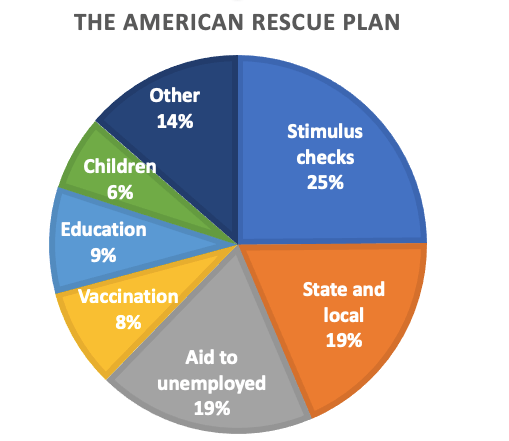
And that’s what the American Rescue Plan mostly involves; it is, as Biden’s economists say, a bottom-up plan that starts with estimated needs. Using numbers from the Committee for a Responsible Federal Budget, here’s the composition of the proposed package:070221krugman1-jumboAlthough discussion is weirdly dominated by those proposed $1400 checks, they’re only a fraction of the total; medical spending, school aid, aid to the unemployed, and help for state and local governments dominate the plan. And there’s a good case for those checks, too; more about that later.

. . . But what about the argument that there are big elements of the Biden plan that aren’t essential relief?

Skepticism about the substance of the Biden plan, as opposed to its size per se, mainly centers on the idea of sending cash to the great majority of American adults — the so-called stimulus checks, although they aren’t stimulus and they aren’t checks. There are other elements; . . . some believe that aid to state and local governments will be bigger than necessary. But the stimulus checks are the big question mark. So let’s focus on them, and with them the broader question of how to set the stage for future policy.

There’s no question that many people receiving stimulus checks will be people who haven’t taken a serious hit to their income and don’t need special help. In that sense the checks will be poorly targeted, certainly as compared to enhanced unemployment benefits.

However, we know that a substantial number of people experiencing significant income losses won’t be helped by unemployment benefits — for example, those who are still working but at reduced hours or wages. Universal basic payments will give such people much-needed help. True, they’re a leaky bucket, and you wouldn’t want them to be the main element of a rescue plan — but they aren’t! They’re a supplement that will do some good.

And they’re also hugely popular, which isn’t an irrelevant consideration.

Actually, every major element in the Biden plan has strong public approval. But support for stimulus checks is through the roof.

[Note: According to a poll taken this month, 68% of voters want Biden and the Democratic Congress to pass a relief package that will do the most to stop the spread of coronavirus and help people economically. Only 32% favor a smaller package that will do less but have bipartisan Republican support.]

Now, policy shouldn’t be driven entirely by opinion polls. But if you care about setting the stage for policy beyond the pandemic, delivering the goods to voters in the first round will be crucial.

Of all the arguments made by critics of a big rescue plan, the one that really has me rubbing my eyes is the suggestion that we should scale the plan back to make room for later policies, like investment in infrastructure. Wasn’t the overwhelming lesson from the Obama years that that’s not how it works? The effective constraint on good policy isn’t financial, it’s political — and as a result underpowered policy in the short run ends up killing the chance of good policy in the years ahead.

A trip down memory lane: Back in 2009 I was more or less frantically warning that the Obama stimulus was too small, and a key part of that warning was my fear that going small would undermine future policy prospects. Here’s what I wrote in January 2009:

“I see the following scenario: a weak stimulus plan, perhaps even weaker than what we’re talking about now, is crafted to win those extra GOP votes. The plan limits the rise in unemployment, but things are still pretty bad, with the rate peaking at something like 9 percent and coming down only slowly. And then Mitch McConnell says “See, government spending doesn’t work.”

“Let’s hope I’ve got this wrong.”

Alas, I didn’t have it wrong.

Circumstances are different now, but the basic logic is the same. If you want effective policy on infrastructure, on the environment, on children and more, Biden has to deliver big, tangible benefits with his rescue plan. Otherwise he’ll squander political capital, and probably lose any chance to do significantly more.

So this plan really needs to go big. The risks, economic and political, of falling short are huge, and should [end the discussion].