It All Hangs Together

Yesterday, the leader of the Republican Party claimed that the January 6th riot was “staged by the government”. He didn’t explain why he, as head of the government, did nothing to stop the riot as the afternoon wore on or why juries have since convicted hundreds of the riot’s participants, including, given his assessment, many government agents.

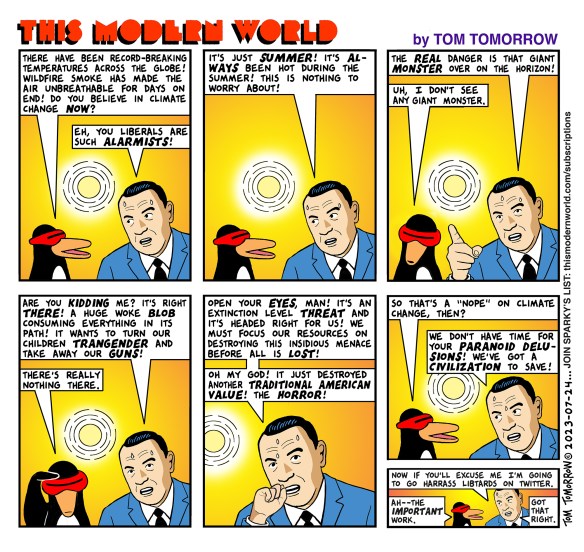
That he is still the leader of the party tells us a lot about Republican voters and politicians. It also provides context for Tom Tomorrow’s latest bulletin from This Modern World.

06556a5b-f184-76cb-de64-c6c3fbfc8c81

Where We Live Matches How We Vote

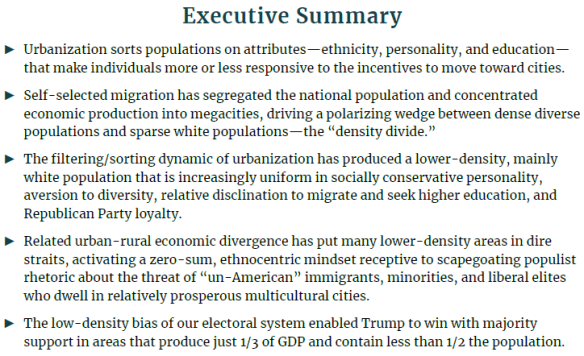
To understand the disheartening state of American politics, we need to consider the growth of cities and suburbs and the related decline of rural areas. That’s the conclusion of a 79-page report issued a few years ago by Will Wilkinson of the Niskanen Center. It’s called “The Density Divide: Urbanization, Polarization and Populist Backlash”. Here the author summarizes his findings: 

I weave recent research in political science, economics, psychology and more into an account of political polarization and the rise of populist nationalism as a surprising and overlooked side-effect of urbanization.

I claim that we’ve failed to fully grasp that urbanization is a relentless, glacial social force that transforms entire societies and, in the process, generates cultural and political polarization by segregating populations along the lines of the traits that make individuals more or less responsive to the incentives that draw people to the city. I explore three such traits — ethnicity, ideology-correlated aspects of personality, and level of educational achievement — and their intricate web of relationships.

The upshot is that, over the course of millions of moves over many decades, high density areas have become economically thriving multicultural havens while whiter, lower density places are facing stagnation and decline as their populations have become increasingly uniform in terms of socially conservative personality, aversion to diversity, and lower levels of education. This self-segregation of the population, I argue, created the polarized economic and cultural conditions that led to populist backlash.

Because the story of urbanization just is the story of a strengthening relationship between density, human capital and economic productivity, it’s also the story of relative small town and rural decline. The same process that has filtered better-educated, more temperamentally liberal whites out of lower density places has left those places with less vibrant economies, but also with more place-bound, ethnocentric populations.

It’s no shock that leavers leave and stayers stay. What’s surprising is that, if you’re white (and if you’re not, you’re almost certainly urban), the personality traits that make you more or less inclined to leave or stay — that make you more or less magnetized to the rising attractive force of the city — also predict how socially conservative or liberal you’ll tend to be, and which political party you’ll tend to support.

So the pull of urbanization has segregated us geographically on those traits, and it has done it so thoroughly that Democratic vote share now rises, and Republican vote share drops, in a remarkably linear fashion as population density rises. The relationship between density and party affiliation is, with few exceptions, similar everywhere — in “red states” and “blue states,” in sprawling metro regions and bucolic small towns — and majorities tend to flip at the density typical of a big city’s outer suburbs. I call this partisan polarization on population density the “density divide.”

When populations segregate geographically on traits relevant to ideology and party affiliation, political polarization is sure to follow. The increasing concentration of the economy in big cities, which is both a cause and effect of urbanization, amplifies this polarization. Rising prosperity reliably produces a liberalizing, tolerant, positive-sum mood. Material insecurity, in contrast, tends to elicit a grim, zero-sum, us-or-them mindset.

Because the sunshine of prosperity has become increasingly focused on urban populations, lower density white populations — which, thanks to the sorting logic of urbanization, are already more conservative and ethnocentric — have been left with objectively darkening prospects and a mounting sense of anxiety that is, at once, economic and ethno-cultural.

This combination of conditions created a political opportunity [our former president] managed to exploit. Because urbanization is reshaping societies everywhere around the world, it has created similar conditions, and similarly illiberal strongman leaders, in other countries as well. If we’re going to be able to do anything about the acrimony of polarization and the peril of ethno-nationalist populism, we’re going to have to get the story straight. This cross-disciplinary account of the social and psychological forces behind the density divide is my preliminary attempt to put us, finally, on the right track.

Untitled

Unquote.

The growth of cities and suburbs tends to make American politics more progressive, but a constitution ratified in 1789 that favors small states doesn’t make it easy.

It’s Dangerous to Criticize Israel

Israel is one of the sacred cows of American politics. Thou shalt not speak ill of Israel. A Democratic politician made a questionable statement this week. Reaction was swift and, according to Michelle Goldberg of The New York Times, “hysterical”:

Last weekend, Representative Pramila Jayapal, a Washington Democrat who is chair of the Congressional Progressive Caucus, made a significant political error. She called Israel a “racist state,” instead of simply a state that has racist leaders who treat many of the people under their authority as second-class citizens or worse on account of their ethnic and religious background.

Her rhetorical misstep generated international headlines and rebukes from Democrats and Republicans alike, demonstrating that, no matter how far Israel veers from liberal democratic norms, when it comes to American politics, it’s still protected by a thick lattice of taboos.

Jayapal’s gaffe occurred at Netroots Nation, a progressive conference held in Chicago, where pro-Palestinian activists interrupted a panel she was on…. Seeking to placate the demonstrators, Jayapal agreed that Israel is a “racist state” — one of their key contentions — and said that the “Palestinian people deserve self-determination and autonomy, that the dream of a two-state solution is slipping away from us.”

Almost as soon as she got off the stage, Jayapal told me on Monday, she realized she shouldn’t have used the phrase “racist state.” Sure enough, she was soon deluged by criticism not just from the right, but from some in her own party.

One group of centrist Democratic lawmakers circulated a draft of a letter blasting her words as “unacceptable” and saying that efforts to “delegitimize and demonize” Israel are “dangerous and antisemitic.” House Democratic leaders declared that “Israel is not a racist state” in a statement of their own….. On Sunday, Jayapal offered an apology and a clarification, saying, “I do not believe the idea of Israel as a nation is racist,” even though there are “extreme racists” enacting “outright racist policies” in Prime Minister Benjamin Netanyahu’s government.

Jayapal’s clarification was wise: It’s good to be as precise as possible when discussing an issue as fraught and complex as the conflict between Israelis and Palestinians. Her words at Netroots Nation could have been interpreted as ideological opposition to Zionism, which does not reflect Jayapal’s views; like most Democrats, she wants to see a Jewish state alongside a Palestinian one. Nevertheless, the ferocity of the backlash was striking, suggesting a brittle political denial about Israel’s increasingly authoritarian, jingoistic turn.

It’s telling that Democratic House leaders referred in their statement to Israel’s 1948 Declaration of Independence, which pledges that Israel will “uphold the full social and political equality of all its citizens, without distinction of race, creed or sex.” We can argue about whether that promise was ever compatible with a political project that, in creating a national home for one oppressed and stateless people, made refugees of another. What’s important today, however, is that Israel’s leadership no longer even appears to aspire to this founding ideal.

“Israel is not a state of all its citizens,” Netanyahu wrote in 2019. “According to the basic nationality law we passed, Israel is the nation state of the Jewish people — and only it.” He was referring to a 2018 law, which, among other things, downgraded the official status of Arabic, the language of about a fifth of Israel’s population.

Today, there are nearly equal numbers of Jews and Palestinian Arabs living in Israel and the occupied territories. For Palestinians living under occupation, there is no pretense of equal rights: They are subject to regular land seizures and home demolitions and constant restrictions on their freedom of movement. But even Palestinian citizens of Israel face legal as well as social discrimination. Israel’s Palestinian citizens, for example, cannot obtain citizenship for spouses who are from the West Bank or Gaza, dooming thousands of couples to live separately.

Israel’s security minister, Itamar Ben-Gvir, a disciple of the fanatically anti-Arab rabbi Meir Kahane, was once convicted of inciting racism and supporting terrorism. He used to have a photograph of Baruch Goldstein, a settler who massacred 29 Muslim worshipers in 1994, hanging in his living room. Israel’s government is considering creating a security militia under his control.

Of course, a state’s leaders and policies can be bigoted without the state itself being irredeemable. That’s basically Jayapal’s stance, which is why she’s not an anti-Zionist. But the rush to condemn her offhand remarks is not about encouraging linguistic rigor. It’s about raising the political price of speaking about Israel forthrightly. If you believe in liberal ideals, Netanyahu’s government is very hard to defend. It’s easier for Israel’s most stalwart boosters to harp on a critic’s slight misstatement — especially when denunciation of Israel is likely to ramp up ahead of the address by Israel’s president, Isaac Herzog, to Congress on Wednesday, which several progressive lawmakers are refusing to attend.

Israel’s most die-hard backers, Jayapal told me, are “feeling that they’ve lost credibility because the Netanyahu government’s policies are so racist, and they want to silence any discussion of any criticism.” She’s right. If Israel’s champions are truly worried about the fallout from accusations of racism, they might act to make them seem less credible.

Two Very Different Presidents, Two Very Different Paths

Like so many others, the historian Kruse Kruse now has a Substack newsletter. In this edition, he sheds light on a famous speech from 43 years ago that attempted to make America better but failed.

Today [July 15th] marks the anniversary of [President] Jimmy Carter’s deeply unpopular “Malaise speech,” which actually was not deeply unpopular and actually never used the word “malaise.”

In the late 1970s, the United States was reeling from crises on several fronts, ranging from economic “stagflation” (a new term coined to describe the previously unimaginable mix of high inflation and high unemployment) to an energy crisis sparked by the one-two punch of Middle Eastern oil embargoes and OPEC’s price hikes.

In early July, President Carter scrapped plans for an address on the energy crisis, deciding that he needed to dig deeper to diagnose what was ailing America. The president assembled a cast of political figures and public intellectuals for ten days of free-ranging discussion and frank deliberation at Camp David. The conversations covered a great deal of ground, but the president focused in on what became the actual title of his misremembered speech: the country’s “Crisis of Confidence.”

On July 15, 1979, Carter delivered the speech in a nationally televised address.

Pairing the Camp David conversations with feedback he’d gotten from “other Americans, men and women like you,” Carter rattled off a series of seemingly disconnected comments that, taken together, spoke to the dissatisfaction, distrust and discontent of the American people. “The erosion of our confidence in the future,” he warned, “is threatening to destroy the social and the political fabric of America.”

Carter offered a clear-eyed vision of how, and why, Americans had come to doubt their government and, as a result, to doubt themselves too:

We were sure that ours was a nation of the ballot, not the bullet, until the murders of John Kennedy and Robert Kennedy and Martin Luther King, Jr. We were taught that our armies were always invincible and our causes were always just, only to suffer the agony of Vietnam. We respected the Presidency as a place of honor until the shock of Watergate.

We remember when the phrase “sound as a dollar” was an expression of absolute dependability, until ten years of inflation began to shrink our dollar and our savings. We believed that our nation’s resources were limitless until 1973 when we had to face a growing dependence on foreign oil.

As he well understood, the general dissatisfaction and distrust in government had been a main reason for Carter’s own election. While presidential candidates had long campaigned on a résumé thick with political roles and posts in Washington D.C., Carter leveraged his identity as “an outsider” — in a move others would quickly copy — who bore no responsibility for creating these crises and who could therefore have a better shot at fixing them.

But two and a half years into his presidency, Carter was “Washington” and these problems were now his own. Still, he tried to ally himself with unhappy Americans: “You don’t like it, and neither do I. What can we do?”

The president offered a blunt assessment:

We are at a turning point in our history. There are two paths to choose. One is a path I’ve warned about tonight, the path that leads to fragmentation and self-interest. Down that road lies a mistaken idea of freedom, the right to grasp for ourselves some advantage over others. That path would be one of constant conflict between narrow interests ending in chaos and immobility. It is a certain route to failure.

All the traditions of our past, all the lessons of our heritage, all the promises of our future point to another path — the path of common purpose and the restoration of American values. That path leads to true freedom for our nation and ourselves. We can take the first steps down that path as we begin to solve our energy problem.

Energy will be the immediate test of our ability to unite this nation, and it can also be the standard around which we rally. On the battlefield of energy we can win for our nation a new confidence, and we can seize control again of our common destiny.

Carter then laid out a detailed plan for common action on the energy crisis, one that called for reducing oil imports, diverting resources to alternative fuels, imposing stark conservation efforts and rationing gasoline.

There were, as one might expect, calls for government programs — a version of the War Production Board of World War II that would focus on energy, a plan for greater investments in public transportation, a tax on windfall profits to fund it all, etc. — but the emphasis was on the private, voluntary action of the American people. President Carter was confident they would rise to the challenge. “With God’s help and for the sake of our nation, it is time for us to join hands in America,” he urged in closing. “Let us commit ourselves together to a rebirth of the American spirit. Working together with our common faith we cannot fail.”

Despite later memories of the speech as a disaster, it was actually a tremendous success. News coverage was generally positive, with political leaders heaping praise on the president for his mixture of blunt talk and bold faith.

Most notably, President Carter’s approval rating, which had been an abysmal 26% before the speech, shot up to 37% after the speech, an impressive 11-point bump that seemed to many to signal a turnaround in his political fortunes.

But that good luck was short-lived. As he moved from words to deeds, Carter made some serious missteps, most significantly securing formal offers of resignation from his entire Cabinet and several senior White House aides…. Carter meant this to be a sign of how serious his administration was taking the crisis, but most Americans saw it [as] a sign of chaos and confusion. The good will of the speech was quickly wiped away, and as additional problems arrived, like the Iran hostage crisis, Carter only found himself discredited again.

Meanwhile, an alternative vision — the first path of “self-interest” that the pious Carter had dismissed — was advanced by former California Governor Ronald Reagan as he secured the Republican nomination and challenged the incumbent president. Like Carter’s critics on both the left and right, Reagan ignored much of what Carter had actually said and instead latched onto a word the longtime Democratic operative Clark Clifford had casually tossed out to reporters in describing the speech: America’s sense of “malaise.”

“That is really the question before us tonight,” Reagan said the evening before the 1980 election. “For the first time in our memory many Americans are asking: does history still have a place for America, for her people, for her great ideals? There are some who answer no; that our energy is spent, our days of greatness at an end, that a great national malaise is upon us.”

Carter had offered a blunt assessment of the country’s problems but expressed a sharp faith in Americans’ ability to come together and conquer them, but in Reagan’s hands the underlying optimism of that message was spun into nihilistic pessimism. “I find no national malaise,” Reagan said. “I find nothing wrong with the American people.”

Carter called on the American people to join together in common cause and to make personal sacrifices for the sake of the nation. Reagan dismissed all that as needless pessimism and confirmed their complacency….

Seeking to echo FDR’s famous first inaugural address, Carter had bluntly addressed the nation’s “crisis of confidence” but expressed his faith that, with a little hard work and personal sacrifice, Americans could pull themselves out of their problem. There was, in effect, nothing to fear but fear itself.

In sharp contrast, Reagan simply insisted there was nothing to fear, nothing to sacrifice, nothing to work together to do — except show Jimmy Carter the door.

It’s not surprising which message ultimately resonated with voters, between the challenge of self-sacrifice and the comfort of self-interest.

And it’s not surprising that political leaders, from both parties, took notice.
Bidenomics as Transformational

Ronald Reagan gave us Reaganomics, for which he should never be forgiven. The next “n” president was responsible for Clintonomics, a set of policies somewhere to the left of Reaganomics. Now we have Bidenomics. Journalist and lecturer John Stoehr is very impressed:

Joe Biden ran for president as Mr. Normalcy. During the pandemic, with the body count rising and the economy teetering, he looked pretty good next to a lying, thieving, philandering sadist who refused to lead the nation or take responsibility for it. Compared to [that other guy], Biden was a no-brainer. All he had to do was brush his teeth and mind his posture.

But Biden is not Mr. Normalcy…. Last month, during a speech in Chicago, he embraced the fact that he is what his former boss (you remember center-left Obama) had always wanted to be: a transformational president. “Bidenomics is working,” he said….

This is a BFD, and not because he’s reclaiming an insult. “Bidenomics” is real, new and, most of all, believable. Its namesake is self-consciously embracing it, indeed he’s running for reelection on it. Biden is saying the old regime is dead, and if I win, I’ll make sure it stays that way.

That’s a BFD.

“Bidenomics” is real. The economy is adding jobs at rates unseen since the 1960s. Private firms hired nearly half a million people last month, doubling expectations. (Inflation has also been slowing, for months) [now at an annual rate of 3% according to the government’s latest estimate].

“Bidenomics” is new. The last time the government invested in the economy, in the way that it’s currently investing in it, was six decades ago, which is also the last time jobs were added at such rates.

“Government is no longer shying away from pushing investment toward specific goals and industries,” wrote EJ Dionne. “Spending on public works is back in fashion. New free-trade treaties are no longer at the heart of the nation’s international strategy. Challenging monopolies and providing support for unionization efforts are higher priorities.”

But the biggest reason “Bidenomics” is a BFD is that it’s believable.

Since I came of age in the 1980s, most people most of the time have been receptive to the claim that “government interference” in a free market society – taxing wealth progressively, regulating critical industries, expanding opportunities, investing in public works – is something akin to socialism. To be sure, no one really knew what socialism was, not even the so-called socialists. It just sounded right….

For one thing, the Great (Long) Recession showed us that a free market society can’t be free. If you’re too big to fail, you’re also too big to jail – full stop. For another, the pandemic showed us that “government interference” isn’t as bad as we thought, given that we’d have died without it. The lucky survivors among us would be much poorer, too.

So Biden is not arguing that the old political order is dead. He’s pointing his finger at its moldering cadaver and saying, look! It’s dead! In Chicago, he declared that the regime of the last 40 years, which included the policies of his Democratic predecessors, is no longer viable. New conditions, challenges and urgencies call for a new regime.

Normal presidents try to appear to break from the past.

Transformational presidents do not try to appear to break. They break.

But the past was already broken.

Biden is not leading us toward regime change as much as he is leading us toward a consensus that the old regime has already changed. The old regime (sometimes called “neoliberalism,” sometimes called “Reaganomics,” after Ronald Reagan) started OK. It privileged tax cuts, deregulation, privatization and free trade. But that was at the expense of normal people, their standards of living, and the democracies they inhabited. The old regime was good — for the very obscenely rich.

Even so, every president since 1980, including Biden’s former boss, protected that political order, even as it immiserated the middle class over time. (Wages were higher in the 1960s, adjusted for inflation, than today, though, thanks to “Bidenomics,” they are finally catching up.)

Joe Biden is the first president in my lifetime, going back to Richard Nixon, to self-consciously take the side of people who work for a living while also self-consciously making enemies of people who own so much they don’t have to work. That’s a transformational president.

That’s regime change.

That’s a BFD.