Radical Judges Running Wild

It’s only getting worse at the Supreme Court now that six of the nine justices are Republicans. A University of Texas law professor explains:

Last week the Supreme Court, by a 5-to-4 vote, put back into effect a T___ administration regulation that [makes it harder for] states to [protect rivers and streams from being polluted]. The unsigned, unexplained order in Louisiana v. American Rivers came as part of a highly technical dispute over the scope of the Clean Water Act — and leaves for another day whether the regulation is a valid interpretation of that Nixon-era statute.

But the temporary decision cannot be ignored, especially because of the brief but blistering dissenting opinion written by Justice Elena Kagan. It’s not the first time that liberal justices have called out most of the court’s conservative [no, radical] justices for their increasingly frequent use of the so-called shadow docket — unsigned, unexplained orders like the one last week. But it was significant for being the first time that [Republican] Chief Justice John Roberts joined her (and Justices Stephen Breyer and Sonia Sotomayor) in doing so.

With the striking public stance, the chief justice illustrated how concerns about the procedural shortcuts the other [right-wing] justices are taking . . . . He also made clear what many have long suspected: The Roberts court is over.

The term “shadow docket” was introduced by the University of Chicago law professor Will Baude in 2015 to describe the more obscure part of the Supreme Court’s work — the thousands of unsigned and usually unexplained orders that the justices issue each year to manage their docket. Those orders are in contrast to the merits docket, the 60 to 70 cases each year that go through rounds of briefing and oral argument before being resolved in long, signed opinions for the court.

Owing to its inscrutability, the shadow docket has historically received much less public attention or scrutiny. Most shadow docket orders are anodyne — matters as routine as refusing to take up an appeal or giving a party more time to file a brief.

But far more than ever before, the court is using procedural orders on applications for emergency relief while appeals work their way through the courts to resolve disputes affecting the lives of millions of Americans — whether in blocking a rule from the Occupational Safety and Health Administration on a vaccination mandate for large employers, refusing to block Texas’ ban on most abortions after six weeks or putting back into effect congressional district maps that two Alabama lower courts struck down as violating the Voting Rights Act.

Time and again, the [Republican] justices are ordering lower courts to treat these decisions as precedents — even when, as in last week’s ruling, the order includes no analysis to apply to other cases, which often makes the precedent difficult for lower courts to apply.

Unsurprisingly, these rulings have provoked increasingly strident dissents from the court’s liberal justices. Last September, when the justices refused, by a 5-to-4 vote, to halt the patently unconstitutional Texas abortion law, Justice Kagan criticized the majority not just for the substance of its ruling but also for what that ruling said about the shadow docket. She wrote, “The majority’s decision is emblematic of too much of this court’s shadow-docket decision making — which every day becomes more unreasoned, inconsistent and impossible to defend.”

Last week, by freezing a district court injunction despite a lack of evidence that it was harming the complaining states, the majority once again defied the requirements for the very emergency relief they granted. Justice Kagan wrote that that renders the court’s “emergency docket not for emergencies at all” but rather “only another place for merits determinations — except made without full briefing and argument.” In other words, the principal justification for shadow docket orders — the need to intervene early in litigation to prevent a party from suffering irreversible harm while the appeal unfolded — was nowhere to be found.

Chief Justice Roberts voted with Justices Breyer, Sotomayor and Kagan in dissenting from six previous shadow docket rulings. But the Clean Water Act dispute was the first time he joined in the procedural criticism that the other conservatives were not just using the shadow docket but abusing it. . . .  By publicly endorsing the charge that the conservative justices are short-circuiting ordinary procedures to reach their desired results without sufficient explanation, Chief Justice Roberts provided a powerful counter to defenders of the court’s behavior, [such as hard-right] Justice Samuel Alito. . . . 

What is especially telling about Chief Justice Roberts’s dissents in these shadow docket cases is that, unlike Justices Breyer, Sotomayor and Kagan, he’s often been sympathetic to the results. In February’s Alabama redistricting ruling, for instance, Chief Justice Roberts agreed that the court should reconsider the interpretation of the Voting Rights Act under which Alabama’s maps had been struck down; he just believed that any change in that interpretation had to come through the merits docket, not the shadow docket.

At least on the shadow docket, though, that’s no longer up to him. Instead, the court’s destiny increasingly appears to be controlled by Justices Brett Kavanaugh and Amy Coney Barrett. She implored an audience at the Ronald Reagan Presidential Library just last week to “read the opinion” before jumping to any conclusions about whether the justices are acting more like politicians than judges. Two days later, she joined the majority’s unsigned, unexplained order in the Clean Water Act case, in which there was no opinion to read. Justice Kavanaugh, too, [is] troubled by criticism of the court’s behavior, [not] the behavior itself . . . . 

The court’s credibility [is wearing out]. The justices have long insisted — as Justices Sandra Day O’Connor, Anthony Kennedy and David Souter [all nominated by Republican presidents] put it in 1992 — that “the court’s legitimacy depends on making legally principled decisions under circumstances in which their principled character is sufficiently plausible to be accepted by the nation.” The proliferation of principle-free decisions affecting more and more Americans — and with a clear, troubling tendency of favoring Republicans over Democrats — calls that legitimacy into increasingly serious question.

It’s understandable, then, why Chief Justice Roberts would finally speak out. . . .  If even his objections can’t persuade the other [Republicans] to stop abusing the shadow docket, then that may signal the willingness of the court’s [radical right] majority to go even further in the future and to use the shadow docket to resolve even more significant and contentious constitutional questions.
Providing for the General Welfare Works

I don’t think I’ve ever heard anybody say the goal of the Democratic Party is to “provide for the general welfare” (that phrase from the Constitution). We’ve all heard instead that Democrats are fiscally irresponsible big spenders, while Republicans keep government spending under control, helping the economy grow. Simon Rosenberg, who leads a progressive think tank, explains how wrong this is: 

Inconvenient truth, fiscal responsibility edition:

Biden is now the third consecutive Democratic president to have seen the annual deficit drop significantly on their watch. It rose significantly under the last three Republican presidents.

[Biden] said he’d soon become the only president “ever to cut the deficit by more than $1 trillion in a single year.” He’s on track to deliver. . . . 

When it comes to the deficit, Americans have endured a remarkably consistent pattern for four decades.

It starts with a Republican presidential candidate denouncing the deficit and vowing to balance the budget if elected. That Republican then takes office, abandons interest in the issue, and expresses indifference when the deficit becomes vastly larger. Then a Democrat takes office, at which point Republican lawmakers who didn’t care at all about the deficit suddenly decide it’s a critical issue that the new president must immediately prioritize.

During the Democratic administration, the deficit invariably shrinks — a development Republicans tend to ignore — at which point the entire cycle starts over.

As the cycle spins, polls continue to show that most Americans see Republicans as the party most trustworthy to reduce the deficit, despite reality, because some partisan branding is tough to change, even in the face of four decades’ worth of evidence. [Steve Benen, MSNBC]

There is perhaps no more important false narrative in American politics than the [Republican Party] is the party of growth and fiscal responsibility.

Team Biden appears to be eager to take that on. Praise f—ing be.

The White House is leaning into a new argument: That deficit reduction can and should be recast as a positive feature of successful *progressive* economic policy. [Greg Sargent]

As we’ve been saying for many months now, it is essential that every 2022 voter knows that when Democrats are in power things get better, and when Republicans are in power they don’t.

The data is clear, overwhelming. . . .

 [It’s] the most important, least understood story in American politics. . . 

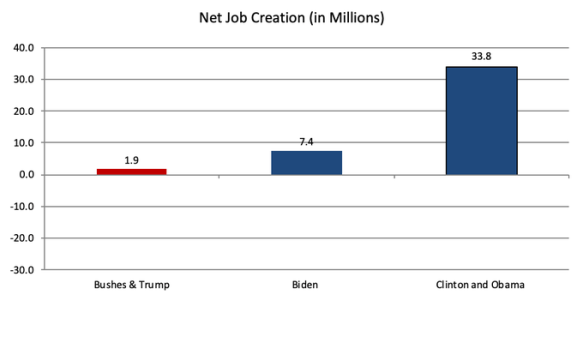
Since 1989, 43 million jobs have been created in the US, 41 million – 95% – have come under Democratic presidents. 

33.8 million jobs = 16 yrs of Clinton & Obama 

7.4 million jobs = 13 months of Biden

1.9 million jobs = 16 years of Bush, Bush & T____ [Rosenberg]

FNBxgDGX0AQdi1L

. . . Democrats need to have this conversation with voters this year. It is essential knowledge, critical to understanding where we are, and where we are going as a nation.

Unquote.

It’s amazing that voters regularly say they “trust” Republicans more on the economy despite their consistently worse results. Why? Republicans associate themselves with low taxes and getting the government “out of the way”. But reducing taxes on people and corporations who already have lots of money doesn’t help the economy; it simply concentrates more wealth at the top. Repealing the Affordable Care Act or abolishing the Department of Education wouldn’t create jobs. Democrats do a better job on the economy by spreading the wealth around. They do this by promoting the “general welfare”, as the Constitution requires. When the general population is better off, the economy is better off. It’s as simple as that.

What Was Putin Thinking?

Why did he miscalculate so badly? Greg Sargent of The Washington Post asked that question of historian Timothy Snyder, the author of Bloodlands: Europe Between Hitler and Stalin and On Tyranny: Twenty Lessons from the Twentieth Century:

Sargent: What is it about Putin’s way of seeing the world, and his understanding of his own mythologies, that made it inevitable that he’d underestimate the Western response?

Snyder: For me the most revealing text here is the victory declaration, which the Russian press agency accidentally published on Feb. 26. What they say is that the West just basically needed one more push to fall into total disarray.

If you watch Jan. 6 clips over and over again, you can get that impression. The Russians really have been fixated on Jan. 6.

They thought a successful military operation in Ukraine would be that nudge: We’d feel helpless, we’d fall into conflict, it would help D____ T____ in the U.S., it would help populists around the world.

Sargent: When you say Russia has been making a lot of Jan. 6 — what do they read into it?

Snyder: . . . T____’s attempt to overthrow the election on Jan. 6 made the American system look fragile. They think, “One more T____ and the Americans are done.” In invading Ukraine, they think they’re putting huge pressure on the Biden administration. They’re going to make Biden look weak.

That probably was their deep fantasy about the West: Successful military occupation in Ukraine; the Biden administration is totally impotent; we humiliate them; T____ comes back; this is a big strategic victory for us.

Sargent: There’s an essential through line from Jan. 6 to what we’re seeing now: Accountability for Jan. 6 becomes more important in this geopolitical context, where we’re reentering a conflict with Russia over whether liberal democracy is durable.

Snyder: . . . Putin’s idea about Ukraine is something like, “Ukrainian democracy is just a joke, I can overturn it easily. Everybody knows democracy and the rule of law are just a joke. What really matters are the capricious ideas of a tyrant. My capricious ideas happen to be that there are no Ukrainians. I’m going to send my army to make that true”.

That is much closer to the way T____ talks about politics than the way the average American talks about politics. I’m not saying T____ and Putin are exactly the same. But T____’s way of looking at the world — “there are no rules, nothing binds me” — that’s much closer to Putin. So there’s a very clear through line.

Sargent: . . . on some fundamental level, [Republicans aren’t] willing to forthrightly disavow Trump’s alignment with Putin and against Ukraine and the West.

Snyder: I have this faint hope that Ukraine allows some folks to look at domestic politics from a new angle.

When we were in the Cold War, one reason the civil rights movement had the success it did, and one reason we kept up a welfare state, was that we were concerned about the Soviet rival.

Russia is a radically anti-democratic country now. Not only has it done frightful things to its own society; it has invaded another country that happens to be an imperfect democracy. We’re also an imperfect democracy.

When you have to look straight at the reality that a big powerful country is aimed at taking imperfect democracies and wiping them out, that gives you pause. I’m hopeful the realization that democracy rises and falls internationally might change the conversation at some deeper level about how we carry out our own voting.

Sargent: Rising populism made Putin think Western liberal democracy was on the losing end of a grand struggle. But Biden and the Western allies may have seen that populism as a reason to get more galvanized and unified in response to the invasion.

Snyder: In Putin’s mind, there’s a kind of confusion of pluralism with weakness. He’s misjudged both Zelensky and Biden, who are both pluralists: They’re both willing to look at things from various points of view. That can look like a form of weakness.

But history also shows that you can be a resolute pluralist. . . . Zelensky and Biden both embody that: At the end of the day, this whole idea that we listen to each other is something that we’re going to defend.

People in Ukraine are used to being able to exchange views and listen or not listen to their own government. That’s the thing which makes them different from Russia right now. That’s not something Putin can see from a distance.

Sargent: You put your finger on something that’s been an anti-liberal trope for at least a century: That pluralism is in some sense crippling to the possibilities of resolute national action. Putin is steeped in that type of anti-liberal philosophy, isn’t he?

Snyder: Authoritarian regimes look efficient and attractive because they can make rapid decisions. But they often make rapid bad decisions — like the rapid bad decision to invade Ukraine. Putin made it with just a handful of people, so he could make that decision rapidly.

That’s the reason you want institutions, the rule of law and pluralism and public discussion: To avoid idiotic decisions like that.

He’s been working from a certain far-right Russian tradition — that the state and the leader are the same person, and there should be no institutional barriers to what the leader wants to do.

It’s important for us to see that this is the realization of a different model, which has its own logic.

Sargent: Paradoxically, we’re seeing that model’s decadence display itself.

Snyder: Of course the situation is dangerous right now. But a lot of the sparks that are flying out of Russian media are a result precisely of their own fear and their own sense of crisis.

Your word “decadence” is helpful here: When you’re decadent, what you say starts to depart more and more from the way the world actually is. Some Russian politicians are talking about how Poland needs to be taught a lesson. That’s alarming but it’s also unrealistic.

Sargent: I want to explore something you said to Ezra Klein: That in many ways, the response from the Western allies has been realistic and grounded, in that they aren’t trying to do too much. . . . 

Snyder: The thing that I’ve liked about the Biden administration is that they don’t have this metaphysical language that previous administrations have had about American power. They’ve stuck much closer to the ground.

They say, “We can’t do everything. But we can be creative and do a lot of things.”

By the way, that includes some stuff that we and others could go further on. We have to keep pouring arms into Ukraine, and the Europeans — now is the time to move forward on not buying oil and gas from Russia.

Sargent: What’s your sense of where this is all going?

Snyder: This war is happening because of the worldview and decisions of essentially one person. And I think it comes to an end when something shakes the worldview of that one person.

If the Ukrainians can get the upper hand and keep it for a few weeks, I think the worldview we have been talking about may start to shudder.

The right side has to be winning. That’s when we might have a settlement that ends this horrible war.

They Wanted To Assassinate a Troublesome Reporter

President Richard Nixon avoided impeachment or a jail cell by resigning. This strange story from 50 years ago made me wonder what plots were discussed in the White House more recently and whether that president will ever be punished. From The Washington Post:

Nixon’s hatred for the news media long predated his election as president. Where other politicians shrugged off public criticism, Nixon believed he was uniquely the target of journalistic vilification. When he entered the White House in 1969, he vowed revenge.

As president, Nixon ordered illegal wiretaps on newsmen who criticized his administration and instructed FBI director J. Edgar Hoover to compile a dossier on “homosexuals known and suspected in the Washington press corps.” Nixon’s Justice Department filed antitrust charges against television networks that criticized him and went to court in an unprecedented attempt to legalize government censorship. Nixon’s aides even put together a list of “enemies,” including journalists, to be secretly targeted for government retaliation.

The journalist Nixon despised most was crusading columnist Jack Anderson, then the most famous and feared investigative reporter in the country. Anderson had a hand in exposing virtually every Nixon scandal since he first entered politics, and he escalated his attacks once Nixon was president, uncovering Nixon’s deceit in foreign policy, and his political and personal corruption.

Nixon railed that “we’ve got to do something with this son of a bitch,” but nothing seemed to stop Anderson. The president’s reelection campaign planted a mole in the newsman’s office, but Anderson’s secretary discovered the snooping and ejected the infiltrator. A top White House adviser tried to discredit Anderson by leaking him forged documents, but he figured out they were bogus and didn’t fall for the ruse. The CIA illegally wiretapped and surveilled Anderson, but his nine children chased the spies away and Anderson mocked their incompetence in his column. The president even ordered his staff to smear Anderson as gay, but the allegation was as false as it was ridiculous and went nowhere.

Finally, in March 1972, the Nixon White House turned to the one method guaranteed to silence Anderson permanently: assassination. After meeting with the president in his hideaway office in the Old Executive Office Building, White House special counsel Charles Colson contacted his top White House operative, E. Howard Hunt. The “son of a bitch” Anderson “had become a great thorn in the side of the president,” Colson told Hunt, according to Hunt’s later Senate testimony, and the White House had to “stop Anderson at all costs.” (Hunt also corroborated this story in a 2003 interview.)

According to Hunt, Colson proposed assassinating Anderson by using an untraceable poison, perhaps a high dose of a hallucinogen like LSD. Colson instructed Hunt to “explore the matter with the CIA,” where Hunt had previously worked as a spy. Although he never explicitly stated that Nixon gave the order, Colson told Hunt that he was “authorized to do whatever was necessary” to eliminate the reporter.

Hunt brought in his White House sidekick, G. Gordon Liddy, who was “forever volunteering to rub people out,” as Hunt put it. Liddy was enthusiastic: It would be a “justifiable homicide,” he later said in media interviews, because Anderson was a “mutant” journalist who had “gone too far” and “had to be stopped.”

On March 24, 1972, Hunt and Liddy met with a veteran CIA poison expert, Edward T. Gunn, in the basement of the Hay-Adams Hotel, a block from the White House. Gunn and Liddy, who didn’t know each other, used aliases.

Gunn later told Watergate prosecutors that Hunt said someone “was giving them trouble” and wanted an untraceable poison “that would get him out of the way.” Gunn replied that no poison was completely undetectable. But he said the CIA had success painting LSD on a car’s steering wheel; the drug was then absorbed while driving and could cause a fatal car crash. However, there was also the risk that others — such as Anderson’s wife or children — would be poisoned if they drove the car instead.

“Of course, there’s always the old simple method of simply dropping a pill in a guy’s cocktail,” Gunn suggested. But Hunt pointed out that as a Mormon, Anderson was a teetotaler.

“Aspirin roulette” was another option, Liddy said: slipping a “poisoned replica” of his headache tablet into his medicine bottle. Liddy and Hunt had already cased Anderson’s house for a possible break-in. But it would be “highly impractical,” Hunt argued, to “go clandestinely into a medicine cabinet with a household full of people and pore over all of the drugs … until you found the one that Jack Anderson normally administered to himself.”

Besides, Liddy realized, it would take too long: “Months could go by before [Anderson] swallowed it.” Not to mention the “danger than an innocent member of his family might take the pill” instead.

It might be simpler, Gunn suggested, to make Anderson’s car crash by ramming into it. Hunt and Liddy had already tailed Anderson as he drove between his home and office, and Gunn suggested a specific location along the route that was “ideal” because it was already “notorious as the scene of fatal auto accidents” in Washington.

But Liddy thought this method was “too chancy” and argued for simplicity: Anderson “should just become a fatal victim of the notorious Washington street-crime rate.” Liddy offered to stab Anderson to death and make it look like a routine robbery by stealing Anderson’s watch and wallet. “I know it violates the sensibilities of the innocent and tender-minded,” Liddy later told Playboy, “but in the real world, you sometimes have to employ extreme and extralegal methods to preserve the very system whose laws you’re violating.”

Hunt briefed Colson about these various assassination options. But a few days later, the hit was canceled. The White House had a more urgent assignment: bugging the Democratic Party’s headquarters in the Watergate office building.

A few weeks later, Hunt and Liddy were arrested for their role in the Watergate burglary. The scandal that toppled Nixon’s presidency began unraveling.

In the aftermath, a Senate committee investigated and confirmed the plot to poison Anderson. Liddy and Hunt eventually acknowledged their participation in the conspiracy. Colson never did. All three went to prison for Watergate-related crimes.

But not Nixon, whose role in the Anderson plot has never been definitively established. Hunt believed that Colson didn’t have the “balls” to order the assassination on his own and had acted at Nixon’s behest. Colson denied that. But it is hard to imagine Nixon’s closest advisers plotting to execute America’s leading investigative reporter without the tacit — if not explicit — authorization of the president.

Where Putin’s Head Is At

A Russian journalist, Mikhail Zygar, offers this explanation of Putin’s behavior. From The New York Times:

I have been talking to high-level businessmen and Kremlin insiders for years. In 2016 I published a book, “All the Kremlin’s Men,” about Mr. Putin’s inner circle. Since then I’ve been gathering reporting for a potential sequel. While the goings on around the president are opaque — Mr. Putin, a former K.G.B. officer, has always been secretive and conspiratorial — my sources, who speak to me on condition of anonymity, have regularly been correct.

What I have heard about the president’s behavior over the past two years is alarming. His seclusion and inaccessibility, his deep belief that Russian domination over Ukraine must be restored and his decision to surround himself with ideologues and sycophants have all helped to bring Europe to its most dangerous moment since World War II.

Mr. Putin spent the spring and summer of 2020 quarantining at his residence in Valdai, approximately halfway between Moscow and St. Petersburg. According to sources in the administration, he was accompanied there by Yuri Kovalchuk. Mr. Kovalchuk, who is the largest shareholder in Rossiya Bank and controls several state-approved media outlets, has been Mr. Putin’s close friend and trusted adviser since the 1990s. But by 2020, according to my sources, he had established himself as the de facto second man in Russia, the most influential among the president’s entourage.

Mr. Kovalchuk has a doctorate in physics. . . But he isn’t just a man of science. He is also an ideologue, subscribing to a worldview that combines Orthodox Christian mysticism, anti-American conspiracy theories and hedonism. This appears to be Mr. Putin’s worldview, too. Since the summer of 2020, Mr. Putin and Mr. Kovalchuk have been almost inseparable, and the two of them have been making plans together to restore Russia’s greatness.

According to people with knowledge of Mr. Putin’s conversations with his aides over the past two years, the president has completely lost interest in the present: the economy, social issues, the coronavirus pandemic, these all annoy him. Instead, he and Mr. Kovalchuk obsess over the past. A French diplomat told me that President Emmanuel Macron of France was astonished when Mr. Putin gave him a lengthy history lecture during one of their talks last month. He shouldn’t have been surprised.

In his mind, Mr. Putin finds himself in a unique historical situation in which he can finally recover for the previous years of humiliation. In the 1990s, when Mr. Putin and Mr. Kovalchuk first met, they were both struggling to find their footing after the fall of the Soviet Union, and so was the country. The West, they believe, took advantage of Russia’s weakness to push NATO as close as possible to the country’s borders. In Mr. Putin’s view, the situation today is the opposite: It is the West that’s weak. The only Western leader that Mr. Putin took seriously was Germany’s previous chancellor, Angela Merkel. Now she is gone and it’s time for Russia to avenge the humiliations of the 1990s.

It seems that there is no one around to tell him otherwise. Mr. Putin no longer meets with his buddies for drinks and barbecues, according to people who know him. In recent years — and especially since the start of the pandemic — he has cut off most contacts with advisers and friends. While he used to look like an emperor who enjoyed playing on the controversies of his subjects, listening to them denounce one another and pitting them against one another, he is now isolated and distant, even from most of his old entourage.

. . . No one can see the president without a week’s quarantine — not even Igor Sechin, once his personal secretary, now head of the state-owned oil company Rosneft. Mr. Sechin is said to quarantine for two or three weeks a month, all for the sake of occasional meetings with the president.

In “All the Kremlin’s Men” I described the phenomenon of the “collective Putin” — the way his entourage always tried to eagerly anticipate what the president would want. These cronies would tell Mr. Putin exactly what he wanted to hear. The “collective Putin” still exists: The whole world saw it on the eve of the invasion when he summoned top officials, one by one, and asked them their views on the coming war. All of them understood their task and submissively tried to describe the president’s thoughts in their own words . . .

As I have reported for years, some members of Mr. Putin’s entourage have long worked to convince him that he is the only person who can save Russia, that every other potential leader would only fail the country. This was the message that the president heard going back to 2003, when he contemplated stepping down, only to be told by his advisers — many of whom also had backgrounds in the K.G.B. — that he should stay on. A few years later, Mr. Putin and his entourage were discussing “Operation Successor” and Dmitri Medvedev was made president. But after four years, Mr. Putin returned to replace him. Now he has really and truly come to believe that only he can save Russia. In fact, he believes it so much that he thinks the people around him are likely to foil his plans. He can’t trust them either. . . .