Whereof One Can Speak đŸ‡ș🇩

Nothing special, one post at a time since 2012

The Fix Is In at the Supreme Court

The draft opinion overturning Roe v. Wade is built on the assumption fetuses deserve special treatment while denying that assumption is being made. Liza Batkin explains with “Deceit in Plain Sight” for the New York Review of Books:  

Justice Alito’s draft opinion in Dobbs v. Jackson Women’s Health Organization would have you believe that the forthcoming decision to overrule Roe v. Wade is a display of great judicial restraint and independence. The draft is written in the language of solemn duty: we do not want to take away abortion rights, the conservative justices say, but it does not matter what we want. “We can only do our job,” Alito writes, “which is to interpret the law,” and to do so regardless of personal preferences or public opinion. In the draft decision’s logic, it was Roe that exercised “raw judicial power” and Dobbs that will remedy this error by returning “the issue of abortion to the people’s elected representatives.”

These claims to neutrality and humility should make you nauseous and irate. For one thing, they come in the middle of a decision that would wield extraordinary power, disposing with a nearly half-century-old fundamental right and reshaping the lives of millions of Americans. It’s also skin-crawling that these justices pretend to be concerned with empowering “the people” through their representatives after eroding the voting rights and electoral rules that would have allowed them to be adequately represented.

This performance of duty comes from justices who have routinely championed religious interests, were nominated by Republican presidents, and have all been affiliated with the Federalist Society, an organization dedicated to promoting conservative legal ideology. While only Justice Barrett has made explicit her personal opinions about abortion, stating in a co-authored law review article in 1998 that it is “always immoral,” the others are clearly not sacrificing their moral or political views for some higher charge.

You don’t need to look very far to see that the decision is a power grab cloaked in false modesty. The flaws in the majority’s central argument, that Roe was wrong to recognize a fundamental right to abortion, have been well-exposed elsewhere. But there is another deceit at play here: while claiming fidelity to the constitutional text, the majority’s draft is steeped in unexplained views about the importance of protecting fetuses at all stages of development—views that do not come from the Constitution but have traditionally been the purview of conservative and religious antiabortion advocates, and that are exactly the kind of personal belief the majority claims not to rely on.

The issue of abortion since Roe has been a battle between competing rights: a pregnant person’s right to control their reproductive choices, and the state’s interest in protecting the potential life of a fetus. To balance these different interests, the Court has historically tried to avoid opining on the legal or moral claims of fetuses, since the issue teems with conflicting beliefs. One way to establish when the state’s interest in protecting potential life becomes compelling, the Court recognized in Roe, was to determine “when life begins.” But after a brief survey of opposing religious, philosophical, and theological views, the Court steered clear of the mire and landed instead on the line of viability, which protects the right to abortion until the fetus can survive outside the womb.

If you take Alito at his word, the Dobbs majority has managed to sidestep this balancing act altogether. The draft decision proclaims that it is “not based on any view about when a State should regard prenatal life as having rights or legally cognizable interests” and says little about the source, strength, or timing of the state’s interest in potential fetal life.

But the majority has not avoided the issue. While claiming high-minded neutrality, they hint over and over at views about the importance of protecting fetal life. Early in the opinion, Alito explains that abortion “is fundamentally different” from all other liberty interests “because it destroys what [Roe and Casey] called ‘fetal life’ and what the law now before us describes as an ‘unborn human being.’” As a result, the right to abortion presents a distinct and “critical moral question.” The draft makes this point four times.

There is, however, no reason to assert that abortion at all stages of a pregnancy presents a unique and “critical moral question” unless one already gives weight and legitimacy to moral claims for the protection of fetuses at all stages of development, starting even as soon as conception. How else can we explain the draft opinion’s circular insistence that the right to abortion is different from other rights simply because it destroys fetuses, which merely defines what an abortion does?

The terms the draft uses, too, are revealing. In veering from the “potential life” invoked by Roe and Casey and repeating without qualification the language used by the Mississippi legislature along with antiabortion amicus briefs that defend the rights of the “unborn human being” and the “unborn child,” the majority divulges its allegiances. The footnotes tell the same story. In addition to citing a large array of prior dissenting opinions by conservative justices which have no legal authority, the draft draws on amicus briefs and articles dedicated to proving that fetuses are people. Alito’s majority does all of this while claiming that it “has neither the authority nor the expertise to adjudicate” disputes about “the status of the fetus” and citing language that courts must not “substitute their social and economic beliefs for the judgment of legislative bodies.”

While we rally to protect the right of pregnant people to make decisions about their bodies and futures (and desperately hope that this draft decision does not become law), we should recognize what’s going on here. The [reactionary] justices are preparing to abuse their power, cause grievous harm, and treat us—the “people” they pretend to empower—like fools, assuming we won’t notice the contradictions they’ve left in plain sight.

Watergate Would Have Been a Bump in the Road

June 17th will be the 50th anniversary of the Watergate burglary, the poorly-executed crime that eventually led to President Richard Nixon’s resignation in lieu of impeachment. Margaret Sullivan of The Washington Post points out Nixon would have easily finished his second term if his “plumbers” had been discovered nowadays:

Thinking about Watergate saddens me these days. The nation that came together to force a corrupt president from office and send many of his co-conspirator aides to prison is a nation that no longer exists.

It’s not just our politics that have changed. It’s also our radically transformed media environment.

“The national newspapers mattered in a way that is unimaginable to us today, and even the regional newspapers were incredibly strong,” Garrett Graff, author of “Watergate: A New History,” told me last week. I have been immersed in his nearly 800-page history . . . that sets out to retell the entire story.

Graff depicts Watergate not as a singular event but as the entire mind-set of the Nixon presidency — “a shaggy umbrella of a dozen distinct scandals,” as he told me. By the time the break-in captured the attention of the most Americans, they were essentially “walking into the second or third act of a play.”

Woodward and Bernstein were almost alone on the story for months. But eventually the leading newspapers of the nation started to cover the hell out of the burgeoning scandal and the percolating questions of what — and when — the president knew about the burglary plot.

Americans read this coverage in their local papers; many cities still had two or more dailies at that point. Later, they were riveted by the proceedings of the Senate Watergate Committee, whose hearings were aired live on the three big television networks during the summer of 1973. Graff reports that the average American household watched 30 hours of the hearings, which were also rebroadcast at night by PBS. (“The best thing that has happened to public television since ‘Sesame Street,’” one Los Angeles Times TV critic noted.)

Still, “we forget how close Nixon came to surviving Watergate,” Graff told me. “Even at the end of the hearings, there was no guarantee that Nixon was out of office.”

What changed that? The increasing public awareness of the president’s wrongdoing and the coverup. “The sheer accumulation of the lies,” he said, “at a time when the idea that a president could lie to America was unthinkable.”

Flash-forward to today. The House select committee investigating the Jan. 6 insurrection will hold hearings beginning early next month, some of which will be televised during prime-time hours. Rep. Jamie Raskin, the Maryland Democrat who is a prominent member, predicts the revelations will “blow the roof off the House” — offering evidence, he promises, of an organized coup attempt involving Trump, his closest allies and the supporters who attacked the Capitol as they tried to overturn the 2020 presidential election results.

I’m willing to believe that the hearings will be dramatic. They might even change some people’s minds. But the amount of public attention they get will be minuscule compared with what happened when the folksy Sen. Sam Ervin of North Carolina presided over the Senate Watergate Committee.

Our media environment is far more fractured, and news organizations are far less trusted.

And in part, we can blame the rise of a right-wing media system. At its heart is Fox News, which was founded in 1996, nearly a quarter century after the break-in, with a purported mission to provide a “fair and balanced” counterpoint to the mainstream media. Of course, that message often manifested in relentless and damaging criticism of its news rivals. Meanwhile, Fox and company have served as a highly effective laundry service for T____’s lies. With that network’s help, his tens of thousands of false or misleading claims have found fertile ground among his fervent supporters — oblivious to the skillful reporting elsewhere that has called out and debunked those lies.

As Graff sees it, the growth of right-wing media has enabled many Republican members of Congress to turn a blind eye to the malfeasance of Team T____. Not so during the Watergate investigation; after all, it was Sen. Howard Baker, the Tennessee Republican, who posed the immortal question, “What did the President know and when did he know it?” Even the stalwart conservative Sen. Barry Goldwater of Arizona was among those who, at the end, managed to convince Nixon that he must resign.

“Republican members of Congress understood that they had a unique and important role as the legislative branch to hold the abuses of the executive branch in check,” Graff said. “That freedom of action was made possible because there was no right-wing media ecosystem.”

Not everything was good about the media world of the 1970s. . . . But it was a time when we had a news media that commanded the trust of the general public, a necessity in helping bring Nixon to justice. That, at least during his presidency, was never possible with D____ T____.

As we remember Watergate, we ought to remember how very unlikely its righteous conclusion would be today.

Richard M. Nixon’s presidency would have survived.

Some Truth About the Constitution and Well-Regulated Militias

Rolling Stone has a good article about the twisted reading of the 2nd Amendment we’re living under. From legal affairs journalist Jay Michaelson:

The lie at the heart of all of this insanity is the Right’s ludicrous perversion of the Second Amendment. . . . Until 2008, no federal court had held that the Second Amendment conveyed a right to own a gun. On the contrary, the Supreme Court clearly said that it didn’t.

Why? Because of the obvious language of the amendment, which reads, in full, “A well regulated Militia, being necessary to the security of a free State, the right of the people to keep and bear Arms, shall not be infringed.”

For nearly two hundred years, there was widespread agreement that the Second Amendment meant what it said: that the right “of the people” meant the right to bear arms in well-regulated militias, which was how the nation protected itself prior to standing armed forces and police, and which slave-owners maintained to protect against possible uprisings.

Unquote. I interrupt the Rolling Stone article to insert more about militias from lawyer M. S. Bellows, Jr.:

What many don’t know is the Constitution’s *other* militia clauses that give the 2nd Amendment context:

Yes, “militia” is discussed OUTSIDE the 2nd Amendment. Article 1, Section 8 gives Congress power over national defense, including the army, navy – and militia. If we want to understand what the 2nd Amendment means by “well-regulated militia,” that’s where we have to start.

First, the Framers knew Caesar had led his troops across the Rubicon to crush the Republic and foresaw that a too-strong standing army could topple their nascent democracy in a military coup (as we’ve seen countless times elsewhere).

Accordingly, the Framers allowed for a permanent navy but a TEMPORARY army: “Congress shall have the power… To provide and maintain a Navy” (full stop), and “To raise and support Armies, but no Appropriation of Money to that Use shall be for a longer Term than two Years.”

But how could the new nation defend itself on land without a standing (i.e., permanent) army? The militia.

The idea being that in 1787, armies weren’t hard to create quickly: just pull cannons out of a warehouse, requisition a bunch of mules/horses, and call for volunteers . . .

But there’s more to it:

By “militia,” the Framers didn’t mean the Proud Boys and similar beer-swilling yahoos acting on their own initiative. They meant volunteer professionals, soldiers who would be equipped, trained, regulated, and deployed BY CONGRESS just like other military units. Here, read it for yourself. Article I, section 8, clauses 15 and 16:

“[Congress shall have Power] To provide for calling forth the Militia to execute the Laws of the Union, suppress Insurrections and repel Invasions” and “to provide for organizing, arming, and disciplining, the Militia, and for governing such Part of them as may be employed in the Service of the United States, 
 reserving to the States respectively, the Appointment of the Officers, and the Authority of training the Militia according to the discipline prescribed by Congress.”

So: CONGRESS is responsible for deploying, overseeing, *arming*, and *disciplining* (i.e training and regulating) the militia (with the states choosing local officers and arranging for training as Congress directs). Basically, the National Guard. . . .

Which is the point of this thread: that the 2nd Amendment doesn’t stand in isolation. It’s part of a larger scheme. After the original Constitution was adopted, the Framers immediately wrote the Bill of Rights: ten amendments designed to clearly identify and protect certain rights. One of them was the right to keep and bear arms.

Why? Some Framers feared the Constitution endangered states’ rights. Southern Framers, in particular, feared Congress might disarm the state militias that existed mainly to suppress rebellion by enslaved people. So the 2nd Amendment provides that members of the militia can’t be disarmed by the federal government.

Which basically is the same as saying that federal troops aren’t allowed to seize the Oregon National Guard armory in Salem. Which is fine. I can live with that.

Unquote. So how did we get to the point where a well-regulated militia is now interpreted as almost anybody with a credit card? Back to Rolling Stone:

What changed?

. . .  While the 1972 Republican party platform had actually supported gun control, the Reagan Revolution transformed the party.  (Ronald Reagan wrote an article praising individual gun ownership in Guns & Ammo magazine in 1975.)  Now, being pro-gun, like being anti-abortion, became a pillar of the New Right ideology.

After all, it ticked all the boxes, tapping into white fears of “crime” and “the inner cities,” populist resentment of “big government,” and male fears of losing power in the age of women’s liberation. The Right’s newfound infatuation with guns was white, male fragility projected onto firearm ownership.

And what had once been a fringe view rejected by the Supreme Court — that the Second Amendment gave individuals a right to own guns — gradually became Republican Party gospel when the fringe took over the party.  Former Chief Justice Warren Burger (a conservative appointed by Richard Nixon) described it as “a fraud on the Amer­ican public.”

Eventually, this view won out, not by persuasion but by simple politics. By 2008, there were five conservative justices on the Supreme Court, and Justice Scalia wrote an opinion in D.C. v. Heller saying that the Second Amendment conferred an individual right to own guns.

There are numerous problems with Scalia’s opinion:

First, he claims that the clause about militias is just a preface, with no relevance to the meaning of the right. “The former does not limit the latter grammatically, but rather announces a purpose,” he wrote. . . .  But wait a minute – if maintaining militias is the purpose of the amendment, then why does “the people” mean not militias but individuals?  Why is a purpose not a purpose? Justice Scalia simply dismisses the first half of the amendment as merely decorative, with no function whatsoever.

Second, Scalia simply dispatches as “dubious” the drafting history of the amendment, in which James Madison deliberately did not use language of individual rights that was present in contemporaneous documents. Thomas Jefferson, for example, had once proposed “No freeman shall ever be debarred the use of arms.” That proposal was rejected.

Third, Scalia inverts the meaning of the Second Amendment itself, by saying that Congress actually can ban military-grade weapons (i.e. the kinds a militia would use) but not handguns, which are used for self-defense (which the amendment never mentions).

Of course, what’s really happening here is a social, cultural phenomenon, using the constitution as an excuse. . . .

The tragic irony . . . is that we know how to stop this from happening. . . . The advocacy group Everytown for Gun Safety lists 37 solutions on its website, from background checks to waiting periods, prohibiting ‘open carry’ to repealing ‘stand your ground’ laws, banning high-capacity magazines and assault weapons to holding the gun industry accountable.

. . .  But God help any Republican who has the courage to stand up to the NRA, gun manufacturers, and the rage of the populist Right. . . . Our [inability] to do anything about these horrifying mass shootings is not the Second Amendment’s fault. . . .It’s Republicans’ fault. It is that simple.

Unquote. Today it’s also the fault of a few rogue Democrats in the Senate who love the filibuster and fear doing anything about guns. But the point remains: almost all Republican politicians oppose gun control and almost all Democratic politicians support it. 

We’re Screwed: A Periodic Reminder (Part 2)

Jamelle Bouie of The New York Times compares today to the early 19th century, when America was ruled by the “Slave Power”. It was a crisis then. It’s a crisis now:

The antislavery politicians of the 1840s and 1850s did not speak with a single voice. . . . What tied the antislavery factions of American politics to each other wasn’t a single view of slavery or Black Americans but a shared view of the crisis facing the American republic. That crisis, they said in unison, was the “slave power.”

The “slave power” thesis was the belief that a slaveholding oligarchy ran the United States for its own benefit. It had ruled the nation for decades, went the argument, and now intended to expand slavery across the continent and even further into the North.

The “slave power” thesis was also a claim about the structure of American government itself. As these antislavery politicians saw it, “the real underpinnings of southern power were regional unity, parity in the Senate, and the three-fifths clause of the Constitution,” the historian Leonard L. Richards writes in The Slave Power. Together, this gave the slaveholding oligarchs of the South a virtual lock on much of the federal government, including the Supreme Court. “Between Washington’s election and Lincoln’s,” Richards points out, “nineteen of the thirty-four Supreme Court appointees were slaveholders.”

For antislavery politicians, the counter-majoritarian institutions of the American system enabled a faction that threatened democracy. The question of the “slave power,” then, was ultimately one of self-government. . . . 

You’ve probably guessed, by now, that this is not an idle history lesson. I am thinking about “the slave power” because I am thinking about the ways that narrow, destructive factions can capture the counter-majoritarian institutions of the American system for their own ends. I am thinking of how they can then use the levers of government to impose their vision of society and civil life against the will of the majority. And I am thinking of this in the context of guns, gun violence and the successful movement, thus far, to make the United States an armed society.

Although there has been, in the wake of the atrocities [in Buffalo and Uvalde], the requisite call for new gun control laws, no one believes that Congress will actually do much of anything to address gun violence or reduce the odds of gun massacres. The reason is that the Republican Party does not want to. And with the legislative filibuster still in place (preserved, as it has been for the last year, by at least two Democratic senators), Senate Republicans have all the votes they need to stop a bill — any bill — from passing.

The filibuster, however, is only one part of the larger problem of the capture of America’s political institutions by an unrepresentative minority whose outright refusal to compromise is pushing the entire system to a breaking point.

Large majorities of Americans favor universal background checks, bans on “assault-style” weapons, bans on high-capacity magazines and “red flag” laws that would prevent people who might harm themselves or others from purchasing guns.

But the American political system was not designed to directly represent national majorities. To the extent that it does, it’s via the House of Representatives. The Senate, of course, represents the states. And in the Senate (much to the chagrin of many of the framers), population doesn’t matter — each state gets equal say. Fifty-one lawmakers representing a minority of voters can block 49 lawmakers representing a majority of them (and that’s before, again, we get to the filibuster).

Add the polarization of voters by geography — a rural and exurban Republican Party against an urban and suburban Democratic Party — and the picture goes from bad to perverse. Not only can Republicans, who tend to represent the most sparsely populated states, win a majority of the Senate with far less than a majority of votes nationally, but by using the filibuster a small number of Republican senators representing an even smaller faction of voters can kill legislation supported by most voters and most members of Congress.

The Senate might have been counter-majoritarian by design, but there is a difference between a system that tempers majorities and one that stymies them from any action at all. We have the latter, and like Congress under the failed Articles of Confederation, it makes a mockery of what James Madison called the “republican principle,” which is supposed to enable the majority of the people to defeat the “sinister views” of a minority faction by “regular vote.”

Rather than suppress the “mischiefs of faction,” our system empowers them. Few Americans want the most permissive gun laws on offer. But those who do have captured the Republican Party and used its institutional advantages to both stop gun control and elevate an expansive and idiosyncratic view of gun rights to the level of constitutional law.

The result is a country so saturated in guns that there’s no real hope of going back to the status quo ante. If anything, American gun laws are poised to get even more permissive. If the Supreme Court rules as expected in New York State Rifle & Pistol Association v. Bruen, it will strike down a law that requires a license for carrying a concealed firearm.

Whether or not the public wants a world of ubiquitous firearms, the [reactionary] majority on the court — which Americans have never voted for and which would not exist without the counter-majoritarian institutions that gave D____ T____ the White House and the Republican Party a Senate majority — seems ready to impose one.

Over the years, historians have been divided on the “slave power” thesis. . . . The slaveholding South may not have been as political unified as charged, but the institutions of American democracy were slanted toward slaveholders who really did capture the state for their own ends. As much as possible, they used the power of the federal government to further their interests and stymie opposition, with the help of a like-minded majority on the Supreme Court that did not hesitate to act on their behalf.

What must be understood is that the institutions that enabled this subversion of self-government are still with us, a practically indissoluble part of our constitutional order. To say that it is possible for a narrow faction of ideologues to weaponize the counter-majoritarian features of our system against the “republican principle” is, basically, to describe the current state of our democracy. It is, in other words, to state the crisis.

Insanity Again

How long would this list be now? From July 24, 2012:

Insanity

1999 – Columbine – 12 dead, 21 wounded.

2007 – Virginia Tech – 32 dead, 17 wounded.

2008 – Northern Illinois – 5 dead, 21 wounded.

2009 – Fort Hood – 13 dead, 29 wounded.

2009 – Binghamton – 13 dead, 4 wounded.

2011 – Tucson – 6 dead, 14 wounded.

2012 – Tuscaloosa – 18 wounded.

2012 – Aurora – 12 dead, 58 wounded.

“A well regulated Militia, being necessary to the security of a free State, the right of the people to keep and bear Arms, shall not be infringed.”

We don’t have a well-regulated militia. Instead, we have the unregulated sale of dangerous weapons.

Either weapons of war like the AR-15 assault rifle should be illegal or we should all be able to purchase surface-to-air missiles. It’s one way or the other.

Or, as a Republican Supreme Court justice said back when Republicans were  conservatives, not radicals:

FTkx8PwXoAA_Rvd

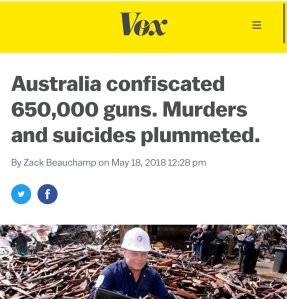
And what normal countries do: