Whereof One Can Speak đŸ‡ș🇩

Nothing special, one post at a time since 2012

Two Nations, Not One? Or One Under Reactionary Control?

It’s no secret that the division of America into blue Democratic states and red Republican ones roughly corresponds to the two sides in the Civil War. It’s also pretty clear that the Civil War never quite ended. Ronald Brownstein of The Atlantic says we should assume the blue/red division will become more pronounced in the coming years:

In a private newsletter that he writes for a small group of activists, [Michael Podhorzer, a longtime labor union political strategist] recently laid out a detailed case for thinking of the two blocs as fundamentally different nations uneasily sharing the same geographic space.

… Podhorzer writes: “In truth, we have never been one nation. We are more like a federated republic of two nations: Blue Nation and Red Nation. This is not a metaphor; it is a geographic and historical reality”.

To Podhorzer, the growing divisions between red and blue states represent a reversion to the lines of separation through much of the nation’s history. The differences among states [today], he writes, are “very similar, both geographically and culturally, to the divides between the Union and the Confederacy. And those dividing lines were largely set at the nation’s founding, when slave states and free states forged an uneasy alliance to become ‘one nation.’”

Podhorzer isn’t predicting another civil war …, but he’s warning that the pressure on the country’s fundamental cohesion is likely to continue ratcheting up in the 2020s. Like other analysts who study democracy, he views the faction that now dominates the Republican Party—what he terms the “MAGA movement”—as the U.S. equivalent to the authoritarian parties in places such as Hungary and Venezuela. It is a multipronged, fundamentally antidemocratic movement that has built a solidifying base of institutional support through conservative media networks, evangelical churches, wealthy Republican donors, GOP elected officials, paramilitary white-nationalist groups, and a mass public following. And it is determined to impose its policy and social vision on the entire country—with or without majority support. “The structural attacks on our institutions that paved the way for T____’s candidacy will continue to progress,” Podhorzer argues, “with or without him at the helm.”

All of this is fueling what I’ve called “the great divergence” now under way between red and blue states. This divergence itself creates enormous strain on the country’s cohesion, but more and more even that looks like only a way station. What’s becoming clearer over time is that the [Republican Party] is hoping to use its electoral dominance of the red states, the small-state bias in the Electoral College and the Senate, and the GOP-appointed majority on the Supreme Court to impose its economic and social model on the entire nation—with or without majority public support. As measured on fronts including the January 6 insurrection, the procession of Republican 2020 election deniers running for offices that would provide them with control over the 2024 electoral machinery, and the systematic advance of a Republican agenda by the Supreme Court, the underlying political question of the 2020s remains whether majority rule—and democracy as we’ve known it—can survive this offensive….

The hardening difference between red and blue, Podhorzer maintains, “empowers” the 10 purple states (if you include Arizona and Georgia) to “decide which of the two superpower nations’ values, Blue or Red, will prevail” in presidential and congressional elections. And that leaves the country perpetually teetering on a knife’s edge: The combined vote margin for either party across those purple states has been no greater than two percentage points in any of the past three presidential elections, he calculates.

The increasing divergence—and antagonism—between the red nation and the blue nation is a defining characteristic of 21st-century America. That’s a reversal from the middle decades of the 20th century, when the basic trend was toward greater convergence.

Mr. Brownstein then devotes several paragraphs to describing differences between the two parts of the country. The blue states are richer, healthier, better educated and more productive than the red states, by all kinds of measures, the same way cities in red states tend to be richer, healthier, better educated and more productive than their rural surroundings. Obviously, blue states and red states are also diverging in the kind of laws they’re passing: it’s easier to end an unwanted pregnancy in a blue state and easier to shoot a stranger in a red state. Mr. Brownstein continues:

To Podhorzer, the growing separation means that after the period of fading distinctions, bedrock differences dating back to the country’s founding are resurfacing. And one crucial element of that, he argues, is the return of what he calls “one-party rule in the red nation.”

… He documents a return to historical patterns from the Jim Crow era in which the dominant party (segregationist Democrats then, conservative Republicans now) has skewed the playing field to achieve a level of political dominance in the red nation far beyond its level of popular support. Undergirding that advantage, he argues, are laws that make registering or voting in many of the red states more difficult, and severe gerrymanders that have allowed Republicans to virtually lock in indefinite control of many state legislatures….

The core question that Podhorzer’s analysis raises is how the United States will function with two sections that are moving so far apart. History, in my view, offers two models.

During the seven decades of legal Jim Crow segregation from the 1890s through the 1960s, the principal goal of the southern states at the core of red America was defensive: They worked tirelessly to prevent federal interference with state-sponsored segregation but did not seek to impose it on states outside the region.

By contrast, in the last years before the Civil War, the South’s political orientation was offensive: Through the courts (the 1857 Dred Scott decision) and in Congress (the Kansas-Nebraska Act in 1854), its principal aim was to authorize the expansion of slavery into more territories and states. Rather than just protecting slavery within their borders, the Southern states sought to control federal policy to impose their vision across more of the nation, including, potentially, to the point of overriding the prohibitions against slavery in the free states.

It seems unlikely that the [today’s] Republicans installing the policy priorities of their preponderantly white and Christian coalition across the red states will be satisfied just setting the rules in the places now under their control. [Many believe] that the MAGA movement’s long-term goal is to tilt the electoral rules in enough states to make winning Congress or the White House almost impossible for Democrats. Then, with support from the GOP-appointed majority on the Supreme Court, Republicans could impose red-state values and programs nationwide, even if most Americans oppose them. The “MAGA movement is not stopping at the borders of the states it already controls,” Podhorzer writes. “It seeks to conquer as much territory as possible by any means possible.”

The model, in other words, is more the South in 1850 than the South in 1950…. That doesn’t mean that Americans are condemned to fight one another again as they did after the 1850s. But it does mean that the 2020s may bring the greatest threats to the country’s basic stability since those dark and tumultuous years.

Unquote.

For more on the defensive vs. offensive efforts of the Republican Party and the historical background in the South, see this column by Jamelle Bouie of the New York Times. He says this is the party’s goal:

A government of reactionaries, by reactionaries and for reactionaries. Or, put a little differently, Heads we win, tails you lose.
“One of the Most Intellectually Dishonest and Poorly Argued Decisions in American Judicial History”

So writes Saul Cornell, professor of history at Fordham University and the author of “A Well-Regulated Militia: the Founding Fathers and the Origins of Gun Control in America”:

In a 6–3 decision …, the Supreme Court struck down New York’s century-old gun law against concealed carry on [June 23rd]. New Yorkers and residents of a handful of other states and the District of Columbia—which had more strictly regulated who can have a concealed-carry permit—must now accept the type of laws popular in Texas and other red states. The decision was hardly a surprise to court watchers, but the opinion is nonetheless troubling on many levels.

The fact that this opinion was written by Justice Clarence Thomas, an originalist so rigid in his thinking that Justice Antonin Scalia once used him as a foil to distinguish his respect for precedent—”I’m an originalist and a textualist, not a nut,” Scalia quipped— contrasting the burn-it-all-down approach favored by his laconic colleague. Thomas has long been a proponent of supersizing the Second Amendment and has argued—against strong statistical evidence—that lower courts were treating the Second Amendment as a second-class right.

Thomas and his fellow originalists have set out to analogize the Second Amendment to core free speech rights, a bizarre legal analogy with little foundation in either legal history or tradition. In fact, guns have generally been treated as a form of property under American law for more than three centuries, a fact that appears to have escaped the notice of Thomas and the court’s newest originalists despite their professed commitment to an interpretive approach that focuses on history, text, and tradition.

Ultimately, the majority opinion in NYSRPA v. Bruen is one of the most intellectually dishonest and poorly argued decisions in American judicial history. Indeed, with little sense of irony, Thomas even quotes Chief Justice Roger B. Taney’s infamous opinion in Dred Scott approvingly, not only treating it as good legal authority but suggesting that the author of the worst decision in American law understood the Second Amendment better than any other judicial figure in American history. Turning to Taney for judicial inspiration would have once ended a judge’s career, but the court’s new originalist majority appears most of the time to be making history by inventing it, instead of by interpreting the law.

The old originalism of Robert Bork and Chief Justice William Rehnquist sought to use history to constrain judicial discretion and activism. The new originalism favored by Thomas and his fellow originalists has embraced judicial activism on steroids. Indeed, the court’s current use of originalism more clearly resembles an act of ventriloquism in which old texts are pressed into the service of modern agendas with little regard to how they were read at the time they were written. The new originalism, including the Bruen decision, turns historical actors into little more than stage dummies for the justices to project their own modern values and ideas onto the past.

One of the most remarkable features of Justice Stephen Breyer’s trenchant dissent in Bruen is his frank assessment of the appalling quality of the history being pedaled by his colleagues. Calling out the justices for engaging in “law office history,” a degraded form of legal analysis that warps history to fit the desired ends favored by a judge or justice, is something scholars have criticized the courts—including the Supreme Court—for practicing with some frequency. Still, it is unprecedented for a serving justice to hurl this type of accusation at colleagues sitting on the bench, and Breyer did just that. It is hard to dispute Breyer’s characterization of his colleagues given that Bruen is an opinion filled with legal and historical errors that all cut in the same direction, expanding gun rights by rewriting the American past.

To illustrate the shocking and amateurish use of history in Bruen, one need only examine the way Thomas ignored and distorted the evidence of robust gun regulation during Reconstruction, the period of history that he and other originalists have claimed is the key to understanding the scope of legitimate gun regulation by states and localities. Thomas reluctantly conceded that Reconstruction-era Texas had laws of similar scope to New York’s challenged laws. Yes, once upon a time Texas led the nation in enacting strong gun regulation!

Thomas, though, falsely claimed Texas was an outlier and, hence, that its evidence could be discarded. Similarly, Thomas discounts strong gun regulations in the Western United States because these too were unrepresentative outliers. In the Thomas originalist universe, apparently no amount of evidence is enough to support gun control, but no amount of evidence is too little to legitimate gun rights claims. In fact, millions of Americans were living with gun laws at least as restrictive as the New York law at issue in Bruen for many years during the period of history Thomas contends is crucial to understanding the application of the Second Amendment to states and localities.

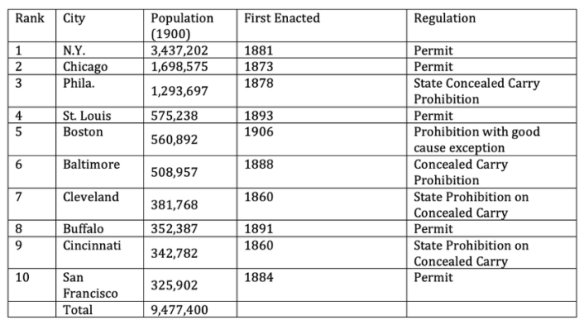
Just looking at the history of firearms law in nation’s largest cities undermine the central claim in Bruen. As the table below shows, all of the nation’s largest cities were living under some form of restrictive public carry regime by the end of the 19th century. Many of these laws were enacted during Reconstruction, or soon after. Thomas not only ignores this evidence, but he also ignores recent scholarship showing that these laws were enforced in a racially neutral fashion for decades before white supremacists turned them against Black people.

Untitled

Unfortunately, Bruen’s level of intellectual dishonesty and ignorance of basic legal historical method and well established facts easily located in readily accessible sources further undermines the legitimacy of the court at a moment when it can ill afford any further erosion in its standing. Bruen may be a victory for gun rights advocates, but it is another example of a court in serious intellectual and moral decline.

How To Fix a Lawless Supreme Court

The Judiciary Act of 1869 “provided that the Supreme Court of the United States would consist of the chief justice of the United States and eight associate justices [and] established separate judgeships for the U.S. circuit courts”.

There were nine circuit or appellate courts in 1869. The US population was around 38 million. Now there are thirteen circuits. The population is 338 million. We’ve also got a lot more laws and lawyers. A simple act of Congress, signed into law by the president, could add four justices to the Supreme Court, one for each circuit. Given the Court’s additional workload, simple arithmetic and common sense support adding four Supreme Court justices.

An added benefit would be that the president could nominate and the Senate could approve four justices who respect the Constitution and legal precedents; who don’t want to promote Christianity, patriarchy, white supremacy, plutocracy and the gun culture; and who don’t want to give corporations license to destroy the environment. In other words, seven honorable justices vs. the six dishonorable ones we have now.

I think that’s the best way to fix a lawless Supreme Court, although there are other possibilities (all, of course, assuming a Democratic House of Representatives and at least fifty Democratic senators go along).

Paul Waldman explains how states like California and New York are already working on new licensing requirements and the wide-ranging designation of what the Republican majority called “sensitive places” where guns can be prohibited:

[When you say] “the Supreme Court says I have the right to carry around this lethal instrument giving me the ability to murder anyone I encounter in an instant”, the rest of us are more than justified in responding: “Yes, that’s what the Supreme Court says. But we will take steps to protect ourselves from the danger you and other gun owners pose”….You’ll be able to get your guns, but just as you have to show you can operate a motor vehicle safely before getting a driver’s license, you’ll have to satisfy some requirements before getting a gun permit.

And just like you can’t drive your car on sidewalks or in grocery stores, you can’t take your gun anywhere you want. No doubt the Supreme Court Six will rule in favor of insanity, but, as Mr. Waldman says, some laws will survive, the legal process could take years and, meanwhile, lives will be saved.

Jamelle Bouie has written two columns on the same subject this week. From his second:

[Article 3, section 2 of] the Constitution tells us that the court’s appellate jurisdiction is subject to “such Exceptions” and “under such Regulations” as “the Congress shall make.” [But] the court’s appellate jurisdiction accounts for virtually everything it touches. And the Constitution says that Congress can regulate the nature of that jurisdiction. Congress can strip the court of its ability to hear certain cases, or it can mandate new rules for how the court decides cases where it has appellate jurisdiction.
 It can even tell the court that it needs a supermajority of justices to declare a federal law or previous decision unconstitutional.

He then discusses the “Guarantee Clause” (Article 4, section 4″, which says that “the United States shall guarantee to every State in this Union a Republican Form of Government”. A republic is generally considered to be a state in which supreme power is held by the people and their elected representatives, not by a monarch. Interestingly, courts have been reluctant to specify exactly what a republican form of government is, leaving that decision to Congress. Mr. Bouie continues:

[But we do have] Justice John Marshall Harlan’s famous dissent in Plessy v. Ferguson, in which he condemns “sinister legislation” passed to “interfere with the full enjoyment of the blessings of freedom, to regulate civil rights, common to all citizens, … and to place in a condition of legal inferiority a large body of American citizens, now constituting a part of the political community.”

This, he writes, “is inconsistent with the guarantee given by the Constitution to each State of a republican form of government, and may be stricken down by congressional action, or by the courts in the discharge of their solemn duty to maintain the supreme law of the land.”

A Congress that wanted to could, in theory, use the Guarantee Clause to defend the basic rights of citizens against overbearing and tyrannical state governments. It’s been done before. After the Civil War, Radical Republicans in Congress found their constitutional power to reconstruct the South chiefly in the Guarantee Clause, which they used to protect the rights of Black Americans from revanchist state governments.

 As Mr. Bouie says in his first column:

The Supreme Court does not exist above the constitutional system… In the face of a reckless, reactionary and power-hungry court, Congress has options
.The power to check the Supreme Court is there, in the Constitution. The task now is to seize it.

It’s almost impossible to imagine the 50 Democrats in today’s Senate all having the courage and understanding to seize the moment and reform the Supreme Court (one of them who’s against reforming the filibuster is rumored to have killed a proposed surtax on incomes over 10 million dollars, I suppose because of her support for the working class).

But it looks like a terrible crisis may be approaching. Three law professors write in today’s Washington Post about a case the Court has agreed to hear later this year, Moore v. Harper:

Just three years ago, a 5-to-4 Supreme Court prohibited federal courts from addressing whether extreme partisan gerrymandering violates the Constitution. But don’t worry, the court said, state courts can curb the practice if they conclude it violates state constitutions.

Harper invites the Supreme Court to go back on that promise. This invitation is based on an unsupportable legal claim known as the independent state legislature theory (ISLT). The theory would disable state courts from protecting voting rights in federal elections.

In theory (and given the recklessness of the Republican majority), the Court might rule that state legislatures have absolute authority to determine how their states vote for president. State legislators could ignore the voters and appoint whoever they wanted to represent their state in the Electoral College.

The outcome in 2024 is a virtual clone of the 2020 election: Biden carries the same states he did that year and DeSantis gets [the rest]. Biden is going to the White House for another four years.

Until the announcement comes out of Georgia. Although Biden won the popular vote in Georgia, their legislature decided it can overrule the popular vote and just awarded the state’s 16 electoral votes to DeSantis.

We then hear from five other states with Republican-controlled legislatures where Biden won the majority of the vote: North Carolina, Wisconsin, Michigan, Pennsylvania and Arizona.

CNN announces that DeSantis has won the election…. 

What Is To Be Done?

That’s the title of an 1863 novel by Nikolai Chernyshevsky. It’s about a woman who escapes the control of her family and finds economic independence. (Lenin borrowed the title for a pamphlet about a few “burning questions” in 1902.)

It’s the phrase that came to mind in reaction to the Supreme Court Six’s effort to make America fit their reactionary politics.

Here are two aspects of the situation that make it remarkable (there are others).

One is that the six reactionary Republicans are trying to justify their bizarre rulings by referring to made-up legal theories. As right-wing judges have done for years, they cite “originalism” and “textualism”, the ideas that the Court should pay close attention to the Constitution’s precise text and the specific intentions of its authors. It just so happens that the text and the perceived intentions always support whatever justices like Alito and Thomas prefer to do. Justice Kagan pointed this out in her dissent to the EPA case:

The current Court is textualist only when being so suits it. When that method would frustrate broader goals, special canons like the “major questions doctrine” magically appear as get-out-of-text-free cards.

The “major questions doctrine” is a classic conservative invention. Paul Waldman explains that one:

[It] holds that agencies can’t regulate in ways that aren’t explicitly laid out in statutes if what they’re doing is too consequential — into precedent. Yet in practice, everyone knows that the major questions doctrine, being vague and versatile, will be used only to strike down agency regulations the conservatives don’t like; regulations from Republican administrations they find pleasing will be left intact.

Another right-wing invention concerns “independent” state legislatures. Mr. Waldman continues:

Lest anyone think, on the final day of its term, that the court wasn’t champing at the bit to give Republicans even more power, it announced it will be hearing the case of Moore v. Harper. That’s a challenge to the North Carolina Supreme Court’s striking down of an absurdly gerrymandered congressional map on the grounds that it violated the state constitution.

Conservatives are eager to use this case to enshrine the “independent state legislature theory,” which would effectively say that legislatures alone can set rules for how federal elections are carried out, making state constitutions, governors’ vetoes and the decisions of state courts essentially irrelevant.

Why are conservatives attracted to this idea? … The reason is simple: At this moment in history, there are multiple states where Republicans have successfully gerrymandered themselves into control of a state legislature despite the fact that the electorate of that state is closely divided.

In these states — including Wisconsin, North Carolina, Pennsylvania and Georgia — … the legislature remains firmly in Republican hands no matter what. So if the legislature alone has the power to write election rules [no matter what the state’s constitution or courts say], they can [help] Republicans win.

The Supreme Court Six’s decision-making is all about the Republican agenda. It’s all about power.

So how did we get here? That brings up another remarkable aspect of our situation. Trump toady and US senator Lindsey Graham is outraged that Senate Democrats might want to do something about this renegade Court (like changing the filibuster rule, which Republicans did in 2017 in order to easily install Supreme Court justices of their choosing). Graham says it took 50 years for Republicans to skew the Court and now Democrats want to clean up the mess in a matter of weeks.

Josh Marshall responded to Graham:

This is true. It took them 50 years. But it’s also the first time in history a party plotted to take over the Courts like this. There were 3 Democratic appointees on the Court when it decided Roe. And one of those was one of the two dissenters. The Roe Court was dominated by Eisenhower and mostly Nixon appointees. Yes, lots of elections [over 50 years]. But the first time in American history any party or movement tried to do such a thing. And when the election thing stopped working, they started stealing seats.

The best you can say about the Republican capture of the Courts is that they stole it fair and square, to paraphrase Theodore Roosevelt. When it wasn’t stealing seats, it was winning elections with the fewest votes, i.e., exploiting the minoritarian quirks of the political system.

… What Graham is complaining about here is that Democrats want to put the whole thing before the peoples representatives with an up or down vote, i.e. majority rule. Graham is saying that’s not fair. The minority gets to say you can’t vote on it….

Having captured the courts through unprecedented political means, Republicans like Graham now want to dive headlong onto the fainting couch when the other side wants to repair the damage by political means. And unlike the crafty efforts to steal seats or exploit the minoritarian quirks of the Constitution, the remedy is the most foundational of democratic remedies, passing laws by majority vote. Whether Democrats will be able to pull this off will come down to the results of the November election.

Republicans like Graham are so deep in the world of partisan scheming and theft that a majority vote looks like the ultimate travesty. The simple reality is that the corrupt Court majority is the fruit of Republican corruption and the answer is majority rule.

But what can be done? I want to blog about that next time.

He Tried to Pull a Mussolini

Will Bunch of The Philadelphia Inquirer asks what would have happened if the Cancer on America had made it to the Capitol on January 6th and what’s going to happen next:

The nation’s right wing — swelled by disgruntled military veterans and those with a penchant for violence — had grown increasingly restless that fall, with occasional street clashes between these reactionaries and anti-fascists on the left. Finally, the leader of the right bloc — a big man who strutted on stage, sometimes buffoonishly — massed his followers and urged them to march on the capital and fight for their country, even though in the end he didn’t march with them.

Instead, Benito Mussolini would get in a car and drive to Rome in October 1922, where he again met up with the throng of as many as 60,000 who’d marched there after the future dictator’s speech to them in Naples. This was the-now notorious March on Rome, and the intimidation of Italy’s ruling elites by this large, angry mob and its “strongman” leader worked beyond anyone’s wildest dream. By month’s end, King Victor Emmanuel III had ceded all political power to Mussolini and the fascists, who would not relinquish it for two decades.

Just four months before the 100th anniversary of what is now seen as the lift-off of modern fascism, we have seen in dramatic fashion how the concept and underlying terror tactics of Mussolini’s March on Rome never went away, but lived on to be modernized by a reality-TV star who’d faked his way into the White House and was determined to stay there.

Tuesday’s riveting testimony before the House Jan. 6 Committee by former D___ Trump White House insider Cassidy Hutchinson … revealed just how close T____ came to a true Mussolini moment: His own plan to “march” on the U.S. Capitol.

The now 26-year-old Hutchinson — deputy to T____’s chief of staff Mark Meadows, embedded in the then-president’s inner circle on Jan. 6, 2021 — testified under oath that T____ knew that his supporters were heavily armed when he exhorted them to march from a rally near the White House to the Capitol, where the ceremony to certify President Biden’s win was beginning.

… Hutchison confirmed prior suggestions that the 45th president had demanded to go to the Capitol, where he would have stood among Proud Boys and others launching a violent assault on democracy.

“I’m the effing president — take me up to the Capitol right now,” T____ is said to have bellowed at the head of his security detail, as Hutchinson said was related to her that afternoon by Secret Service-connected deputy chief of staff Tony Ornato in the presence of that security head, Robert Engle. But the president was overruled by aides who insisted his security could not be guaranteed at or near the wild and increasingly violent melee.

To experts on authoritarianism — who’ve been some of the most reliable tour guides during the long, strange trip of America’s last seven years — T___’s scheme was an effort to create a legend, reassert his leadership, and reverse his embarrassment over losing the election to Biden by 7 million votes.

As Hutchinson was testifying, Ruth Ben-Ghiat, the New York University historian who’d specialized in Mussolini and wrote the book Strongmen, tweeted that “of course T____ was trying to get to the Capitol. A coup leader must be there to bless the new order birthed by violence and be acclaimed as savior by the crowd.”

I reached out to Ben-Ghiat to follow up on this. She told me that Jan. 6 was essentially “a cult leader rescue operation,” in which T____ “prepped his followers for months to be outraged at their hero being robbed of what was rightfully his, and then summoned them to the Capitol to save America by saving him.” She had written recently that the moment T____ hoped to achieve — restoring his movement’s warped sense of justice and order — is what is known as “the pronunciamiento.”

June 28, 2022, was a devastating day for T____ … Over just a couple of hours, Hutchinson laid out a compelling case that he and his closest aides knew the potential for violence on Jan. 6 and knew that morning of dangerous weapons, yet still sought mayhem at the Capitol when the votes were to be counted. She showed how T____ not only had no real interest in calling off the insurrectionists but supported their chants to hang Mike Pence. Most aides, she testified, knew what they were doing was against the law, either from their in-house legal advice or the pathetic last-minute begging for pardons….

But … what if the Secret Service and other aides had indeed kowtowed to “the (expletive deleted) president” and driven him to the Capitol? How might that have changed the course of the attempted and ultimately failed coup that was underway?

… T____’s physical presence could have intensified the violence [and] prolonged it…. If that had happened, it might have been unsafe for Vice President Mike Pence and Congress to resume Biden’s certification. T____ might have declared the national emergency that the worst of his advisors had been urging.

Simply put, Hutchinson’s testimony showed how close … the American Experiment came to bursting into flames.

Which is why “what next?” is so important. Just how, exactly, will the slow-moving Justice Department of Attorney General Merrick Garland respond to the increasingly mapped-out-for-them case that T____, his lawyers Rudy Giuliani and John Eastman, and others took part in a criminal conspiracy in fomenting the insurrection?

The Magic 8 Ball is very cloudy…. There are understandable reasons to fear indicting T____, which would surely heighten the partisan divisions in America…  But recent events, from political violence to a rogue Supreme Court that was molded by T____, suggest that unrest is happening, no matter what. The real pressure is not to keep a false calm but to do the right thing, with the future of America on the line. D____ T____ [and his co-conspirators] must be brought to justice.