Patience and the Affordable Care Act

It’s always bothered me that the Obama administration didn’t come up with a catchy name for the health insurance provisions of the Affordable Care Act. We’ve got “Social Security”, “Medicare” and “Medicaid”, so why couldn’t the administration come up with an equally helpful name for this thing, instead of leaving an opening for it to be called “Obamacare”?

I bet if Saint Ronald was still President, one of the first things on his agenda would have been to give his pet program a great name that would help sell it to the American people. But Obama apparently thinks he’s above such things.

Nevertheless, the important thing is that this landmark legislation is going into effect two days from now, regardless of what any misguided, foolish, cowardly and/or evil House Republicans do in the meantime.

I know people (including myself) who will probably be taking advantage of the ACA in the relatively near future, so I’ve been wondering how much it’s going to cost. Unfortunately, there are reports in the media that suggest what “average” premiums will be. There was one such unhelpful article in the New York Times today: “‘Affordable Care’ or a Rip-Off?”.

The problem is that you can’t know what a person’s or a family’s costs will be until you factor in where they live, how old they are and, especially, what their income is. Many or most people in this country, not just the poorest among us, will be eligible for subsidies from the government. In fact, if you’re eligible for a subsidy, you won’t even have to wait for the IRS to send you a check. The subsidy will be applied right up front when you pay your insurance premium (which means that some people won’t have to pay anything at all).

There is good news here. The health insurance premiums being discussed so far are generally cheaper than what people would pay for private health insurance today, and the premiums are going to be lower, often much lower, for many of us after the subsidies are applied.

So maybe everyone who’s interested should wait a couple days and then go to https://www.healthcare.gov/ to see the real numbers (and also see the pretty young woman with a big smile on her face). I’m sure we can all wait a couple more days.

Here’s today’s New York Times editorial on the importance of the ACA and the subsidies:

http://www.nytimes.com/2013/09/29/opinion/sunday/dawn-of-a-revolution-in-health-care.html?

If you’re in the mood for even more good news, take a look at this column from Nicholas Kristof. Here’s his conclusion, supported by statistics from the World Bank, the Gates Foundation and the U.S. Agency for International Development:

So let’s acknowledge that there’s plenty of work remaining — and that cycles of poverty in America must be a top priority at home — yet also celebrate a triumph for humanity. The world of extreme poverty and disease that characterized life for most people throughout history may now finally be on its way out.
http://www.nytimes.com/2013/09/29/opinion/sunday/kristof-a-way-of-life-is-ending-thank-goodness.html?

Class Warfare Is a Fact – Part 3

After some discussion in the comments on Part 2 of what has turned into a brief series, I thought it would be a good idea to post the concluding paragraphs of the underlying paper by Emmanuel Saez (winner of the John Bates Clark Medal, periodically awarded to an outstanding young economist).

Here are his conclusions (my emphasis added):

“Interestingly, the income composition pattern at the very top has
changed considerably over the century. The share of wage and salary income
has increased sharply from the 1920s to the present, and especially since the
1970s. Therefore, a significant fraction of the surge in top incomes since 1970
is due to an explosion of top wages and salaries. Indeed, estimates based
purely on wages and salaries show that the share of total wages and salaries
earned by the top 1 percent wage income earners has jumped from 5.1
percent in 1970 to 12.4 percent in 2007.

(Footnote:  this dramatic increase in top wage incomes has not been mitigated by an increase in mobility at the top of the wage distribution.As Wojciech Kopczuk, myself, and JaeSong have shown in a separate paper,the probability of staying in the top 1 percent wage income group from one year to the next has remained remarkably stable since the 1970s.)

Evidence based on the wealth distribution is consistent with those
facts. Estimates of wealth concentration, measured by the share of total
wealth accruing to top 1 percent wealth holders, constructed by Wojciech
Kopczuk and myself from estate tax returns for the 1916-2000 period in the
United States show a precipitous decline in the first part of the century with
only fairly modest increases in recent decades. The evidence suggests that
top incomes earners today are not “rentiers” deriving their incomes from past
wealth but rather are “working rich,” highly paid employees or new
entrepreneurs who have not yet accumulated fortunes comparable to those
accumulated during the Gilded Age. Such a pattern might not last for very
long. The drastic cuts of the federal tax on large estates could certainly
accelerate the path toward the reconstitution of the great wealth concentration
that existed in the U.S. economy before the Great Depression.
The labor market has been creating much more inequality over the
last thirty years, with the very top earners capturing a large fraction of
macroeconomic productivity gains.

A number of factors may help explain this increase in inequality, not only underlying technological changes but also the retreat of institutions developed during the New Deal and World War II – such as progressive tax policies, powerful unions, corporate provision of health and retirement benefits, and changing social norms regarding pay inequality. We need to decide as a society whether this increase in income inequality is efficient and acceptable and, if not, what mix of institutional and tax reforms should be developed to counter it.

End quote.

By the way, the latest column by Paul Krugman (winner of the Nobel Prize in economics and one of the most astute op-ed columnists writing today) is called “Rich Man’s Recovery”:

“Whatever is causing the growing concentration of income at the top, the effect of that concentration is to undermine all the values that define America. Year by year, we’re diverging from our ideals. Inherited privilege is crowding out equality of opportunity; the power of money is crowding out effective democracy.

So what can be done? For the moment, the kind of transformation that took place under the New Deal — a transformation that created a middle-class society, not just through government programs, but by greatly increasing workers’ bargaining power — seems politically out of reach. But that doesn’t mean we should give up on smaller steps, initiatives that do at least a bit to level the playing field.”

End quote.

This isn’t a war in the usual sense, but the fact remains that the people in this country who have the most money are using their high incomes and wealth to manipulate the political system and other levers of power in order to increase their advantages still more. It’s not a shooting war, but it’s an assault on America as a prosperous and democratic nation.

——————————————————————————————————————-

Professor Saez’s relatively short paper:

http://elsa.berkeley.edu/~saez/saez-UStopincomes-2012.pdf

Professor Krugman’s most recent column:

http://www.nytimes.com/2013/09/13/opinion/krugman-rich-mans-recovery.html?hp

Class Warfare Is a Fact – Part 2

Paul Krugman makes the important point that the substantial gains in income for the richest Americans has been concentrated in a very small group. It’s not the top 10% or the top 5% or even the top 1% that has prospered the most — it’s the top tenth of 1% and the top hundredth of 1% who have substantially increased their share of the national income:

Of the gains made by the top 10 percent [since 1979], almost none went to the 90-95 group; in fact, the great bulk went to the top 1 percent. The bulk of the gains of the top 1, in turn, went to the top 0.1; and the bulk of those gains went to the top 0.01. We really are talking about the flourishing of a tiny elite.

In other words, income has only increased for the top 5.0% since 1979, and more than half of that increase went to the top 0.1%. It’s as if the bottom 95.0% of Americans haven’t received a raise in 30 years.

http://krugman.blogs.nytimes.com/2013/09/12/good-times-at-the-top/

Class Warfare Is a Fact

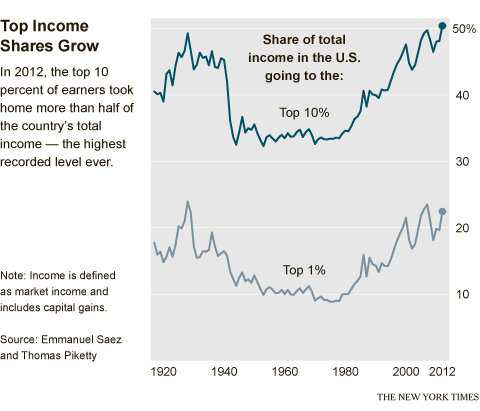
An updated study by economist Emanuel Saez of U.C. Berkeley shows that the the top 1% of earners in the United States received more than 20% of the country’s total income in 2012, while the top 10% of earners received more than half of the country’s income. The share of income going to the wealthiest Americans is now at or near the highest levels on record since the government began keeping the relevant statistics and the federal income tax was created in 1913.

What’s even more remarkable, perhaps, is that the income of the top 1% went up nearly 20% in 2012, while the income of the remaining 99% rose only 1%. Since 2009, the wealthiest 1% have taken 95% of the income gains in our supposedly classless society.

We should remember these statistics when we hear Republican politicians, who pretend to be friends of the middle class, claim that lower taxes for the wealthy benefit everyone. It’s past time to raise taxes on the rich, invest in America’s infrastructure and start creating decent jobs again. Otherwise we’re going to continue to get economically screwed.

Note the year 1980 in this chart, when class warrior and demagogue supreme Ronald Reagan was elected President:

10economix-sub-wealth-blog480

http://takingnote.blogs.nytimes.com/2013/09/11/the-rich-got-richer/

Surely, You Must Pay Your Debts!

Not necessarily, and don’t call me Shirley!

Below is a link to a fairly long review by journalist Robert Kuttner of a book called Debt: The First 5,000 Years. I’ll summarize:

People, especially poor people, have been borrowing from other people, especially rich people, for thousands of years.

As long as people have borrowed, lenders (not all of them, but some of them) have accepted partial payment, especially in difficult economic times. Sometimes it makes economic sense for lenders to suffer a loss, if that’s what’s required to make the economy as a whole (and possibly the lenders themselves) more prosperous. It isn’t mentioned in the review, but Babylonian kinds periodically canceled debts so their wealthy subjects didn’t end up owning all the land. 

The modern form of bankruptcy was invented 300 years ago in England. The idea was that both creditors and debtors would be better off if debtors were allowed to start over, repaying what they could instead of wasting away in debtor’s prison.

Our current laws are tilted in favor of banks and the people who run corporations. Corporations are allowed to declare bankruptcy, sometimes more than once. Corporate officers generally remain in control of their bankrupt companies. On the other hand, countries like Greece can’t declare bankruptcy, although this has been proposed. Homeowners can’t use bankruptcy to deal with their mortgages. Students can’t even refinance their student loans at lower rates. In Kuttner’s words: “The obligations of a student loan follow a borrower to the grave”.

The Germans use the same word for “debt” and “guilt” (Schuld). They’re strongly in favor of other countries paying everything they owe, but seem to have forgotten that, after World War II, the Allies forgave almost all of Germany’s debts and allowed the Germans to postpone their remaining payments for 50 years, helping Germany rebuild and eventually become a creditor to other nations: “Germany, whose debt-to-GDP ratio in 1939 was [a whopping] 675 percent, had a debt load of about 12 percent in the early 1950s—far less than that of the victorious Allies”.

Most of us believe there is a moral aspect to paying our debts, but that’s not the way it’s generally thought of in the business world:

The double standard in debt relief that favored large merchants, present at the creation of bankruptcy law in 1706, persists today in many different forms. It gets surprisingly little attention in the debt debates. Despite the tacit assumption that “surely one has to pay one’s debts,” the evasion of repayment is both widespread and selective. Corporate executives routinely walk away from their debts via Chapter 11 of the national bankruptcy law when that seems expedient. Morality scarcely enters the conversation—this is strictly business.

It’s an excellent, eye-opening article. It even includes some recommendations for changing how various kinds of debt are handled today.

http://www.nybooks.com/articles/archives/2013/may/09/debt-we-shouldnt-pay/?page=1