Some Progress, But We Could Be Doing Much More

Jonathan Chait of New York Magazine sums up the continuing success of the Affordable Care Act here :

The Commonwealth Fund has a new survey showing that the proportion of adults lacking health insurance has fallen by a quarter, from 20 percent of the population to 15 percent. (Most respondents, including 74 percent of newly-insured Republicans, report liking their plan.) Also, this week, the Congressional Budget Office again revised down its cost estimates for Medicare, which now spends $50 billion a year less than it was projected to before Obamacare passed. Also, the New England Journal of Medicine recently estimated that 20 million Americans gained insurance under the new law.

Just think what we’d be able to do in this country if the Republicans were reasonable or if there were fewer of them in office. We could have boosted the economy, for example, by investing in our infrastructure during this terrible recession instead of going crazy about the deficit. Below is a chart from Paul Krugman’s blog showing the “Great Disinvestment”, how public spending on construction has dropped in the past four years when it should have increased:

070314krugman1-blog480

Five Bad Men Screw Us Again

I didn’t want to write about the Supreme Court decision in Burwell vs. Hobby Lobby Stores. That’s the recent case in which the Republican majority ruled that a corporation can refuse to provide health insurance for certain kinds of contraception on religious grounds. However, one way to stop thinking about something is to write about it, and this is not a subject that’s fun to think about:

1) It’s no coincidence that the five Republicans on the Supreme Court are prone to rule against and ignore the rights of women to end or prevent pregnancies. Those five Republicans are all Roman Catholics.

2) Having previously declared that corporations should be allowed to spend on political campaigns because they have the same right to free speech that people do, the Republican majority has ruled again that corporations are no different from people. The law at issue in Burwell vs. Hobby states that the government should not “substantially burden a person’s religious beliefs”. Although corporations are treated as persons in some legal contexts, and it’s proper for the government to respect people’s religion up to a point, it makes no sense to ascribe religious beliefs to a corporation.

In addition, people’s right to practice their religion as they wish does not give them the right to harm other people. According to the majority opinion, however, a corporation can not only have religious beliefs, those beliefs should be honored even though acting on those beliefs negatively affects the corporation’s employees, their families and the rest of society (one of the majority’s suggestions is that taxpayers pay for contraception if corporations won’t – as if the Republicans in Congress would agree to that). 

3) Religion can be a wonderfully flexible way to justify all kinds of behavior. In this case, the corporations claimed that dropping all health insurance coverage for their employees, so that their employees could instead get insurance through the government-run exchanges, would also infringe on their (the corporations’) religious beliefs, even though allowing their employees to use the government exchanges would save the corporations money and benefit their employees. “It is our firmly-held, specific religious belief that you should get your health insurance through our company instead of a government website, but it shouldn’t cover certain kinds of care.” Right.

4) Allowing employers to dictate which health insurance their employees have, on religious or any other grounds, is yet another reason the United States should join the rest of the industrialized world and adopt taxpayer-supported, government-regulated, single-payer health insurance.

5) The idea that the owners of a business shouldn’t be forced to spend money for something they don’t like assumes that the money in question is theirs, just like the money in your checking account is yours. However, economists have found that the money a company spends on health insurance would otherwise generally be paid to employees as wages. After all, health insurance is a form of compensation and businesses tend to offer as little compensation as possible (except for senior management, of course). As Uwe Reinhardt writes:

Evidently the majority of Supreme Court justices … believe that the owners of “closely held” business firms buy health insurance for their employees out of the kindness of their hearts and with the owners’ money. On that belief, they accord these owners the right to impose some of their personal preferences – in this case their religious beliefs — on their employee’s health insurance…. [But research shows that] the premiums ostensibly paid by employers to buy health insurance coverage for their employees are actually part of the employee’s total pay package — the price of labor, in economic parlance – and that the cost of that fringe benefit is recovered from employees through commensurate reductions in take-home pay.

6) This is a case in which religion is being allowed to trump science. These corporations object to particular kinds of contraception on the grounds that they are equivalent to having an abortion. But medical researchers have shown that the methods in question (certain intrauterine devices and the “morning after” pill) don’t actually work that way, as discussed here:

The owners of Hobby Lobby told the Court that they were willing to cover some forms of contraception but believed that the so-called morning-after pills and two kinds of IUDs can cause what they believe to be a type of abortion, by preventing a fertilized egg from implanting in the uterine wall or causing an already implanted egg to fail to thrive… The scientific consensus is against this idea…Most scientists believe that [these methods] interfere with the ability of sperm to get to an egg in time to fertilize it before they die….Research does not support the idea that they prevent fertilized eggs to implant.

If a religious belief is based on faulty science, that belief should be given less respect by the rest of us. It’s safe to assume, for example, that even this Supreme Court would have ruled differently if the religious belief in question had been that certain kinds of contraception cause droughts.

7) There have been a lot of dumb arguments in favor of this decision or suggesting that it’s not a big deal. The truth is that this decision could set a very bad precedent, opening the door to other claims for special treatment, especially given the Republican majority on the Court. In addition, trying to find a job with another company isn’t a great option for many people; getting pregnant is a very big deal; IUD’s are among the most effective form of birth control; it can cost some women a month’s pay to get one; the morning after pill is an important option for women; and choosing to have sex shouldn’t disqualify people from getting appropriate medical care (people also choose to smoke, spend a lot of time on their couches and eat at McDonald’s). As the saying goes, if men could get pregnant, abortion would be a sacrament.

8) It’s been clear since their decision in Bush vs. Gore, when the Republican justices decided that we didn’t need an accurate vote count in a Presidential election, that lacking proper legal justification for their decisions won’t stop them from advancing their political agenda. All Supreme Court justices issue rulings consistent with their political perspectives, but these particular justices are extremists. They may have some shame, but it’s hardly worth mentioning.

Bacteria Are Our Friends, Except When They’re Not

It’s good to remind ourselves occasionally that we human beings are little worlds of a sort. Each of our bodies is composed of trillions of cells (about 40 trillion, based on a recent estimate), each going about their individual business, and many more microorganisms, mainly bacteria, each going about their business too.

I’m not sure why it’s good to remind ourselves of this fact, but it seems like something worth keeping in mind. It might, for example, help us not be so fearful of bacteria. They’re not necessarily bad for us. For one thing, they help us with digestion. More surprisingly, some scientists believe that, before people began frequent applications of soap and shampoo, one kind of bacteria (Nitrosomonas eutropha) flourished on people’s skin, acting as a “built-in cleanser, deodorant, anti-inflammatory and immune booster by feeding on the ammonia in our sweat and converting it into nitrite and nitric oxide”.

That’s the theory behind an article in the New York Times by a woman who went one month without using soap or shampoo. Aside from her greasy hair, she didn’t notice any ill effects. Nobody complained about her odor. In fact, after encouraging the growth of N. eutropha on her body for a month, her skin was in better shape than when she started the experiment. The scientists involved hope that bacteria might one day be used to treat various skin conditions, like eczema and acne, and even help certain wounds heal more quickly.

That’s the good news. The bad news (which is much worse than the other news is good), is that medical authorities are calling attention yet again to the spread of dangerous antibiotic-resistant bacteria. The Guardian reports that a group of senior British scientists expressed concern last week that we face “the prospect of people dying from routine infections because effective antibiotics no longer exist”. One scientist said:

In the near future it is possible that a scratch from a rose thorn could become septic. Without effective antibiotics, septicaemia could easily set in and result in death. It is a terrible prospect, but a very real one. We are facing a return to the state of affairs that existed before antibiotics were discovered.

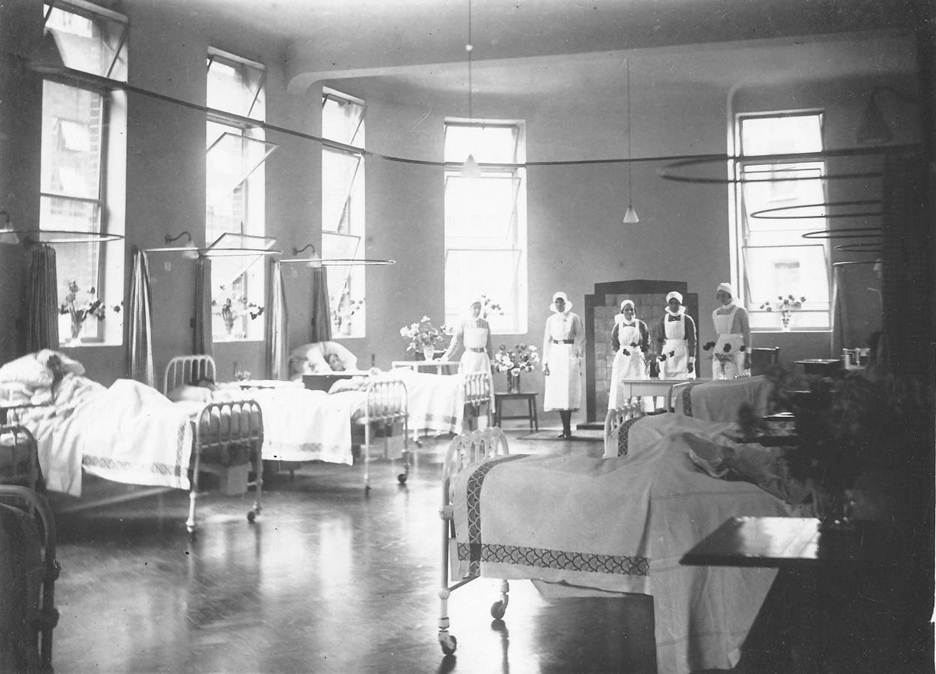
Any kind of surgery and treatments that affect the immune system could all become life-threatening. As a stop-gap measure, the scientists recommend that hospitals go back to having old-fashioned rooms with widely-separated beds and windows that can be opened to allow in fresh air. 

lewes_victoria_hospital_ward

Unfortunately for us communities of cells and bacteria, the drug companies aren’t developing new antibiotics, because there is little profit to be made off drugs that people only take for a short period of time. Chalk another one up for capitalism and the free market. 

As dangerous bacteria continue to evolve, it becomes increasingly likely that epidemics will sweep the world before new antibiotics or other treatments will be available, unless there is increased government support for the needed research. The alternative is to wait for the problem to get so bad that it becomes profitable to fix it. 

Taking these developments into account, it’s safe to assume that one day many of us will be dead from bacterial diseases we don’t know how to fight. But our skin will be in the best shape ever.

Dollars and Poverty

Republican Congressman Paul Ryan, chairman of the House Budget Committee, is worried that the federal government spends too much money trying to help poor people:

“The question isn’t whether the federal government should help; the question is how,” Mr. Ryan said at [a committee] hearing on Wednesday. “How do we make sure that every single taxpayer dollar we spend to reduce poverty is actually working?” 

Can you imagine someone like Ryan ever wanting to make sure that every single dollar spent on the military is actually working? I can’t.

The quote above comes from a New York Times article called “Changed Life of the Poor: Better Off But Far Behind”. The article describes the economic situation facing the poor today: 

Two broad trends account for much of the change in poor families’ consumption over the past generation: federal programs and falling prices.

Since the 1960s, both Republican and Democratic administrations have expanded programs like food stamps and the earned-income tax credit….

As a result, the differences in what poor and middle-class families consume on a day-to-day basis are much smaller than the differences in what they earn.

“There’s just a whole lot more assistance per low-income person than there ever has been,” said … a senior research fellow at the conservative Heritage Foundation. “That is propping up the living standards to a considerable degree,” he said, citing a number of statistics on housing, nutrition and other categories.

[At the same time], the same global economic trends that have helped drive down the price of most goods also have limited the well-paying industrial jobs once available to a huge swath of working Americans. And the cost of many services crucial to escaping poverty — including education, health care and child care — has soared.

So, for example:

Tammie Hagen-Noey, a 49-year-old living in Richmond, Va., tapped at an iPhone as she sat on the porch of the group home where she lives… She earns $7.25 an hour at a local McDonald’s, and makes a little extra money on the side from planting small plots of land for neighbors….A few months ago, she sold her car for $500 to make rent.

Almost everybody could manage their spending better (even members of Congress) and that woman in Virginia presumably didn’t spend hundreds of dollars to buy the latest iPhone. Human beings get into all kinds of trouble, because of their own mistakes or through no fault of their own, and will continue to need help from the rest of us, even if every single dollar intended to help them doesn’t “work”. Republicans claim that cutting taxes and reducing regulations will create lots of better-paying jobs, allowing us to spend less on government assistance for the poor. What they’re really advocating is a race to the bottom, with more inequality, dangerous workplaces, pollution and unsafe food. Since we have to compete in a global economy, we’ll end up closer to the economic middle in future decades (nobody stays on top forever), but we shouldn’t race to become worse off.

“Obamacare” Not Such a Disaster After All; Republicans Reconsider Opposition

The Congressional Budget Office (CBO) has issued a document entitled “Updated Estimates of the Effects of the Insurance Coverage Provisions of the Affordable Care Act, April 2014”.

I quote (some posts are easier to write than others):

Relative to their previous projections, CBO and JCT [Joint Committee on Taxation] now estimate that the ACA’s coverage provisions will result in lower net costs to the federal government: The agencies now project a net cost of $36 billion for 2014, $5 billion less than the previous projection for the year; and $1,383 billion for the 2015–2024 period, $104 billion less than the previous projection….

CBO and JCT estimate that the insurance coverage provisions of the ACA will increase the proportion of the non-elderly population with insurance from roughly 80 percent in the absence of the ACA to about 84 percent in 2014 and to about 89 percent in 2016 and beyond… CBO and JCT project that 12 million more non-elderly people will have health insurance in 2014 than would have had it in the absence of the ACA. They also project that 19 million more people will be insured in 2015, 25 million more will be insured in 2016, and 26 million more will be insured each year from 2017 through 2024 than would have been the case without the ACA.

In other words, the Affordable Care Act will cost less and result in more people having health insurance than previously estimated. Given these very encouraging new estimates, leading Republicans are reconsidering their short-sighted, hypocritical opposition to “Obamacare”. (I made up that last part.)