Pro-Market or Pro-Big Business?

“Donald Trump, Crony Capitalist” is a nice little article by Luigi Zingales, a professor at the University of Chicago’s business school. He analyzes one aspect of Trump’s surprising presidential campaign: the fact that Trump presents himself as a critic of big business, even though he’s a long-standing member of “the pro-business establishment”.

One of the best parts of Zingales’s article is his explanation of the difference between big business and the free market. He says the Republican establishment has spent years obscuring that difference, claiming to be champions of the free market while serving as “big business’s mouthpiece”.

Supporting the market means being in favor of competition and against concentrated economic power. Zingales cites Theodore Roosevelt, a Republican President from a century ago. From Wikipedia:

One of Roosevelt’s first notable acts as president was to deliver a 20,000-word address to Congress asking it to curb the power of large corporations (called “trusts”). He also spoke in support of organized labor to further chagrin big business … For his aggressive use of United States antitrust law, he became known as the “trust-buster”. He brought 40 antitrust suits, and broke up major companies, such as the largest railroad and Standard Oil, the largest oil company.

Being pro-market means you’re against monopolies (in which one company controls a market) and oligopolies (in which a few companies do). It also means you’re in favor of government regulations and policies that help make markets competitive. A fair, properly functioning market requires that the playing field be level, not slanted to the advantage of insiders or the powerful.

Big business, however, is totally in favor of special advantages when it increases profits. As Zingales says, “business executives are only pro-market when they want to enter a new sector”. But:

[Once] they become established in a sector, they favor entry restrictions, excessive licensing, distortive regulation and corporate subsidies. Those policies are pro-business (in the sense that they favor existing businesses), but they are harmful and distort a competitive market economy.

Zingales points out, for example, how rare it is for Republican politicians to call for antitrust enforcement, the prosecution of white-collar criminals and pro-market policies like fostering competition in the market for prescription drugs. That’s because the men who run the Republican Party are in the business of protecting big business, not the market.

Many of his supporters think Trump is fervently pro-market, but:

As a businessman Mr. Trump has a longstanding habit of using his money and power aggressively to obtain special deals from the government… He is, in short, the essence of that commingling of big business and government that goes under the name of crony capitalism.

Anyway, it’s a good little article that’s worth reading even if you’re sick of hearing about the Republican freak show currently touring the country.

Parting thought:

The Bill of Rights would have been better if the Second Amendment, including its call for a properly-regulated militia, had never been written. In its place, we could have had an amendment like this:

A well-regulated Market, being necessary to the prosperity of a free State, the right of the people to enjoy the benefits of fair competition shall not be infringed except to benefit the Nation as a whole.
If You Have To Ask (World Travel Edition)

If someone in your house subscribes to the National Geographic Society’s magazine and your zip code implies relative affluence, you probably received a very nice booklet in the mail entitled “National Geographic 2016/2017 Private Jet Expeditions”.

Ours came yesterday. It’s the kind of mail that has “recycling bin” all over it, but my curiosity was piqued. What the hell is a “private jet expedition”?

It turns out that National Geographic offers four such tours, each lasting about three weeks. One of them takes you around the world. You leave Orlando, Florida, and then visit places like Machu Picchu, Easter Island, Angkor Wat, the Serengeti and Marrakesh, before returning to Orlando. (They do let you off the plane to walk around and sleep in a nice bed – you’re not seeing everything from 20,000 feet.)

Another trip is advertised as “around the world”, but doesn’t quite make it. You board your private jet in Seattle, take a northern route, mostly across Asia, and are then deposited in Boston, 3,000 miles from where you started.

The other two trips are even more geographically limited. One begins and ends in London, with stops in places like Mongolia, Sri Lanka, Ethiopia and Israel. The other starts in Orlando and includes South America, the South Pacific, China and Japan, before inexplicably dropping you off in Seattle.

But how private is this jet anyway? I figured it must be one of those Gulfstream jobs that movie stars and titans of industry enjoy. They probably carry 10 or 20 people at most. 

Unfortunately, the National Geographic’s plane isn’t that private. You ride in “two-by-two VIP-style seats” that look really comfortable, but your “specially outfitted Boeing 757” has room for 75 other passengers.  

Thinking about this, I suppose I could handle the lack of exclusivity, but being on a tour with 75 other world travelers, plus the flight crew, plus the various guides and lecturers, plus the staff photographer, plus the on-call-24-hours-a-day physician, doesn’t seem exactly “private” to me.

Being familiar with that old expression “if you have to ask …”, I went ahead and asked (myself) anyway. The bad news is that the most expensive trip (the one that goes around the world and thoughtfully brings you back to where you started) costs $79,950. With sales tax, let’s call it $80,000. The cheapest trip goes for $67,950. But seriously, who would want to experience a bunch of exotic locations with a down-market group like that?

By the way, those prices are per person with double occupancy. If you don’t want company at night, it’s another $8,000 or so.

To sum up, if you and your significant other select one of these expeditions, your total bill will be around $150,000, maybe more, maybe less (hotel minibar and laundry, among other things, not included).

I don’t know why, but the booklet indicates that this is “sustainable travel”. Sadly, it doesn’t look like anything I’ll be sustaining any time soon. If you’re in the market, however, and you inadvertently recycled your booklet, you can get more information at National Geographic Expeditions. But if you’re as unimpressed by their definition of “travel by private jet” as I am, you might want to visit here instead.

So have a wonderful time, take lots of pictures, vaya con dios and don’t forget your yellow fever shot! Proof of inoculation is required.

Cutting the Cord (the Saga Ends)

Four weeks ago, we began the convoluted process of breaking away from Comcast, the cable TV giant that is one of America’s least admired companies. We had a package deal for television, internet and phone service with Comcast that wasn’t worth the monthly fee, especially since we weren’t watching much live television. With the arrival of Verizon’s fiber optic internet service in our neighborhood, it was a good time to consider alternatives.

First, I called Comcast to see if there was a way to lower our monthly bill. They told me that was impossible. Even if we completely eliminated our cable TV service, we wouldn’t save money (the combined price of Comcast’s internet and phone service bought separately would be almost as much as what we were paying for internet, phone and television as a bundle). 

Like Comcast, Verizon offers its best deals to new customers. Unfortunately, most of these deals weren’t as good as they first appeared. For example, to get TV through Verizon, you pay an additional fee for every television you hook up. That makes sense, except that Verizon assesses this additional fee even if you’ve only got one television! I believe this is known as “chutzpah”. (“Since you don’t actually have a television, you can get Verizon cable TV for the advertised price!”)

It turned out that even with an introductory offer, we’d pay Verizon almost as much as Comcast if we got Verizon’s phone and television services in addition to the internet. So our best option was to buy as little as possible from Verizon. That meant getting their internet service and nothing else. The good news was that Verizon offered a faster internet connection than Comcast for the same amount of money (and installation was free).

Not wanting to give up our current home phone number, we then signed up with Ooma, an internet phone company. Ooma doesn’t charge a monthly fee. You buy one of their boxes up front. You also pay a fee if you want to keep your old number. After that, you pay Ooma a few dollars each month (in our case, $4) to cover federal and state taxes. 

Finally, there was the television problem. Many people don’t realize you can still get a lot of channels free with an antenna connected to your TV, kind of like the old days. It’s called OTA (“Over The Air”) television now. The bad news is that the broadcast signals aren’t as strong as they used to be. I looked at a Federal Communications Commission website to see which channels are available where we live. There weren’t very many. even though we’re only 20 miles from a big city. A quick experiment with a borrowed antenna confirmed that we would need an expensive antenna up on the roof to get more than one or two channels. 

That led us to Roku, an internet streaming service. Like Ooma, our new phone company, you buy one of their boxes up front. If you stick with the free channels, there is no monthly fee. And the free channels could be sufficient, since Roku has more than 2,000 of them. The bad news is that maybe 1% of Roku’s free channels are worth watching. For example, about 1/3 of them are devoted to religious programming, and looking at their many “special interest” channels didn’t reveal anything interesting.

The Roku website isn’t very clear about it, but what you get free is easy access to loads and loads of videos that can be played whenever you want. Very few channels have live feeds. For instance, you can watch videos from PBS and the Smithsonian Channel. You can also watch video segments from the network news shows.

For live news, you have the BBC and Sky News (also British) and a strange collection of American stations (in case you want to watch the local news from Sacramento or Little Rock). If you want to watch much live television or so-called “premium” cable channels, Roku says “the service may require additional fees”. However, so far as I could see, the “may” in that sentence always means “does”. If you already subscribe to something like Netflix or Showtime, you can access those channels through the Roku device.

In conclusion, we’re happy so far. We may eventually spend a bit more to add some live television (some sports, in particular), but for now our total monthly payment is $90 less than before. Taking into account the Ooma and Roku boxes we bought, the Ooma phone number transfer fee, and some new internet security software (Verizon doesn’t include security software in its standard package like Comcast does), and then spreading those costs over two years, we’ll still be saving $75 every month.

One other note: I didn’t have to tell Comcast that we’re moving to Iceland in order to easily disconnect our account. Fortunately, once I told them we’d already switched to Verizon, there wasn’t much to talk about.

Cutting the Cord (Thanks to a Hard-Working Man)

The Verizon website said their technician would get to our house around 9:30 pm to do our installation. The anonymous dispatcher said it would really be around 8:15 (only three hours after the original 5 pm deadline).

So it was a pleasant surprise when the technician called at 6:30 to say he’d be at our house in fifteen minutes. He arrived as promised and quickly got to work.

Four hours later, he was done. Among other things, he’d had to string 350 feet of cable from our basement to a telephone pole two blocks away, working in the dark on a hot, humid night. It was an impressive performance.

When we thanked him and said good-night, we assumed he’d be dropping off his van at some Verizon garage and then get home by midnight or so. No, he’d actually be driving to Newark to do some work for another customer. He explained that Verizon is forcing their previously-unionized technicians to work 60 hours a week.

We didn’t ask what time he started work yesterday. But on a good day, if all goes well, he puts in 12 hours. That’s not 12 hours in an air-conditioned or heated office. That’s 12 hours of driving around, in good and bad weather, carrying equipment, going up and down stairs, climbing on roofs, drilling holes, stringing cable, attaching electronic gizmos to inside and outside walls, while also dealing with people like us. Sometimes in the dark. 

Do you think it would be a good idea for Verizon to hire and train more technicians, so their employees wouldn’t have to work 12 hours a day (or more), five days a week? We all know the corporate business model is to get as much work as possible out of workers while providing as little compensation as possible, but there are lots of Americans who could use a decent job. It would be good for the country and even good for the corporations if they’d spread some of the wealth around.

Cutting the Cord (the Saga Continues and Continues)

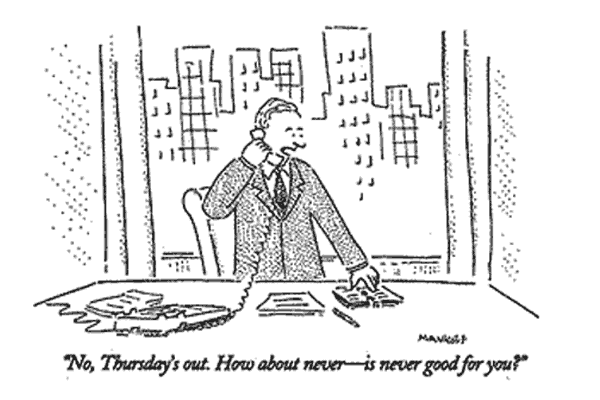
how-about-never

Verizon told us they’d be at our house between 11 am and 2 pm to install our new fiber optic connection (good-bye, Comcast!). The installation was supposed to take three hours and might require work on the outside of our house.

After a while, I checked our order status on the Verizon website. A note had been added. The technician will arrive between 1 pm and 5 pm. Ok, whatever.

The afternoon wore on. No technician. No word from Verizon. No email, no phone call.

But another visit to their website reveals an updated note: the technician will arrive between 7:45 pm and 8:45 pm. Really? To do a three-hour job that might involve working outside? In the dark?

Ok, let’s contact Verizon. First, a brief online chat. Second, a phone call to “customer service”. Third, another phone call to “customer service” after the first call disconnects.

The Verizon representative is surprised to hear that Verizon technicians do installations at night. So am I. I ask her to confirm that this is actually going to happen. Or will the technician actually show up tomorrow morning? Or never?

She contacts the dispatcher, who confirms that the technician will be arriving tonight. I’m not convinced.

Meanwhile, the website has a new note: the technician will arrive between 9 pm and 10 pm:

verizon 1

verizon 2

I find this new promise even less believable than “between 7:45 and 8:45”. Our technician will be working past midnight to finish this job? I express my skepticism and repeat my request for confirmation.

Yes, the dispatcher still says the technician will arrive between 7:45 and 8:45 pm, even though the website disagrees. I express an opinion or two to “customer service” and we say good-bye.

Comcast, I already miss you and you haven’t gone away!