Summing Him Up

Last night, I was musing about the current crisis and asked myself again why they didn’t see that he’s a con man, so his promises about “the forgotten men and women of our country” were pure baloney. The answer that occurred to me was that he said what they wanted to hear about race and immigration. That was enough for them to give him the benefit of the doubt on economics.

This morning, Neera Tanden summed him up very well:

The economic populism was always the con. The racism was always real.

One of Those Charts

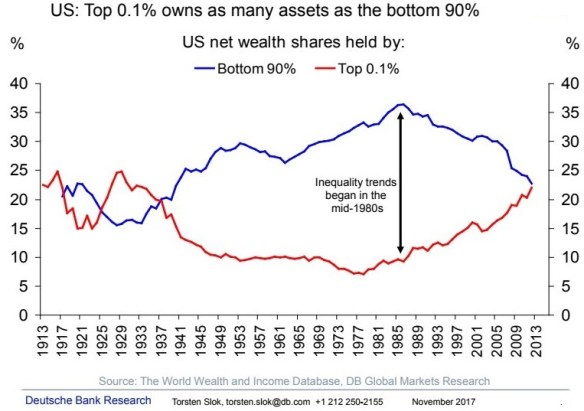
The last time we had a big overhaul of the federal tax code was in 1986. Back then, the poorest 90 percent of the population owned 3 1/2 times as much as the richest 1/10th of 1 percent. I’ll say that again. In 1986, the net worth of the least wealthy 90% of Americans was 3.5 times the net worth of the richest 0.1%.

That’s not the America we live in today. As of 2013, the richest 1/10th of 1 percent owned as much as the poorest 90 percent. To repeat: the net worth of the richest 0.1% was the same as the net worth of the poorest 90%. 

DQ9rJW2XcAAzXuK

I’m sure the red line goes even higher now and the blue line goes lower. We should keep this astounding economic inequality in mind when we have the opportunity to vote eleven months from now. That will be eleven months after the Republicans ram through another overhaul of the tax code, one that helps the richest Americans get even richer.

If They Wanted Real Tax Reform

The big story in Washington this week is the Senate Republicans scrambling to pass a major tax bill that nobody but their donors and other members of the plutocracy likes. Assuming something like it eventually becomes law, it will give a temporary tax cut to most members of the middle class and raise taxes for others, while giving a permanent tax cut to rich people and corporations. It will also add more than a trillion dollars to the deficit while requiring billions of dollars to be cut from programs like Medicare. (There is a nice summary of the giant con here.)

Republicans and even some journalists are calling it “tax reform”, even though it will make our system of taxation worse than it already is.

Wondering what real reform would look like, I read a book called A Fine Mess: A Global Quest for a Simpler, Fairer and More Efficient Tax System. It’s by a journalist named T. R. Reid. After a lot of research and conversations with tax experts around the world, he reached the same conclusion most experts have. The simplest, fairest and most efficient system of taxation is based on the “Broad Base, Low Rate” (BBLR) model.

The BBLR idea is that countries should tax as much as possible while keeping rates as low as possible. So, in the case of income tax, it’s best to tax all kinds of income at the same low rate. That means getting rid of deductions, exemptions and credits, many of which benefit people with the highest incomes, while categorizing things like health insurance benefits from your employer as personal income. That’s the “broad base” part. Once you’ve broadened the base and made more income subject to taxation, you can then lower everyone’s rates (that, obviously, is the “low rate” part).

The BBLR approach has a number of benefits. Filing and auditing tax returns is far simpler. Since rates are low and everyone’s income is treated the same, fewer people are tempted to avoid or evade taxes. Also, decisions about things like buying a house or building a factory tend to be made on the merits, not on the basis of tax considerations.

Reid also thinks the U.S. should institute a Value Added Tax (VAT). It’s a kind of sales tax, but one that is applied at every step of the manufacturing or distribution process, i.e. whenever money changes hands. We are the only rich country in the world that doesn’t have a VAT. Since it’s a tax on consumption, not income or savings, a VAT apparently has beneficial effects on a nation’s economy. It’s also difficult to evade. That’s why everyone else has one.

Another change Reid recommends is to reduce taxes on corporations. The U.S. has a high corporate tax rate, which results in corporations devoting a lot of effort to reducing or even eliminating their taxes. He thinks it would be better if all of the income people receive from corporations, especially dividends and capital gains, were subject to the same tax rate as other income (today, supposedly in order to foster investment, that income is taxed at a lower rate, which again mainly helps the wealthy). In fact, in a very interesting article in The Washington Post earlier this month, Reid advocated eliminating the corporate tax altogether, since it doesn’t do what it’s supposed to do.

What surprised me most about A Fine Mess, however, was that some of the ideas Reid endorses are included in the Republican tax bill. (Seriously, it doesn’t happen very often that there is overlap between “Republican policy” and “good idea”.) For instance, the Republicans have talked about getting rid of the deductions for medical expenses, state and local taxes and interest on mortgages. They would try to offset the disappearance of those deductions by increasing the standard deduction and lowering everyone’s rates. The result would be that more income would be taxed, but at a lower rate (that’s BBLR). Another result, not so beneficial, would be that millions of average taxpayers, for example, those who have major medical expenses or live in states with high taxes or who have big mortgages, would get a tax increase, even if their tax rates were lowered.

Unfortunately, the Republicans want to combine their few good ideas with many bad ones. For example, they want to get rid of the estate tax, which only affects the truly wealthy, and give more favorable treatment to certain kinds of business income (it’s been said that the Republican tax plan could have been written by Trump’s accountant). They also want to reduce taxes on the rich so much that they’ll have to cut social programs like Medicare, while adding more than a trillion dollars to the deficit.

Reid points out that Congress tends to produce a major tax bill every 32 years. The last one was in 1986. Congress worked on it for two years. The bill had bipartisan support and actually deserved being called “tax reform”. This year, the Republicans are trying to pass their bill in a matter of weeks, without hearings and without input from the Democrats. That indicates how screwed up our government is and how far away we are from getting actual reform.

This Chart Shows Who’s Winning at Capitalism

Capitalism involves competition. Competition involves winning. This chart shows who’s winning. Unless we change the rules, it shows who’s already won.

6a00d8341c4eab53ef01bb09b7368b970d-800wi

The gray line represents inflation-adjusted income growth in the U.S. between 1946 and 1980. The gray line is higher on the left side of the chart than on the right, because, in those years, annual income growth for low-income people (the people on the left of the chart) was higher than income growth for high-income people (the ones on the right). That meant people who made less money were gaining (however slowly) on people who made more.

As you can see, the red line goes in the other direction. It shows income growth between 1980 and 2014. The red line is higher, in fact way higher, on the right than on the left because income growth for high-income people (the ones on the right) was much higher than for low-income people (the ones on the left).

In other words, since 1980, people who made more money pulled away from people who made less. The fact that the red line goes straight up at the end shows that the people who made the most money (not just the 1% but the 0.1%, 0.01% and 0.001%) pulled away even faster. Thus, since 1980 (when Ronald Reagan was elected), the better off you were, the better off you’ve done. And the worse off you were, the worse off you’ve done.

The chart is from a column by David Leonhardt of The New York Times. He goes into some of the nuances and suggests ways to fix this growing inequality:

Different policies could produce a different outcome. My list would start with a tax code that does less to favor the affluent, a better-functioning education system, more bargaining power for workers and less tolerance for corporate consolidation.

He also notes that the president* and his Republican co-conspirators are trying to make the situation even worse. They want the opposite of what’s needed: even lower taxes for the rich, less money for public education, weaker unions and less competition for big corporations.

So the chart shows who’s been winning. What it doesn’t show is that the game may already be over. Increased wealth translates into increased political power. But the more power you have, the easier it is to change the rules so that you can accumulate even more wealth (viz. the Citizens United decision). From the point of view of the upper 0.001%, it’s a virtuous circle. For the rest of us, it’s vicious.

Unless we fight back – which means being more politically active, as in voting every chance we get – it will become even vicious-er. 

What’s Their Deal With Health Insurance Anyway?

It feels odd to write about anything else now that a senseless, malevolent being has taken control of the White House, but here goes anyway:

Four years ago, Dr. Ben Carson, who is expected to be the U.S. Secretary of Housing and Urban Development in the new administration, compared the Affordable Care Act to slavery:

“You know, Obamacare is really I think the worst thing that has happened in this nation since slavery,” Carson … said … in remarks at the Values Voter Summit in Washington. “And it is in a way, it is slavery in a way, because it is making all of us subservient to the government, and it was never about health care. It was about control…”

“And why did [the Obama administration] want to pass it so badly? Well, as I said the other night on television, Vladimir Lenin … said that socialized medicine is the keystone to the establishment of a socialist state.”

As we might expect, there is no evidence that Lenin said any such thing. The “socialized medicine” quote attributed to him by Carson and others was fabricated for a 1949 brochure issued by the American Medical Association. That’s back when the AMA was fighting President Truman’s proposal for national health insurance (and years before they opposed Medicare). But Carson telling that tall tale helps explain why the Republican Party is so opposed to the Affordable Care Act.

The ACA requires individuals to have health insurance (or pay more income tax) and employers of a certain size to offer health insurance to their employees (or pay more income tax). It also requires that health insurance plans meet specific requirements in order to qualify as health insurance for purposes of the law. So that’s one reason Republicans want to repeal the ACA. The law requires that we do something for our own benefit or for the benefit of others. It limits our freedom to do whatever the hell we want. That makes it a prime example of government overreach, or what the right-wing calls the “Nanny State”.

But since Republicans are forced to buy insurance for their houses and cars without making a fuss (let alone bringing up slavery or Nazi Germany), being forced to buy insurance for their bodies (or their employees’ bodies) can’t be the only reason they’re against the ACA.

A second reason is simply political. After decades of trying, a Democratic President finally got a bill passed that takes us closer to universal health insurance. But whatever Obama was for, the Republicans were against. They immediately labeled the ACA as “Obamacare” to help convince right-wingers to oppose the law, even if they didn’t know what the law did (and even if the law would improve their own lives). 

That’s despite the fact that the ACA adopted the conservative approach to universal healthcare that Republicans had been advocating since the 1970s. It’s pretty amazing. A letter to the editor in The Chicago Tribune tells the disheartening story:

Obamacare is virtually the same privatized mandate plan [the Republican Party] pushed since President Richard Nixon first proposed the National Health Strategy in 1971, then again in 1974. Then the GOP revived its privatized mandate plan again in 1993 with … the [HEART] act … an alternative to the [Clinton] single-payer plan… 

Obama — as a compromise to have basic health reform passed — used this same GOP blueprint with one significant change: adding a public option alongside the GOP’s privatized mandate plan … 

Eventually the public option was stripped out of the 2010 ACA bill as a further compromise to attract bipartisan support for the bill, leaving in its place the very plan that the GOP wanted and pushed for decades. Unfortunately, the ACA did not receive a single vote from the Republican Party that created the plan’s primary concepts as an alternative to a single-payer — “Medicare for all” — type of system.

No wonder the Republicans have had so much trouble coming up with a replacement for “Obamacare”. The law they’re so against is the law they used to be for.

A third reason the Republicans oppose the ACA is that it’s the kind of Robin Hood economic redistribution Republicans hate. It takes from the rich and gives to the poor. Paul Krugman explains in a blog post called “Health Care Fundamentals”:

Providing health care to those previously denied it is, necessarily, a matter of redistributing from the lucky to the unlucky. And, of course, reversing a policy that expanded health care is redistribution in reverse. You can’t make this reality go away.

Left to its own devices, a market economy won’t care for the sick unless they can pay for it; insurance can help up to a point, but insurance companies have no interest in covering people they suspect will get sick. So unfettered markets mean that health care goes only to those who are wealthy and/or healthy enough that they won’t need it often, and hence can get insurance….

The thing is, however, that guaranteeing health care comes with a cost. You can tell insurance companies that they can’t discriminate based on medical history, but that means higher premiums for the healthy — and you also create an incentive to stay uninsured until … you get sick, which pushes premiums even higher. So you have to regulate individuals as well as insurers, requiring that everyone sign up — the mandate. And since some people won’t be able to obey such a mandate, you need subsidies, which must be paid for out of taxes…

What [the Republicans] are left with is … voodoo: they’ll invoke the magic of the market to somehow provide insurance so cheap that everyone will be able to afford it whatever their income and medical status. This is obvious nonsense [but] it’s all they’ve got.

The redistribution is related to a fourth reason they’re against the ACA and it might be their biggest reason of all. Not only did the ACA impose fines in the form of tax increases on taxpayers who wouldn’t buy health insurance, it included a separate, relatively large tax increase on the richest Americans. As everyone knows, that‘s anathema to Republican politicians. Repealing the ACA, therefore, would mean a big tax cut for the Republicans’ favorite people. From Slate:

One of the core, very simple things [the ACA] did was raise taxes on the wealthy in order to fund subsidized health care for more Americans. Couples earning more than $250,000 saw a 0.9 percent increase in their top Medicare tax rate, as well as a new, 3.8 percent Medicare surtax on investment income.

If Republicans have their way and successfully repeal the Affordable Care Act, those two taxes will be toast—which will mean a substantial break for some of the country’s wealthiest families. The liberal Center on Budget and Policy Priorities estimates that millionaires would see 80 percent of the benefits from those tax reductions. Based on the most recent IRS data, the think tank roughly projects that the 400 highest income households—which earned an average of more than $300 million each in 2014—would see a $2.8 billion annual tax cut, worth about $7 million on average per filer.

So that’s at least four reasons why Republicans want to scrap the Affordable Care Act:

1) It’s what they call the “Nanny State” in action. 

2) It was an important Obama accomplishment.

3) It’s the kind of redistribution Robin Hood was for and the bad guys were against.

4) It raised taxes, especially for the rich.

In conclusion, Republicans don’t necessarily want millions of Americans suffering and dying without medical treatment. Being concerned about that kind of thing is simply low on their list of priorities.