From The Lincoln Project, made by Republicans for Republicans:
From a group calling themselves Republican Voters Against Txxxx:
They call themselves MeidasTouch:
I bet lots of his supporters would appreciate seeing these.
Note: “Nobody likes me”.
From The Lincoln Project, made by Republicans for Republicans:
From a group calling themselves Republican Voters Against Txxxx:
They call themselves MeidasTouch:
I bet lots of his supporters would appreciate seeing these.
Note: “Nobody likes me”.
Léo Delibes (1836 –1891) was a French composer, best known for his ballets and operas. His works include the ballets Coppélia and Sylvia, both of which were important in the development of modern ballet.
Delibes achieved critical and commercial success in 1883 with his opera Lakmé. Its somewhat unlikely subject was the contemporary British occupation of India. In Act 1, there is a duet for a soprano and mezzo-soprano, performed by Lakmé, the daughter of a Brahmin priest and her servant Mallika.
I bet everyone has heard part of this duet but not many know its origin. I didn’t until a few days ago. In the YouTube video I’ve been playing, the music becomes very recognizable around one minute in. The singers, Sabine Devieilhe and Marianne Crebassa, revisit that part at the end (it’s from Devieilhe’s 2017 album Mirages).
Unfortunately, the video won’t play if I put it here, so you’ll have to follow this link to see and hear their brief performance. It’s worth the trip.
PS: Kick all the Republicans out in November.
Following a path of YouTube recommendations sometimes works out very well. I clicked on a disappointing little thing from The Criterion Collection this morning, but was then led to a series of videos called “Three Reasons”. Each one offers three reasons to watch a movie Criterion will sell you. I watched a bunch, although not all 81 of them (lunch beckoned and I do have some self-respect).
It’s my duty to share a few “Three Reasons” I especially liked.
Badlands (1973), directed by Terrence Malick, maker of distinctively beautiful, sometimes puzzling works of art.
Fellini Satryicon (1969), from the wonderful Federico Fellini, who unfortunately didn’t get better with age.
The Killing (1956), by my favorite director, Stanley Kubrick, who left us too soon.
Anatomy of a Murder (1959), the best movie Otto Preminger ever directed.
Ok, one more.
Something Wild (1986), directed by Jonathan Demme, whose varied credits include The Silence of the Lambs, Philadelphia, Stop Making Sense and three episodes of Saturday Night Live.
In addition to their DVD collection, Criterion has a streaming channel. It’s got hundreds of American and foreign films, but none of these five. They have their reasons ($$$) for not offering their entire DVD collection online, but it’s still worth checking out as an addition or alternative to Netflix, whether your taste runs to L’avventura, West Side Story or Godzilla: King of the Monsters.
The American president is a disaster. He’s almost certainly doing something horrendous right now. That’s why we should vote him and every other Republican out of office in November. If you’re willing and able to support Democratic candidates in addition to voting for them, please do.
The Lincoln Project — named for a Republican president from the 19th century, back when Republicans were the liberal party — is making great little anti-Republican advertisements. Their two latest:
You can follow the The Lincoln Project on YouTube. You can help spread the word by sharing their videos. You can also give them some of your hard-earned money.
An art and architecture critic, Phillip Kennicott of The Washington Post, examines yesterday’s disturbing image of troops at the Lincoln Memorial:
Who in the Pentagon, or the leadership of the National Guard of the District of Columbia, thought this was a good look? Who thought what America needs now is a viral image of the American military in camouflage and body armor occupying a memorial that symbolizes the hope of reconciliation, that has drawn to its steps Marian Anderson to sing for a mixed-race crowd during a time of segregation and Martin Luther King to proclaim “I have a dream,” and millions of nameless souls, of all races, who believe there is some meaning in words like “the better angels of our nature”?
A photograph of members of the District’s National Guard on the steps of the Lincoln Memorial began racing around Twitter and other social media Tuesday, as the country was still digesting a violent assault by Secret Service, police and guard troops on peaceful protesters outside the White House on Monday. The photo showed troops standing resolutely, perhaps provocatively, on the memorial’s wide and inviting steps, as if they owned it. To many, it symbolized the militarization of Washington, of our government and country, and the terrifying dissolution of old boundaries between partisan politics and the independent, professional military….
Anyone who has photographed the Lincoln Memorial knows that it is hard to find a spot sufficiently distant to include the whole thing in the frame. That, in part, may explain some of the of ominous power of one of the images that circulated widely Wednesday, taken by Getty Images photographer Win McNamee.
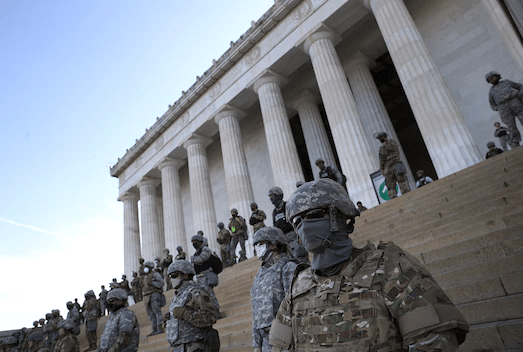
That picture was taken from the side of the steps, such that the cornice and frieze of the memorial, emblazoned with the names of the states that Lincoln helped stitch back to political unity, plunge precipitously at an angle to the lower left of the frame. A soldier looms large in the foreground, his face covered by a mask, his eyes hidden by sunglasses, his thoughts and his humanity obscured by a carapace of military resolve and inscrutability.
Throughout the crisis of the past week, there have been images, scattered but reassuring, of National Guard troops and some law enforcement officers joining in expressions of common purpose with protesters, speaking respectfully, even taking a knee with people who have flocked to the streets…
The image of troops arrayed on the steps of the Lincoln Memorial only added to the sense of crisis and civil disintegration. No matter their intent and purpose, the D.C. Guard looked not like protecting sentinels, but possessive custodians. Ultimately, their orders came from the president, and so it is inevitable that many people will see their presence there not as protective, but aggressive, as if they are facing off with the city and its residents, whom they are meant to serve.
The District, which is not a state, has long been at the mercy of the federal government and opportunistic politicians, despite having no voting representatives in Congress. The guards, who were local troops, looked like outsiders, like a colonial force.
Given the volatility of the current moment, images like this suggest that a worrying trend — of the military being co-opted into partisan politics — is accelerating, from the president signing Make America Great Again hats on an Army base in Iraq, to last summer’s display of military hardware during a traditionally nonpartisan Fourth of July celebration at the Lincoln Memorial, to new concerns about Trump’s plans for another display of the military during a pandemic, this coming Independence Day.
The decision of Gen. Mark A. Milley, chairman of the Joint Chiefs of Staff, to march with the president across Lafayette Square, which had been violently purged of peaceful demonstrators, and the participation of Defense Secretary Mark T. Esper in a religious-themed photo op at St. John’s Episcopal Church, is yet more worrisome.
The power of the image is also directly connected to the fraught power of the Lincoln Memorial, which is architecturally one of the most beautiful in the country….
The bulk of the memorial’s substance and content is about who goes there, the history of who has stood on its steps, facing the Capitol in the distance, and the obelisk devoted to George Washington, simultaneously the founder of the country, the American Cincinnatus and a slaveholder. The memorial is about the concerts and speeches and protests that have transpired there, about the continuing impulse of ordinary Americans to make it a pilgrimage site.
But one dark truth of the memorial, accidentally amplified by this image of soldiers on its steps, is: For many white Americans, it symbolizes a fantasy of society made whole by Lincoln, of a country that skipped from the trauma of civil war straight to the reconciliation and healing that was adumbrated but not achieved by him, nor any of his successors…
Now we have an image that suggests that raw, naked power — old-guard, old-style, patriarchal military power — has taken possession of something that is already a fragile cultural symbol. To many people looking at this photograph, it seemed to say, “they own it,” not us, not we, not the people.
And that raises an even deeper fear, one that recalls memories of the National Guard at Kent State and atrocities committed by U.S. troops in its wars overseas…. It exacerbates a fear that Washingtonians feel keenly, as more troops pour in, military hardware rattles through the streets, helicopters shatter the calm of night, and as the president’s bellicose rhetoric continues to spew like a fire hose. It’s a simple fear, and a question every soldier, no matter his or her rank, must answer: If the president tells you to shoot us, will you do it?
 Whereof One Can Speak 🇺🇦
You must be logged in to post a comment.