The Beach Boys recorded “Little Honda” in April 1964, when the Beatles occupied positions 1, 2, 3, 4 and 5 on Billboard’s Hot 100 singles chart (something nobody else has ever done). Written by Brian Wilson and Mike Love, “Little Honda” was released on the Beach Boys’ All Summer Long album in the summer of ’64.
Gary Usher (who had earlier written “In My Room” and “409” with Brian Wilson) heard the album and decided to include “Little Honda” on an album of car songs, mostly written by him and Roger Christian (who had written “Don’t Worry Baby” and “Little Deuce Coupe” with Brian Wilson).
Usher hired some studio musicians and singers to make the album, although it was supposedly recorded by the Hondells, a group that didn’t exist yet. Usher made up a story for the album cover explaining how the fictional Hondells had gotten together. In order to release “Little Honda” as a single, however, he needed a group to tour and promote the record, so four young men, one of whom had sung backing vocals on the song, became the real-life Hondells.
“Little Honda” was the only hit record the Hondells ever had, rising to #9 on the Billboard chart. Brian Wilson and the other Beach Boys went on to other things.
Here’s the Beach Boys’ version of “Little Honda”. I think that’s the late Dennis Wilson yelling “Go!” at the beginning. (From the advertising pictures in the video, it appears that young women weren’t supposed to drive Hondas in 1964, although they were encouraged to have fun and hang on tight.)
In 1997, the “alternative” rock band Yo La Tengo released their own “Little Honda” on their I Can Hear the Heart Beating as One album. It’s unlikely that anyone in Yo La Tengo ever had fun riding a Honda, but it’s a cool, rather disturbing version of the song.
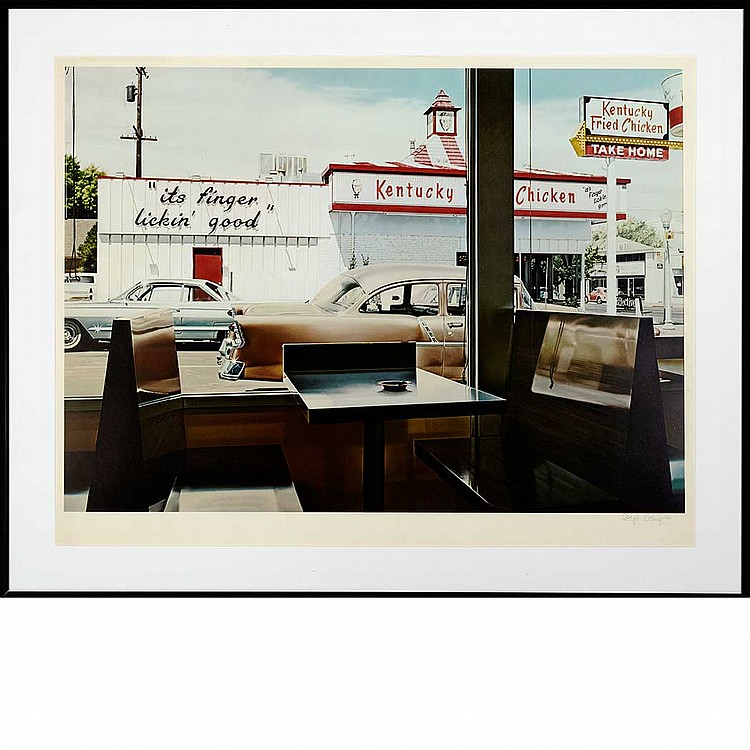
Back in the 70s, we bought a piece of art that’s still hanging on a bedroom wall. It’s a print by the photorealist painter Ralph Goings. I don’t think it’s one of his most popular works, but an image did make it onto the internet:
Which I was reminded of by seeing some paintings by Gregory Thielker. For example:
And:
There is something wonderful about paintings that look photographic. In addition to their purely visual qualities, they are like magic tricks, successful illusions performed by a brilliant magician.
Virginia Woolf is supposed to have said: “Art is not a copy of the real world; one of the damn things is enough.”
That’s an excellent point, but in this case, the “copies” are pretty good.
I’ve heard there was a time when the lyrics to popular songs were easily understandable. In fact, I heard that from my father more than once. He found it highly amusing when a friend and I played one particular song over and over, trying to make sense of the words, sometime in the late 60s.
Often, however, we were pretty sure what the lyrics were. Take, for example, a Beach Boys song called “Cabinessence” (or “Cabin Essence”). It’s a strangely beautiful, relatively psychedelic song about the American frontier, written by Brian Wilson and Van Dyke Parks for the long unfinished Smile album.
“Cabinessence” has a special place in the history of the Beach Boys (and the history of American popular music, for that matter), since conflict concerning its lyrics supposedly contributed to Brian Wilson giving up on Smile, history’s most famous unfinished rock album. The person who famously objected to the lyrics back in 1967 was Mike Love, frequent lead singer and lyricist for the Beach Boys (especially in their early days). Newly appointed lyricist Van Dyke Parks didn’t give Mike a satisfying answer when asked to explain the following lines: “Over and over the crow cries uncover the cornfield/Over and over the thresher uncovers the wheatfield”.
I’ve never thought these lyrics were all that mysterious, especially compared to some other lyrics from that period (“The preacher looked so baffled when I asked him why he dressed/With twenty pounds of headlines stapled to his chest”?). What was Mike Love’s problem anyway? Aside from being bald, jealous and relatively untalented?
So it was quite a surprise when I learned the other day that I have apparently misheard the lyrics to “Cabinessence” for the past 46 years. According to the most official sources (lyrics sheets in recent releases), the final words to the song are: “Over and over, the crow cries uncover the cornfield, over and over, the thresher, and hover the wheatfield”.
“And hover?” Not “uncovers”? What the hell does “and hover the wheatfield” mean? It’s not even English. If that’s the line that bothered Mike Love, I suddenly feel (a tiny bit) more sympathetic toward the guy.
Well, it turns out that matters are not quite that simple. A bit of research reveals the following:
1) Sheet music from 1968 says that the song ends with “the crow flies [sic] uncover the cornfield”. There’s no mention of the thresher or the wheatfield at all.
2) Wikipedia has one paragraph indicating that the song ends with “Over and over, the thresher and plover, the wheatfield” (“plover” = a short-billed, gregarious wading bird).
3) In 2004, an anonymous expert on a Smile message board (there used to be such things) suggested that the last two lines make more sense if they are rearranged, as follows: “Over and over the crow cries and hovers the wheatfield/Over and over the thresher uncovers the cornfield”. Which does make more sense grammatically — although in the 19th century you’d expect to find scarecrows in cornfields and threshers in wheatfields, not the other way around.
4) When I listen to the song, I still (think I) hear the thresher uncovering the wheatfield, with no hovering going on at all.
5) The song was written and first recorded in the mid-60s, when lots of people, including Wilson and Parks, weren’t terribly sober, so who knows what the words were?
And, you might ask, who cares? Well, I do. Now every time I listen to the song, I’m going to be wondering: Now what are they saying? I might as well be back on our living room floor with Dean from across the street, playing some damn song over and over again, with my father shaking his head in the background.
——————————————————————————————————————-
What are accepted, apparently by everyone else, as the song’s full lyrics:
Stephen Foster wrote more than 200 songs. Some of them are still being sung. He could have used the royalties, since he died in poverty at the age of 37. “Slumber My Darling” isn’t as well-known as “Oh! Susanna”, “Camptown Races”, “Beautiful Dreamer” or “Jeanie With the Light Brown Hair”, but it’s certainly one of his most beautiful songs, maybe his most beautiful.
It’s always a pleasure finding a website that deserves frequent visits. I didn’t know that Garrison Keillor has a Writer’s Almanac site. It appears to be updated every day.
Yesterday’s entry quoted Walt Whitman’s preface to the 1855 edition of Leaves of Grass. Whitman offered some wise advice:
“This is what you shall do: Love the earth and sun and the animals, despise riches, give alms to every one that asks, stand up for the stupid and crazy, devote your income and labor to others, hate tyrants, argue not concerning God, have patience and indulgence toward the people, take off your hat to nothing known or unknown or to any man or number of men, go freely with powerful uneducated persons and with the young and with the mothers of families, read these leaves in the open air every season of every year of your life, re-examine all you have been told at school or church or in any book, dismiss whatever insults your own soul; and your very flesh shall be a great poem and have the richest fluency not only in its words but in the silent lines of its lips and face and between the lashes of your eyes and in every motion and joint of your body.”
I don’t generally favor standing up for the stupid and crazy, although it’s good to stand up for the “stupid” and “crazy” (scare quotes inserted).


 Whereof One Can Speak 🇺🇦
You must be logged in to post a comment.