Using the Democracy We Already Have

Michael Lind, writing at Salon, argues that the agenda of the American right wing amounts to a “Southern Autonomy Project”: an attempt to attract investment to the South by insuring cheap labor and minimal government regulation, while limiting any negative response from Southern voters and interfering with possible corrective action in Washington.

Lind believes we need a progressive agenda to counteract the right, a “National Majority Rule Project”:

Setting political difficulty aside, it is intellectually easy to set forth a grand national strategy that consists of coordinated federal policies to defeat the Southern Autonomy Project.

He thinks these policies would do the trick:

1) A federal living wage, which would level the economic playing field among the states;
2) Nationalization of social insurance, so that Southern states couldn’t water down programs like Medicaid and the ACA to their advantage;
3) Real voting rights for all Americans, insured by Federal law;
4) Truly nonpartisan redistricting in order to eliminate gerrymandering of Congressional districts;
5) Abolition of the Senate filibuster (I’d add a change to House rules that would make it easier to bring legislation to a vote);
6) Abolition of the Federal debt ceiling.

http://www.salon.com/2013/10/13/the_south_is_holding_america_hostage/

Unfortunately, it’s really hard in practice to “set political difficulty aside”. As things stand now, any such reforms would require cooperation from the people the reforms are aimed at.  

The same problem applies to a Salon article that calls for a new Constitutional Convention. The author of this article argues that the Constitution should be amended to make it more democratic, including changes like:

1) Ten-year terms for Supreme Court justices;
2) Public funding for elections and the elimination of campaign contributions;
3) Abolition of the Electoral College;
4) Elimination of special voting rules and earmarks in Congress;
5) A requirement that Congress approve a yearly budget or face a special election;
6) Elimination of the need for state legislatures to approve constitutional amendments.

The author concludes, however:

Of course, it is unthinkable that the United States would do what its states have done 230 times, i.e., call a constitutional convention to design a modern framework of governance. This would require two-thirds of the states to agree. Amending the current constitution is also nearly impossible as it demands a two-thirds majority in both chambers of Congress as well as the approval by 38 states.

 http://www.salon.com/2013/10/12/us_constitutional_reform/

It’s reasonable to conclude that the only way to make our country more democratic is for more right-thinking people to participate in the democracy we already have. People need to vote for politicians who would support changes like those above. (We’d also have to get over the idea that our Constitution as written is a sacred document.)

Having the right people in office can certainly do wonders. Since the voters of California elected a Democratic governor and Democratic majorities in both houses of the legislature, California has started moving in the right direction again.

According to an article in the New Yorker (whose author argues, by the way, for Obama to ignore the debt ceiling if it comes to that), a similar phenomenon occurred after the Southern states seceded:

Throughout the Civil War and afterward, Republicans in Congress had enacted some of the most forward-looking legislation in American history: a national currency, the Homestead Act, a transcontinental railroad, support for higher education, the definitive abolition of slavery—all thanks to the extended absence of delegations from the self-styled Confederate states.

http://www.newyorker.com/talk/comment/2013/10/21/131021

See, all we need to do is use the democracy we already have! (And keep having babies who grow up to be Democrats, especially in Texas, Florida and Ohio.)

Getting to the Bottom of Things Physics-Wise

One of the things that made physicist Richard Feynman famous was his invention of the Feynman diagram. Feynman diagrams provide a method for understanding the interactions between sub-atomic particles. Here, for example, is a diagram that represents the collision of an electron and a positron, resulting in the creation of two photons:

640px-Feynman_EP_Annihilation.svg

Using Feynman diagrams to describe certain interactions turns out to be extremely challenging, however. The collision of two gluons, resulting in the creation of four less energetic gluons, requires 220 diagrams. Some calculations based on this methodology cannot be done without the aid of a powerful computer, since they require thousands, millions and even billions of mathematical terms.

Over the years, various physicists and mathematicians have found ways to simplify these calculations. Recently, in fact, physicists have discovered a new geometrical object, the use of which simplifies the calculations to an amazing degree. They call the new structure an “amplituhedron”:

Interactions that were previously calculated with mathematical formulas thousands of terms long can now be described by computing the volume of the corresponding jewel-like “amplituhedron,” which yields an equivalent one-term expression.

“The degree of efficiency is mind-boggling,” said Jacob Bourjaily, … one of the researchers who developed the new idea. “You can easily do, on paper, computations that weren’t feasible even with a computer before.”

For example, calculating the volume of the amplituhedron in this diagram, which represents the interaction of 8 gluons, provides the same result as 500 pages of algebra based on Feynman diagrams:

amplituhedron-drawing_web

I learned about this latest development in an article called “A Jewel at the Heart of Physics”, which can be found here:

https://www.simonsfoundation.org/quanta/20130917-a-jewel-at-the-heart-of-quantum-physics/

The article suggests that the discovery of the amplituhedron might one day lead to major consequences for our understanding of the universe: “a theory of quantum gravity that would seamlessly connect the large- and small-scale pictures of the universe”:

Attempts thus far to incorporate gravity into the laws of physics at the quantum scale have run up against nonsensical infinities and deep paradoxes. …The amplituhedron is not built out of space-time and probabilities; these properties merely arise as consequences of the jewel’s geometry. The usual picture of space and time, and particles moving around in them, is a construct.

If two methods give the same results, the simpler method is clearly preferable from a pragmatic point of view. In fact, it’s likely in such a case that the simpler method better reflects the way the universe works. Perhaps the simplicity of this new method indicates that fundamental reality is simpler than previously believed:

Beyond making calculations easier or possibly leading the way to quantum gravity, the discovery of the amplituhedron could cause an even more profound shift, [physicist Nima] Arkani-Hamed said. That is, giving up space and time as fundamental constituents of nature and figuring out how the Big Bang and cosmological evolution of the universe arose out of pure geometry.

“In a sense, we would see that change arises from the structure of the object,” he said. “But it’s not from the object changing. The object is basically timeless.”

None of this means that there are tiny amplituhedrons underlying the universe, floating around outside space and time (whatever that would mean). It’s not even clear (to me anyway) what “pure geometry” is, since the geometry of an object, whether real or imagined, usually refers to its spatial characteristics.

Nevertheless, this latest labor-saving device may help physicists get closer to the bottom of things, assuming there is a bottom to get to.

Selected Reading On The Mess We’re In

Historian Sean Wilentz makes a forceful argument in favor of Obama invoking the 14th Amendment to protect the world’s economy:

… the president would have done his constitutional duty, saved the country and undoubtedly earned the gratitude of a relieved people. Then the people would find the opportunity to punish those who vandalized the Constitution and brought the country to the brink of ruin.

http://www.nytimes.com/2013/10/08/opinion/obamas-options.html?pagewanted=2&hp

The New York Times editorial board is justifiably outraged that many people living in Republican-run states will still lack health insurance next year — they’ll earn too little to be covered by the Affordable Care Act and too much to be covered by Medicaid:

Their plight is a result of the Supreme Court’s decision last year that struck down the reform law’s mandatory expansion of Medicaid and made expansion optional. Every state in the Deep South except Arkansas has rejected expansion, as have Republican-led states elsewhere, [although] there is no provision in the ACA to provide health insurance subsidies for anyone below the poverty line … those people are supposed to be covered by Medicaid… Eight million Americans who are impoverished and uninsured will be ineligible for help of either kind.

http://www.nytimes.com/2013/10/04/opinion/a-population-betrayed.html?ref=opinion

Of course, Congress could easily fix this problem, but that would require You Know Who to cooperate.

At Jacobin, Shawn Gude writes about the fundamental tension between capitalism and democracy, in the context of living-wage legislation in the District of Columbia:

The controversy throws into sharp relief one of our era’s great unspoken truths: Capitalist democracy, if not an oxymoron, is less a placid pairing than an acrimonious amalgamation. The marriage that Francis Fukuyama famously pronounced eternal is in fact a union of opposites. Inherent to capitalism is inequality, fundamental to democracy is equality. Class stratification, the lifeblood of capitalism, leaves democracy comatose. The economic “base,” to put it in classical Marxian terms, actively undermines the purported values of the political superstructure.

http://jacobinmag.com/2013/08/capitalism-vs-democracy/

And finally, Nobel Prize-winning economist Joseph Stiglitz argues that we can undo the decisions that got us into this mess:

We have become the advanced country with the highest level of inequality, with the greatest divide between the rich and the poor… The central message of my book, The Price of Inequality, is that all of us, rich and poor, are footing the bill for this yawning gap. And that this inequality is not inevitable. It is not … like the weather, something that just happens to us. It is not the result of the laws of nature or the laws of economics. Rather, it is something that we create, by our policies, by what we do.  

We created this inequality—chose it, really—with laws that weakened unions, that eroded our minimum wage to the lowest level, in real terms, since the 1950s, with laws that allowed CEO’s to take a bigger slice of the corporate pie, bankruptcy laws that put Wall Street’s toxic innovations ahead of workers. We made it nearly impossible for student debt to be forgiven. We underinvested in education. We taxed gamblers in the stock market at lower rates than workers, and encouraged investment overseas rather than at home.

http://www.alternet.org/economy/joe-stiglitz-people-who-break-rules-have-raked-huge-profits-and-wealth-and-its-sickening-our

Meanwhile, the Swiss are voting on whether to guarantee everybody a minimum monthly income of $2500 francs ($2800 dollars). They’re also voting on a proposal to limit executive pay to no more than 12 times what the company’s lowest-paid workers earn. Who knew that the businesslike, orderly Swiss were a bunch of commies? Or maybe they’re just fed up with rising inequality, even in Switzerland.

http://www.reuters.com/article/2013/10/04/us-swiss-pay-idUSBRE9930O620131004

Twelve Years Ago, Plus Yesterday

Everybody of a certain age has some kind of 9/11 story to tell. Mine isn’t especially interesting, but unlike most people, I was on my way to the World Trade Center that morning.

It was my usual route to work: a commuter train to Hoboken, a PATH train under the Hudson River to the Trade Center, followed by a subway to Brooklyn.

On our way to Hoboken, the conductor announced that a plane had flown into one of the towers, resulting in the train station under the Trade Center being temporarily closed. I assumed it was some disgruntled, suicidal guy in a Cessna.

Since I needed to get to work, I took a PATH train to Greenwich Village, a couple miles north of my original destination. Up on the street, walking to the subway, I could see one of the towers burning.

By the time I got to work in Brooklyn, the second tower had been attacked. We could see the smoke from the upper floors of our building, but I wasn’t watching when the towers fell. 

The stock exchange closed that week, but we back office people still had work to do, mainly preparing for the exchange to open again.

I read the paper as the days went by, but didn’t watch much television. I avoided the TV news coverage. I didn’t watch the same videos over and over again, or see the Mayor or the President visit the site.

A week or so later, I had to visit Lower Manhattan for a meeting. What I remember most walking through those gray, relatively empty streets was the terrible, acrid smell. It seemed like the air had been poisoned.

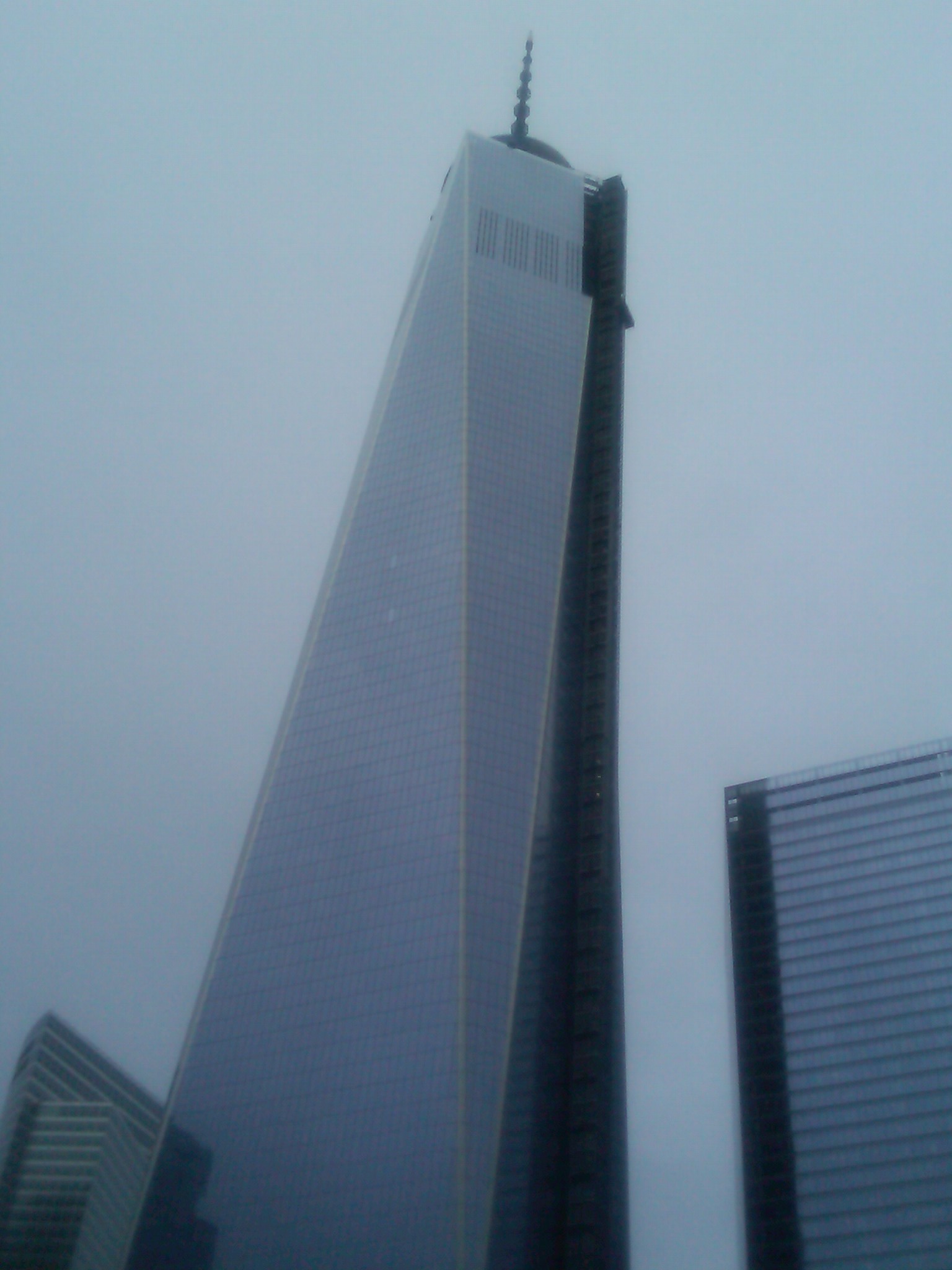
Yesterday, 12 years later, I happened to be in the Wall Street area with some time on my hands, so I decided to visit the 9/11 memorial, not knowing how much of it has been completed. 

You can print out a free ticket from the memorial’s website, which allows you to get inside the memorial more quickly. But even on a cool, cloudy October weekday, there were hundreds of people with tickets waiting in line. And, of course, there was a security checkpoint, with the standard grey plastic tray for your wallet, keys, phone and belt.

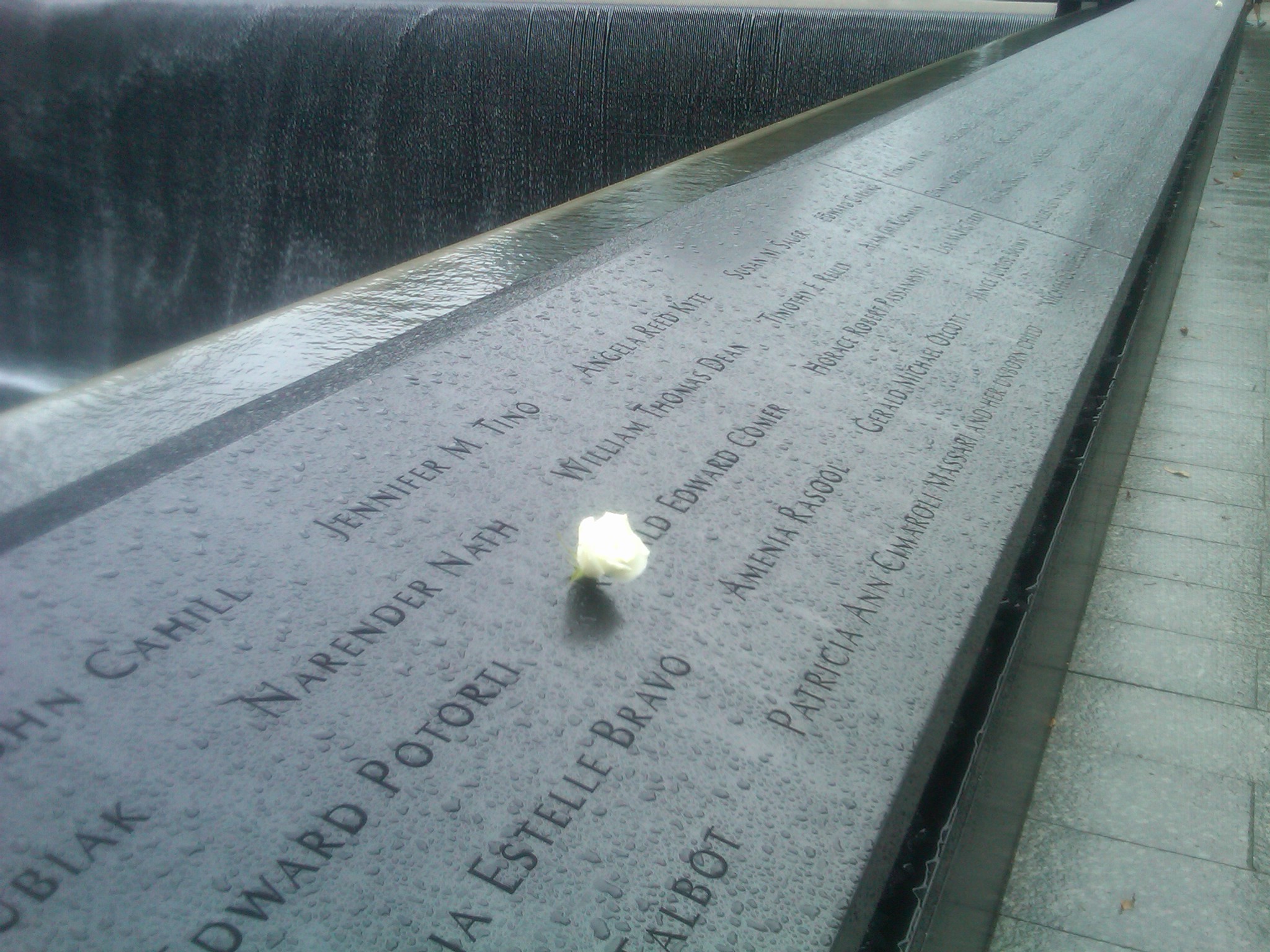
When you finally get inside, you’re in a kind of park, in the large space between the new buildings. You hear the water falling down the sides of the enormous fountain that marks the outline of the South Tower. The visitors are crowded along the nearest sides of the fountain, looking over the edge, taking pictures and reading the names inscribed in the black marble.

To get away from the crowd, you can walk around the fountain, stopping to read some of the names, which I did. On my way to the exit I noticed the fountain that marks the outline of the North Tower. Hardly anyone was there.

I suppose if you’ve seen one enormous black fountain with thousands of gallons of water plunging down it sides into an apparently bottomless pit, you’ve seen them all. 

After walking around the second fountain, I headed for the exit again.

People say the site is sacred. I thought it was sad.

And human. There are lots of visitors, the regular people you see at other tourist attractions: a lot of miscellaneous, casually-dressed people taking pictures of the place and each other, some being a little loud, some being led around by tour guides, most of them crowded together where a fountain is closest to the entrance. Some of them have bought souvenirs at the stores in the neighborhood that sell trinkets and t-shirts. I suppose it’s all a reminder that those were regular people killed 12 years ago, in fact, the same kind of people you’ll see if you visit the memorial.

Of course, some of those regular people were heroes that morning. For the most part, however, they were average men and women, a mixture of colleagues and strangers with a variety of names, all kinds of names reflecting the many places their ancestors came from. At least as impressive as all that water rushing down, the scale of the place, and the tall buildings around it, are all those names.
_________________________________________________________________________
IMG-20131010-01171 IMG-20131010-01172 IMG-20131010-01174 IMG-20131010-01178 IMG-20131010-01179

If You’ve Got It, Flaunt It

A friend and I spent some time at the local arboretum yesterday. It’s a pleasant place to stroll around or sit on a bench discussing weighty matters or nothing at all.

Walking along one of the paths, we came upon this backyard view of somebody’s new house, apparently getting its finishing touches.

IMG-20131009-01170

What this country definitely needs is lower taxes on rich people. How can you afford to furnish such a place and pay your utility bills when the Federal government demands a punishing 15% of your long-term capital gains?