It Would Be Great To Focus On Good News

But it must be noted that the deformed human being in the White House now has unidentifiable law enforcement officers deployed on the streets of Portland, Oregon, over the objections of the mayor, the governor, the state’s two senators and members of the House of Representatives.

These officers — dressed up like they’re facing imminent combat — are driving around in unmarked vans, picking up people off the street, with no justification, and then taking them somewhere to be questioned, without explaining why they’re being detained.

So far, there’s no evidence that anybody they’ve picked up has been “disappeared” (e.g. flown away in a helicopter and dropped over the Pacific Ocean), but the officials’ behavior is standard practice under authoritarian regimes. They’re already calling the protesters “violent anarchists”. The next step would be to hype the supposed danger to public order even further and declare martial law.

These events were first reported by Oregon Public Broadcasting:

Federal Law Enforcement Use Unmarked Vehicles To Grab Protesters Off Portland Street

Local officials and the ACLU have filed lawsuits to remove the federal presence, but the president’s cronies who run the Department of Homeland Security say it’s only the beginning.

The New York Times reports that the situation is deteriorating:

An aggressive federal campaign to suppress unrest in Portland appears to have instead rejuvenated the city’s movement, as protesters gathered by the hundreds late Friday and into Saturday morning — the largest crowd in weeks.

Federal officers at times flooded street corridors with tear gas and shot projectiles from paintball guns, while demonstrators responded by shouting that the officers in fatigues were “terrorists” and chanting, “Whose streets? Our streets.”

A court ruling has largely prohibited local police from using tear gas during the recent protests, which have played out for more than 50 consecutive nights in Portland.

While the protesters have repeatedly decried the city’s own police tactics, Mayor Ted Wheeler, who also serves as police commissioner, and other leaders have united in calls for federal agencies to stay away. City commissioner Jo Ann Hardesty went to join protesters gathered outside the county Justice Center downtown, saying the city will “not allow armed military forces to attack our people.”

“Today we show the country and the world that the city of Portland, even as much as we fight among ourselves, will come together to stand up for our Constitutional rights,” Ms. Hardesty said Friday.

Josh Marshall of Talking Points Memo explains the government’s deception in a Twitter thread:

When you go to a federal courthouse and you see security there you probably realize it’s not the local [police department]. They’re federal agents. Since 2002 [Federal Protective Services] has been housed with [the Department of Homeland Security]. The White House and acting officials at DHS are now using this jurisdiction over federal facilities as a hook to make [Immigration and Customs Enforcement] and [Customs and Border Patrol] into a sort of federal political police, run by acting appointees at DHS and responding to the President’s campaign needs.

They are saying that they’ve authorized ICE and CBP to operate in support of the FPS mission. In other words, in their view it’s not really CBP it’s just officers backing up FPS. But of course there’s nothing happening that FPS can’t handle on its own. But through this hook of jurisdiction over federal installations, CBP is now assuming police powers over anyone either spray painting on federal facilities or who simply might be protesting near one. Because there have been some instances of vandalism against federal buildings and monuments, this is the hook through which DHS has authorized CBP and ICE as what amounts to Txxxx’s private police force or domestic security service. It’s no accident that it’s ICE and CBP. They’re among the most politicized federal police agencies, most . . . organizational loyal to and supportive or Txxxx’s agenda and political ambitions.

The problem, of course, is that the truly dangerous “violent anarchists” in Portland are dressed for combat and paid by our tax dollars. See the video below.

https://twitter.com/iansmit01/status/1282758702685196294


An Argument for Vice President Warren

Joe Biden has promised to announce his pick for Vice President in a few weeks. A poll last month suggested that Sen. Elizabeth Warren is the first choice among Democratic voters. It’s interesting to note that she was also the first choice (by a slimmer margin) among Black Democrats. Washington Post columnist Jonathan Capehart, a Black man who prefers Sen. Kamala Harris for the job, has written about one Black voter, his Aunt Gloria, who wants Biden to choose Warren.

GJP5VAFMWJE7NEVEPEU2NK7ZR4

Now two Black activists, Angela Peoples and Phillip Agnew, make an argument for Warren in the same paper:

America is on fire, and Joe Biden faces a choice. The spark may have been the brutal killing of George Floyd, but the current awakening is about more than police violence. Black communities around the country are responding to decades of policies and practices that constrain and destroy black lives: wealth-stripping, redlining, school closures, poverty-wage jobs, voter suppression and gentrification. The coronavirus pandemic has underscored the ways in which racialized capitalism leaves black and brown Americans disproportionately exposed to dangers, from hazardous working conditions to crowded housing to underfunded and overburdened health-care facilities.

The former vice president and presumptive Democratic presidential nominee already has committed to picking a woman as his running mate. Against the backdrop of the growing movement for black liberation, he’s been encouraged to select a potential governing partner from a list of qualified black women . . .

But if Biden is committed to choosing a running mate who consistently challenges the status quo on behalf of working people, particularly in the black community, who offers detailed policy prescriptions to remake our economy and strengthen our democracy, and who has clearly articulated the centrality of race, gender and class in the persistence of structural inequality, his choice doesn’t automatically have to be black. And the potential candidate who obviously meets that standard isn’t black. It’s Elizabeth Warren.

In September 2015 — nearly five years before Floyd was killed — Sen. Warren (Mass.) spoke passionately: “None of us can ignore what is happening in this country. Not when our black friends, family, neighbors literally fear dying in the streets,” she said. “This is the reality all of us must confront, as uncomfortable and ugly as that reality may be. It comes to us to once again affirm that black lives matter, that black citizens matter, that black families matter.”

Today, she marches with protesters. “Being anti-racist means fighting for anti-racist public policy,” she has continued to insist. “Being race neutral just won’t work.”

Before she was an elected official, Warren had established a track record of speaking inconvenient truths about racism and taking on the fights that matter. She identified the factors that keep working families in cycles of economic insecurity and the specific role that racism plays in trapping black and brown communities. In a 2004 law review article on the economics of race, she explained: “The economic security that comes with arrival in the middle class is divided by race, leaving Hispanic and black families at far more risk than their white counterparts.” In the popular book she authored with her daughter, “The Two-Income Trap: Why Middle-Class Mothers and Fathers Are Going Broke,” Warren laid out her view that “subprime lending, payday loans, and the host of predatory, high-interest loan products that target minority neighborhoods should be called by their true names: legally sanctioned corporate plans to steal from minorities.”

She had a lead role in founding the Consumer Financial Protection Bureau, which in its relatively short tenure has pursued a series of enforcement actions against institutions that have discriminated against black and brown borrowers.

As a presidential candidate, Warren’s “Working Agenda for Black America” outlined a student loan debt cancellation plan with a goal of reducing the black-white racial wealth gap by 25 percent. She called for tackling the deplorable black maternal mortality rate by rewarding health systems that keep black mothers healthier. And she proposed the creation of a small-business equity fund with $7 billion to provide grants to entrepreneurs of color.

Along with several of her Senate and House colleagues, Warren introduced a bill calling for the Centers for Disease Control and Prevention to publish data on covid-19 testing, treatment and outcomes that is disaggregated by race, ethnicity, gender, age, primary language, socioeconomic status and other demographic characteristics. On Tuesday, Warren and Rep. Ayanna Pressley (D-Mass.) sent a letter to Health and Human Services Secretary Alex Azar requesting HHS reporting on the administration’s efforts to address health disparities, including those affected by covid-19. The Trump administration’s lack of planning for the pandemic and its economic consequences has been catastrophic for black America.

No politician is perfect; we haven’t always agreed with Warren’s positions or politics. . . But she has demonstrated what is possible when politicians commit to working with social movements to achieve our shared goals. When Black Womxn For challenged the language she used to describe people serving life sentences, she responded by meeting with black women activists, apologizing and updating her policy plans. One lesser-known example: Warren listened to black farmers and amended her agriculture policy to address their concerns.

Warren’s willingness and ability to listen and respond have earned her the respect of many black leaders and thinkers. After Ta-Nehisi Coates penned his acclaimed essay, “The Case for Reparations,” Warren reached out to Coates to discuss his work. In an interview last year, Coates expressed his view that of the 2020 Democratic presidential candidates, Warren was the most serious about reparations. Throughout her campaign, she prioritized building relationships with black women leaders by incorporating their demands into her platform . . .

In the midst of this historic uprising that has many calling for a complete overhaul of the criminal legal system, it speaks volumes that Warren’s political career isn’t tied to the Jim Crow system of mass incarceration, and her plan to reform it was one of the strongest in the Democratic primary. Her latest legislative victory — getting Senate Republicans to stand up to President Trump by approving her measure requiring the military to rid bases of Confederate names — is another example of her commitment to challenging racism and her ability to get things done.

. . . [We are part] of the movement for black liberation that is shaping the consciousness of a generation, and we are convinced that only elected servants with a people-centered vision will compel our movement to fight at the polls the way we have in the streets.

Not only will Warren’s commitment to racial equity and challenging oppressive systems register with a rising generation of voters; her record shows that if she becomes vice president, she will remain committed to an agenda that lifts the experiences and leadership of the most marginalized.

Representation is important. When generations of white supremacy have kept black folks from proportional representation in the highest offices at all levels of government, undoubtedly it means something when one of us shatters the glass ceiling, clearing space for others to follow. However, the fires that burn in the streets of cities across the country will not be put out simply by putting a black name on the ticket. Without transformative policy, representation alone is insufficient.

If Democrats’ response to the reckoning against systemic racism is simply to nominate a black woman for vice president, no matter her politics, they will affirm the skepticism of young and progressive voters and rob this country of another opportunity to enact the sweeping changes needed for our communities to thrive. Voters want, and America needs, someone who has shown the courage to take on the corrupting forces of racism and greed. Warren has.

Unquote.

By the way, Post columnist Paul Waldman says that “if you aren’t filled with rage at [our president], you aren’t paying attention”. So many reasons make it crucial to support Democratic candidates up and down the ballot in November and severely damage the Republican Party for years to come.

Spinoza, Nietzsche and Living in a Material World

Charlie Huenemann, a philosophy professor at Utah State, was interviewed in April by Richard Marshall for Marshall’s “End Times” series. It’s a good interview, and I especially liked the way Huenemann compared the philosophies of Spinoza and Nietzsche.

images

    Baruch and Friedrich

[CH] I think of Spinoza as a radical religious reformer. I think he was trying to say this: “There is a single entity whose nature determines the structure and existence of the universe, and that entity is the thing that people have been calling “God” for many centuries. But they got the metaphysics (or theology) very wrong, and now we’re in a position to figure out what this divine thing really is, and to see how the writers of scriptures managed to get the basic moral of the story right, while getting all the metaphysical stuff wrong. And by the way, if you understand what I’m saying, you’ll see that there’s no harm in allowing philosophers to write about such things.”

It’s surprising how explicit Spinoza is about all this in his Theological-Political Treatise. He basically says just what I said, though with greater care, and elegant Latin. And saying that was hugely radical for his day. The hypothesis that it was somehow a cloak meant to disguise a view that was even more unthinkable seems to me very unlikely. If that’s what he was up to, then he was an idiot, or at least completely out of touch with his audience. The book he wrote was seen immediately as about the most heretical thing a person could write. So it’s implausible to suspect that he was pulling any punches.

[RM] You say you pit a Spinoza naturalism against a Nietzsche naturalism. Can you sketch for us the salient elements that form this contrast and what it tells us about contemporary attitudes towards naturalism . . . ?

[CH] I should say at the outset that I myself don’t feel like I have a dog in this fight. I suspect the naturalism I would describe as Nietzschean is probably true, and that it’s sort of disappointing, and Spinoza’s naturalism is far groovier, but implausible. . . I can’t blame someone for going in with Spinoza: it’s profoundly moving to see the whole of nature as divine. On the other hand, if someone throws in with Nietzsche, they should be fully aware of all they are repudiating. In distinguishing the two kinds of naturalism, I mainly want to direct readers’ attention to the “meaning of life” consequences of these ways of being a naturalist.

Anyway, on to the distinction. Spinoza sees the universe as divine in some important sense. There is an essence to it that lives and breathes in all of its parts. We can come to know that essence through rational demonstration, but he also leaves room for a more immediate and somewhat mystical access to that essence. In his naturalism, humans are part of nature in a way that might best be called “belonging”: we share an essence with all natural things, and in virtue of sharing that essence we can come to know our universal union with all things and attain a special kind of joy in contemplating it. It’s in that sense that I’d call Spinoza’s nature a sanctuary. It’s a sanctuary from despair, alienation, and disconnection – which, incidentally, must have been significant forces in Spinoza’s own life. To be a Spinozist is to see all things, including oneself, as an expression of divinity.

But Nietzsche’s naturalism is quite different. Here I need to be careful, because I think Nietzsche isn’t perfectly consistent over his writings, and sometimes (especially when Zarathustra is speaking) nature is every bit as holy and mystical as anything found in Spinoza. But in other moods, Nietzsche seeks to establish a naturalism that is more like our modern-day naturalism, which is fundamentally a denial of any special features of the universe that might make us feel more at home. The universe itself is a product of chance; that life evolves in some parts of it is entirely accidental; humans are pushed and pulled by all sorts of blind, non-teleological [i.e. non-purposeful] forces. Nothing is inherently significant, and that certainly includes us. Clearly Spinoza agrees with some elements of this (such as denying teleology and any special human significance), but somehow Spinoza manages, at least by the end of the Ethics, to restore a sense of natural divinity and belonging.

In the parts of Nietzsche’s philosophy that might be called “nay-sayings”, any sense of belonging is obliterated as merely wishful thinking. We stand at the edge of an uncaring abyss, which is oblivion, death, and meaninglessness. This is followed by Nietzsche’s “yea-saying” part, in which we take it upon ourselves to create meaning, etc. But that challenging, never-ending project of “becoming who you are” makes sense only against a backdrop of an utterly uncaring natural world. To put the distinction into a tidy formula, Spinoza thinks we need to sync ourselves with nature, while Nietzsche thinks we need to weaponize it in the war we wage against meaninglessness. (That strikes me immediately as too tidy, but on the other hand I kind of like how it sounds, so I’ll stick with it!)

Because of their similarities, Nietzsche was enthusiastic about Spinoza early on, but I think he eventually saw Spinoza as illegitimately allowing himself a refuge under the banner of “reason”. If Spinoza had sought true authenticity, he would have torn that banner down and faced down the irrational, chaotic indifference Nietzsche saw in the natural order. (This indifference of the world was an important element in Nietzsche’s own life, too.) It’s the will to power we are dealing with, according to Nietzsche, not the reason for all being.

So, if we want to be naturalists, we might ask ourselves just what it means to be purely natural beings. Is it to be inconsequential by-products of an meaningless process of generation and destruction? Or do we somehow attain an important kind of peace (or even salvation, in some sense) by coming to understand our place in nature? The people who popularize science tend to suggest something uplifting like the second view: human glory consists in coming to understand the vast cosmos, etc. Few people allow the first view any air time, except maybe dystopian sci-fi authors. I realize it’s no fun to mope about in existential despair, and it’s pointless to be pointless. Still, the real character of Nietzschean naturalism . . . needs to be seen clearly for what it is, and we’re guilty of false consciousness when we pretend that anything of alleged intrinsic value survives it.

[LF] With all this in mind, is there any doubt that Spinoza, Nietzsche, Huenemann and Marshall would agree that the current American president is a disaster and we should vote him and every other Republican out of office in November?

No, there isn’t any doubt. If you’re willing and able to support Democratic candidates in addition to voting for them, please consider doing so.

Cinematic Entertainment of a High Order

Following a path of YouTube recommendations sometimes works out very well. I clicked on a disappointing little thing from The Criterion Collection this morning, but was then led to a series of videos called “Three Reasons”. Each one offers three reasons to watch a movie Criterion will sell you. I watched a bunch, although not all 81 of them (lunch beckoned and I do have some self-respect).

It’s my duty to share a few “Three Reasons” I especially liked.

Badlands (1973), directed by Terrence Malick, maker of distinctively beautiful, sometimes puzzling works of art.

Fellini Satryicon (1969), from the wonderful Federico Fellini, who unfortunately didn’t get better with age.

The Killing (1956), by my favorite director, Stanley Kubrick, who left us too soon.

Anatomy of a Murder (1959), the best movie Otto Preminger ever directed.

Ok, one more.

Something Wild (1986), directed by Jonathan Demme, whose varied credits include The Silence of the Lambs, Philadelphia, Stop Making Sense and three episodes of Saturday Night Live.

In addition to their DVD collection, Criterion has a streaming channel. It’s got hundreds of American and foreign films, but none of these five. They have their reasons ($$$) for not offering their entire DVD collection online, but it’s still worth checking out as an addition or alternative to Netflix, whether your taste runs to L’avventura, West Side Story or Godzilla: King of the Monsters.

Now a public service message:

The American president is a disaster. He’s almost certainly doing something horrendous right now. That’s why we should vote him and every other Republican out of office in November. If you’re willing and able to support Democratic candidates in addition to voting for them, please do.

Changing Course

After talking with someone about the constant stream of bad news assaulting us every day, I decided to do something different with this blog. I’m going to try to post about more positive topics. Given how things are, this will probably mean I’ll have less to say.

The same phenomenon is visible in a political newsletter I get. The section called “Is That Hope?” — which features encouraging news — is always the smallest by far.

My posting less shouldn’t be much of a loss, however, since there is too much to read on the internet anyway (as well as in out of the way places like “books”).

But there’s one qualification: I intend to insert something like the following in every post, as a reminder and because silence might be seen as acquiescence:

The American president is a disaster. He is almost certainly doing something horrendous right now. That’s why we should vote him and every other Republican out of office in November. If you’re willing and able to support Democratic candidates in addition to voting for them, please do.

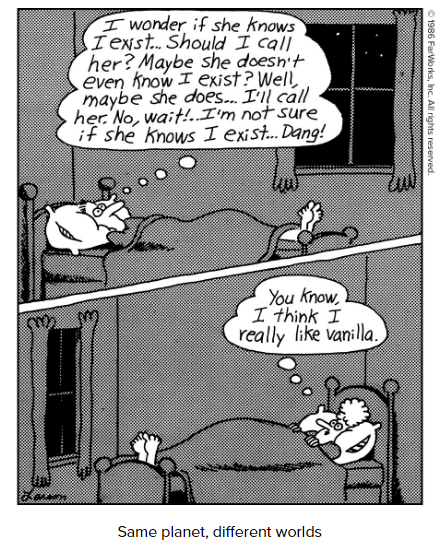
For example, I might point out that Gary Larson, the cartoonist responsible for The Far Side, has a site now. It features a few of his old cartoons every day (and it’s free). They had one of my favorites yesterday:

Untitled

And by the way, the American president is a disaster. He is almost certainly doing something horrendous right now. That’s why we should vote him and every other Republican out of office in November. If you’re willing and able to support Democratic candidates in addition to voting for them, please do.Â